



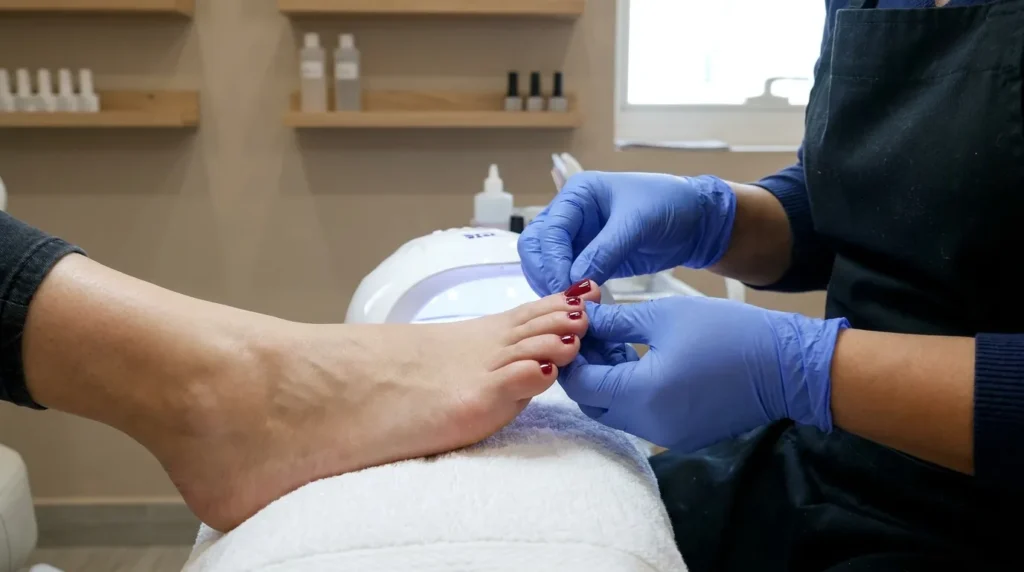
Are gel pedicures safe? In moderation, yes, but they carry real risks: UV exposure from the curing lamp, allergic reactions to gel chemicals, nail thinning from harsh removal, and infection from poorly sanitised salon tools. A standard gel pedicure in Dubai runs AED 60 to AED 600 or more, depending on the salon tier. The risk sits less in the gel itself and more in how the salon applies and removes it.
What a gel pedicure actually is
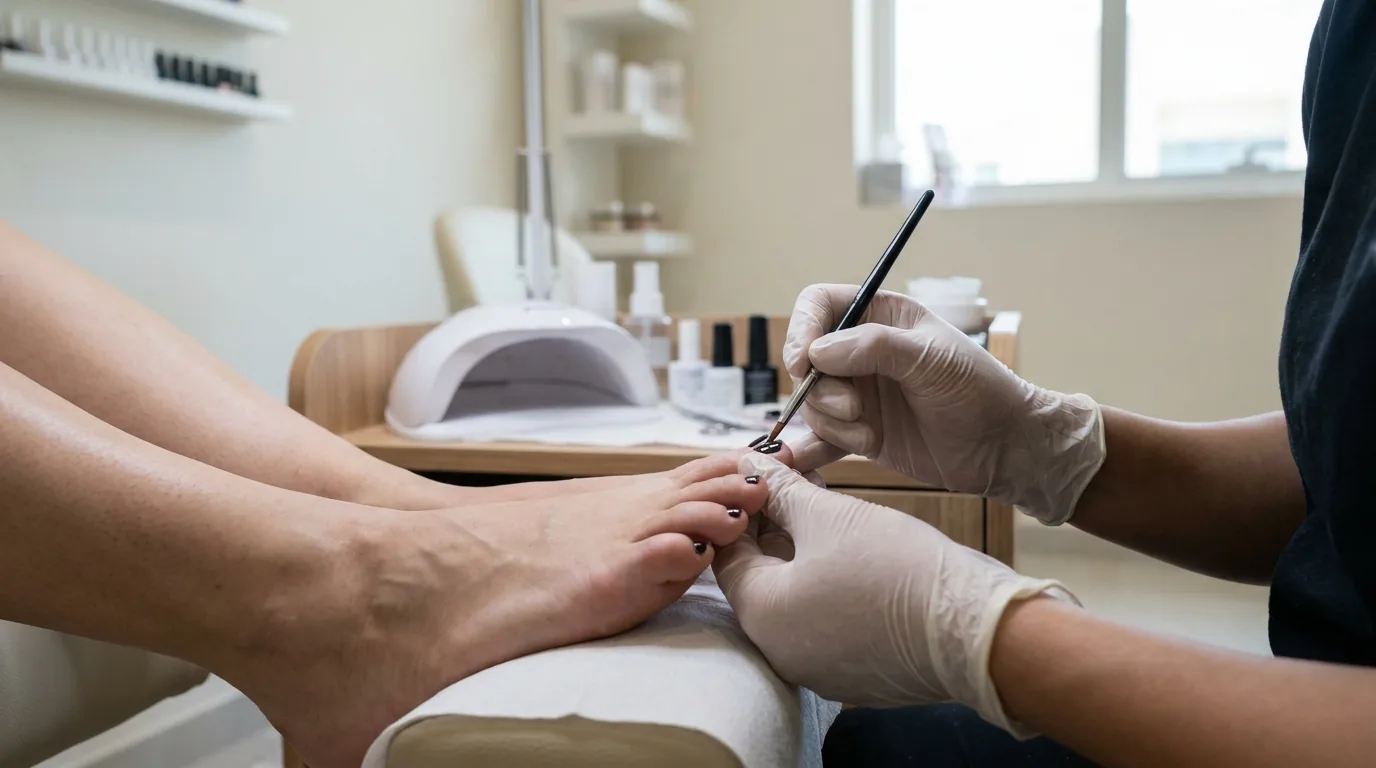
A gel pedicure applies a soak-off gel polish to the toenails, then sets it under a UV or LED lamp. The light cures the polish into a hard, glossy film that resists chips for two to four weeks, far longer than regular polish. For the full picture on cadence, see how often to do a pedicure. That durability is the appeal, especially in Dubai, where open-toe sandals and pool days keep toenails on show most of the year.
The trade-off is that gel bonds tightly to the nail and needs a curing lamp to set and acetone to remove. Both steps are where most of the safety questions come from. Regular polish air-dries and wipes off with remover, so it skips the lamp and the soak entirely. That single difference explains why dermatologists treat gel as a higher-maintenance choice for nail health.
Are gel pedicures bad for your toenails?
Gel polish is not toxic to a healthy nail on its own, but the cycle around it can weaken toenails over time. The two pressure points are the curing lamp and the removal.
The lamps that cure gel emit UVA radiation, the same wavelength linked to skin ageing and skin cancer. Dermatologists at the American Academy of Dermatology note the exposure during one session is brief, but it is concentrated and adds up across repeat visits. Cleveland Clinic frames it plainly: there is no risk-free nail lamp, just as there is no risk-free tanning bed, because both rely on UVA light.
Removal does the more visible damage. Picking or peeling gel off pulls away the top layers of the nail plate, leaving toenails thin, split, and rough. This is why aggressive filing with an electric drill, or peeling at home out of impatience, causes more harm than the gel itself ever does. The same caution applies to a gel pedicure done at home without the right removal kit.
The real risks of gel pedicures
The dangers of gel pedicures come up across dermatology and podiatry sources, and four of them recur. Knowing each one turns “are gel pedicures safe” from a yes-or-no into a checklist you can manage.
| Risk | What causes it | How to reduce it |
|---|---|---|
| UV radiation | UVA from the curing lamp, repeated over many sessions | Apply broad-spectrum sunscreen to your feet first, or use UV-blocking sleeves |
| Allergic reaction | Acrylates and methacrylates in the gel touching skin | Choose a salon that keeps gel off the surrounding skin; ask about HEMA-free formulas |
| Nail thinning | Peeling, picking, or electric-drill filing during removal | Insist on a proper acetone soak-off; never pick gel off |
| Infection | Unsanitised footbaths and tools introducing bacteria or fungus | Book a licensed salon that sterilises tools between clients |
The allergy risk is worth a closer look. Gel polishes contain acrylates and methacrylates, which can trigger contact dermatitis: a red, itchy rash on the skin around the nail. It happens when uncured gel touches skin, which is why careful application matters more than the brand on the bottle. A 2025 chemistry note adds context here: the European Union banned a common gel ingredient called TPO in September 2025 over reproductive-toxicity concerns in animal studies, though the same chemists note real-world exposure during a manicure is very low because the lamp reacts the ingredient away. If the topic concerns you, ask for a TPO-free or HEMA-free gel.
Infection risk: the part specific to pedicures
Pedicures carry an infection angle that manicures do not: the footbath. Whirlpool tubs and shared basins that are not disinfected between clients can harbour bacteria. If a technician nicks the skin, cuts a cuticle too deep, or files too hard, that break lets bacteria in. Podiatrists link this to paronychia, an infection around the nail bed that causes pain, redness, and swelling, and in rare cases to cellulitis when the skin barrier breaks.
Your cuticle is the body’s natural seal against infection, so a good technician leaves it alone rather than cutting it back. This is also where Dubai’s licensing system helps you. A salon that holds both a valid Department of Economy and Tourism (DET) trade licence and a Dubai Health Authority (DHA) health permit is operating under inspected hygiene rules, which is the single clearest signal that footbaths and tools are handled properly. Every venue in our directory of licensed providers is checked against that standard.
What gel pedicures cost in Dubai
Pricing tracks the area and the salon tier more than the gel brand. Budget neighbourhood salons sit at the low end; hotel and Palm Jumeirah lounges sit well above it. Here is the current spread.
| Tier | Typical price | Duration | Room | Products | Staff experience | Best for |
|---|---|---|---|---|---|---|
| Budget | AED 60 to 130 | 30 to 50 min | Mall kiosk or shared pedicure station | Generic gel polish, LED cure, single-use file (ask first) | Volume-paced, polish-focus technicians | Plain gel colour, quick toe refresh |
| Mid | AED 130 to 260 | 50 to 80 min | Private or semi-private pedicure chair | Branded gel (OPI, The GelBottle, Bio Sculpture), foot soak, callus care | Trained technicians, 3+ years on the chair | Standard gel pedicure, mani-pedi combo, light nail art |
| Premium | AED 260 to 600+ | 80 to 120 min | Spa-like suite or hotel salon | Medical-grade prep, IBX repair, paraffin, premium gel systems | Certified specialists, 5+ years tenure | Spa gel pedicure, detailed toe art, special occasions |
Browse all 13 budget-tier Nail Salons providers on our directory.
Top Dubai areas for a gel pedicure
Nail salons cluster where residents and visitors are densest. Jumeirah, Dubai Marina, and Business Bay carry the widest choice across tiers, while International City and Al Karama anchor the budget end. The table below shows where listings concentrate.
| Neighborhood | Providers | Dominant tier | Typical AED range |
|---|---|---|---|
| Business Bay | 6 | All three, strong density | AED 80 to 350 |
| Jumeirah Lake Towers | 5 | Mid | AED 150 to 300 |
| Sheikh Zayed Rd | 5 | Budget to mid | AED 50 to 250 |
| Al Barsha 1 | 4 | Mid value | AED 120 to 280 |
| Al Wasl | 4 | Mid value | AED 150 to 320 |
| DIFC | 4 | Premium | AED 250 to 600 |
| Dubai Marina | 4 | Mid to premium | AED 180 to 450 |
| Jumeirah | 4 | Premium hotel spas | AED 300 to 1,200+ |
| Jumeirah Village Circle | 3 | Budget to mid | AED 100 to 250 |
| Meadows | 3 | Budget to mid | AED 100 to 250 |
| Mira | 3 | Budget to mid | AED 100 to 220 |
How a gel pedicure works, step by step
Knowing the sequence helps you spot a salon that rushes or cuts corners.
- Soak and prep: feet are soaked, nails are shaped, and the surface is lightly buffed so the gel grips.
- Cuticle care: a good technician pushes cuticles gently and leaves the seal intact, never cutting deep.
- Base and colour: thin gel layers are painted on, kept off the surrounding skin.
- Curing: each layer sets under the UV or LED lamp for 30 to 60 seconds.
- Finish: a top coat is cured, and cuticle oil is applied to rehydrate the nail.
Gel pedicure removal: how to do it safely
Gel pedicure removal is the step most people get wrong, and it is where toenails actually thin. The safe method is an acetone soak-off, not peeling.
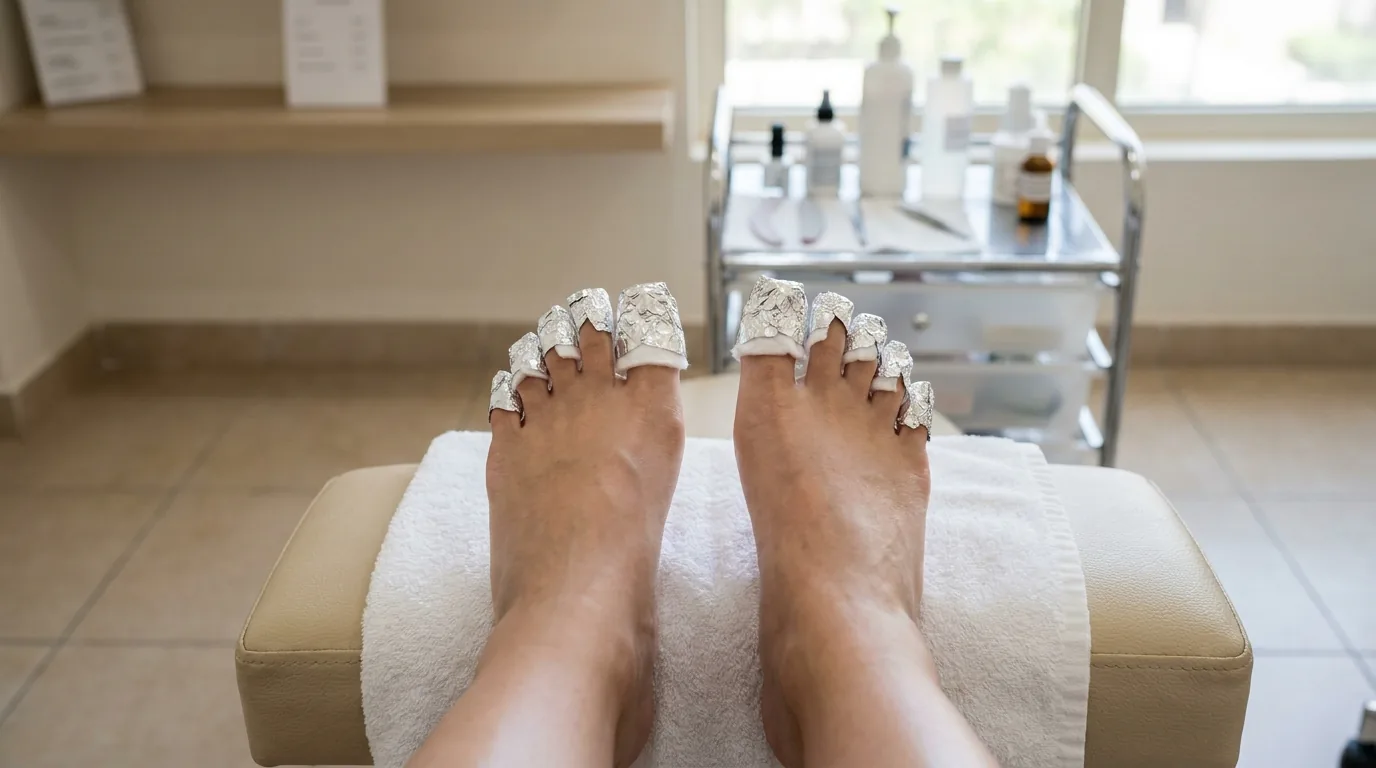
At the salon, the technician roughens the gel surface, soaks acetone-dampened cotton on each nail, wraps it in foil, and waits until the gel lifts on its own. If you remove gel at home, follow the same method and keep the acetone off the surrounding skin, which dries and irritates easily. Never scrape, pick, or force it. After removal, moisturise and apply cuticle oil for a few days, and give your toenails a break before the next gel application so the nail can recover.
Gel pedicure vs regular pedicure
The choice comes down to how much wear you need against how much you want to protect the nail. A gel pedicure lasts longer and resists chips, but adds the lamp and the soak-off. A regular pedicure skips both, so dermatologists call it the gentler option for anyone with recurring nail problems.
| Factor | Gel pedicure | Regular pedicure |
|---|---|---|
| Wear time | 2 to 4 weeks, chip-resistant | Several days to a week |
| Curing lamp | Required (UV or LED) | None, air-dries |
| Removal | Acetone soak-off | Wipes off with remover |
| Nail-health load | Higher over repeat cycles | Lower |
If your toenails already split or peel, the regular pedicure is the safer default until they recover. The same trade-off applies on the hands: a gel nails set lasts longer than a french manicure, but carries the same lamp and removal load.
Who should be extra careful
Two groups should take more care than the average reader.
- People with diabetes or poor circulation: reduced blood flow and nerve sensitivity in the feet raise the stakes of any accidental cut, because wounds heal slowly. A medical pedicure or a podiatrist visit is the safer route here.
- Anyone with a current nail infection or fungus: sealing gel over an infected or fungal toenail traps the problem and can make it worse. Treat the nail first, then return to gel once it is clear.
If you want length or strength rather than colour alone, browse the nail salons in our directory, and weigh gentler add-ons such as nail extensions against the wear of repeat gel.
How to choose a safe gel pedicure salon in Dubai
The salon matters more than the polish. Run this checklist before you book.
- Confirm the salon holds a valid DET trade licence and a DHA health permit; both are required to operate legally in Dubai, and our ranking method uses the same checks.
- Watch whether tools are sterilised or sealed in fresh pouches, and whether the footbath is disinfected between clients.
- Ask whether they offer HEMA-free or TPO-free gel if you have sensitive skin.
- Check that the technician soaks gel off rather than peeling or drilling it.
- Read recent reviews for sanitation comments, not just the finish, and compare against the top-rated nail salons in Dubai.
These nail salons rank highly in our directory on rating and review volume. Each is a licensed venue you can book directly.

Popular nail salons in Dubai
Feel Pink is a nail and beauty service based in Sheikh Noora Tower in Barsha Heights, offering gel and French manicures, nail art and extensions, gel pedicures, waxing, eyebrow shaping and eyelash extensions. It is rated from reviews. Reviewers consistently praise the team as punctual, professional and highly attentive to detail, with waxing and nail services both singled out for clean, precise, long-lasting results. Several reviews highlight the convenience of salon-level results delivered as a home visit, describing the atmosphere as friendly and relaxed even outside a traditional salon setting. On-site, home-visit appointments are the norm here according to reviewers, and gender-neutral toilet facilities are available at the Sheikh Noora Tower base for those visiting in person. Booking ahead is recommended.
Years of regular visits and a genuine sense of loyalty define reviews of Chi Nail Spa at Detroit House in Dubai Motor City. It is rated from reviews, with the salon repeatedly called a welcome escape from a busy day.The space is repeatedly described as spotless and peaceful, with a warm team that reviewers say remembers their preferences and treats them with real consistency over time. Lash lift and tint, along with brow tidy-ups, are mentioned as reliably well done alongside nail work.The salon offers acrylic nails, gel nails, gel pedicure, nail art, nail extensions, chrome nails, French manicure, eyelash extensions, IPL hair removal, and a range of massage and reflexology treatments. On-site facilities include a toilet and parking.
ITS Beauty is a nail salon in Business Bay's Iris Bay tower, rated from reviews. Many reviewers highlight the nail art, gel manicures and pedicures as standout work, and several mention a warm welcome from the reception team as part of the experience.Feedback is not universally consistent, though, with at least one detailed account describing flawed nail work discovered once home and a lack of follow up after the salon was asked to put it right. Services span acrylic and gel nails, nail art and extensions, Russian manicure, French manicure, eyelash extensions, eyebrow shaping, back massage, hair colouring and highlights, blow dry, balayage, bridal makeup and waxing.The salon has free Wi-Fi, on-site services and wheelchair-accessible parking, entrance and toilet, and booking ahead is worth doing given how busy it gets.
N.Bar Nail Spa & Salon is a nail salon at Ibn Battuta Mall, India Court, rated from reviews. Beyond manicures and pedicures, the salon offers gel nails, nail art, eyelash extensions, eyebrow shaping and blow dries.Reviewers consistently praise the dry skin removal and pedicure work in particular, describing a careful, gentle touch even for sensitive feet. Many clients mention returning to the same specialists over months or years and being looked after just as well each time, no matter how long the gap between visits or how busy the branch is.The salon has an on-site toilet, wheelchair-accessible parking and entrance, and accepts walk-ins alongside booked appointments. It suits both quick nail top-ups and longer pampering sessions.
N.Bar Nail Spa & Salon is a nail salon in Umm Suqeim 3, based at The Mall on Jumeira Street. Services include gel nails, chrome nails, French manicure, nail art, nail extensions, Russian manicure, paraffin treatment, hand and back massage, reflexology, eyelash extensions and anti-aging facials.It is rated from reviews. Reviewers consistently praise the gel manicures and pedicures for being neat and long lasting, with technicians described as meticulous, careful and friendly throughout the appointment. Facials booked at the same time are also mentioned as thorough and comfortable. Many clients note being offered tea, coffee or water during their visit.With a clean, welcoming atmosphere, the salon suits clients booking ahead for detailed nail work or a combined nail and facial appointment.


