



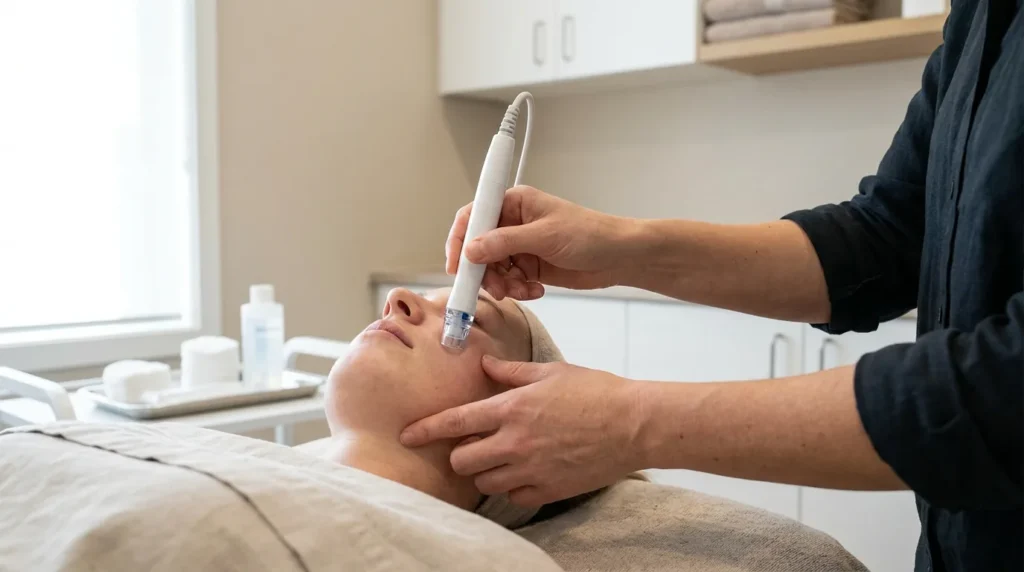
How often can you do HydraFacial treatments? Most skin types handle one session every four to six weeks, matching the roughly 28-day skin renewal cycle. Acne-prone or congested skin often starts closer to every two weeks for a short course, then settles into monthly upkeep. In Dubai, expect AED 450 to 900 per session.
This guide is general information, not medical advice. Skin responds differently from person to person, so ask a DHA-licensed provider what schedule suits your skin before you commit to a course.
How often can you do HydraFacial treatments?
The working answer is every four to six weeks for most people, and every two to three weeks for a short corrective run when skin is oily, congested or breaking out. Both figures come from the same logic rather than from marketing: the treatment exfoliates the surface, and the surface needs time to rebuild before you take another layer off.
Frequency sits on a spectrum rather than at a single number. A reasonable starting point is to book a short series first if you have a specific concern, drop to a maintenance rhythm once skin settles, then adjust for season, budget and how your skin actually behaves between sessions.
One clinical detail is worth carrying with you. A multicentre study of patients with mild to moderate acne ran six sessions at one every two weeks across 12 weeks, and reported a statistically significant drop in acne severity scores. That two-week interval is the tightest schedule with published evidence behind it, and it was a fixed course, not an indefinite habit.
Why four weeks is the usual answer
Skin cells migrate from the base of the epidermis to the surface and shed on a cycle of roughly 28 days in healthy adult skin. The cycle lengthens with age. A treatment built on exfoliation and extractions works best when it meets fresh surface cells rather than stripping skin that has not finished rebuilding.
That is why four weeks became the default. It lines up one session with one turnover cycle. Go faster and you are exfoliating skin twice in one cycle. Go much slower and the congestion you cleared has largely returned. If you want the full mechanics of the three-step process before choosing a rhythm, the HydraFacial in Dubai guide covers what happens in the chair.
HydraFacial frequency by skin type and goal
How often should you get a HydraFacial depends far more on what your skin is doing than on your age or budget. Oily and congested skin tolerates and benefits from a tighter rhythm. Dry, thin or reactive skin does not. The table below reflects the schedules skin therapists most commonly work to.
| Skin type or goal | Common schedule | Why |
|---|---|---|
| Oily, congested or acne-prone | Every 2 to 3 weeks for a course, then monthly | Keeps sebum and clogged pores under control while skin stabilises |
| Fine lines, texture or hyperpigmentation | Every 3 to 4 weeks | Antioxidant and peptide serums build on each other with consistency |
| Normal skin, general maintenance | Every 4 to 6 weeks | One session per renewal cycle holds results without over-exfoliating |
| Dry, sensitive or reactive | Every 6 to 8 weeks | A longer gap protects the barrier; hydrating serums do the work |
| Occasional glow only | 3 to 4 times a year | Enough to reset dull skin, not enough to change it structurally |
Read the rows as starting positions rather than prescriptions. Skin with active breakouts often earns a place on the tighter schedule for a defined run of six sessions, then moves down a row, usually with a salicylic acid clarifying serum swapped in during the course. If congestion is your main issue, browsing providers by acne treatment or pigmentation treatment narrows the list faster than filtering by facial alone.
How long to wait between HydraFacials
Two weeks is the practical floor for a full session. Below that you are exfoliating skin that has not completed a renewal cycle, so the returns drop while the irritation risk climbs. Most Dubai clinics will decline to book a full session inside seven days of the last one.
Three signals tell you the gap is right: skin looks settled rather than tight by day three, congestion has started to return by the time you rebook, and you are not relying on the session to fix redness the previous one caused. If any of those are off, add a week before the next appointment.
Can you have a HydraFacial too often?
Yes, and it happens more often than people expect. The treatment is gentle compared with a clinical chemical peel and carries almost no downtime, which makes over-treatment easy to slide into. The device does still exfoliate, and repeated exfoliation inside one turnover cycle wears down the skin barrier.
What over-treatment actually looks like: skin that stings when you apply your usual serum, redness that lingers past a day, new sensitivity to sun or wind, a tight squeaky feeling that does not settle, and breakouts appearing in places you do not normally get them. None of these are dramatic, which is exactly why people miss them and book again.
The fix is a pause rather than a stronger product: skip a cycle, keep the routine simple and hydrating, and return at a longer interval. Skin therapists and estheticians see this pattern often enough that a good one will tell you to wait rather than take the booking.
What a year of HydraFacials costs in Dubai
Frequency is a budget decision as much as a skin decision, and almost nobody does the annual maths before committing. Using the mid-tier Dubai rate of AED 450 to 900 per session, here is what each schedule actually costs over 12 months.
| Schedule | Sessions per year | Yearly cost at AED 450 to 900 | Suits |
|---|---|---|---|
| Every 2 weeks, as a 12-week course | 6 in the course | AED 2,700 to 5,400 for the course | A corrective run for active congestion |
| Every 4 weeks | 13 | AED 5,850 to 11,700 | Oily skin and visible-change goals |
| Every 6 weeks | 9 | AED 4,050 to 8,100 | General maintenance |
| Every 3 months | 4 | AED 1,800 to 3,600 | Budget-led upkeep and event prep |
The gap between a monthly habit and a six-weekly one is roughly AED 1,800 to 3,600 a year, which is the real reason many people quietly drift to the longer interval. Package pricing narrows it: most Dubai clinics discount a block of six. For a full breakdown of what drives a single quote up or down, see the guide to how much a HydraFacial costs.
How Dubai’s climate changes your schedule
Global frequency guides assume a temperate climate. Dubai is not one, and three local factors genuinely shift the right interval.
Air conditioning runs for most of the year and pulls moisture out of skin continuously. Dehydrated skin reads as dull and looks like it needs exfoliating when it actually needs water, so people book more often than they need to. A hydrating facial or a hyaluronic acid serum between sessions is usually the better call than shortening the gap.
UV levels stay high year-round. Freshly exfoliated skin is more photosensitive, so a tight schedule through summer without disciplined SPF use invites pigmentation rather than clearing it. Humidity swings between the coastal and inland areas also change how much congestion builds, which is why two people on identical schedules get different results.
The practical adjustment: hold the longer interval through the peak summer months, tighten it in the cooler season if congestion demands it, and treat a hydrating facial as the in-between option rather than another exfoliating session.
Timing sessions around events and other treatments
For a wedding or a shoot, book the last session 5 to 7 days ahead. That clears any transient redness and lands you on the settled, hydrated look rather than the immediately-post-treatment one. Starting a short course three months out gives skin time to actually change; a single session the day before does not.
Spacing around other treatments matters more than most people expect. The gaps below are what Dubai clinics commonly ask for. Confirm the exact spacing with the provider performing both, since protocols differ by device and by clinic.
| Treatment | Gap before a session | Gap after |
|---|---|---|
| Chemical peel | 2 weeks | 2 weeks |
| Microneedling | 2 weeks | 2 to 4 weeks |
| Laser or IPL | 2 weeks | 2 weeks |
| Injectables | Usually fine beforehand | 1 to 2 weeks |
| Facial waxing or threading | 2 to 3 days | 2 to 3 days |
| Prescription retinoid | Pause 3 to 5 days | Resume after 2 to 3 days |
If you are running a chemical peel series alongside, alternate rather than stack them, and tell each provider what the other is doing.

How long HydraFacial results last
The visible glow holds for about five to seven days. The deeper benefits, meaning clearer pores and smoother texture, hold for three to four weeks, which is the second reason the monthly rhythm exists. Results are cumulative: the fourth session in a series looks better than the first because each one starts from a better baseline.
What extends them is unglamorous. Daily SPF, a simple barrier-supporting routine, and not layering strong actives in the 48 hours afterwards. What shortens them is sun exposure, chlorine from regular pool use, and skipping hydration in an air-conditioned environment.
How to choose where to book your sessions
Licensing is the first filter and the one most people skip. A salon or spa in Dubai trades on a Department of Economy and Tourism trade licence, while clinical skin treatments and the practitioners delivering them fall under Dubai Health Authority health licensing. Ask which one the venue holds for the treatment you are booking, and be wary of anywhere that cannot answer plainly.
After that, three checks separate a venue worth a standing monthly appointment from one worth a single visit. Confirm the device is a genuine unit rather than a generic hydradermabrasion machine, since the serums and the suction differ. Ask whether the same therapist will see you across the course, because continuity is what makes a schedule work. Confirm what the quoted price includes, as targeted boosters are usually billed separately. Our ranking methodology explains how listings are ordered.
The directory currently lists 56 skin care salons and 126 venues offering facial treatments across Dubai, filterable by area and rating.

Popular facial and skin clinics in Dubai
Skin Camouflage beauty therapists, fully licensed by the Dubai Health Authority, specialize in advanced skin treatments. Inkless Stretch Marks Removal effectively minimizes stretch marks without invasive procedures. Our Scalp Micropigmentation (Hair Tattoo) restores the look of fuller hair with precision pigmentation. The BB Glow Treatment achieves smooth, radiant skin that lasts.
Nova Clinic The Palm is a skin care clinic in Palm Jumeirah Mall by Dubai Retail, on the Palm Jumeirah, rated from reviews. Reviewers consistently describe a modern, extremely clean clinic where therapists explain each step of a facial treatment and leave skin feeling clean, fresh and glowing. Several also mention attentive, professional consultations that left them noticeably more comfortable and satisfied with their results. Treatments include acne treatment, anti-aging facials, body contouring, Botox injections, chemical peel, deep cleansing facial, dermal fillers, hair treatment, IPL and laser hair removal, microneedling, pigmentation treatment, PRP therapy, skin rejuvenation, skin tightening and tattoo removal. Appointments are recommended, and the clinic is wheelchair accessible with parking, entrance and toilet facilities on site at Nakheel Mall.
Glow Aesthetics Dermatology Clinic is in Al Attar Business Centre in Al Barsha, offering botox injections, dermal fillers, chemical peels, microneedling, laser and IPL hair removal, skin tightening, scar treatment and pigmentation treatment. It is rated from reviews.Reviewers consistently praise the honesty of the medical guidance, noting that the team recommends only what is genuinely needed rather than upselling treatments. The clinic is described as professional and welcoming from arrival, with several highlighting fair pricing relative to the standard of care.The clinic has on-site services with a wheelchair-accessible entrance, car park and toilet. It suits patients across Dubai researching skin treatments, anti-aging facials or laser hair removal, with a consultation recommended to discuss the right treatment plan.
Derma 247 Laser Clinic is a skin and laser clinic in Nadd Al Hamar, rated from reviews. Treatments cover laser and IPL hair removal, botox injections, dermal fillers, chemical peels, pigmentation treatment, skin rejuvenation and tattoo removal.Reviewers consistently mention feeling well informed before and during laser sessions, with practitioners who explain each step in plain terms and check in throughout rather than rushing through the appointment. That attentiveness comes up often enough to be a genuine pattern rather than a one-off.The clinic runs by appointment, with on-site services and a fully wheelchair-accessible setup including gender-neutral toilets. It suits anyone after laser or aesthetic treatments who wants a clinical, unhurried approach rather than a quick in-and-out visit.
Avoria Aesthetic Clinic is a skin care and medical aesthetics clinic in Al Barsha, rated from reviews. Treatments include Botox and dermal fillers, chemical peels, microneedling, laser hair removal, pigmentation and acne treatment, tattoo removal, electrolysis, lip blush and eyebrow microblading, plus body contouring and hair transplant procedures. Reviewers consistently describe a modern, spotless clinic with a calming atmosphere, and praise the team for explaining each treatment thoroughly before starting and taking time to listen to concerns. Laser hair removal sessions are described as comfortable and effective, and reviewers mention good results from HydraFacial treatments too, with outcomes generally meeting or exceeding expectations. Free underground parking is available, and the clinic has a wheelchair-accessible car park, entrance and toilet, all within the Deyaar Building unit that houses the clinic.
Browse all 56 Skin Care Salons providers on our directory.


