



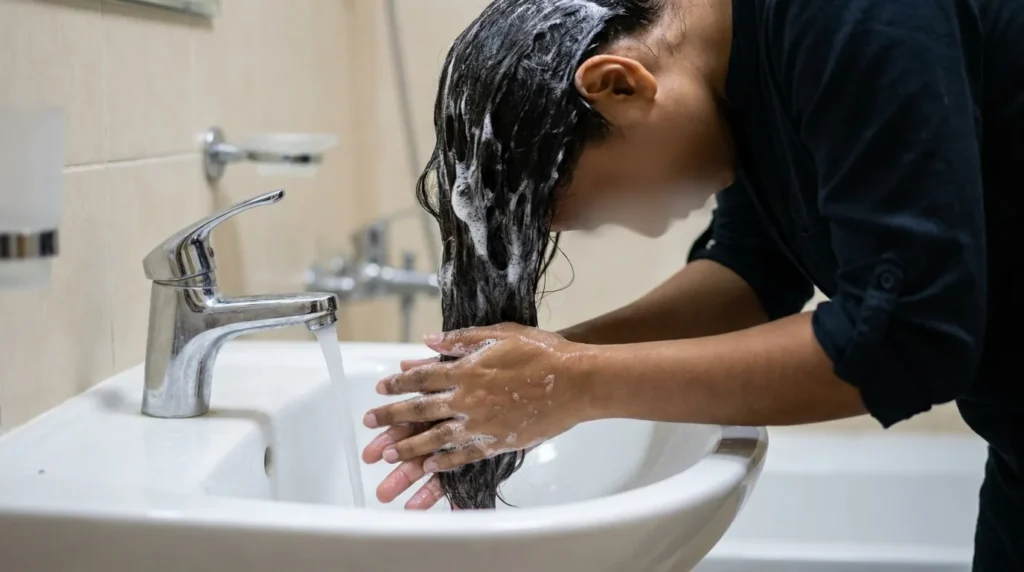
How to wash hair with hard water comes down to three habits rather than three products: use less shampoo than the lather suggests, run a chelating wash on a fixed cadence instead of every time, and finish cool with a diluted acidic rinse. Minerals sit on the cuticle as a film, so the job is removal and prevention.
Why shampoo stops lathering in hard water
Anyone washing hair with hard water notices the foam first. Shampoo that whipped up easily somewhere else goes flat, and the reflex is to squeeze out more.
That reflex has now been measured. A 2025 study in the journal Cosmetics by Richa Mehta and Ratnadeep Paul Choudhury tested a hair shampoo in soft water and in standard hard water at 375 parts per million, then tracked what the foam did. In hard water the shampoo foam decayed by about 35 percent against 19 percent in soft water. Its drainage half-life, the time taken for half the liquid to drain out of the foam, fell from 160 seconds to 89.9 seconds. Under the microscope the bubbles merged into far larger ones, with mean bubble area rising from roughly 9,400 to 209,000 square micrometres.
One result matters more than the rest: the viscosity of the product did not change. The bottle pours the same, so nothing warns the person in the shower that the water is the variable. The foam collapses in about half the time, that reads as a weak product, and the correction is to add more.
Adding more is the step that creates hard water buildup in hair. Calcium and magnesium react with the surfactants in shampoo to leave an insoluble residue on the strand, so a bigger dose in the same water leaves more film behind, not less. When you wash hair with hard water, the lather is a poor guide to how clean it is getting.
How to wash hair with hard water, step by step
The sequence below is one ordinary wash. People who wash hair with hard water still wash it the usual way; what changes is the dose, the rinse and the finish. The chelating step belongs to a separate schedule covered further down.
- Wet the hair properly first. A full minute under running water. Under-wet hair needs a larger dose of shampoo to spread at all, which is the thing to avoid here.
- Dose by hair length, not by foam. Decide the amount before the water starts, then hold it whatever the lather does. Short hair needs very little; long or thick hair needs more, spread across the scalp rather than piled in one spot.
- Wash the scalp, condition the lengths. Shampoo belongs where oil and sweat sit. Conditioner belongs from mid-length to ends, the oldest and most porous part of the strand.
- Rinse for longer than feels necessary. Residue left behind dulls colour and roughens the cuticle, and mineral-laden water rinses less efficiently than soft water.
- Finish with the coolest water tolerable. A cool final rinse leaves the cuticle flatter, which is the difference between hair that combs out and hair that catches.
Two shorter washes beat one long one on a day when the hair genuinely feels coated. The first pass lifts surface oil so the second reaches the scalp, and both together use less product than one heavy application that refuses to foam.
How often to run a chelating reset wash
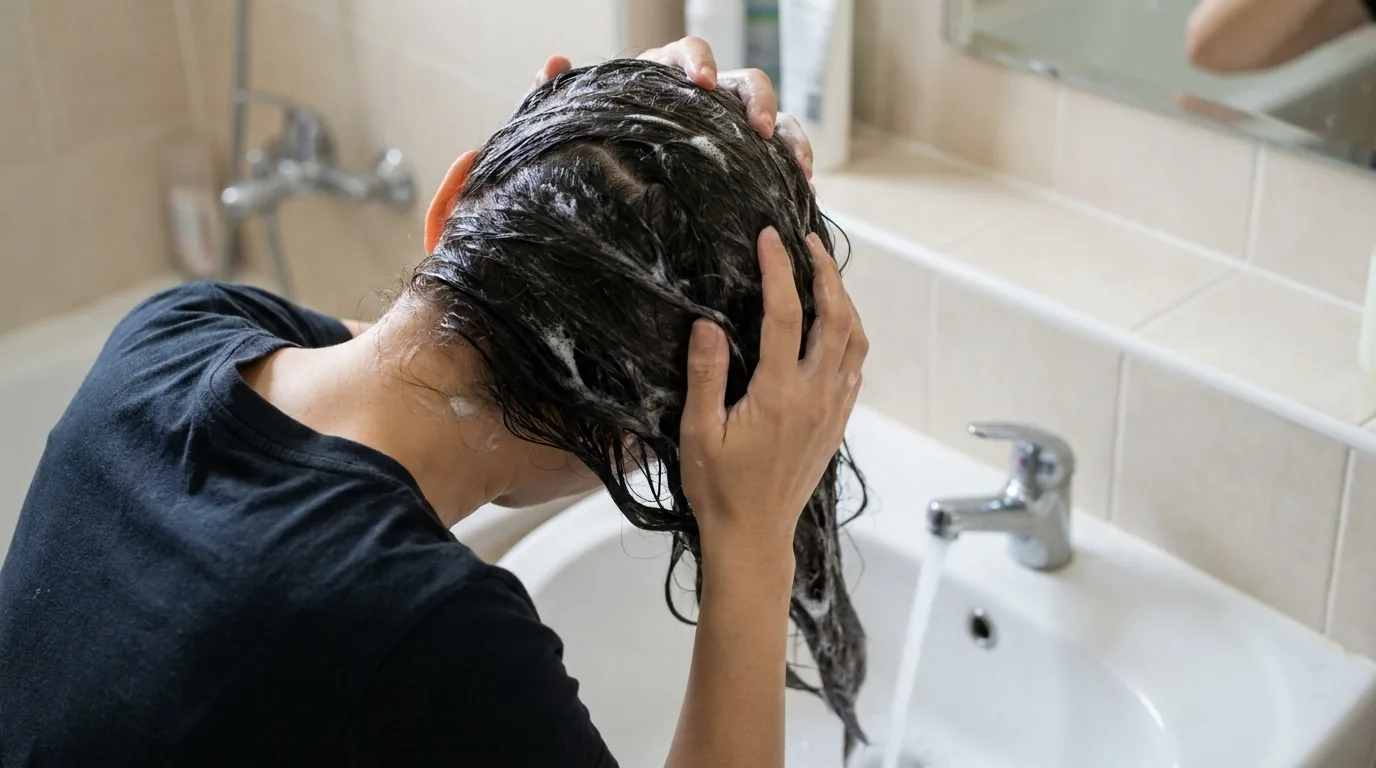
Chelating shampoos do something ordinary shampoos cannot. They carry a binding agent, usually EDTA or citric acid, that grips calcium, magnesium, copper and iron and carries them off the strand. Clarifying shampoos are stronger detergents that lift oil and styling product, which is a different job.
Both strip. That is why neither belongs in every wash, and it is the part most advice on washing hair with hard water leaves out.
| Wash type | How often | What it does | Follow with |
|---|---|---|---|
| Ordinary wash | Every wash day | Removes oil, sweat and sunscreen | Conditioner on lengths |
| Clarifying wash | Every 2 to 4 weeks | Lifts styling product and oil buildup | Conditioner, or a mask if hair feels dry |
| Chelating reset | Every 2 to 4 weeks | Binds and removes mineral deposits | A deep conditioning treatment, always |
The last column is the part that gets skipped. A reset wash with no conditioning step afterwards trades one problem for another, and hair that felt coated on Monday feels brittle by Wednesday.
A salon version of the same wash is worth considering when hair is long, colour-treated, or has gone months without a reset. Salons operate on a Department of Economy and Tourism trade licence, which covers cosmetic services such as a clarifying or detox wash. Diagnosing or treating a scalp condition sits with a clinician holding a Dubai Health Authority licence instead, and the two are not interchangeable.
The directory lists 167 hair salons across Dubai, and clarifying, detox and conditioning washes appear on menus at every price level, so this is not a service that needs a premium address.Browse all 167 Hair Salons providers on our directory.

Popular hair salons in Dubai
Collective is a hair salon inside the MAG Warehouses complex in Al Quoz Industrial Area 2, rated from reviews. Services cover hair colouring, balayage, hair highlights, hair extensions, keratin treatment, ladies haircuts, blow dry, bridal makeup, manicures, gel pedicures and waxing services. Several reviewers like the modern, classy interior and mention stylists using Dyson equipment for finishing, with one client describing a playful, well judged cut from a stylist who listened closely to the brief. Feedback on colour work is more mixed, with one detailed report describing hair damage and billing disagreements after a balayage and toner service, so it makes sense to agree the full scope and price before any colour treatment begins. The salon has a toilet on site along with wheelchair-accessible parking and entrance.
Version Francaise is a hairdressing salon inside the Marriott Harbour Hotel and Suites in Dubai Marina, offering haircuts, hair colouring, highlights, hair extensions, keratin treatment, blow dry styling, threading, manicures and nail art. It is rated from reviews.Reviewers consistently describe the salon as welcoming, with several returning for years and calling it their regular salon for haircuts and colour treatments. The team is praised for professionalism, attention to detail and a warm welcome from arrival to the end of the appointment.The salon has free Wi-Fi, on-site services, a wheelchair-accessible entrance, car park and toilet, plus gender-neutral toilets. It suits residents and hotel guests in Dubai Marina after a haircut, colour service or hair treatment appointment, with appointments recommended given the salon's loyal following.
Locks By Lou Lou is a hair salon on Al Wasl Road in Jumeirah, rated from reviews. Reviewers consistently praise the colour work, from balayage and highlights to root touch ups, and several mention hair extensions that look natural rather than obviously fitted. Clients also note that stylists take time to understand what they want before starting and explain aftercare so hair stays in good condition afterwards.Beyond colour, the salon offers blow dry, keratin treatment, hair extensions, manicure, gel pedicure, microneedling and anti-aging facial treatments. The entrance is wheelchair accessible and there is an on-site toilet.Appointments are recommended, particularly for colour and extension work, and the salon suits clients looking for an ongoing colourist relationship rather than a single visit.
Version Francaise Pour Elle is a hairdresser and beauty salon on Al Wasl Road, Al Safa 2, rated from reviews. Services span hair colouring, balayage, highlights, extensions, keratin treatment and blow dry, ladies' haircuts, beard trim, manicure, gel nails, gel pedicure, eyelash extensions, anti-aging facials and waxing.Reviewers consistently praise the colour and highlight work, describing meticulous stylists who take the time to understand what a client wants even when it is hard to explain. The salon is also noted for its cleanliness, product quality and reasonable prices, with several reviewers mentioning the owner is regularly on site overseeing the team and the client experience.Free Wi-Fi and parking are available. Suits clients after precise colour work from a team that takes the time to get it right.
Trinity Hair Salon is a hair salon in Al Barsha South, based at Danube Resortz, rated from reviews.Colour work is what reviewers talk about most, with several describing years of trust in the stylists for balayage, highlights and full colour changes, including recovering from a previous bad dye job elsewhere. The salon also offers ladies haircuts, blow dries, hair treatment and a back massage, plus manicures and pedicures. More than one reviewer describes the atmosphere as warm and modern with a good energy, and says they would not trust anyone else with their hair colour.There is a toilet on site, the salon offers on-site services, and a wheelchair-accessible car park makes it an easy stop for residents around Al Barsha South.
How to soften hard water for hair wash at home
Softening the water is the only approach that stops mineral buildup forming at all. Three options exist, and they are not equal.
- A shower filter. The practical choice for most people, and the one to check carefully. A plain carbon cartridge targets chlorine and does very little to calcium, so a unit has to be specified for hardness to be worth fitting.
- A whole-home water softener. The most effective option and the least available, since it means plumbing work most tenants in Dubai cannot authorise.
- A filtered or bottled final rinse. A jug of purified water poured through as the last step, carrying off the tap minerals left behind. Cheap for one step, unworkable as a way to wash.
None of these repairs a strand. They reduce what lands on it, which is why softening pairs with the routine rather than replacing it: people who wash hair with hard water through a filter still benefit from the dosing and rinsing habits above.
Acidic rinses, and getting the dilution right
An acidic rinse is the standard answer for how to remove hard water from hair naturally, and it does have a mechanism behind it. Lowering the pH at the end of a wash helps dissolve some of the mineral residue and encourages the cuticle to lie flat.
Dilution is where it goes wrong. The usual ratio is one tablespoon of apple cider vinegar or lemon juice in about three cups of filtered water, poured through after conditioning, left a few minutes, then rinsed out. Neat vinegar or undiluted citrus is an irritation risk and delivers no extra benefit.
Colour is the other caution. Lemon juice in particular can shift tone on lightened or freshly coloured hair, so anyone maintaining a salon colour service should ask their colourist first. Once a fortnight is plenty; weekly is where scalps start to complain.
How to protect hair from hard water between washes
Most of the damage attributed to minerals happens during handling rather than during the wash itself. Coated hair drags, and dragging is what breaks it, so what happens after you wash hair with hard water matters as much as the wash.
Three habits carry most of the benefit. A light oil applied 20 to 30 minutes before a reset wash gives the strand a barrier while the water works. A leave-in conditioner keeps the cuticle slick between washes so the comb passes instead of catching. Detangling from the ends upward, on damp rather than soaking hair, spares the mid-lengths the tension that snaps them, which is what the American Academy of Dermatology advises for dry or damaged hair.
Where the scalp rather than the strand is the complaint, flaking and tightness that persist through a routine change are worth a professional scalp treatment rather than another bottle.
Finding your own reset cadence in Dubai
Dubai has no single answer here, and the reason is structural. The city drinks desalinated seawater, and minerals are added back during treatment before the supply is distributed. What reaches a particular shower head then depends on the building: how long water sits in storage tanks, and the age of the pipework it travels through. Two towers on the same road can behave differently.
That is why anyone washing hair with hard water in Dubai should calibrate rather than copy a schedule. Start at one reset wash a fortnight and watch three markers over the next month:
- How quickly the roots feel coated again after a wash.
- Whether conditioner still absorbs, or sits on the surface and rinses straight off.
- Whether the ends feel rough once dry, on days when no heat was used.
If all three stay clear for the full fortnight, stretch the interval to three weeks. If the coated feeling returns within four or five days, shorten it to ten days and add a mask rather than another chelating wash. Fine hair usually needs a shorter interval than coarse hair, because there is less surface area per strand to hide a deposit on. Anyone booking a hair treatment in Dubai can time the reset to land the week before, so the treatment goes onto a clean strand.
Washing habits that make hard water worse
Some of the most repeated advice on how to counteract hard water on hair does more harm than the water. These are the habits worth dropping.
- Clarifying every wash. Daily stripping removes the oil the cuticle needs and leaves hair rougher than the minerals did.
- Neat lemon juice or vinegar. Undiluted acid on the scalp irritates without cleaning any better.
- Baking soda as a scrub. Strongly alkaline, which lifts the cuticle in the opposite direction to everything else in the routine.
- Adding shampoo until it foams. The foam is behaving exactly as the study predicts. More product leaves more residue.
- Very hot showers. Heat opens the cuticle and makes the rinse harsher on colour, and a hair spa session will not undo a daily habit.
- Skipping conditioner because hair feels coated. The coating is mineral, not oil. Dropping the conditioning step makes tangling worse.
Hard water gets blamed for a great deal it does not do. The only controlled experiment on the question, published in the International Journal of Trichology in 2013, soaked hair samples for 30 days at 212.5 parts per million calcium carbonate and found no significant change in tensile strength or elasticity. The fibre holds. What changes is the surface, and the surface is what a washing routine can reach. The hair care guides go further into what the mineral load does and does not cause.
For the reasoning behind how venues appear here, the ranking methodology sets out the criteria, and the full list of hair salons in Dubai filters by area and service.


