


What is layered hair? Hair cut to two or more lengths on the same head, so the upper sections sit shorter than the ones underneath. The cut takes out weight rather than length. Done well, it gives movement and lift. Done wrong on fine hair, it thins the ends and drops the shape flat.
What is layered hair, and what do layers actually do
A one-length cut holds every strand at the same distance from the floor, so all the weight collects at the ends, which is exactly why thick hair in a blunt cut tends to sit heavy at the bottom and completely flat at the crown.
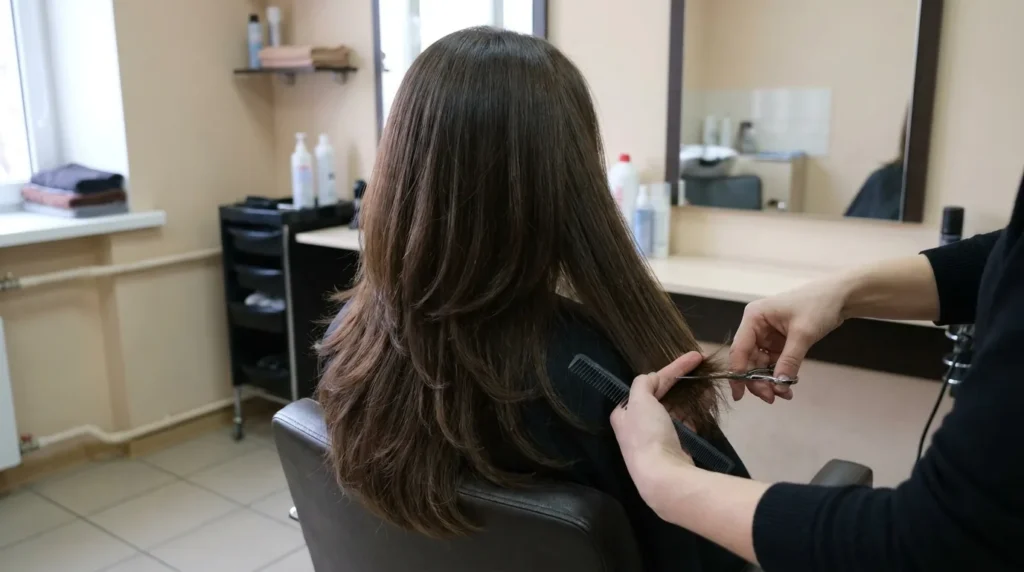
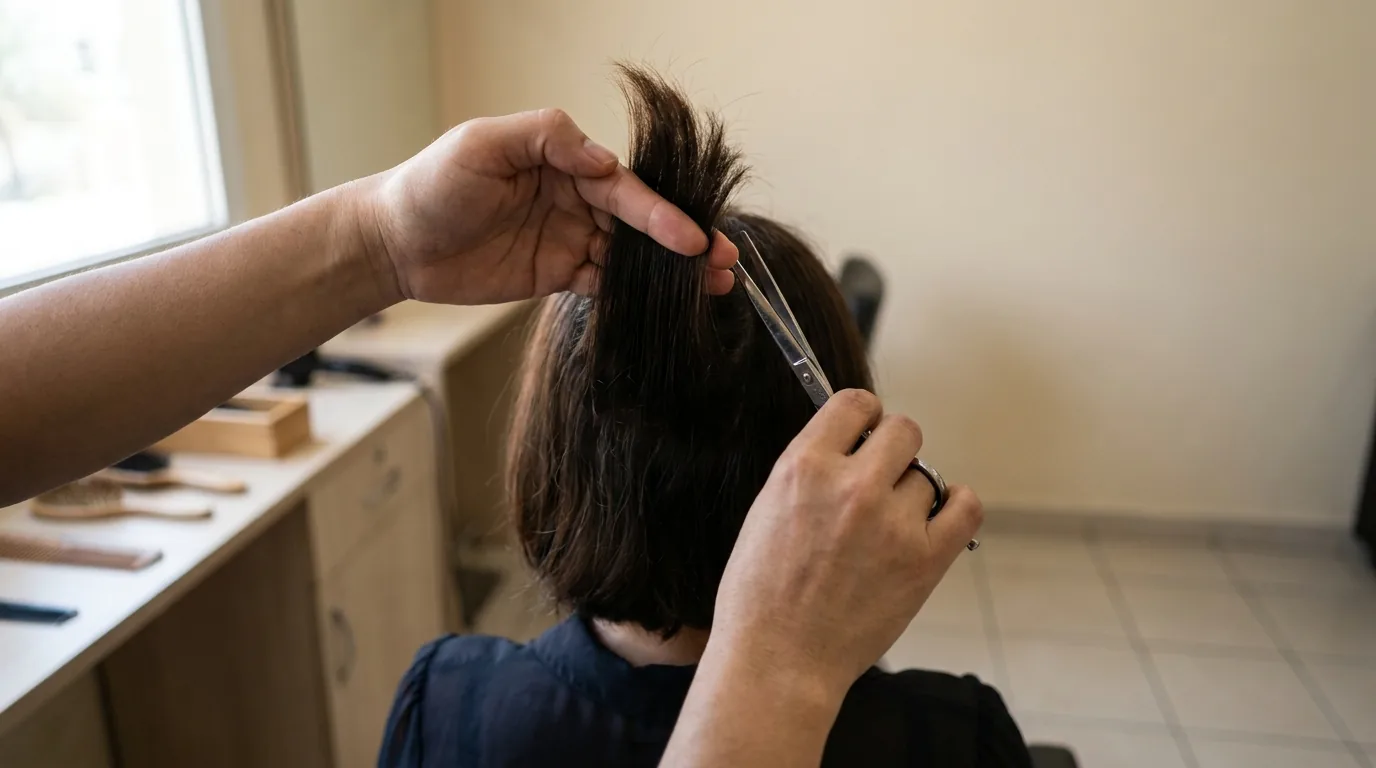
Layering breaks that up. The stylist lifts a section away from the head before cutting it, usually somewhere between 45 and 90 degrees, and the higher the lift the shorter that section ends up. Those shorter pieces fall over the longer ones below. Weight spreads through the length instead of piling at the bottom.
Three things change as a result: volume sits higher up at the crown, the hair swings instead of hanging, and the ends look considerably softer because they no longer form one hard horizontal line. None of that involves removing length, since layered hair can keep its longest point exactly where it started.
The cost of all that movement is control, because every section you remove weight from afterwards behaves on its own terms, and on genuinely fine hair there may not be enough weight available to spare.
How to tell if your hair is already layered
Most people discover the answer the hard way, at the moment a stylist asks what was done at the previous appointment. Three quick checks will tell you whether you already have layered hair, and together they take under a minute.
- The lift test. Take a section from the top of your head, pull it straight out from the scalp, and examine the ends: if they line up along a straight edge the hair is one length, and if they fan out at different points there are layers underneath.
- The ponytail test. Tie everything up and watch what escapes, because shorter pieces falling around the face and nape are usually deliberate layers rather than breakage. Breakage is irregular and frayed at the tip, whereas a cut layer finishes with a clean, blunt end.
- The dry-shape test. Air-dry with no product at all and study the outline from the side, where a one-length cut reads as a solid rectangular block. Layered hair instead shows a visible taper, noticeably narrower at the bottom than at its widest point.
Worth checking before booking, because a stylist working blind on hair that already carries three sets of old layers will either chase them or cut straight through them.
So what is a layered haircut called
Layered hair carries no single name, and that is the honest answer to what is a layered haircut called: layering is a cutting technique rather than an individual style, so the recognisable names all belong to the particular shapes built with it.
The list below covers most of what gets asked for by name in Dubai salons. Several overlap with a fringe or bangs, which is really a layer cut short at the front.
| Name | What the layers are doing | Suits |
|---|---|---|
| Long layers | Few and low, generally starting below the collarbone | Most hair types, including comparatively finer hair |
| Face-framing layers | Front sections only, leaving everything else untouched | Anyone wanting shape without committing to a full recut |
| Layered bob or lob | Short internal layers underneath a strong perimeter outline | Thick hair that needs internal debulking |
| Shag | Heavy layering from the crown down, plus a fringe | Wavy and curly hair with density to lose |
| Wolf cut | Shag with a shorter, more disconnected top | Thick hair, high maintenance |
| Butterfly cut | Two tiers: short face-framing over long length | Long hair that must stay long |
| Feathered layers | Soft, tapered ends cut at a shallow angle | Straight to slightly wavy hair |
| Choppy layers | Point-cut ends with deliberate separation | Medium to thick hair, textured finish |
A name establishes the mood rather than the mechanics, which is why two stylists can produce dramatically different shags from one reference photograph: the underlying shape decides the outcome.
Round layers, square layers and the two shapes in between
Underneath every named style sits one of four fundamental cutting shapes, which British and Gulf academies both teach as forms, and this is the vocabulary that travels furthest across a multinational Dubai salon floor.
| Shape | How it is cut | Result |
|---|---|---|
| Round layers | Sections follow the curve of the skull, cut at even elevation throughout | Soft and blended with no corners, and volume distributed evenly |
| Square layers | Sections cut to a flat plane rather than following the head shape | Corners retained at the sides, so weight stays wide and structured |
| Graduated | Low elevation, stacking shorter sections underneath longer ones | Weight accumulates into a visible line, commonly seen in bobs |
| Uniform | Every section cut to an identical length at 90 degrees | Follows the head exactly and removes the most weight overall |
Round layers are the shape most requests land on, because they soften a heavy perimeter without taking the corners off the silhouette, which suits curly and wavy hair needing bulk removed but not width. Square layers do the opposite and hold the outline wide, which flatters fine hair that would collapse under a rounded cut. Uniform layering removes the most weight of the four and goes wrong most often on thick hair, where an identical length everywhere reads as an unintended pouf rather than genuine lift.
Who layers suit, and who should skip them
Layered hair is fundamentally a weight-removal technique before it is a recognisable look, so the deciding question is always whether the hair has enough surplus weight available to lose.
- Thick, coarse hair: the clearest case for layering, because removing internal bulk prevents the triangular silhouette that thick hair collapses into whenever it is cut to a single length.
- Curly hair: benefits from layers cut dry, curl by curl, so that every spring settles exactly where it lands, whereas wet-cut layers on curls shrink unpredictably as they dry.
- Wavy hair: long, low layered hair brings out the wave pattern that a blunt line flattens.
- Straight hair: accepts clean, evenly executed layers extremely well, and displays every inconsistent one with equal clarity.
- Fine or thinning hair: the group that should be most careful with layered hair. Fine hair relies on its perimeter for the appearance of density, and heavy layering strips exactly that.
Three groups should genuinely skip layered hair: fine hair already showing scalp, anyone close to evening out a previous layered cut, and hair mid-recovery from chemical damage. If colour is part of the picture, frizzy hair treatment is the more useful first appointment.
Face shape matters considerably less than the internet suggests, while the position of the shortest layer matters enormously. A layer finishing at the widest point of the face visibly broadens it, whereas the identical cut moved two centimetres lower does nothing of the kind.
How to ask for layers in a Dubai salon chair
Dubai salon floors are staffed by stylists trained across Filipino, Lebanese, Indian, Russian, British and Emirati traditions, and the same English word does not always mean the same cut. Asking for layered hair, and nothing more specific, is the least useful thing you can say.
Four specifics resolve almost every misunderstanding, and they hold whichever academy the person holding the scissors originally trained through. Most Dubai hairdressers conduct the consultation in English, so this vocabulary is genuinely worth preparing beforehand.
| Instead of saying | Say this |
|---|---|
| “Just some layers” | “Round layers, softest at the front” or “square layers, keep the width” |
| “Not too short” | “The shortest piece should reach my chin and no higher” |
| “Add volume” | “Take weight out through the middle, keep the ends thick” |
| “Like this photo” | “Like this photo, and here is the back of it too” |
Bring a photo of the back, not only the front. With layered hair the back is where the shape is built, and where most disappointment comes from. Ask where the shortest layer will sit once the hair is dry, and ask before the cutting starts, because a blow dry at the end can hide a shape that will not come back at home.
Ask one further question: scissors, razor, or thinning shears. Thinning shears are quick, and they are also precisely how thick hair develops a frizzy halo around the crown six weeks afterwards, whereas point cutting with scissors takes longer and holds its condition considerably better.
Layered hair versus a blunt cut
The opposite of layered hair is a blunt cut, also called a one-length cut, which answers the question of what a haircut with no layers is called. Every strand finishes on the same line and the entire weight of the hair sits at the bottom.
| Layered | Blunt | |
|---|---|---|
| Weight | Distributed evenly through the whole length | Concentrated entirely at the ends |
| Appearance of thickness | Noticeably fuller at the crown, finer at the ends | Considerably thicker at the ends, flatter on top |
| Styling time | Longer, because more separate pieces need directing | Shorter, because the shape does most of the work |
| Growing out | Roughly 8 to 12 months before it evens out | Grows out evenly without intervention |
| Best for | Thick, wavy or curly hair carrying surplus weight | Fine hair, and anyone wanting maximum density at the ends |
Between the two sits internal or invisible layering: short pieces cut underneath while the outline stays blunt. It removes bulk without changing the silhouette, and it is the safest route for anyone unsure about committing to layered hair. Both shapes are built from the same two sectioning methods, sliding and blended elevation.
What Dubai does to a layered cut
On layered hair the shortest pieces sit most exposed on the head, which makes them the first to react to anything in the surrounding environment, and in Dubai that means four separate conditions operating simultaneously.
Summer humidity along the coast runs high enough that hair takes on moisture from the air faster than it can be styled out, and swollen strands read as frizz. The short top layers frizz first and most visibly. Indoor air conditioning then does the opposite and dries those same ends out, so hair shifts between the two states several times a day.
Dubai tap water is hard, and the mineral deposit it leaves builds up on the ends carrying the least protection. Add year-round UV and layered hair ages faster than a blunt cut, because the damage shows on the shortest pieces first, right at eye level. Anyone with hair colouring on top of layers sees both problems compound.
Keep a leave-in conditioner with a UV filter for the top layers only. The ends underneath already carry weight and product; the short pieces at the crown are the ones taking the sun and the humidity, and treating the whole head the same way weighs down exactly the sections meant to lift.
None of this argues against layered hair in Dubai. It argues for fewer, lower layers than the same person would carry in a cooler, softer-water city, and for a shorter gap between trims.
What a layered haircut costs in Dubai
Layered hair is priced as a standard haircut at almost every salon in the city, and layering itself rarely carries a separate surcharge, although a dry curly cut and a complete restyle from a blunt shape both take longer and are occasionally billed at a higher rate.
| Tier | Typical price | Duration | Room | Products | Staff experience | Best for |
|---|---|---|---|---|---|---|
| Budget | AED 50 to AED 150 | 30 to 60 min | Open-floor salon, shared stations | Local and regional retail lines | Junior to mid stylists | Routine cuts, blow-dry, root touch-ups |
| Mid | AED 150 to AED 450 | 60 to 120 min | Private or semi-private stations | Professional lines (L'Oreal Pro, Wella, Olaplex add-on) | Senior stylists, dedicated colourists | Colour, highlights, keratin, event styling |
| Premium | AED 450 to AED 1,500+ | 90 to 240 min | Private suites, hotel and Palm lounges | Kerastase, imported colour systems, bond builders | Master stylists and named colourists | Balayage, corrective colour, bridal, full transformations |
Where you book matters more to the final bill than what you ask for. A ladies haircut in a neighbourhood salon in Deira or Al Karama sits in a different bracket to the same cut in Marina, and the table below shows the spread across the areas with the most listings.
| Neighborhood | Providers | Dominant tier | Typical AED range |
|---|---|---|---|
| Business Bay | 125 | range | AED 120 to AED 700 |
| Al Barsha 1 | 86 | range | AED 80 to AED 500 |
| Al Karama | 80 | Budget | AED 50 to AED 200 |
| Deira | 80 | Budget | AED 50 to AED 250 |
| Dubai Marina | 80 | range | AED 150 to AED 900 |
| Jumeirah Lake Towers | 75 | Mid | AED 120 to AED 600 |
| Dubai International City | 68 | Budget | AED 40 to AED 180 |
| Jumeirah | 55 | range | AED 120 to AED 900 |
| Jumeirah Village Circle | 55 | Mid | AED 90 to AED 450 |
| Mirdif | 54 | Mid | AED 90 to AED 400 |
| Oud Metha | 52 | Budget | AED 60 to AED 280 |
| Al Barsha South | 48 | Mid | AED 90 to AED 450 |
Premium pricing buys consultation time and a stylist who cuts dry and checks the shape as it falls, which matters far more on layered hair than on a blunt cut because a bad shape cannot be corrected by taking more off. Salons in Jumeirah and the Marina price at the upper end for that reason.
Browse all mid-tier providers on our directory.
How long layers last before they need reshaping
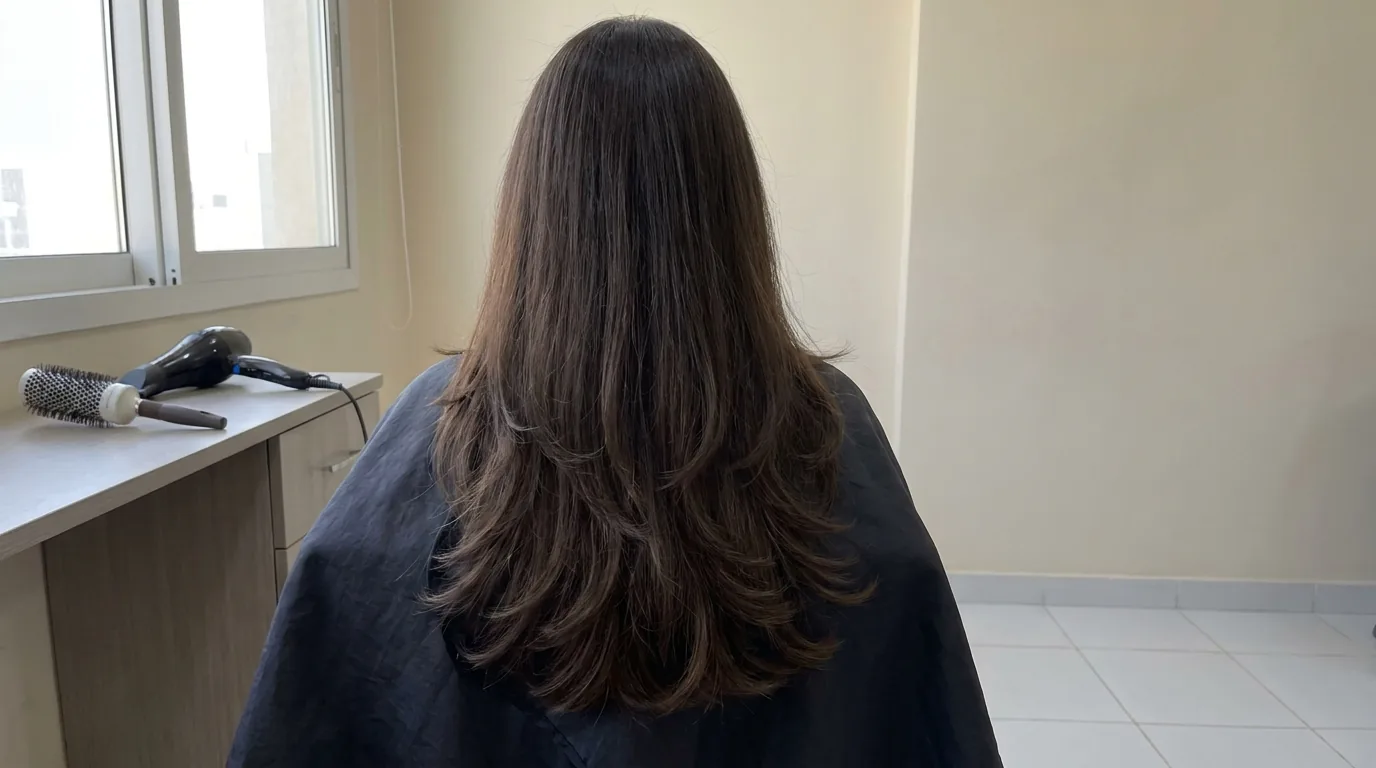
Hair grows around a centimetre a month, so layered hair holds its shape for roughly 8 to 12 weeks before the tiers blur into each other. Fine hair loses it sooner, closer to 6 to 8 weeks, because there is less contrast between layers to begin with.
What disappears first is the shape rather than the length, because the top layers gradually grow down into the ones below, the taper vanishes, and layered hair starts reading as one heavy length again. That is the genuine trim signal, and it arrives well before the ends look visibly damaged. Anyone maintaining highlights alongside a layered cut usually times the two together, since a colour appointment already involves a cut.
Growing layered hair out is the slower job, and a stylist can shorten it considerably by cutting the perimeter up to meet the layers rather than waiting the other way round.
How to check a Dubai salon before you sit down
Layered hair is a cut rather than a treatment, so the relevant checks concern competence rather than clinical safety, although the licensing floor still applies to any salon operating commercially in the emirate.
Every salon in Dubai holds a trade licence from the Department of Economy and Tourism, and any venue offering treatments that cross into health services also needs a facility licence from the Dubai Health Authority. A haircut sits under the trade licence alone, though a salon that can show neither is worth walking out of, and the ranking method behind these listings uses the same baseline.
Beyond the paperwork, four things separate a stylist who can genuinely cut layered hair from one who only removes length. Ask whether they cut curly hair dry, and request back-of-head photographs of their own work rather than reference images. Watch whether they section cleanly before starting, since a layered cut built on careless sections cannot possibly finish even, and confirm the consultation happens before the gown goes on. Filtering hair salons in Dubai by rating and area narrows the list fast.

Popular hair salons in Dubai
Collective is a hair salon inside the MAG Warehouses complex in Al Quoz Industrial Area 2, rated from reviews. Services cover hair colouring, balayage, hair highlights, hair extensions, keratin treatment, ladies haircuts, blow dry, bridal makeup, manicures, gel pedicures and waxing services. Several reviewers like the modern, classy interior and mention stylists using Dyson equipment for finishing, with one client describing a playful, well judged cut from a stylist who listened closely to the brief. Feedback on colour work is more mixed, with one detailed report describing hair damage and billing disagreements after a balayage and toner service, so it makes sense to agree the full scope and price before any colour treatment begins. The salon has a toilet on site along with wheelchair-accessible parking and entrance.
Version Francaise is a hairdressing salon inside the Marriott Harbour Hotel and Suites in Dubai Marina, offering haircuts, hair colouring, highlights, hair extensions, keratin treatment, blow dry styling, threading, manicures and nail art. It is rated from reviews.Reviewers consistently describe the salon as welcoming, with several returning for years and calling it their regular salon for haircuts and colour treatments. The team is praised for professionalism, attention to detail and a warm welcome from arrival to the end of the appointment.The salon has free Wi-Fi, on-site services, a wheelchair-accessible entrance, car park and toilet, plus gender-neutral toilets. It suits residents and hotel guests in Dubai Marina after a haircut, colour service or hair treatment appointment, with appointments recommended given the salon's loyal following.
Locks By Lou Lou is a hair salon on Al Wasl Road in Jumeirah, rated from reviews. Reviewers consistently praise the colour work, from balayage and highlights to root touch ups, and several mention hair extensions that look natural rather than obviously fitted. Clients also note that stylists take time to understand what they want before starting and explain aftercare so hair stays in good condition afterwards.Beyond colour, the salon offers blow dry, keratin treatment, hair extensions, manicure, gel pedicure, microneedling and anti-aging facial treatments. The entrance is wheelchair accessible and there is an on-site toilet.Appointments are recommended, particularly for colour and extension work, and the salon suits clients looking for an ongoing colourist relationship rather than a single visit.
Version Francaise Pour Elle is a hairdresser and beauty salon on Al Wasl Road, Al Safa 2, rated from reviews. Services span hair colouring, balayage, highlights, extensions, keratin treatment and blow dry, ladies' haircuts, beard trim, manicure, gel nails, gel pedicure, eyelash extensions, anti-aging facials and waxing.Reviewers consistently praise the colour and highlight work, describing meticulous stylists who take the time to understand what a client wants even when it is hard to explain. The salon is also noted for its cleanliness, product quality and reasonable prices, with several reviewers mentioning the owner is regularly on site overseeing the team and the client experience.Free Wi-Fi and parking are available. Suits clients after precise colour work from a team that takes the time to get it right.
Trinity Hair Salon is a hair salon in Al Barsha South, based at Danube Resortz, rated from reviews.Colour work is what reviewers talk about most, with several describing years of trust in the stylists for balayage, highlights and full colour changes, including recovering from a previous bad dye job elsewhere. The salon also offers ladies haircuts, blow dries, hair treatment and a back massage, plus manicures and pedicures. More than one reviewer describes the atmosphere as warm and modern with a good energy, and says they would not trust anyone else with their hair colour.There is a toilet on site, the salon offers on-site services, and a wheelchair-accessible car park makes it an easy stop for residents around Al Barsha South.


