



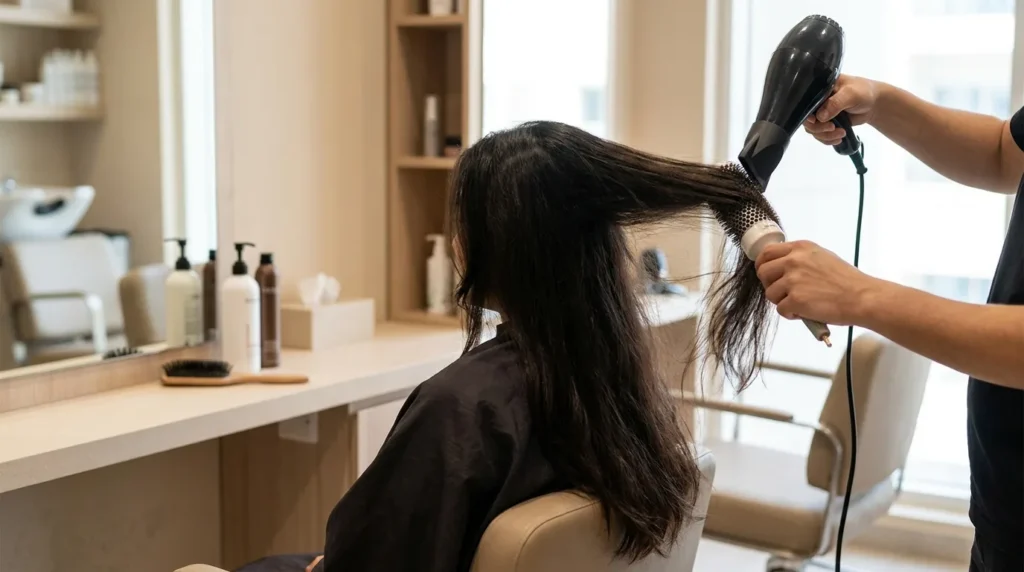
Can blow drying damage hair? Yes, and almost all of it happens on the surface. Heat lifts and cracks the cuticle, and the cracking gets worse as the temperature climbs. A 2011 dermatology study found something less expected: hair dried at 15 cm with the dryer kept moving came out in better condition than hair left to dry naturally.
Where the heat actually lands: cuticle, cortex and CMC
A hair strand has three layers plus a glue. The cuticle is the outer shell of overlapping scales. The cortex underneath holds the keratin bundles giving hair its strength and colour. The medulla sits at the core. Holding the whole thing together is the cell membrane complex, a thin lipid and protein layer between cells.
The 2011 study in Annals of Dermatology dried hair samples at ambient temperature, 47°C, 61°C and 95°C, then examined them under an electron microscope. At 47°C the cuticle showed multiple longitudinal cracks. At 61°C the scales lifted further and cracked more. At 95°C the researchers found cracks, holes, hazy cuticle borders and cuticles punched out entirely.
Two findings matter more than the crack count. No cortex damage appeared at any temperature, which suggests the cuticle absorbs the heat and shields the layer underneath. And the cell membrane complex was damaged in only one group, which was not a heated one.
The four settings that decide how much damage you get
Damage from blow drying is not a fixed property of the tool. It is the product of four variables you control at the point of use.
| Setting | Why it matters | Where to keep it |
|---|---|---|
| Temperature | Cuticle cracking rose steadily from 47°C to 95°C in the 2011 study | The lowest setting still drying in reasonable time |
| Distance | Air cools fast over distance, so the same dryer runs far hotter at 5 cm than at 15 cm | About 15 cm, the furthest of the three distances the study tested |
| Motion | A fixed nozzle concentrates heat on one patch until the water there boils | Moving continuously, never parked |
| Wetness | Soaking hair holds water turning to steam inside the shaft | Towel to damp first, then start |
Three of those four cost nothing and need no new equipment, which makes technique the cheapest upgrade available to most people.
The wetness variable is the one most people skip. Hair holds roughly 30% of its weight in water, and blasting a soaked head with high heat turns some of that trapped water to steam inside the shaft. The result is a hollow bubble in the fibre, and a fibre with a bubble in it snaps. A blow dry starting on damp hair rather than dripping hair removes that risk before it exists.
Air drying damages a layer the dryer leaves alone
Leaving hair to dry on its own sounds like the cautious choice. The 2011 study found the opposite in one specific way.
Damage to the cell membrane complex showed up only in the naturally dried group. Not at 47°C, not at 61°C, not even at 95°C. The reason is time. While hair is wet the cell membrane complex swells to hold the water, then shrinks as it dries. The longer hair stays wet, the longer that layer sits swollen, and repeated swelling and shrinking wears it out. The effect is known as hygral fatigue.
Colour told a similar story. Hair dried at ambient temperature and hair dried at 95°C both showed visible lightening after only ten wash and dry cycles, while the middle temperatures did not.
So the honest answer to does blow drying damage hair is that it trades one kind of damage for another. The dryer roughs up the surface. Air drying leaves the surface alone and works on the glue between cells instead. The study concluded a dryer held at 15 cm and kept moving does less total damage than natural drying.
Does blow drying your hair with cold air damage it?
Cold air removes the thermal half of the problem and leaves the mechanical half behind.
Without heat there is no cuticle cracking from temperature, no steam inside the shaft and no colour lightening. What remains is airflow and whatever brush is in your other hand. High velocity air whips strands against each other, and tangles dragged through a bristle brush break hair whether the air is hot or cold. So does blow drying your hair with cold air damage it? Far less than hot air, with two caveats.
The first is time. Cold air dries slowly, so the swelling window the 2011 study identified stays open longer, which is the exact problem air drying has. The second is that a cool shot at the end of a hot dry does a different job: it sets the cuticle flat after the heat, which is why stylists finish that way.
How often you can blow dry before it shows
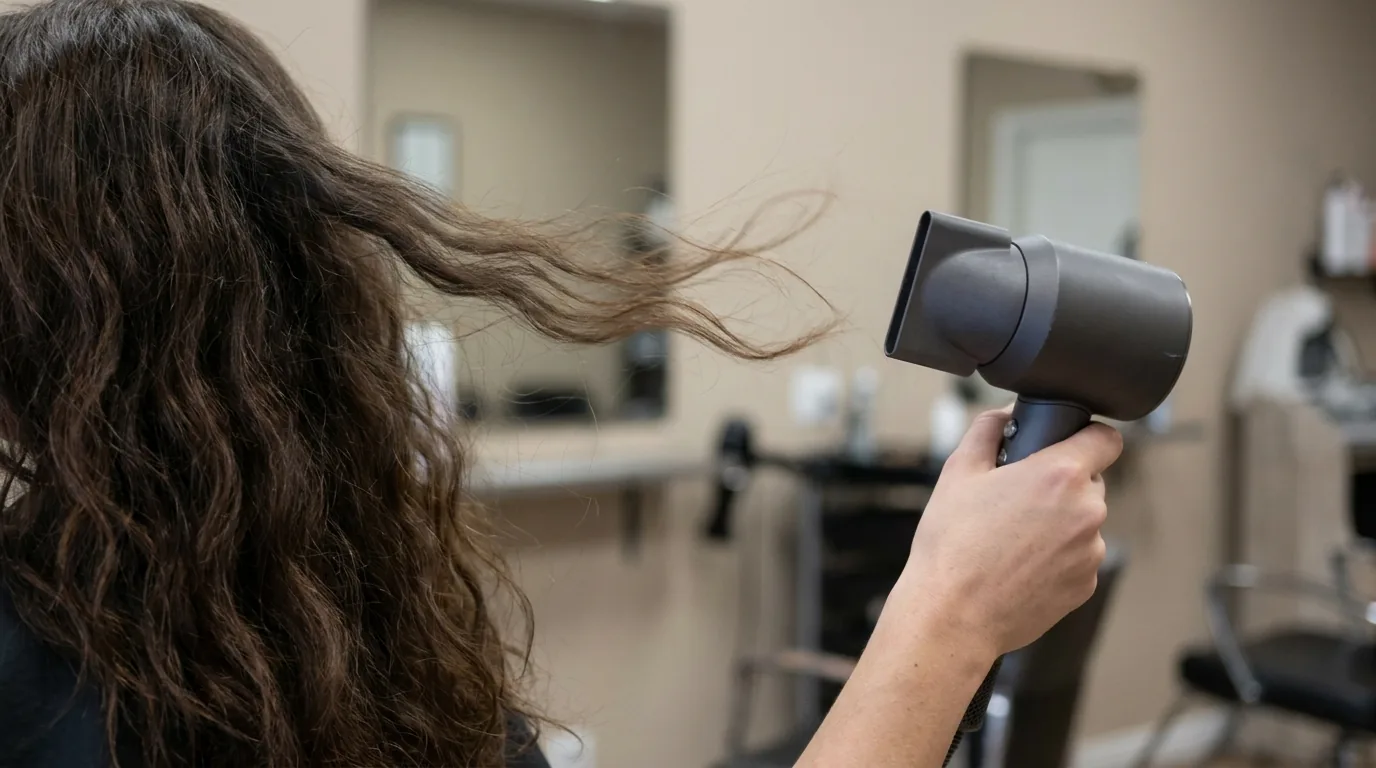
There is no universal ceiling. Can blow drying damage hair at two sessions a week? On healthy uncoloured hair it rarely shows. Damage accumulates per exposure, so the number that matters is total heat cycles rather than calendar days.
The study’s samples showed measurable colour change after ten wash and dry cycles. That is a laboratory result on isolated tresses, not a promise about your head. Read it as a direction of travel: damage from blow drying is cumulative, and it starts earlier than most people assume.
Practical spacing depends on hair type. Fine and chemically treated hair shows heat damage first. Coarse virgin hair takes longer. Curly and coily hair is drier at baseline and generally wants a diffuser rather than a concentrator nozzle. A workable rule for treated hair is two or three full heat sessions a week, with the rest dried to damp and finished cool. Dubai hairdressers will usually set the interval against your hair’s condition at the chair rather than a fixed number.
What Dubai’s water and air do to a blow dry
Two local conditions change the blow drying calculation here, and they pull in opposite directions.
Summer humidity is the first. When outdoor air is heavy with moisture, hair left to dry naturally stays wet far longer than it would in a dry climate. That extends exactly the swelling window the 2011 study linked to cell membrane damage, which makes the case for a controlled low heat dry stronger in July than in January.
Indoor air is the second, and it works the other way. Dubai interiors run air conditioning almost year round, and conditioned air is dry. Hair spending the day in it arrives at the dryer with less moisture to begin with, so the same heat setting bites harder.
Water matters too. Dubai’s supply is desalinated seawater, blended and stabilised before it reaches the network, and the mineral content ending up on your strand varies by building and by whether the water sits in a roof tank first.
Deposits on the cuticle make hair rougher and harder to comb wet, and combing wet is where a lot of blow drying breakage actually happens. A microfibre towel instead of a terry one, and a wide tooth comb instead of a brush, both cut that risk. Pool and sea swimming adds chlorine and salt on top.
Blow drying against flat irons and curling tongs
Search results tend to lump heat tools together. The mechanism differs enough to matter.
| Tool | How heat reaches the hair | Where damage shows first |
|---|---|---|
| Dryer | Hot moving air, spread across a section | General cuticle roughness along the length |
| Flat iron | Direct metal contact, clamped shut | Sharp localised damage where the plates close |
| Curling tong | Direct contact, wrapped and held | The mid lengths and ends wrapping first |
A dryer spreads a lower temperature across a wider area, while irons and tongs put a higher temperature on a narrow band with nothing between the plate and the strand. That is why does blow drying hair damage it usually gets a softer answer than the same question aimed at a flat iron.
Chemical services change the ranking. Hair lightened, permed or through a hair smoothing service carries a compromised cuticle before any tool touches it, and whether a keratin treatment helps or hurts turns on that same cuticle condition.
How to tell if your hair is already heat damaged
Heat damage has a recognisable signature, and it reads differently from ordinary dryness.
- Ends looking see-through or wispy against the light while the roots still look dense.
- A rough, catchy feel running a strand between two fingers from tip to root.
- Hair drinking conditioner and feeling dry again within a day.
- Strands stretching further than usual when wet without springing back.
- Split ends appearing higher up the shaft rather than only at the tip.
- Colour fading faster than it used to, or pulling warm.
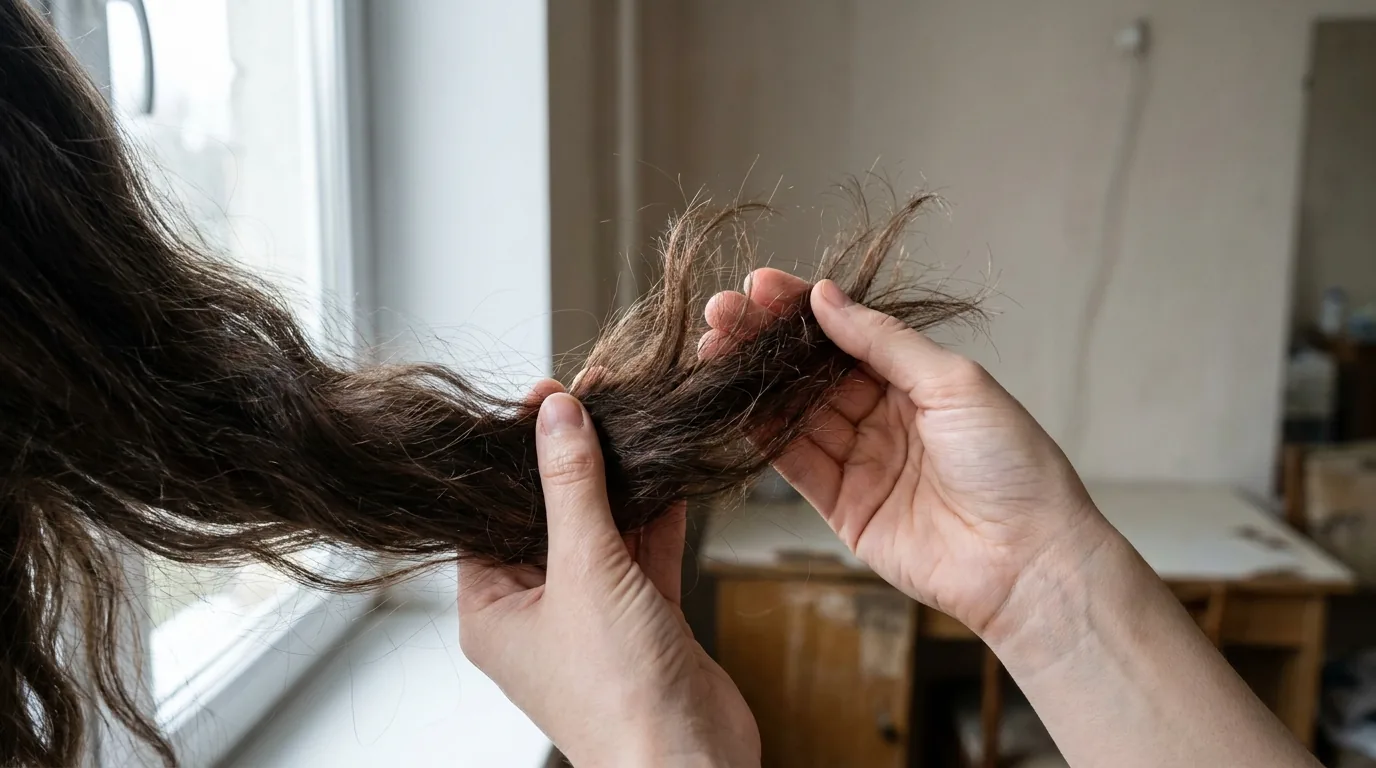
Three or more of those together points at cumulative heat rather than one bad week. Cuticle damage cannot be reversed, because the scales do not regrow. What a bonding or protein hair treatment does is fill and seal the gaps so the strand behaves better while it grows out, so anything sold as repair is buying time on the length you already have. Where the damage arrived alongside hair colouring, treat the two together rather than separately.
Getting a salon blow dry without the damage
Salon blow drying is not automatically gentler than doing it at home. It is gentler when the person holding the dryer keeps it moving, works in clean sections, and starts on damp rather than soaking hair. Asking for a lower heat setting is a reasonable request, and a good stylist will already be working that way.
Two licences sit behind a legitimate Dubai salon. The Department of Economy and Tourism issues the trade licence letting the business operate commercially in Dubai, and the Dubai Health Authority issues the health licence covering the premises, hygiene standards and the practitioners working there. Both are worth confirming before a first visit.
Salons in Dubai lists 167 hair salons across the city, each profile carrying its rating, area and price band, and our ranking method explains how those listings are ordered. The full set sits under hair salons.

Popular hair salons in Dubai
Collective is a hair salon inside the MAG Warehouses complex in Al Quoz Industrial Area 2, rated from reviews. Services cover hair colouring, balayage, hair highlights, hair extensions, keratin treatment, ladies haircuts, blow dry, bridal makeup, manicures, gel pedicures and waxing services. Several reviewers like the modern, classy interior and mention stylists using Dyson equipment for finishing, with one client describing a playful, well judged cut from a stylist who listened closely to the brief. Feedback on colour work is more mixed, with one detailed report describing hair damage and billing disagreements after a balayage and toner service, so it makes sense to agree the full scope and price before any colour treatment begins. The salon has a toilet on site along with wheelchair-accessible parking and entrance.
Version Francaise is a hairdressing salon inside the Marriott Harbour Hotel and Suites in Dubai Marina, offering haircuts, hair colouring, highlights, hair extensions, keratin treatment, blow dry styling, threading, manicures and nail art. It is rated from reviews.Reviewers consistently describe the salon as welcoming, with several returning for years and calling it their regular salon for haircuts and colour treatments. The team is praised for professionalism, attention to detail and a warm welcome from arrival to the end of the appointment.The salon has free Wi-Fi, on-site services, a wheelchair-accessible entrance, car park and toilet, plus gender-neutral toilets. It suits residents and hotel guests in Dubai Marina after a haircut, colour service or hair treatment appointment, with appointments recommended given the salon's loyal following.
Locks By Lou Lou is a hair salon on Al Wasl Road in Jumeirah, rated from reviews. Reviewers consistently praise the colour work, from balayage and highlights to root touch ups, and several mention hair extensions that look natural rather than obviously fitted. Clients also note that stylists take time to understand what they want before starting and explain aftercare so hair stays in good condition afterwards.Beyond colour, the salon offers blow dry, keratin treatment, hair extensions, manicure, gel pedicure, microneedling and anti-aging facial treatments. The entrance is wheelchair accessible and there is an on-site toilet.Appointments are recommended, particularly for colour and extension work, and the salon suits clients looking for an ongoing colourist relationship rather than a single visit.
Version Francaise Pour Elle is a hairdresser and beauty salon on Al Wasl Road, Al Safa 2, rated from reviews. Services span hair colouring, balayage, highlights, extensions, keratin treatment and blow dry, ladies' haircuts, beard trim, manicure, gel nails, gel pedicure, eyelash extensions, anti-aging facials and waxing.Reviewers consistently praise the colour and highlight work, describing meticulous stylists who take the time to understand what a client wants even when it is hard to explain. The salon is also noted for its cleanliness, product quality and reasonable prices, with several reviewers mentioning the owner is regularly on site overseeing the team and the client experience.Free Wi-Fi and parking are available. Suits clients after precise colour work from a team that takes the time to get it right.
Trinity Hair Salon is a hair salon in Al Barsha South, based at Danube Resortz, rated from reviews.Colour work is what reviewers talk about most, with several describing years of trust in the stylists for balayage, highlights and full colour changes, including recovering from a previous bad dye job elsewhere. The salon also offers ladies haircuts, blow dries, hair treatment and a back massage, plus manicures and pedicures. More than one reviewer describes the atmosphere as warm and modern with a good energy, and says they would not trust anyone else with their hair colour.There is a toilet on site, the salon offers on-site services, and a wheelchair-accessible car park makes it an easy stop for residents around Al Barsha South.
Browse all 167 Hair Salons providers on our directory.


