



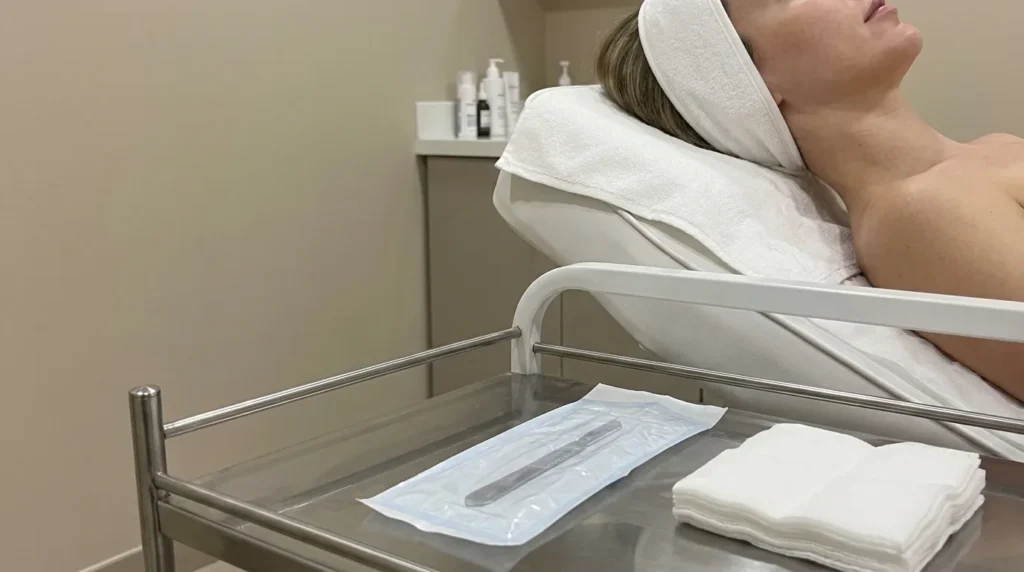
28 days is the number behind every answer to how often can you do dermaplaning. That is roughly how long skin takes to replace the layer a blade removes, so most people book every three to four weeks, and four to six if skin runs dry or sensitive. Dubai sessions run AED 75 to AED 500.
This guide is general information, not medical advice. Dermaplaning is a regulated cosmetic-medical treatment in Dubai: consult a DHA-licensed clinic about your suitability and risks before booking.
How often can you do dermaplaning, and what sets the limit
Skin replaces its outer layer on a cycle of roughly 28 to 30 days. Dermaplaning removes the top of that layer in one pass, along with the peach fuzz sitting in it. Book again before the cycle finishes and the blade meets live cells rather than spent ones.
That single number explains almost every recommendation you will read. A three week gap suits skin that turns over fast. A six week gap suits skin that does not. Everything else, from skin type to what else sits in your routine, adjusts the same underlying clock rather than replacing it.
Age slows the cycle. Turnover in a twenty year old is quicker than in someone in their fifties, which is why mature skin usually sits at the longer end of the range and still looks smooth throughout. The same clock governs the spacing of most other facial treatments in a routine.
Dermaplaning frequency by skin type
Estheticians set the gap by how much barrier reserve the skin has. Oily and resilient skin regenerates fast and tolerates a shorter cycle. Dry, thin or reactive skin needs longer to rebuild lipids after each pass.
| Skin type | Interval |
|---|---|
| Oily or resilient | Every 3 weeks |
| Normal or combination | Every 3 to 4 weeks |
| Dry or sensitive | Every 4 to 6 weeks |
| Mature or sun exposed | Every 4 to 6 weeks |
| Rosacea, eczema or active acne | Not suitable |
The reasoning behind each row is the same mechanism. Oily skin turns over fast and sebum rebuilds the barrier quickly. Dry and sensitive skin replaces lipids slowly, so an early return stings. Turnover slows with age, which is why results on mature skin hold longer at a wider gap.
The last row matters most. Active breakouts are a stop sign, not a longer interval, and most Dubai skin care salons will decline the booking or switch you to a gentler option on the day. Inflammatory rosacea or eczema is a question for a dermatologist before any blade touches the skin.
In clinic sessions and at home blades run on different clocks
A professional pass uses a sterile surgical blade held at roughly 45 degrees by someone trained to keep pressure even. It goes deeper than a drugstore tool and buys a longer gap. How often should you dermaplane in a clinic comes back to the same three to four weeks for most skin.
At home razors marketed for facial hair barely reach the stratum corneum. Brands often suggest every one to three weeks because the pass is so shallow. The catch is that a shallow tool used impatiently still strips the barrier, and nobody is watching your skin between rounds.
Licensing is the other split. Every venue in Dubai needs a DET trade licence to trade at all, and any facility offering the treatment on the clinical side needs a DHA licence covering both the premises and the practitioner performing it. Asking to see both is normal, and the criteria behind the directory’s own vetting are set out in how we rank salons.

Popular facial and skin clinics in Dubai
Skin Camouflage beauty therapists, fully licensed by the Dubai Health Authority, specialize in advanced skin treatments. Inkless Stretch Marks Removal effectively minimizes stretch marks without invasive procedures. Our Scalp Micropigmentation (Hair Tattoo) restores the look of fuller hair with precision pigmentation. The BB Glow Treatment achieves smooth, radiant skin that lasts.
Nova Clinic The Palm is a skin care clinic in Palm Jumeirah Mall by Dubai Retail, on the Palm Jumeirah, rated from reviews. Reviewers consistently describe a modern, extremely clean clinic where therapists explain each step of a facial treatment and leave skin feeling clean, fresh and glowing. Several also mention attentive, professional consultations that left them noticeably more comfortable and satisfied with their results. Treatments include acne treatment, anti-aging facials, body contouring, Botox injections, chemical peel, deep cleansing facial, dermal fillers, hair treatment, IPL and laser hair removal, microneedling, pigmentation treatment, PRP therapy, skin rejuvenation, skin tightening and tattoo removal. Appointments are recommended, and the clinic is wheelchair accessible with parking, entrance and toilet facilities on site at Nakheel Mall.
Glow Aesthetics Dermatology Clinic is in Al Attar Business Centre in Al Barsha, offering botox injections, dermal fillers, chemical peels, microneedling, laser and IPL hair removal, skin tightening, scar treatment and pigmentation treatment. It is rated from reviews.Reviewers consistently praise the honesty of the medical guidance, noting that the team recommends only what is genuinely needed rather than upselling treatments. The clinic is described as professional and welcoming from arrival, with several highlighting fair pricing relative to the standard of care.The clinic has on-site services with a wheelchair-accessible entrance, car park and toilet. It suits patients across Dubai researching skin treatments, anti-aging facials or laser hair removal, with a consultation recommended to discuss the right treatment plan.
Derma 247 Laser Clinic is a skin and laser clinic in Nadd Al Hamar, rated from reviews. Treatments cover laser and IPL hair removal, botox injections, dermal fillers, chemical peels, pigmentation treatment, skin rejuvenation and tattoo removal.Reviewers consistently mention feeling well informed before and during laser sessions, with practitioners who explain each step in plain terms and check in throughout rather than rushing through the appointment. That attentiveness comes up often enough to be a genuine pattern rather than a one-off.The clinic runs by appointment, with on-site services and a fully wheelchair-accessible setup including gender-neutral toilets. It suits anyone after laser or aesthetic treatments who wants a clinical, unhurried approach rather than a quick in-and-out visit.
Avoria Aesthetic Clinic is a skin care and medical aesthetics clinic in Al Barsha, rated from reviews. Treatments include Botox and dermal fillers, chemical peels, microneedling, laser hair removal, pigmentation and acne treatment, tattoo removal, electrolysis, lip blush and eyebrow microblading, plus body contouring and hair transplant procedures. Reviewers consistently describe a modern, spotless clinic with a calming atmosphere, and praise the team for explaining each treatment thoroughly before starting and taking time to listen to concerns. Laser hair removal sessions are described as comfortable and effective, and reviewers mention good results from HydraFacial treatments too, with outcomes generally meeting or exceeding expectations. Free underground parking is available, and the clinic has a wheelchair-accessible car park, entrance and toilet, all within the Deyaar Building unit that houses the clinic.
Is it bad to dermaplane too often?
Yes, and the skin says so before you see it in a mirror. Over exfoliation shows up as tightness after cleansing, stinging from products that never stung before, patchy flaking, and a shine that reads as oil but is actually water loss. Redness that lingers past the evening is the clearest signal.
Push through those signs and the barrier stops holding water and stops keeping bacteria out. So can you dermaplane once a week and get away with it? People who try it report new congestion within a month and blame the blade for causing it. The pattern is common enough that clinics offering acne treatment in Dubai see it as a referral reason.
Recovery is passive. Stop for six to eight weeks, drop every acid and scrub, and rebuild with a plain moisturiser and daily sun protection before restarting at a longer gap.
How often to dermaplane upper lip, chin and other single areas
Spot work follows hair regrowth, not the exfoliation clock. Vellus hair on the upper lip becomes visible again in about two to three weeks, sooner than the face reads as dull, which is why people ask about these areas separately.
Treating one small patch every two weeks is lower risk than a full face pass on the same schedule, because you are exfoliating a fraction of the surface. Keep the rest of the face on its normal cycle. Most facial spas price a lip and chin touch up as a short add on rather than a full session.
One caveat holds across every area: vellus hair grows back at the same texture and colour it had before. Frequency does not change that, and neither does the tool.
Spacing dermaplaning around peels, lasers and retinoids
Dermaplaning is exfoliation. Dermaplaning frequency is therefore a question about the whole routine, not one treatment in isolation, and stacking two exfoliating steps inside the same week is where most barrier damage happens.
Leave two weeks either side of a chemical peel or a resurfacing laser. Pause retinoids for three to five days before a session and restart three days after. Skip acids for 48 hours on both sides.
| Paired treatment | Gap before | Gap after |
|---|---|---|
| Chemical peel or laser | 2 weeks | 2 weeks |
| Retinoid or vitamin A | 3 to 5 days | 3 days |
| AHA or BHA acids | 48 hours | 48 hours |
| Hydrating facial or LED | Same visit | Same visit |
| Waxing on the same area | 2 weeks | 2 weeks |
The hydrating row is the exception. LED and hydrating steps pair inside a single visit because they add rather than remove, which is why a HydraFacial in Dubai is often sold with a blade pass built into the same slot.
Why the Dubai calendar moves your schedule
Freshly dermaplaned skin is more photosensitive for about a week. Dubai runs a UV index in the double digits from May through September, which is long enough to matter to a schedule rather than just an aftercare note.
Through those months, stretching a three week habit to four and treating sun protection as non negotiable costs nothing and protects the result. Residents around Dubai Marina and other beach side areas tend to feel this first, because pool and sea exposure lands in the same window as the treatment.
Chlorine and salt water sting a freshly resurfaced face, so leave 48 hours before swimming, and the same before a hammam or steam room. Air conditioning is the quiet one: it dries the skin all year, which pushes many residents toward the longer end of their range regardless of season.

Timing a session before a wedding, shoot or event
How often can you do dermaplaning matters less than when the last session lands. Three to seven days out is the window professionals use. Same day and next day carry a small risk of residual redness, and skin that has settled for several days takes foundation more evenly than skin treated that morning.
For a first ever session before a major event, book a trial run four to six weeks earlier. That confirms how your skin reacts and still leaves room for the real appointment inside the ideal window. Bridal calendars in Dubai fill quickly around the cooler months, so hold the slot early.
What a year of dermaplaning costs at each interval
Frequency is the number that sets the annual bill, not the sticker price of one session. A four week cycle means 13 appointments a year, a six week cycle means about nine.
Dubai pricing runs AED 75 to AED 150 for a quick add on, AED 150 to AED 300 for a standalone session in a private room, and AED 300 to AED 500 or more when the treatment is folded into a fuller facial. Guides such as the round up of the best facial in Dubai options show how those tiers sit against everything else on a menu.
| Tier | Per session | Year at 4 weeks |
|---|---|---|
| Budget add on | AED 75 to 150 | AED 975 to 1,950 |
| Standalone | AED 150 to 300 | AED 1,950 to 3,900 |
| Clinic or paired | AED 300 to 500 | AED 3,900 to 6,500 |
At a six week gap those totals drop to roughly AED 675 to 1,350, AED 1,350 to 2,700 and AED 2,700 to 4,500, cutting the yearly spend by about a third. Do you have to keep dermaplaning once you start? No, so a multi session package is a convenience rather than a commitment, and it is worth checking the expiry terms before paying up front.
Browse all 56 Skin Care Salons providers on our directory.


