


Is dermaplaning good for acne? Only some of it. The blade clears dead cells and peach fuzz, which helps comedonal skin and post acne marks, and it makes active inflamed breakouts worse. Dubai sessions run AED 75 to 500. Which acne you have decides everything.
This article is general information about a cosmetic skin treatment, not medical advice. Acne is a medical condition. For a diagnosis, a prescription, or a plan for inflamed or scarring acne, see a DHA-licensed clinician.
Is dermaplaning good for acne? Match the answer to your skin
Acne is not one condition, and the blade behaves differently against each version of it. A clogged pore sitting under an intact surface responds to exfoliation. A pus filled lesion with a thin roof does not. Reading the table below against a mirror gets a reader closer to the right answer than any general verdict.
| What the skin is doing | Dermaplaning? | Why |
|---|---|---|
| Blackheads and whiteheads, no redness | Usually a good fit | Clearing the dead cell layer unplugs the pore opening and lets a salicylic acid product work further down |
| Oily skin, clear at the moment | Yes | Less surface build up, flatter makeup, and no open lesion for a blade edge to catch |
| Two or three small red spots | Only if the therapist works around them | Blade contact on a raised lesion tears it open |
| Widespread inflamed or pustular acne | Postpone | Dragging an edge across pus filled spots moves bacteria across the rest of the face |
| Cystic or nodular acne | No | Those lesions sit deep, surface exfoliation cannot reach them, and the irritation makes them angrier |
| Flat brown or red marks left behind after spots heal | Yes, for texture | A smoother surface reflects light more evenly, though the pigment itself needs a pigment treatment |
| Pitted or indented scars | No | The blade takes off dead surface cells and cannot lift a depressed scar |
The pattern across every row: dermaplaning is a maintenance treatment for skin between breakouts, and never a treatment for a breakout in progress.
What the blade does on oily, acne prone skin
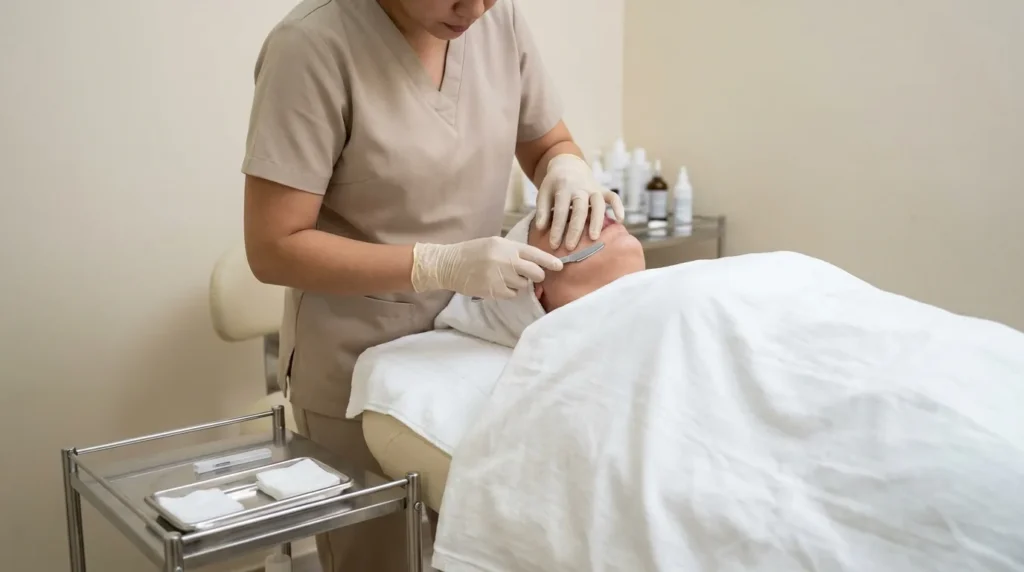
A dermaplaning pass uses a sterile scalpel blade held at roughly a 45 degree angle to scrape off the stratum corneum, the outermost layer of dead skin cells, along with the vellus hair growing through it. Nothing living is cut. The session takes 20 to 60 minutes and leaves the face smooth on contact.
On oily skin that matters more than it does on dry skin. Sebum mixes with dead cells and sits in the pore opening, and fine facial hair holds that mixture against the surface. Removing both leaves fewer places for the mixture to collect. It also removes the barrier that was blunting a leave on product, which is why an acne treatment serum applied afterwards feels noticeably stronger.
Note what the treatment does not touch. Dermaplaning does not reduce oil production, does not kill the bacteria involved in inflammatory acne, and does not reach the follicle where a cyst forms. Research on dermaplaning and acne outcomes is thin, so the honest framing is a surface benefit for skin that is already calm, rather than a treatment that clears spots.
Why blading over an active breakout backfires
Three separate problems stack up when a blade meets an inflamed spot, and none of them are theoretical.
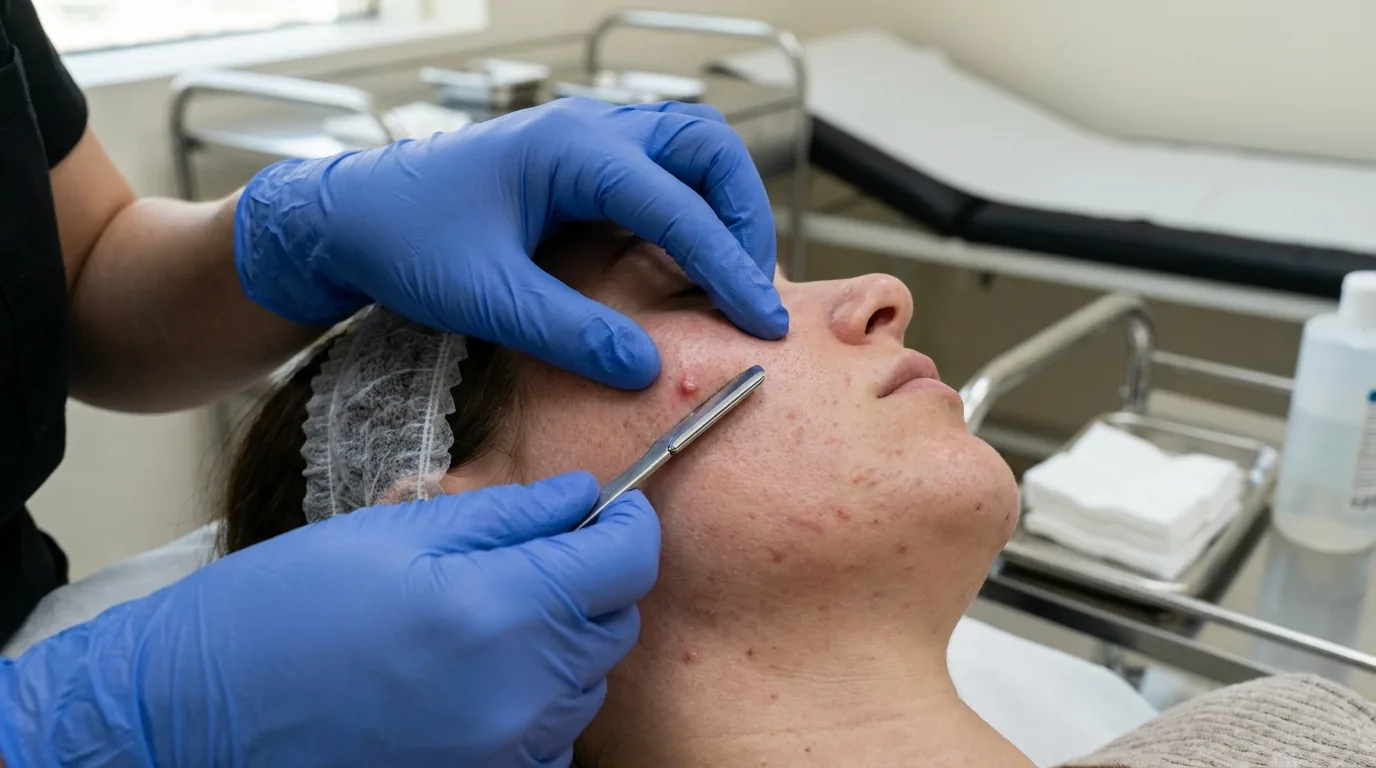
The first is mechanical. A papule or pustule sits above the surface plane, so the edge catches it rather than gliding past. That opens the lesion, which lengthens healing and raises the odds of a mark that outlasts the spot by months. The second is bacterial. The same blade continues across the cheek and jaw afterwards, carrying whatever it picked up. The third is barrier damage. Skin already coping with inflammation loses more water and stings more once the top layer comes off, and heavy hydrating products applied to soothe it can clog the pores that were the original problem.
Risk is not evenly distributed either. On deeper skin tones, any injury to inflamed skin is more likely to leave post inflammatory hyperpigmentation, so a session that opens a spot can trade a two week pimple for a six month brown mark. That mark then needs its own pigmentation treatment to fade.
Does dermaplaning help acne scars?
This is where the search results get loose with the word scar, and the distinction changes the answer completely.
Flat marks are not scars. A brown or red patch where a spot used to be is pigment sitting in otherwise intact skin, and it fades on its own over months. Dermaplaning speeds that slightly by removing pigmented dead cells at the surface, and the smoother finish makes the marks less obvious under light. That is a cosmetic gain, and it is real.
True atrophic scars are indentations: ice pick, boxcar and rolling. Tissue is missing below the surface, and shaving the top layer off cannot fill a hole. Any brightening after a session comes from light bouncing evenly off smooth skin, and it fades as the dead cell layer rebuilds in one to three weeks. Correcting depth needs a treatment that works in the dermis, such as microneedling, a resurfacing laser, or a deeper peel done under clinical supervision. A course of chemical peel sessions sits between the two options and reaches further than a blade without going surgical.
Does removing peach fuzz help acne?
Not directly. Vellus hair does not cause acne, and nobody breaks out because of peach fuzz. Acne starts when oil, dead cells and bacteria block a follicle, and the fine hair on a cheek is a passenger in that process rather than the cause.
The indirect effect is small and worth naming honestly. Fine hair holds a film of oil, sunscreen and makeup against the skin. Clearing it makes cleansing more effective and stops foundation from clinging to the surface, both of which help slightly. The stronger benefit comes from the dead cell layer coming off at the same time, not from the hair itself.
Acne medication changes the answer
Anything already thinning or sensitising the skin turns a routine session into an irritating one, and several standard acne treatments do exactly that.
- Isotretinoin: most clinicians will not dermaplane during a course or for around six months after it, because the skin is fragile and slow to heal.
- Prescription retinoids: pause for three to five days before a session and restart once any redness has settled.
- Benzoyl peroxide and strong salicylic acid: skip the day before, since the combination leaves the surface raw.
- A recent peel, laser or microneedling: allow the skin to recover fully first, which usually means two to four weeks.
- Antibiotics for acne: not a barrier by themselves, though the underlying inflammation they are treating usually is.
Say all of this out loud at booking rather than in the treatment room. A therapist who asks what a client uses at home before picking up a blade is applying the right screen; one who does not ask is the reason these timings exist.
How to avoid a breakout after dermaplaning
Breakouts that follow a session usually trace back to one of four things, and each has a straightforward fix.
- The blade was not sterile or not new. Watch a single use blade come out of its packet. A shared or re used blade is the clearest infection risk in the room.
- Heavy products went on straight afterwards. Freshly exfoliated skin absorbs more of everything, including rich oils and thick creams that can block a pore. Keep the next 48 hours light: a plain moisturiser and sunscreen.
- Actives were layered too soon. Leave retinoids and acids out for two or three days, then reintroduce one at a time.
- The face got touched, sweated on, or steamed. Skip the gym, the sauna and makeup brushes for a day.
Distinguish a purge from a breakout as well. Small spots surfacing within three or four days in areas that were already congested are existing blockages coming up faster, and they settle. New spots in places that never break out, appearing a week or more later, point at a product or a hygiene problem instead. Salons offering facial treatments in Dubai will normally book a follow up to look at either one.
What to book instead while acne is active
The useful move when spots are inflamed is not to wait passively for a dermaplaning slot to become appropriate. Other treatments do the job that is actually needed right now.
A salicylic acid peel works inside the pore rather than on top of it, and it tolerates active congestion far better than a blade does. Extractions performed by a trained esthetician clear comedones directly. A hydrafacial with a clarifying booster combines gentle exfoliation with suction and stays away from lesion edges. LED therapy in the blue range targets the bacteria involved in inflammation and carries almost no downtime. For moderate to severe acne, none of these replaces a prescription, and a dermatologist remains the fastest route to a treatment that works on the cause.
Once the skin is calm again, dermaplaning becomes reasonable, and it fits well as a step inside a longer appointment. Anyone comparing options against a best facial in Dubai shortlist should treat it as a finishing step for clear skin rather than the treatment doing the heavy work.
What a session costs in Dubai
Dermaplaning is priced as an add on at the low end and as a standalone clinic treatment at the top, and the gap reflects the room, the products and who holds the blade.
| Tier | Typical price | Duration | Room | Products | Staff experience | Best for |
|---|---|---|---|---|---|---|
| Budget | AED 75 to 150 | 20 to 30 min | Shared or standard treatment room | Single-use sterile blade, basic cleanser | Beauty therapist | A quick add-on, peach-fuzz removal, smoother makeup base |
| Mid | AED 150 to 300 | 30 to 45 min | Private treatment room | Sterile blade plus a calming serum or mask finish | Trained esthetician | Standalone dermaplaning with a hydrating or LED add-on |
| Premium | AED 300 to 500+ | 45 to 60 min | Private clinic or facial-bar suite | Medical-grade serums, post-treatment SPF, optional peel pairing | Senior esthetician or DHA-licensed clinician | Dermaplaning paired with a facial, peel, or HydraFacial |
For acne prone skin the mid and premium bands buy something specific: a longer consultation, a therapist who will work around a lesion rather than through it, and a calming finish instead of a heavy occlusive cream. Promotional rates near AED 75 are common across Dubai skin care salons, and at that price the session is usually a quick pass with no consultation attached.
Booking with acne prone skin in Dubai
Searching best dermaplaning Dubai returns clinic pages and booking platforms, and none of them screen a face before taking a payment. The screening has to happen in the questions asked at booking.
Start with licensing. Every venue offering the treatment needs a DET trade licence to operate, and a clinic or medical spa performing it in a clinical setting also needs DHA licensing covering both the facility and the practitioner. Ask which applies before a first visit. The criteria used to rank venues on this site are set out in how we rank salons, and licensing sits near the top of them.
Then ask four practical questions: whether the therapist has treated acne prone skin before, whether the blade is single use, whether the session can be adjusted to avoid active spots, and what goes on the skin afterwards. Dedicated facial spas and skin clinics tend to answer these fluently, and the 56 skin care salons listed on this site can be filtered by area and rating before anyone calls.

Popular facial and skin clinics in Dubai
Skin Camouflage beauty therapists, fully licensed by the Dubai Health Authority, specialize in advanced skin treatments. Inkless Stretch Marks Removal effectively minimizes stretch marks without invasive procedures. Our Scalp Micropigmentation (Hair Tattoo) restores the look of fuller hair with precision pigmentation. The BB Glow Treatment achieves smooth, radiant skin that lasts.
Nova Clinic The Palm is a skin care clinic in Palm Jumeirah Mall by Dubai Retail, on the Palm Jumeirah, rated from reviews. Reviewers consistently describe a modern, extremely clean clinic where therapists explain each step of a facial treatment and leave skin feeling clean, fresh and glowing. Several also mention attentive, professional consultations that left them noticeably more comfortable and satisfied with their results. Treatments include acne treatment, anti-aging facials, body contouring, Botox injections, chemical peel, deep cleansing facial, dermal fillers, hair treatment, IPL and laser hair removal, microneedling, pigmentation treatment, PRP therapy, skin rejuvenation, skin tightening and tattoo removal. Appointments are recommended, and the clinic is wheelchair accessible with parking, entrance and toilet facilities on site at Nakheel Mall.
Glow Aesthetics Dermatology Clinic is in Al Attar Business Centre in Al Barsha, offering botox injections, dermal fillers, chemical peels, microneedling, laser and IPL hair removal, skin tightening, scar treatment and pigmentation treatment. It is rated from reviews.Reviewers consistently praise the honesty of the medical guidance, noting that the team recommends only what is genuinely needed rather than upselling treatments. The clinic is described as professional and welcoming from arrival, with several highlighting fair pricing relative to the standard of care.The clinic has on-site services with a wheelchair-accessible entrance, car park and toilet. It suits patients across Dubai researching skin treatments, anti-aging facials or laser hair removal, with a consultation recommended to discuss the right treatment plan.
Derma 247 Laser Clinic is a skin and laser clinic in Nadd Al Hamar, rated from reviews. Treatments cover laser and IPL hair removal, botox injections, dermal fillers, chemical peels, pigmentation treatment, skin rejuvenation and tattoo removal.Reviewers consistently mention feeling well informed before and during laser sessions, with practitioners who explain each step in plain terms and check in throughout rather than rushing through the appointment. That attentiveness comes up often enough to be a genuine pattern rather than a one-off.The clinic runs by appointment, with on-site services and a fully wheelchair-accessible setup including gender-neutral toilets. It suits anyone after laser or aesthetic treatments who wants a clinical, unhurried approach rather than a quick in-and-out visit.
Avoria Aesthetic Clinic is a skin care and medical aesthetics clinic in Al Barsha, rated from reviews. Treatments include Botox and dermal fillers, chemical peels, microneedling, laser hair removal, pigmentation and acne treatment, tattoo removal, electrolysis, lip blush and eyebrow microblading, plus body contouring and hair transplant procedures. Reviewers consistently describe a modern, spotless clinic with a calming atmosphere, and praise the team for explaining each treatment thoroughly before starting and taking time to listen to concerns. Laser hair removal sessions are described as comfortable and effective, and reviewers mention good results from HydraFacial treatments too, with outcomes generally meeting or exceeding expectations. Free underground parking is available, and the clinic has a wheelchair-accessible car park, entrance and toilet, all within the Deyaar Building unit that houses the clinic.
Browse all 56 Skin Care Salons providers on our directory.


