
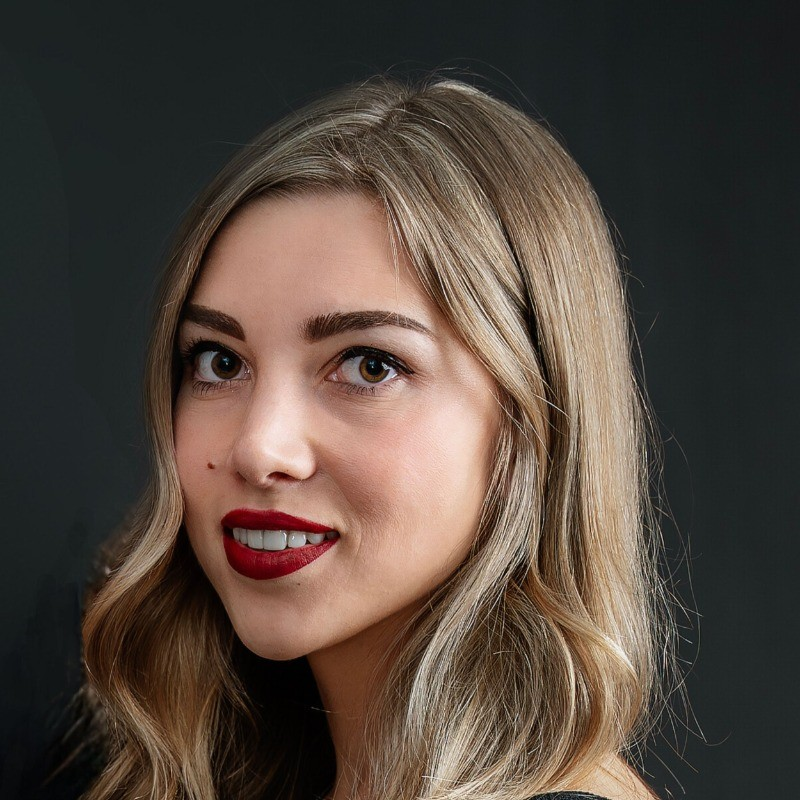


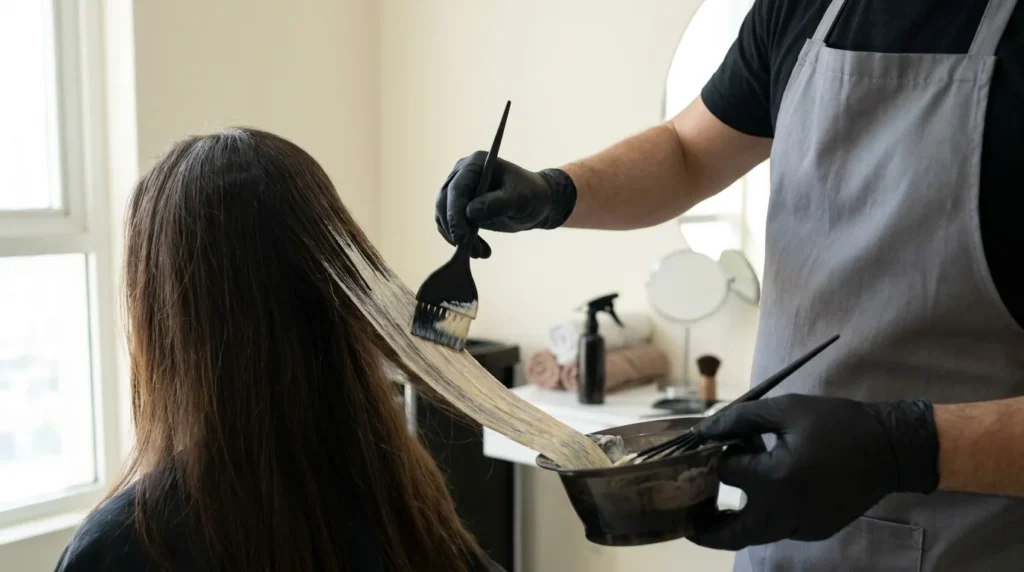
How to do balayage comes down to four moves: section the hair, mix lightener with developer, sweep the product from mid-length to end while feathering the top of each stroke, then tone. A Dubai salon charges AED 350 to 2,800 for the service. The painting itself is simple. The back of your own head is the part that is not.
What a colourist is doing when they paint balayage
Balayage is French for sweeping, and the word describes a hand movement rather than a product. The colourist loads a tinting brush with lightener and draws it down the strand in a surface sweep, heavier near the ends and thinner towards the top of the stroke. Nothing wraps the section. The lightener sits in open air and lifts exactly where it was placed.
That one choice separates the technique from a foil highlight. A foil holds heat against the hair and processes it at even strength from root to tip, which is why foils give bright, uniform ribbons. Balayage leaves a soft start line partway down the strand, so the finished colour reads like hair that has spent a long time outdoors.
Placement decides the look far more than the product does. Two colourists working with the same tub and the same developer can produce a soft blend or a row of hard stripes.
The four decisions made before any lightener is mixed
Every balayage starts with four calls, made during the consultation while the colourist reads the dry hair for density and old colour history.
| Decision | What it controls | Typical call |
|---|---|---|
| Section size and shape | How chunky or blended the finished pieces look | Thicker V shapes for curly or coarse hair, thinner U shapes for fine or straight hair |
| Start point on the strand | How grown-out the colour looks on day one | Higher near the face and lower at the back, following where sun would naturally hit |
| Saturation | How bright the ends go | One side of the section painted for a soft blend, both sides packed for full brightness |
| Developer strength | Speed and depth of lift | 20 volume for a gentle two-level lift, 30 volume when more lift is needed on darker hair |
Those four calls explain the wide price band. A soft set of face-framing pieces takes under two hours; a full head painted in small sections to four levels of lift can run past four. Anyone comparing quotes across salons listing balayage in Dubai is comparing hours of hand work rather than materials.
Painting a section: the sweep, the saturation, the blur
The sequence inside one section is short and repeats across the head. Dry, day-old hair holds product better than a fresh wash, so most colourists ask clients to arrive unwashed.
- Take the section. Comb out a diagonal slice roughly a quarter of an inch thick and hold it under tension, either in the hand or against a balayage board.
- Load the brush. Lightener mixed with developer should sit like thick icing. Runny product travels down the section and bleeds into hair that was meant to stay dark.
- Sweep down. Start where the lift should begin, then drag towards the ends with the flat of the brush, adding pressure so the tip carries the most product.
- Feather the top. Flick the brush upward in short, light strokes at the start line. This blur turns a stripe into a balayage, and home tutorials skip it most often.
- Pack the ends. Coat both sides of the last few inches. Ends carry the brightest part of the finished colour.
Colourists work from the nape upward, alternating diagonal and horizontal sections so the lightened pieces sit in a brick pattern rather than a column. Near the hairline the sections get smaller. The money piece is painted last, because face-framing strokes are the ones a client sees every day.
Open air, foils, or a balayage board
Freehand painting is one of three ways the same sweeping motion gets used. Dubai salons run all three, depending on how much lift a client wants.
| Method | What it changes | Suits |
|---|---|---|
| Open air | Lightener processes in the room with no heat trapped, so lift is slower and gentler | Light and medium brown hair going two or three levels lighter |
| Foilayage | Painted freehand, then wrapped in foil to hold heat and push lift further | Dark or coarse hair that needs four levels, and grey blending |
| Balayage board | A paddle held under the section for tension, keeping the blur clean and product off the rest of the head | Fine hair, tight sections, and any painting done on someone else |
The board solves the problem most beginners hit, which is product bleeding onto the section underneath. Foilayage explains the other one: a salon result on very dark hair looks brighter because that version sits closer to foil highlights in strength while keeping the painted start line.
Lift and tone: the half of the job that decides the colour
Once every section is painted, the hair processes without heat for 20 to 55 minutes. Nobody sets a timer and walks away. The colourist wipes lightener off a test strand every ten minutes to see what is underneath, because hair passes through red, orange and yellow on its way to pale blonde, and the stopping point is a judgement call rather than a clock reading.
Rinsing is only the halfway mark. Freshly lifted hair is raw and warm-toned, and a toner or gloss at the basin for five to twenty minutes cancels the brassiness the lift left behind. Skipping it is the most common reason a home attempt comes out orange rather than beige.
Two extras appear on most Dubai colour bills. A bond additive mixed into the lightener costs AED 80 to 250 and reduces breakage during processing. A gloss or toner refresh runs AED 150 to 400 and is booked every six to eight weeks, usually alongside a root touch-up when the natural base has grown down.
How to do balayage at home, and what stays out of reach
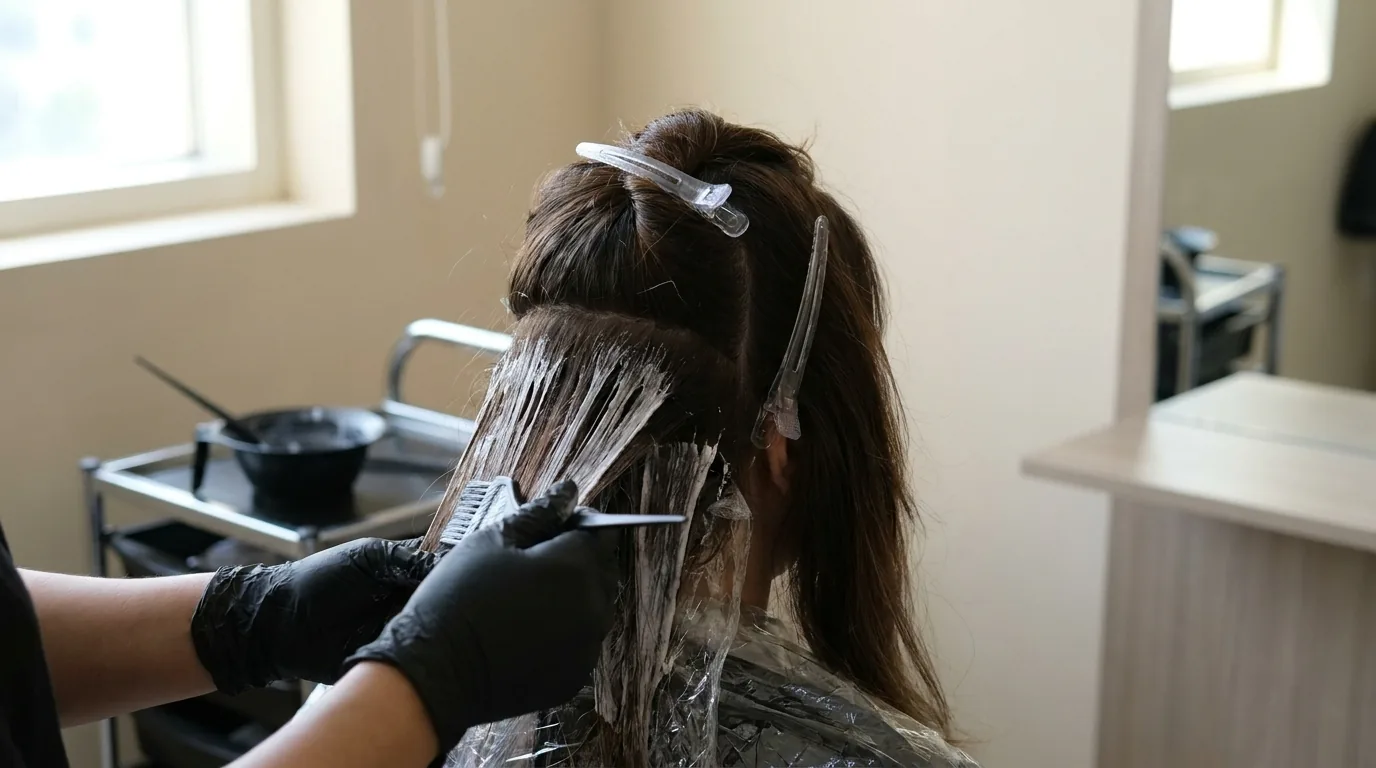
Learning how to do balayage at home is realistic for face-framing pieces and unrealistic for a full head. Front sections sit in your line of sight and take direct hand pressure. The back sections do neither, and the back is where a stripe pattern announces itself.
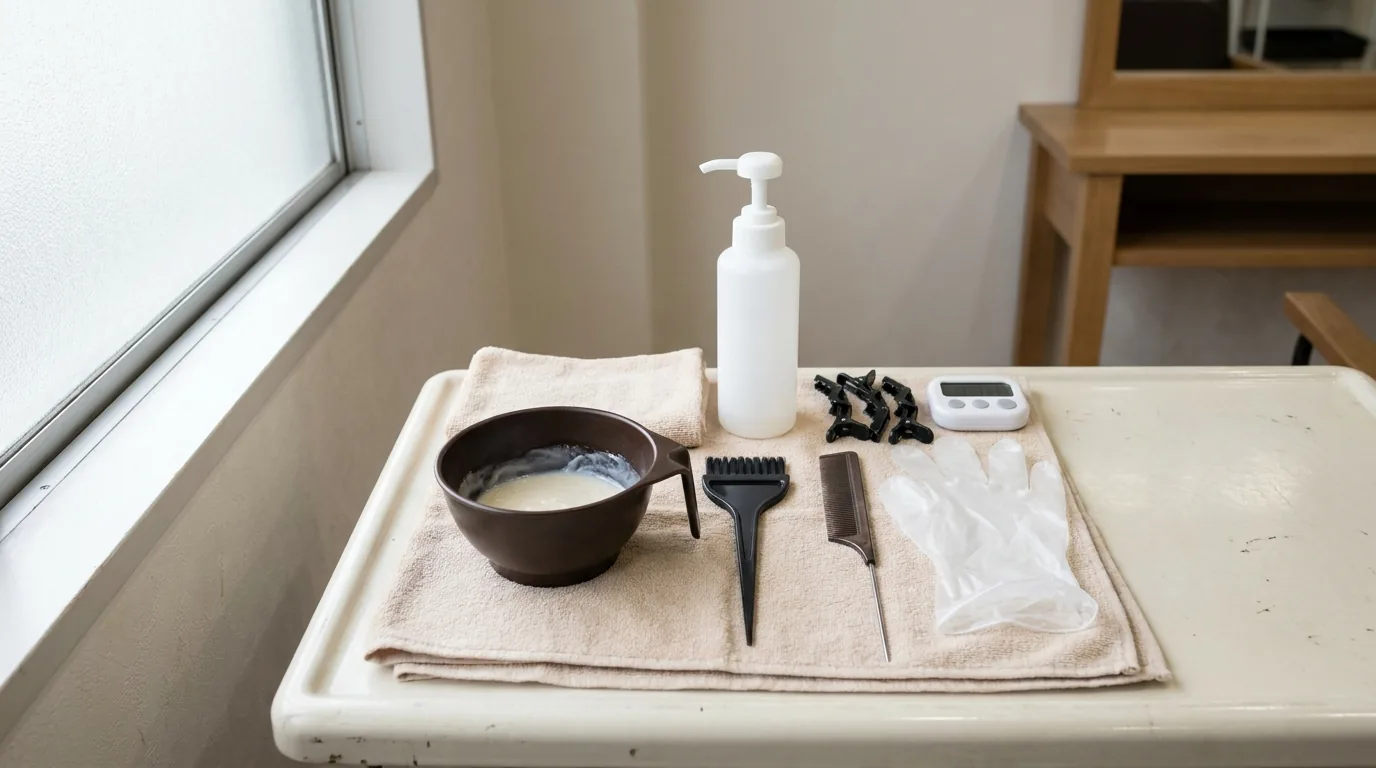
The kit list is short: powder or clay lightener, a cream developer at 20 or 30 volume, a non-metal mixing bowl, a tinting brush, sectioning clips, a tail comb, gloves, a timer, and a toner. Anyone who has followed a guide on how to colour hair at home already owns most of it. A second mirror angled behind you is the addition that changes the outcome.
The workable home method is the ponytail approach: split the hair into four to six loose ponytails, higher at the front and lower at the back, then paint the lengths falling below each band. The bands hold tension and stop product creeping upward. The result is softer and less controlled than a salon service, which is the honest trade for working alone.
Do a strand test on a hidden section at the nape before anything else, and time it. It tells you two things a tutorial cannot: how many minutes your hair needs to reach the stage you want, and whether it lifts evenly at all.
Hair that will not lift predictably
Lightener reacts with what is already on the strand, so hair history matters more than hair type. Four cases regularly go wrong.
- Box dye on the mid-lengths. Permanent box colour builds up over repeat applications and lifts patchy, leaving bands of orange where the old colour sat thickest.
- Henna. Henna coats the strand, and some products sold for hair carry undisclosed dyes and additives, so colourists strand-test henna-treated hair rather than guess at how it behaves under peroxide.
- Previously bleached ends. Painting over hair already lifted twice risks breakage rather than brightness. A bond additive reduces that risk without removing it.
- Very dark virgin hair. Level 2 or 3 to a light blonde needs four or more levels of lift, which is a foilayage or multi-session job.
All four are worth naming out loud at the consultation. Whether the process itself weakens the strand is covered in the guide to whether balayage damages hair.
What Dubai does to a fresh balayage
Lifted hair is porous, and porous hair absorbs whatever it is rinsed in. Dubai municipal water is desalinated and carries dissolved minerals that settle into open cuticles, which is why blonde ends here pull warm faster than the same colour would in a soft-water city. Salons counter it with a chelating or clarifying wash every few weeks.
Pools add a second problem. Chlorine and copper can leave a green or khaki cast on lifted ends, and Dubai swimming runs most of the year. Wetting the hair and coating it in conditioner beforehand gives the strand something to absorb other than pool water. Colourists across Dubai hair salons repeat the same three-part aftercare: a shower filter or clarifying wash, a UV or heat-protectant spray, and a gloss refresh before the tone drifts rather than after.
Sun is the third factor: ten months of strong daylight fade lightened pieces faster than the natural base around them, so the contrast climbs over the season.
Balayage at home versus booking a colourist in Dubai
The two routes differ on cost, time and how much of the result is under your control.
| Factor | At home | Dubai salon |
|---|---|---|
| Cost | AED 60 to 250 for lightener, developer, brush, bowl and toner | AED 350 to 2,800 depending on length, tier and levels of lift |
| Time | Two to four hours, longer working alone | Two to four hours in the chair |
| Reach | Face-framing and front sections | Whole head, back and crown included |
| Correction | A second attempt on already-lifted hair | A multi-session job priced at or above the top of the band |
For balayage at home Dubai adds the water and the sun on top of the usual risks, which shortens the gap between a good result and a brassy one. Readers weighing the two options will find the cost side broken down further across the hair guides on this site. Right now the directory lists 510 Dubai salons offering the service.

Popular hair salons in Dubai
Collective is a hair salon inside the MAG Warehouses complex in Al Quoz Industrial Area 2, rated from reviews. Services cover hair colouring, balayage, hair highlights, hair extensions, keratin treatment, ladies haircuts, blow dry, bridal makeup, manicures, gel pedicures and waxing services. Several reviewers like the modern, classy interior and mention stylists using Dyson equipment for finishing, with one client describing a playful, well judged cut from a stylist who listened closely to the brief. Feedback on colour work is more mixed, with one detailed report describing hair damage and billing disagreements after a balayage and toner service, so it makes sense to agree the full scope and price before any colour treatment begins. The salon has a toilet on site along with wheelchair-accessible parking and entrance.
Version Francaise is a hairdressing salon inside the Marriott Harbour Hotel and Suites in Dubai Marina, offering haircuts, hair colouring, highlights, hair extensions, keratin treatment, blow dry styling, threading, manicures and nail art. It is rated from reviews.Reviewers consistently describe the salon as welcoming, with several returning for years and calling it their regular salon for haircuts and colour treatments. The team is praised for professionalism, attention to detail and a warm welcome from arrival to the end of the appointment.The salon has free Wi-Fi, on-site services, a wheelchair-accessible entrance, car park and toilet, plus gender-neutral toilets. It suits residents and hotel guests in Dubai Marina after a haircut, colour service or hair treatment appointment, with appointments recommended given the salon's loyal following.
Locks By Lou Lou is a hair salon on Al Wasl Road in Jumeirah, rated from reviews. Reviewers consistently praise the colour work, from balayage and highlights to root touch ups, and several mention hair extensions that look natural rather than obviously fitted. Clients also note that stylists take time to understand what they want before starting and explain aftercare so hair stays in good condition afterwards.Beyond colour, the salon offers blow dry, keratin treatment, hair extensions, manicure, gel pedicure, microneedling and anti-aging facial treatments. The entrance is wheelchair accessible and there is an on-site toilet.Appointments are recommended, particularly for colour and extension work, and the salon suits clients looking for an ongoing colourist relationship rather than a single visit.
Version Francaise Pour Elle is a hairdresser and beauty salon on Al Wasl Road, Al Safa 2, rated from reviews. Services span hair colouring, balayage, highlights, extensions, keratin treatment and blow dry, ladies' haircuts, beard trim, manicure, gel nails, gel pedicure, eyelash extensions, anti-aging facials and waxing.Reviewers consistently praise the colour and highlight work, describing meticulous stylists who take the time to understand what a client wants even when it is hard to explain. The salon is also noted for its cleanliness, product quality and reasonable prices, with several reviewers mentioning the owner is regularly on site overseeing the team and the client experience.Free Wi-Fi and parking are available. Suits clients after precise colour work from a team that takes the time to get it right.
Trinity Hair Salon is a hair salon in Al Barsha South, based at Danube Resortz, rated from reviews.Colour work is what reviewers talk about most, with several describing years of trust in the stylists for balayage, highlights and full colour changes, including recovering from a previous bad dye job elsewhere. The salon also offers ladies haircuts, blow dries, hair treatment and a back massage, plus manicures and pedicures. More than one reviewer describes the atmosphere as warm and modern with a good energy, and says they would not trust anyone else with their hair colour.There is a toilet on site, the salon offers on-site services, and a wheelchair-accessible car park makes it an easy stop for residents around Al Barsha South.
What to ask a colourist before the first stroke
A consultation is short. Four questions cover most of what decides the outcome.
- How many levels of lift is my hair realistically getting in one session?
- Is this going open air, foilayage, or on a board, and why that one?
- Is toning included in the quoted price, or billed separately?
- What does the gloss refresh cost, and when should it be booked?
Licensing is the other check. Any salon operating in Dubai holds a DET trade licence from the Department of Economy and Tourism, and a DHA health licence from the Dubai Health Authority applies where a venue’s services cross into health territory. Both are reasonable to ask about at reception, and the criteria this directory uses to rank listings are set out in how we rank salons.
Browse all 167 Hair Salons providers on our directory.


