


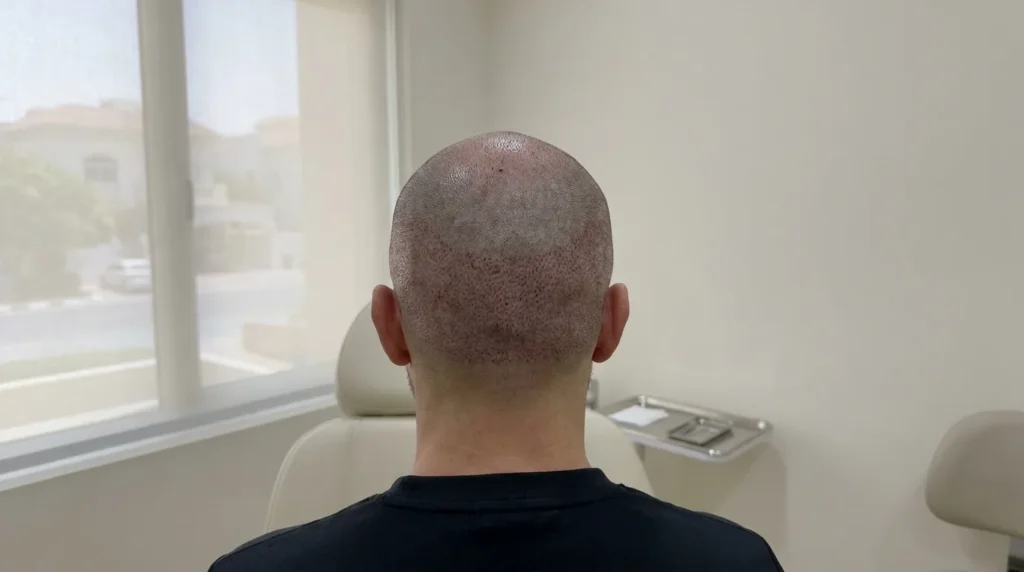
My rule for how to take care after hair transplant surgery is that the first two weeks decide the result. Wash gently from day two or three, sleep propped up, skip the gym, and keep the scalp out of Dubai’s afternoon sun. The graft losses readers write to me about almost always trace back to sweat.
This guide is general information, not medical advice. A hair transplant is a regulated cosmetic-medical procedure in Dubai: follow the written protocol your surgeon gave you, and consult a DHA-licensed clinic about your recovery, suitability and risks.
How to take care after hair transplant surgery: the first 48 hours
The grafts are not anchored yet. For roughly the first two days they sit in shallow incisions held by fibrin and early clotting, which is why almost every hair transplant aftercare protocol treats this window separately.
Three things matter, and none of them is complicated. Keep the recipient area moist with the saline spray your clinic supplies, on the schedule they set. Sleep with your head raised, and do not let anything touch the grafted zone, including a pillow, a towel or your own fingers.
Swelling usually appears on day two or three and travels down toward the forehead and eyes before it settles, which looks alarming and is entirely normal. The donor area at the back tends to feel tight and sore rather than swollen. Your clinic will normally prescribe a short antibiotic course, often three to five days, plus something for pain and swelling.
Sleeping position
Get the after hair transplant sleeping position wrong and you get worse swelling and a pillow pressed into the grafts. Prop your upper body at roughly 35 to 45 degrees for the first three to seven days, using a stack of pillows or a travel neck pillow. Plenty of patients find a recliner easier than a bed for the first few nights, and a dark towel over the pillowcase saves the linen from the light oozing that is expected early on.
Washing hair after hair transplant surgery
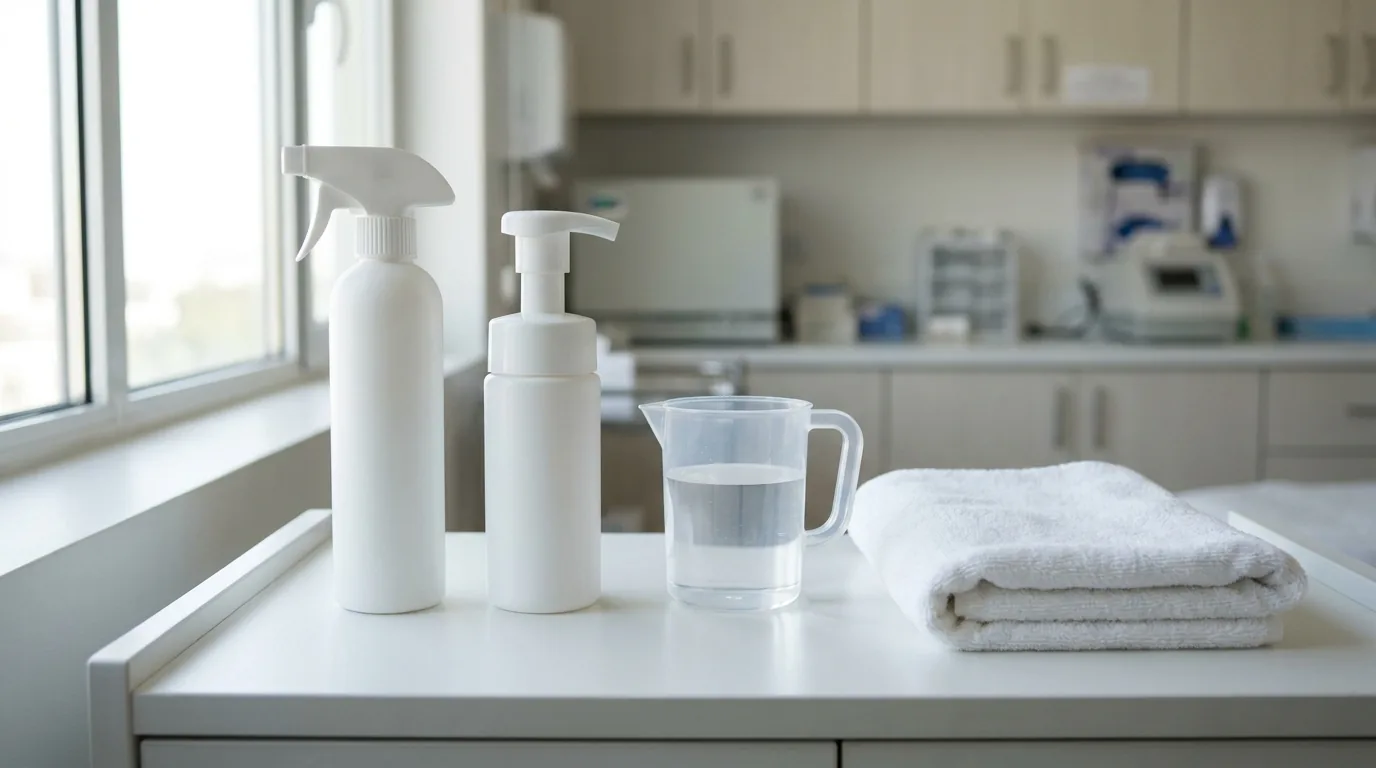
The first wash is the step people fear most, and skipping it is worse than doing it timidly, because crusts left to harden pull on grafts when they finally come off. Most clinics schedule it 24 to 48 hours after surgery and some do it themselves. The routine below is the pattern shared across the clinical guidance we reviewed, and your surgeon’s version wins if it differs.
The short version: soften the crusts with the lotion your clinic supplied, rinse with lukewarm water poured from a cup, lay palm-lathered foam onto the grafts without rubbing, rinse the same way and pat dry. The donor area takes normal gentle fingertip pressure from the first wash. Our full guide to washing hair after a hair transplant covers the shampoo choice, the frequency and the day-by-day timeline.
Expect to keep this routine for about two weeks. Scabs usually clear between seven and ten days, and from roughly day ten to fourteen most clinics allow normal washing and light finger pressure again. Hair dryers on heat, chlorine and salt water stay out of the picture until you are cleared.
One local detail: if your shower runs warm in summer whatever the tap setting, fill a jug and let it cool first. Water arriving at 40 degrees is not lukewarm.
What not to do after a hair transplant
Most of how to take care after hair transplant surgery is a list of things to stop doing. The table sets the common restrictions against the point at which they usually lift, drawn from published clinic protocols. Anything your own surgeon writes down overrides this.
| Avoid | Typical clearance | Why it matters |
|---|---|---|
| Touching, scratching or picking scabs | 10 to 14 days | Physically dislodges grafts before they anchor |
| Gym, running, heavy lifting, anything that makes you sweat | 10 to 14 days, longer for contact sport | Blood pressure spikes and sweat both threaten fresh grafts |
| Swimming pools, the sea, sauna, steam | Around 4 weeks, sauna often 2 months | Chlorine, salt and heat irritate open skin and invite infection |
| Alcohol | 3 to 5 days | Thins blood and worsens early swelling |
| Smoking and vaping | At least 2 weeks | Nicotine narrows vessels and cuts blood flow to healing skin |
| Tight caps, helmets, hoodies pulled over the head | 10 days, then loose only | Friction and pressure on the recipient area |
| Direct sun exposure on the scalp | 2 weeks bare, shade or a loose hat for months after | New skin burns easily and pigments unevenly |
| Haircuts, clippers and dye | Haircut around 3 weeks, colour around 4 | Blades and chemicals reach skin that is still repairing |
The pattern to take from that table is simple: nothing mechanical and nothing sweaty for a fortnight, and nothing chemical for a month.
Two items sit outside the table. Minoxidil is usually paused and resumed about a month after surgery on the clinic’s say so. Oil of any kind, coconut included, waits until your surgeon clears the scalp, because oil traps grit against skin that is still knitting.
Dubai’s heat, sun and dust change the aftercare rules
Generic hair transplant aftercare advice is written for temperate climates. Three local factors compress the margins here, which is why a Dubai recovery needs a stricter reading of the same protocol.
- Sweat arrives faster. A short walk to the car in July does what a light gym session does elsewhere. Salt in the recipient area is an irritant and a contamination risk, so plan errands for early morning or after dark.
- Ultraviolet levels are high for most of the year. Fresh scalp skin burns quickly and can pigment unevenly if it does. The World Health Organization guidance on ultraviolet radiation explains why shade beats sunscreen on skin this new. Use shade or a loose hat rather than SPF in the first two weeks.
- Dust and shamal winds. Fine sand settles on everything, including a scalp with open micro-incisions. Stay indoors on a dusty day, and if you have been out, do your scheduled wash.
Air conditioning cuts the other way. It keeps you cool, which helps, and it dries the scalp out, which does not. Keep the saline spray with you and use it on the schedule you were given.
Hair transplant recovery timeline, week by week
Half of how to take care after hair transplant surgery is simply knowing what is normal, and week three is where readers panic, because that is when the transplanted hair falls out. The shedding is expected. The follicle stays in place below the surface and restarts on its own cycle.
| Stage | What is happening | What to do |
|---|---|---|
| Days 0 to 2 | Grafts unanchored, swelling begins | Saline spray, sleep elevated, no contact before the clinic’s first wash at around 48 hours |
| Days 3 to 7 | Scabs form, swelling peaks then drops | Daily gentle wash routine, rest, no sweating |
| Days 8 to 14 | Scabs lift, redness fades, grafts secure | Normal washing returns around day 10 to 14 |
| Weeks 2 to 4 | Transplanted hairs shed, known as shock loss | Nothing. This is the expected phase |
| Months 2 to 3 | Dormant period, sometimes early sprouting | Resume prescribed treatments if cleared |
| Months 4 to 6 | Visible growth, texture still fine and wispy | Normal cuts and styling, gentle products |
| Months 7 to 12 | Density builds, hair thickens and matures | Judge the hairline result around month 9 to 12 |
| Months 12 to 18 | Crown catches up last | Final assessment, discuss any touch-up |
Read that as a range, not a schedule, because donor quality, graft count and technique all move the dates. The date worth holding on to is the twelve month review, since judging density earlier is how people talk themselves into a second procedure. FUE and FUT follow the same curve; FUT donor sites take longer to settle because the closure is a line rather than dots.
When to call the clinic instead of waiting it out
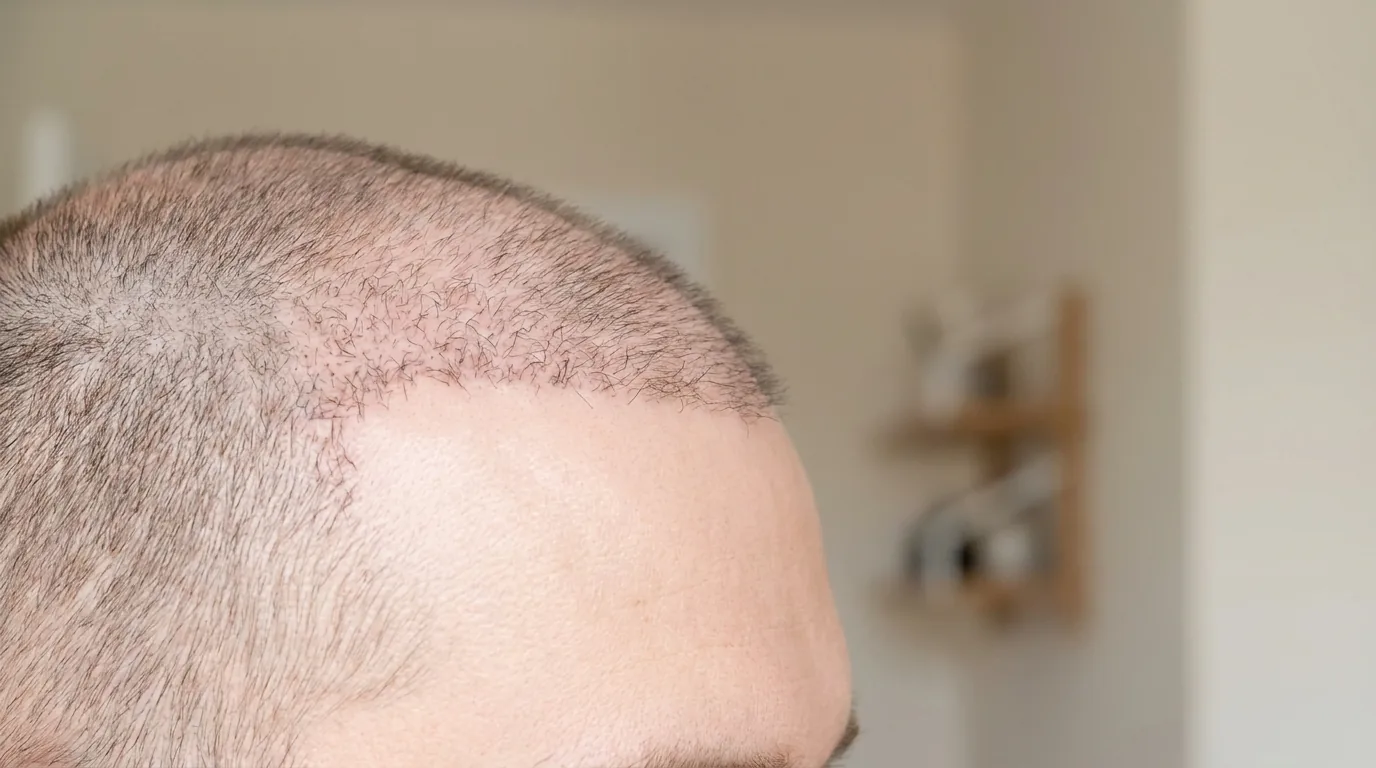
Itching, tightness, small pimples along the hairline and patchy redness are common and usually settle. A handful of signs are not, and they warrant a same-day call rather than a forum search.
- Fever, or spreading heat and redness around the donor area or recipient area.
- Pus, a bad smell, or pain that climbs after day three instead of easing.
- Bleeding that does not stop with ten minutes of light pressure through clean gauze.
- Swelling that reaches the eyes and does not begin easing by day five.
- A graft that comes away with visible tissue attached rather than a dry scab.
The NHS overview of what a hair transplant involves sets out the recognised risks in plain language, which is a useful sanity check when a clinic is slow to answer. It does not replace the surgeon who did the work.
Follow-up care in Dubai when the surgery happened abroad
A large share of Gulf patients fly to Istanbul or Delhi, land back in Dubai within a week, and then find their aftercare plan is a printed sheet and a WhatsApp number in another timezone. Sorting the follow-up before you travel is the cheap fix.
Two licences decide who may legally look at a healing scalp here, and they are not interchangeable. The Dubai Health Authority issues the health licence that covers the clinic as a medical facility and each practitioner inside it. The Department of Economy and Tourism issues the DET trade licence, which registers the business commercially and says nothing about clinical competence. Post-operative review after surgery is medical work, so it belongs with a DHA-licensed clinic or physician, not with a salon that holds a trade licence alone.
Ask your overseas surgeon for the graft count, the technique used, the medication list, photographs and the hair transplant recovery timeline they expect for you, all before you fly home. A Dubai clinic reviewing someone else’s work needs that file, and most will book a paid consultation on it.
Ask too whether the clinic offers PRP therapy as a supportive step, since it is commonly sold alongside transplants; our explainer covers what PRP hair treatment involves and where the evidence sits. For anyone still weighing the procedure itself, the costs, methods and clinic checks are in our guide to hair transplant in Dubai.
If the result is patchy and a second surgery is not on the table, scalp micropigmentation is the usual cosmetic route, and a medicated scalp treatment can help with the flaking and irritation that sometimes lingers. We publish our sourcing and correction rules in full under our editorial standards, and the venues below are drawn from the same directory that lists Dubai’s hair transplant clinics and its wider network of hair salons in Dubai.

Popular hair transplant clinics in Dubai
Vinci Hair Clinic Dubai is a hair transplant clinic in Saba Tower 1, Jumeirah Lake Towers, rated from reviews.Patients consistently describe the FUE and FUT hair transplant process as well managed, with a medical team that explains each step and stays available for questions throughout recovery. PRP therapy follow up sessions and visible growth and density in the months after surgery come up often, along with praise for the pre and post operation support.The clinic also offers pigmentation treatment, liposuction and breast augmentation. Its car park, entrance and toilet are wheelchair accessible, and appointments are recommended.
Yalla Hair Salon specialises in hair replacement and extensions, based at the Movenpick Hotel Apartments on 44th Street in Al Mamzar, Deira. The team works with hair systems, non-surgical hair replacement, clip-in and full extensions, scalp treatment and colour. It is rated from reviews.Reviewers consistently praise how closely the stylists listen to what a client actually wants, and how natural the finished result looks and feels afterwards. Several mention a clean, comfortable salon and appreciate product recommendations suited to their hair type rather than a generic upsell.The salon offers on-site services, gender-neutral toilets and wheelchair-accessible parking. It suits anyone looking for hair replacement or extension work handled with real attention to detail and a proper consultation first.
Tunio Aesthetics Hair Transplant Clinic is a hair transplant and aesthetics clinic in Dubai Healthcare City, rated from reviews. The clinic offers FUE and FUT hair transplant procedures alongside PRP therapy and general skin treatments. Feedback on results has been mixed. While the clinic is established and offers a formal consultation and planning process before any procedure, at least one detailed account describes a result that fell short of what was discussed at consultation. Given that a hair transplant outcome depends heavily on individual planning and technique, it is worth having a thorough, specific consultation and setting clear expectations before committing. On-site services and wheelchair accessible facilities are available. Anyone considering a procedure here should discuss expected results and the planned approach in detail beforehand.
Helia Clinic is a hair transplant and cosmetic clinic in Jumeirah 1, providing FUE and FUT hair transplants alongside eyebrow transplants, pigmentation treatment and PRP therapy. It is rated from reviews.Care from consultation through to aftercare is the theme reviewers return to most, with several praising natural looking eyebrow transplant results tailored to the individual's face shape. The clinic is described as clean and calming, with the medical team noted for explaining each step clearly and keeping the procedure comfortable throughout.The clinic has toilet facilities and full wheelchair access including parking and entrance. A relevant option for anyone researching hair or eyebrow transplant procedures who wants a clear explanation of the process and realistic expectations before committing.
Modern Hair Studio offers advanced hair fixing in the UAE, with proven non-surgical hair replacement solutions designed for natural results and long lasting comfort. With more than 18 years of experience and studios across the GCC and India, its specialists help men and women regain confidence through customised hair systems matched to their face, lifestyle and personal style.
Browse all 28 FUE Hair Transplant providers on our directory.


