



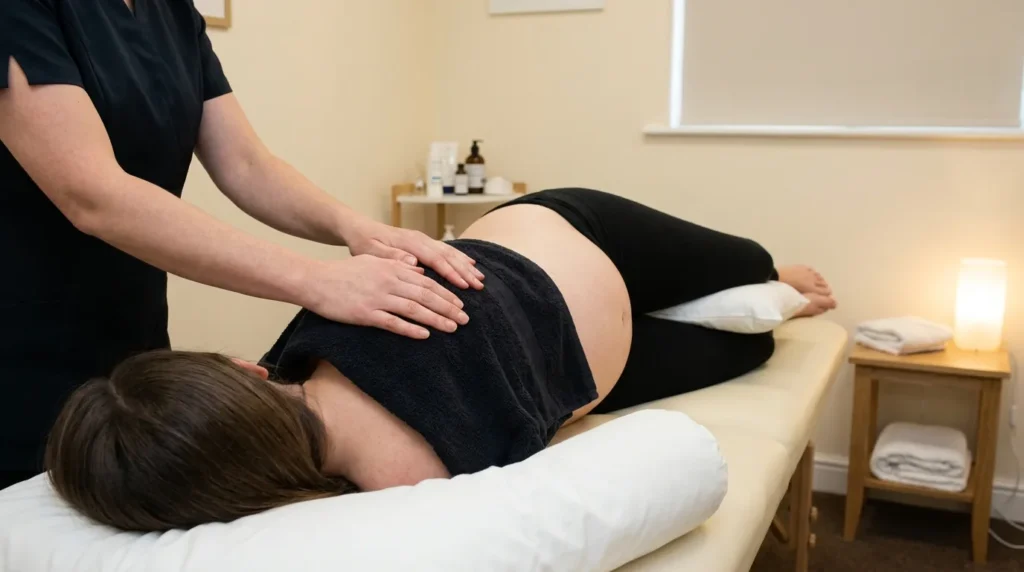
Is prenatal massage safe? In a healthy pregnancy, yes: 12 randomised trials found less back pain, lower anxiety and higher birth weight, with only minor transient side effects. The first trimester is the gap. Every one of those trials started at 12 weeks or later, so the earliest weeks were never actually tested.
This article is general information, not medical advice. Pregnancy is individual, and only the doctor or midwife managing the pregnancy can say whether massage suits a particular case. Anyone with a high risk pregnancy, bleeding, or a condition listed further down should get clearance before booking.
What the trials actually tested
Most prenatal massage guidance comes from spa policy rather than published evidence. The largest evidence summary available is a systematic review in the Journal of Clinical Medicine, which pooled 12 randomised controlled trials of relaxation massage in pregnancy and screened them against PRISMA standards.
The measured prenatal massage benefits were consistent across those trials: reduced stress, less back and leg pain, lower depression and anxiety scores, a stronger immune response, higher serotonin and dopamine levels, higher birth weight in the newborn, and a lower rate of preterm delivery. Two trials also tracked side effects. What they found was tiredness, described as minor and transient. Nothing more serious was attributed to the treatment. Most of these sessions used ordinary Swedish massage technique adapted for a pregnant body, not a specialist protocol.
One detail matters for how the results should be read. Seven of the 12 trials deliberately excluded women with difficult pregnancies or pre-existing complications such as placenta previa, premature labour risk, blood clotting disorders and diabetes. So the finding is narrower than a blanket clearance. It says that relaxation massage is safe for healthy pregnancies, and it says nothing either way about complicated ones.
Why the first trimester rule exists
Almost every spa in Dubai declines a prenatal massage booking before 12 weeks. Read the research behind that rule and something odd shows up: every woman in all 12 trials was at least 12 weeks pregnant when her study started. The first trimester was never tested. The evidence base cannot call it unsafe, because nobody measured it.
The rule is a liability convention. Roughly one in five known pregnancies ends in miscarriage, and the overwhelming majority of those happen in the first trimester, for reasons that have nothing to do with a massage table. A therapist who works on a client at nine weeks and hears about a loss two days later has a problem that no amount of correct technique solves. Declining early bookings removes the coincidence.
Knowing the difference is useful. A reader who understands the rule as risk management rather than as a physiological finding can have a more sensible conversation with their own doctor, who may well clear a first trimester session for a low risk pregnancy. The therapist may still decline, and that is their right.
What changes by trimester
Prenatal massage first trimester
Fatigue and nausea peak here, and the belly is not yet an obstacle. Sessions that do go ahead tend to be short, seated or side-lying, and focused on the neck, shoulders and scalp. Strong scents can worsen nausea, so ask for unscented oil in these weeks.
Second trimester
This is the window most therapists prefer. Energy is usually better, the back has started to complain, and the bump is not yet large enough to make positioning awkward. Lying flat on the back becomes a problem from around 20 weeks, when the weight of the uterus can press on the aorta and the inferior vena cava and reduce blood flow.
Prenatal massage third trimester
Swelling, rib pressure and pelvic pain dominate. Sessions get gentler and positioning does most of the work. Prenatal massage third trimester bookings are common right up to the due date, and the systematic review found no evidence that late pregnancy massage brings labour forward. If anything, the trials pointed the other way, with a lower rate of preterm delivery in the massage groups.
Where not to massage during pregnancy
Guides that answer where not to massage a pregnant woman usually name the same three zones, and the reasoning behind each one differs in strength.
The belly is the clearest. Direct pressure on the abdomen is uncomfortable and serves no purpose, so therapists work around it. The legs come second, and this one is physiological: blood volume rises during pregnancy and circulation in the legs slows, which raises clot risk. Firm deep tissue massage on the calves and thighs could in principle dislodge a clot, so light stroking replaces it.
The third zone is the weakest claim. Certain acupressure points on the wrist, ankle and between the fingers are widely said to trigger contractions. No published evidence supports that. Trials of acupressure in labour point in the opposite direction, associating it with shorter and less painful labour. A cautious therapist will still avoid those points, and there is no cost to that caution, but the belief itself is folklore rather than a finding.
When prenatal massage is not safe
The genuine contraindications are conditions, not techniques. Clearance from the doctor or midwife managing the pregnancy comes first when any of these apply.
| Condition | Why it changes the answer |
|---|---|
| Preeclampsia or high blood pressure | Circulatory load is already abnormal; massage alters blood pressure |
| Blood clots or a clotting disorder | Pressure on the legs carries a dislodgement risk |
| Placenta previa or other placental problems | Bleeding risk; positioning and pressure need medical input |
| Gestational diabetes | Circulation and healing are affected, so providers assess case by case |
| History or current risk of preterm labour | The excluded group in most trials, so the evidence does not cover it |
| Severe swelling of sudden onset | Can signal preeclampsia and needs assessment, not treatment |
None of these is an automatic refusal. Each is a reason to ask your clinician first rather than a booking form. Venues listed across the massage and spa directory vary widely in how strictly they screen for these, which is why the intake conversation matters more than the venue tier.
Side lying, and the table with a hole in it
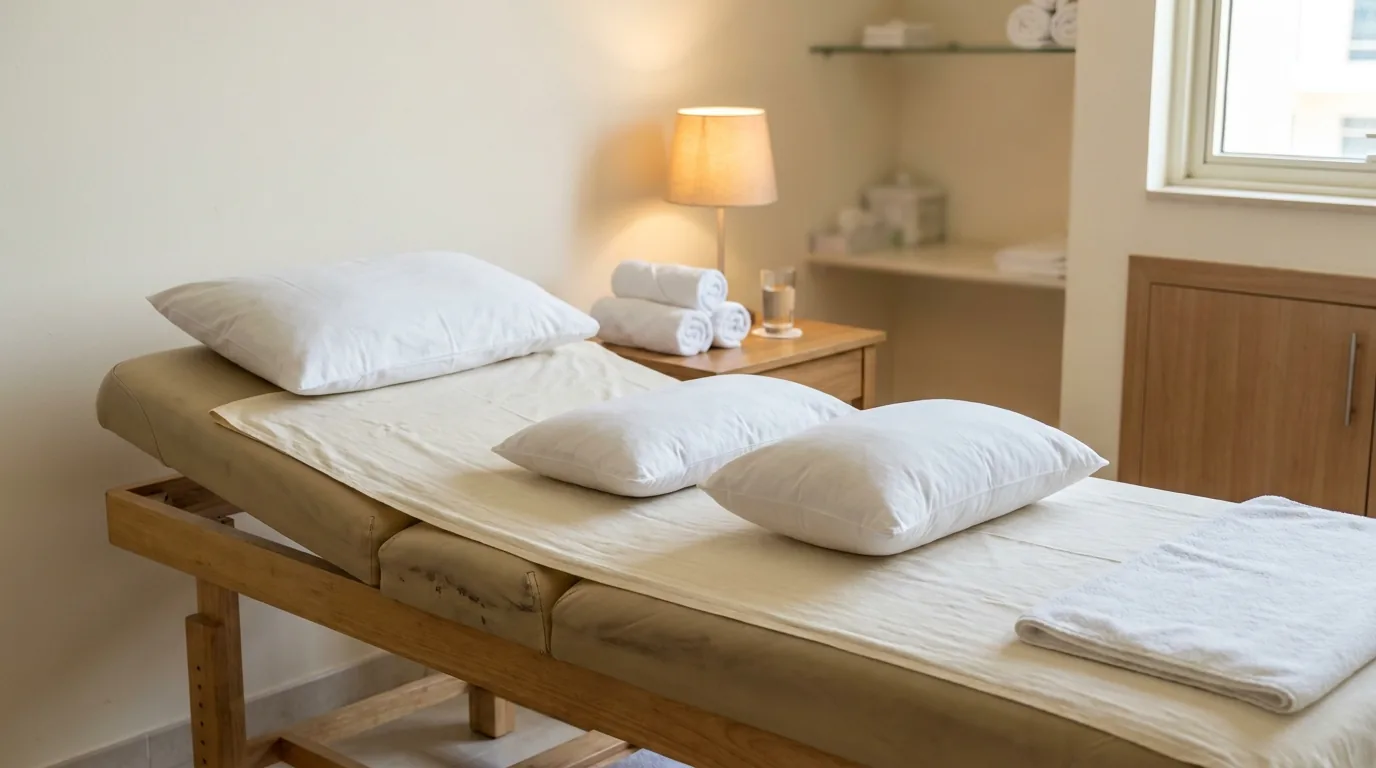
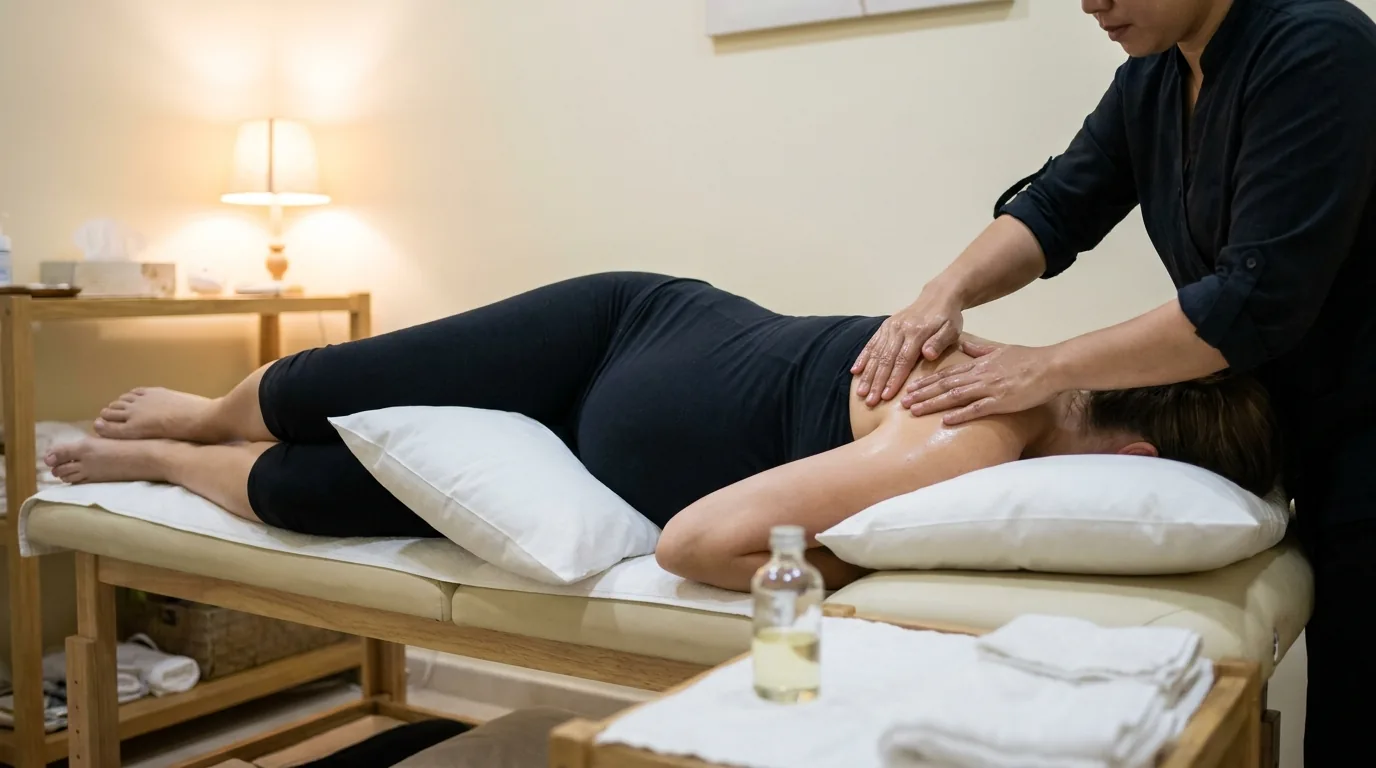
Positioning does more for your safety during a prenatal massage than any product choice. From the second trimester the accepted setup is side-lying, with a firm pillow under your bump, another between your knees and one supporting your top arm. Sitting upright or semi reclined also works. You will not be put flat on your back after around 20 weeks because of the pressure on major blood vessels, and flat on the front is simply uncomfortable.
Some venues advertise a pregnancy table with a cut-out for the belly and present it as the premium option. It is worth understanding what that hardware does. The cut-out lets you lie face down, which feels novel and is often marketed that way, but an unsupported abdomen hanging into a gap puts your lower back into extension and pulls on ligaments already loosened by relaxin. Clinical guidance still treats side-lying as the safest default. A therapist who reaches for support pillows instead of the specialty table is following the evidence, not cutting corners. Practitioners across the Dubai massage market use both, so it is a fair question to ask when booking.
What to ask a Dubai therapist before booking
Every global guide tells you to find a trained prenatal therapist. Few say how to check, and in Dubai you can.
Two licences sit behind a legitimate venue. The Department of Economy and Tourism (DET) issues the trade licence that lets the business operate at all, and the Dubai Health Authority (DHA) licenses health and therapeutic practice, including the individual practitioners working in that capacity. A spa treating pregnant clients should answer questions about both without hesitation. If reception cannot tell you which authority licenses their therapists, treat that as the answer. The directory records DET trade licence status as part of the listing checks described in how salons are ranked.
Four questions separate a prepared venue from an improvising one:
- What specific prenatal training does the therapist assigned to this booking hold?
- Will the session be side-lying with support pillows, or does the venue use a cut-out table?
- What pressure is used on the legs, and does the therapist know why that matters in pregnancy?
- Does the venue want written clearance from the doctor or midwife, and at what stage?
A venue that asks you for clearance before you raise it is generally the safer booking. Across the directory, pregnancy massage is listed as a service by 21 venues in Dubai, which is a small fraction of the 145 massage and spa venues on the site. Specialisation is genuinely narrow here, so it pays to confirm rather than assume.

Popular massage and spa venues in Dubai
On the first floor of Dubai Festival City Mall, Heal Spa runs aromatherapy, deep tissue, hot stone and sports massage alongside couples massage, reflexology, a Moroccan bath and IPL hair removal. It's rated from reviews.Reviewers describe some of the best massages they've had in Dubai here, with the therapists praised for reading pressure correctly and adjusting through the session rather than working to a fixed routine. The space itself comes up as clean and calm, and the team is described as consistently friendly across a large number of reviews.Booking ahead is worth it, and outdoor and on-site services are available. The venue has gender-neutral toilets and wheelchair-accessible parking, entrance, seating and toilet facilities throughout.
Sweet Violet Beauty Salon LLC is a massage spa in Business Bay, at The Prism, rated from reviews. Treatments include deep tissue, Swedish, sports, hot stone and traditional Thai massage, aromatherapy massage, couples massage, therapeutic massage, reflexology, the Moroccan bath, plus threading, eyebrow threading, waxing and facials.Reviewers consistently describe the massage therapists as highly skilled, singling out deep tissue and sports massage for genuinely relieving tension rather than a generic rubdown. Several clients book the team for events and repeat visits, and the overall experience is described as relaxing and professional from start to finish.The salon offers on-site services and wheelchair-accessible parking. Appointments are recommended.
On the HC floor of the Grand Excelsior Hotel on Kuwait Street in Al Mankhool, Lavana Spa Bur Dubai offers Swedish massage, deep tissue massage, Moroccan bath and reflexology, rated from reviews. Swedish massage comes up repeatedly as a highlight, with reviewers describing sessions as deeply relaxing against a calm, soothing atmosphere throughout the spa. Front-desk staff are also praised for recommending the right treatment based on what a client is looking for, rather than defaulting to a standard package. The spa is wheelchair accessible, including parking, entrance and toilet, and appointments are recommended ahead of a visit, opening from 10am. Good for anyone in Al Mankhool after a proper unwind rather than a rushed treatment.
Al Rashaqa Spa is near Lamcy Plaza in Al Karama, rated from reviews for traditional Thai massage, Moroccan bath, hot stone massage, reflexology and aromatherapy treatments. Feedback on the spa is mixed. Some reviewers describe the space as clean with a good, professional massage, while others report a less consistent experience with staff on the day of their visit. Given that spread of feedback, confirming treatment details directly with the spa before booking is a sensible precaution. The venue operates 24 hours and offers on-site services, making it an option outside typical salon hours. Best booked in advance for a specific treatment, given the mixed feedback on consistency, and requesting the same therapist on a return visit is a reasonable way to get a result closer to what you expect.
Touch Life Spa sits inside TIME Oak Hotel & Suites in Barsha Heights, rated from reviews. Reviewers consistently describe a calm, clean and welcoming atmosphere, with attentive, professional staff who take time over every detail. Several guests single out the massage treatments and Turkish hammam for easing tension and back pain, and describe the whole visit as well organised and hygienic from start to finish. The treatment menu runs from deep tissue, hot stone, Swedish and Thai reflexology massage to aromatherapy, back, scalp and sports massage, alongside gel pedicures, manicures and yoga classes. The spa is wheelchair accessible throughout, with an accessible car park, entrance, seating and toilet, and appointments are recommended given its popularity in the Barsha Heights hotel district.
Aftercare in a Gulf summer
Dubai adds two variables that temperate climate guides skip.
The first is fluid balance. Pregnancy already increases fluid retention, and a summer that runs above 40 degrees outdoors while interiors sit at 20 degrees pushes swelling in both directions. Massage moves fluid, so you will be more comfortable if you have drunk steadily through the day rather than topping up in the hour beforehand. Book a morning or late evening slot and you avoid the walk from a car park in peak heat, which ruins more sessions than anything that happens on the treatment couch. Other posts in the massage and spa section cover the same timing logic for other treatments.
The second is heat exposure. Steam rooms, saunas, hot tubs and hot stone work raise core body temperature, which is avoided in pregnancy. Many Dubai spas bundle steam or sauna access with a treatment as standard, so decline that part explicitly at check-in rather than assuming it will be left off your booking. After birth those constraints loosen at different rates, which post natal massage covers separately. Therapists rotate between rooms and shifts, so a written note on your file is what actually travels with you. Ask for one at the first booking, and check it is still there each time you rebook.
Frequently asked questions
Browse all 21 Pregnancy Massage providers on our directory.


