



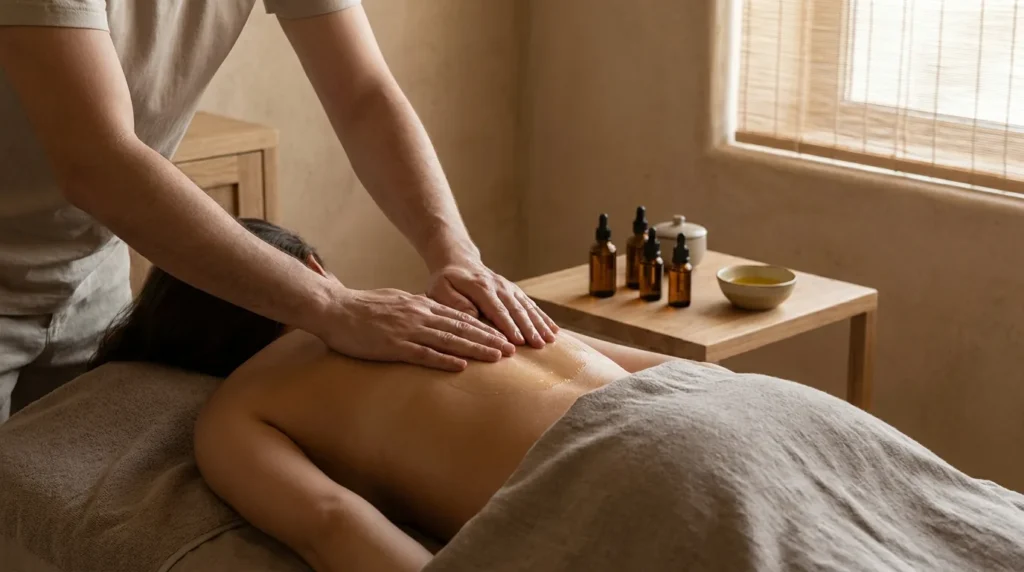
Aromatherapy massage is a light to medium pressure massage in which the therapist blends diluted essential oils into the carrier oil applied to the skin. The oils work along two routes at once: absorption through skin and scent through breath. A full body session in Dubai usually runs 60 to 90 minutes.
The oils are the part most people underestimate. Take them out and the treatment is an ordinary relaxation massage, while leaving them in means the therapist is making a decision before touching anyone: which plant extract suits this person, at what dilution, on which carrier oil.
The directory counts 440 Dubai venues running aromatherapy massage, and the quality of the oil work varies far more between them than the pressure does.

Popular massage and spa venues in Dubai
On the first floor of Dubai Festival City Mall, Heal Spa runs aromatherapy, deep tissue, hot stone and sports massage alongside couples massage, reflexology, a Moroccan bath and IPL hair removal. It's rated from reviews.Reviewers describe some of the best massages they've had in Dubai here, with the therapists praised for reading pressure correctly and adjusting through the session rather than working to a fixed routine. The space itself comes up as clean and calm, and the team is described as consistently friendly across a large number of reviews.Booking ahead is worth it, and outdoor and on-site services are available. The venue has gender-neutral toilets and wheelchair-accessible parking, entrance, seating and toilet facilities throughout.
Sweet Violet Beauty Salon LLC is a massage spa in Business Bay, at The Prism, rated from reviews. Treatments include deep tissue, Swedish, sports, hot stone and traditional Thai massage, aromatherapy massage, couples massage, therapeutic massage, reflexology, the Moroccan bath, plus threading, eyebrow threading, waxing and facials.Reviewers consistently describe the massage therapists as highly skilled, singling out deep tissue and sports massage for genuinely relieving tension rather than a generic rubdown. Several clients book the team for events and repeat visits, and the overall experience is described as relaxing and professional from start to finish.The salon offers on-site services and wheelchair-accessible parking. Appointments are recommended.
On the HC floor of the Grand Excelsior Hotel on Kuwait Street in Al Mankhool, Lavana Spa Bur Dubai offers Swedish massage, deep tissue massage, Moroccan bath and reflexology, rated from reviews. Swedish massage comes up repeatedly as a highlight, with reviewers describing sessions as deeply relaxing against a calm, soothing atmosphere throughout the spa. Front-desk staff are also praised for recommending the right treatment based on what a client is looking for, rather than defaulting to a standard package. The spa is wheelchair accessible, including parking, entrance and toilet, and appointments are recommended ahead of a visit, opening from 10am. Good for anyone in Al Mankhool after a proper unwind rather than a rushed treatment.
Al Rashaqa Spa is near Lamcy Plaza in Al Karama, rated from reviews for traditional Thai massage, Moroccan bath, hot stone massage, reflexology and aromatherapy treatments. Feedback on the spa is mixed. Some reviewers describe the space as clean with a good, professional massage, while others report a less consistent experience with staff on the day of their visit. Given that spread of feedback, confirming treatment details directly with the spa before booking is a sensible precaution. The venue operates 24 hours and offers on-site services, making it an option outside typical salon hours. Best booked in advance for a specific treatment, given the mixed feedback on consistency, and requesting the same therapist on a return visit is a reasonable way to get a result closer to what you expect.
Touch Life Spa sits inside TIME Oak Hotel & Suites in Barsha Heights, rated from reviews. Reviewers consistently describe a calm, clean and welcoming atmosphere, with attentive, professional staff who take time over every detail. Several guests single out the massage treatments and Turkish hammam for easing tension and back pain, and describe the whole visit as well organised and hygienic from start to finish. The treatment menu runs from deep tissue, hot stone, Swedish and Thai reflexology massage to aromatherapy, back, scalp and sports massage, alongside gel pedicures, manicures and yoga classes. The spa is wheelchair accessible throughout, with an accessible car park, entrance, seating and toilet, and appointments are recommended given its popularity in the Barsha Heights hotel district.
What is aromatherapy massage?
It is a massage where essential oils are part of the treatment rather than a scented extra. A therapist selects one or more concentrated plant oils, dilutes them into a neutral carrier oil, and uses that blend for the whole session. The pressure stays gentle to moderate, because the intent is to calm the nervous system rather than work deep into muscle.
Dubai spa menus also list it as aroma massage, aroma oil massage or aromatic massage. The aroma massage meaning is identical in every case: essential oils plus manual massage. Some menus price it as a standalone treatment and some sell it as an oil upgrade on a standard body massage.
Two details separate it from a scented room. The oils touch skin, diluted and deliberately chosen, and a trained therapist, sometimes a qualified aromatherapist, picks the blend against what the client says they want, whether that is sleep, tight shoulders or a flat mood.
How the oils reach you, and which aromatherapy massage benefits hold up
Essential oils enter through two channels during a session. Some compounds pass through skin into surface tissue. The rest is inhalation: the scent travels through the olfactory nerve to brain regions tied to emotion and memory. That second route explains why the effect registers as mood before it registers as muscle.
The evidence sits unevenly across claims. Short term reductions in stress, anxiety and reported pain are the best supported aromatherapy massage benefits, and Cleveland Clinic and the American Massage Therapy Association both describe the research as promising rather than settled. Better sleep and lower reported nausea come up repeatedly in smaller studies, but anything framed as a cure for a diagnosed condition sits outside what the research supports.
A useful way to read a spa menu: treat it as a treatment for how someone feels, not for what a doctor has diagnosed. That framing keeps expectations accurate and still leaves a real benefit on the table, because insomnia and everyday anxiety respond to it more reliably than structural pain does.
Aromatherapy massage vs Swedish massage, deep tissue and hot stone
Most Dubai menus carry four or five body massages, and the differences are easy to blur. The comparison of aromatherapy massage vs Swedish massage is the one people ask about most, and the answer is narrower than expected: aromatherapy massage is usually a Swedish massage with a chosen oil blend running through it.
| Treatment | Pressure | What it is chosen for |
|---|---|---|
| Aromatherapy | Light to medium | Stress, sleep, mood, general tension |
| Swedish | Light to medium | Circulation and whole body relaxation |
| Deep tissue | Firm to strong | Knots, chronic tightness, injury recovery |
| Hot stone | Light, heat led | Deep warmth into stiff muscle |
| Reflexology | Firm, feet only | Targeted point work on feet and hands |
The practical read: pick aromatherapy when the goal is how the week has felt, and pick deep tissue when a specific muscle hurts. Anyone weighing the first two can compare what a Swedish massage actually involves before booking, or browse relaxation massage listings to see which venues treat it as its own service. Oils can also be added to hot stone or deep tissue sessions at many venues, which is why the categories overlap on menus.
Which essential oils get chosen, and for what
A therapist rarely uses one oil alone. Blends of two or three are standard, carried in jojoba, sweet almond or fractionated coconut oil at a low concentration. Undiluted essential oil on skin is a mistake rather than a premium option, whatever a menu implies.
| Oil | Commonly chosen for | Worth knowing |
|---|---|---|
| Lavender | Sleep, general calm | The default in most Dubai spa blends |
| Chamomile | Irritated skin, winding down | Avoid with a ragweed allergy |
| Eucalyptus | Congestion, heavy legs | Strong scent, not for young children |
| Peppermint | Headache, alertness | Can feel cold on skin |
| Bergamot | Low mood | Citrus, raises sun sensitivity |
| Rose | Mood, dry skin | Expensive, often a blend note |
Ask which oils are in the blend rather than accepting the menu name, because a venue that answers precisely is handling its stock properly. The full list of aromatherapy massage listings shows which Dubai venues run it as a named treatment instead of a generic oil massage.
What happens in a Dubai session, start to finish
The sequence is consistent across licensed venues, and it differs from the generic spa description in one respect: oil selection is a real conversation here, not a tray of testers waved past on the way in.
- Consultation. Two or three questions on sleep, stress, pregnancy, allergies and skin sensitivity. This is where a therapist rules oils out.
- Blend selection. The therapist proposes a blend against the stated goal. Most venues let clients smell two options and choose.
- Setup. Undress to comfort, under a towel or sheet. Draping stays in place throughout, and only the area being worked is uncovered.
- The massage. Long flowing strokes, moderate pressure, usually back and shoulders first. An aromatherapy massage full body session covers back, legs, arms, neck, shoulders, scalp and feet.
- Finish. A few minutes lying still, then water. Oil is left on skin deliberately, so the shower comes later.
Two Dubai specifics are worth expecting. Therapists are matched to client gender at almost every licensed venue, and treatment areas are single gender in the majority of spas. Neither is something a visitor needs to request. Both are standard practice, and a venue casual about either is worth leaving.
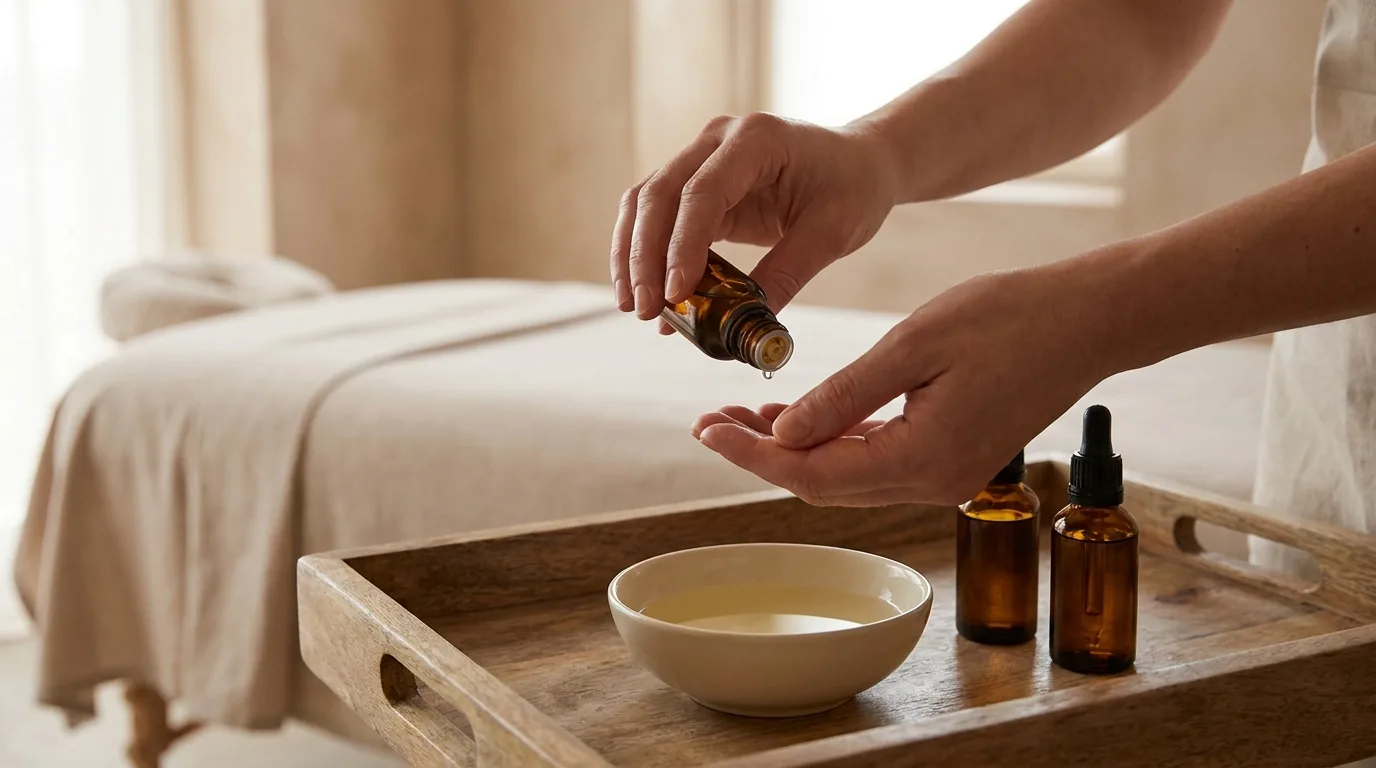
Citrus oils and Dubai sun: the aftercare rule that matters here
This is the one piece of aftercare that changes meaning in the Gulf. Several citrus oils, bergamot above all, contain furocoumarins that raise the skin’s reaction to ultraviolet light. On skin carrying those compounds, sun exposure can produce a burn or a darkened patch at a dose that would normally be harmless.
In a temperate country this is a footnote, but in Dubai, where the UV index runs high for most of the year, it becomes the practical rule. Anyone booking a mid morning session with a citrus blend and walking to a car park afterwards is in the exact scenario the warning describes.
What that means in practice: ask whether the blend contains bergamot, lemon or grapefruit, and if it does, keep treated skin covered or out of direct sun for the rest of the day. Booking late afternoon or evening removes the problem, as does asking for a lavender or chamomile blend instead, which most venues will do without fuss.
The rest of the aftercare is ordinary. Drink water, skip the gym for a few hours, and leave the oil on skin for several hours so absorption finishes, and treat a session booked before a beach day as the one combination to avoid.
Aromatherapy massage side effects, and who should skip it
The treatment is low risk for most adults, and the aromatherapy massage side effects that do appear are usually mild and skin related. Contact irritation, redness or an itchy rash are the common ones, generally caused by too high a concentration or an oil the person reacts to. Headache and nausea happen occasionally, most often from a scent that is simply too strong in a closed room.
A patch test on the inner forearm settles most of this in advance. Any venue that refuses one is telling you something.
Several groups should check before booking rather than after:
- Pregnancy. Several oils are avoided during pregnancy, particularly in the first trimester. Ask for a prenatal trained therapist and clear it with a doctor first. Dedicated pregnancy massage listings show venues set up for it.
- Asthma or respiratory conditions. Concentrated scent in an enclosed treatment room can trigger symptoms.
- Sensitive skin, eczema or known allergies. Chamomile and ragweed cross react, and citrus oils sting broken skin.
- Epilepsy. A small number of oils, including rosemary, are generally avoided.
- Young children. Dilutions differ, and several oils are not used at all.
How to tell a licensed room from an unlicensed one
Aromatherapy massage is a mainstream wellness treatment, and in Dubai it operates inside a clear licensing structure. A legitimate venue holds a Department of Economy and Tourism trade licence covering the business itself. Any venue offering massage as a health or wellness treatment also needs the relevant Dubai Health Authority licensing across the facility and the therapists working in it.
Four signals separate a licensed room from one to walk away from. A displayed trade licence at reception, massage therapists who can name their qualification, gender matched treatment as standard, and a published menu with fixed prices rather than a figure invented at the door. Anyone comparing rates can read what an aromatherapy massage costs across Dubai for the current spread, and how we rank venues sets out what gets checked before a listing appears. More coverage sits in the massage and spa guides, and the wider directory of massage and spa venues in Dubai covers every modality.
Price is the weakest signal of the four. A cheap treatment at a licensed venue is perfectly fine. An expensive one in an unlicensed room is still an unlicensed room.
Booking a citrus blend before a beach day or an outdoor lunch is the one avoidable mistake in this category. Ask for lavender or chamomile if the afternoon involves sun.
Browse all 440 Aromatherapy Massage providers on our directory.


