



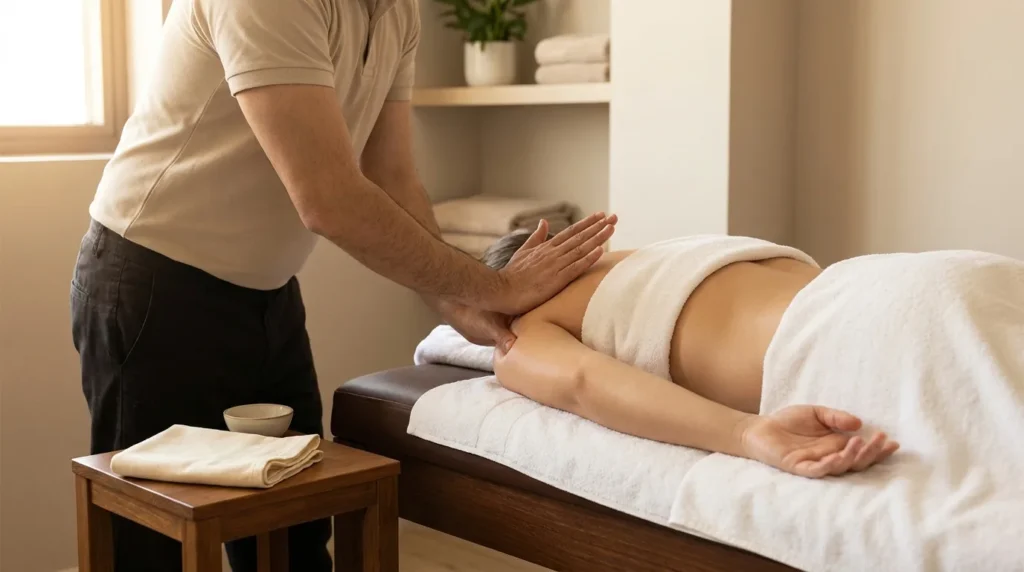
Sustained pressure on a tight muscle produces a dull, spreading soreness, and most people rate it around a five or six out of ten. That reading is normal. Does a deep tissue massage hurt? It aches, and the ache is the working part. Sharp, burning or electric pain is a different signal, and it means the pressure has gone past what the tissue can use.
Is deep tissue massage painful, or just intense?
The technique explains the sensation. A therapist works slowly through muscle and the connective tissue around it, holding pressure on one spot for several seconds instead of gliding across it. Forearms, elbows and knuckles do most of that work, because fingers cannot sustain the load.
Two sensations belong in the room: a dull, spreading ache over a spot that already felt tight, and a stretch or pull as the therapist works along a muscle. Both fade the moment the hands lift. Two others do not belong. Sharp, stabbing or burning pain means the tissue cannot absorb the load. Anything electric, radiating or numb points at a nerve rather than a muscle knot.
| What you feel | What it usually means | What to do |
|---|---|---|
| Dull, spreading ache over a tight spot | Sustained pressure on chronically tight muscle | Stay with it and keep breathing evenly |
| A stretch or pull along the muscle | Connective tissue lengthening under the stroke | Normal, no action needed |
| Sharp, stabbing or burning | More load than the tissue can absorb | Ask for less pressure straight away |
| Electric, radiating or numb | A nerve is involved rather than a muscle | Stop the stroke and name the sensation |
Read the table as a decision tree. The top two rows are the treatment working. The bottom two are reasons to speak up.
Why does a deep tissue massage hurt when the work is going well
Chronically tight muscle carries adhesions, small areas where fibres and the fascia around them have bound together and stopped sliding. Scar tissue behaves the same way. Working through either takes slow force, and force applied to sensitised tissue registers as an ache even when nothing is being damaged.
Inflammation raises the reading further. A muscle overloaded for weeks sits with a lower pain threshold than a fresh one, so the same therapist using the same stroke can produce a five on one shoulder and an eight on the other.
Direction of travel decides it. Pressure that produces a heavy ache and leaves the muscle looser is working. Pressure that produces a wince, then a flinch, then a guarded body is undoing itself. A Swedish massage stays light enough that the question rarely comes up.
The breath test that tells you the pressure is too high
There is a self-check that needs no scale and no vocabulary. While the pressure is on, can you breathe slowly and evenly? If yes, the intensity sits inside the useful band. If you are holding your breath, gripping the table edge, or lifting a shoulder away from the hands, it has passed that band.
Guarding is the mechanism. A muscle under threat contracts to protect itself, and a contracted muscle resists exactly the pressure applied to it. More force meets more resistance, and the tissue underneath never softens. Past a certain point pain stops the treatment working, which is the opposite of the no pain, no gain line the industry inherited from sport.
Skilled therapists watch breathing rather than asking whether the pressure is fine every few minutes, because most clients answer yes out of politeness.
How intense is a deep tissue massage on a 0 to 10 scale
Therapists borrow the 0 to 10 scale hospitals use, where zero is no sensation and ten is the worst pain imaginable. A number removes the guesswork, because firm, strong and gentle mean different things to everyone using them.
The working range sits between five and seven. Below five the pressure glides over the problem instead of into it. At eight the body starts to guard and progress stops. Nine and ten have no place on a massage table. The same numbers work across every modality listed under massage treatments in Dubai.
Say the number at the start rather than waiting to be asked. Work me at a six is a complete instruction, and it gives you a word to change the pressure with later.
Where deep tissue massage hurts most, by body area
Intensity is not spread evenly. Some areas carry thinner muscle cover, denser connective tissue, or a nerve close to the surface, and read higher for identical pressure.
| Body area | Typical intensity | Why it reads that way |
|---|---|---|
| Upper trapezius and neck | High | Desk posture keeps it loaded, and the muscle is thin over bone |
| Glutes and hip rotators | High | Deep muscle needs heavy force to reach, with the sciatic nerve beneath |
| Outer thigh and IT band | High | Dense connective tissue with very little give |
| Calves | Moderate to high | Compact muscle that is sensitive to a sustained hold |
| Lower back | Moderate | Responds to slow work; anything sharp here is a stop signal |
| Between the shoulder blades | Moderate | A common knot site, and usually the classic good hurt |
| Arms, hands and feet | Low to moderate | Small muscles that release quickly |
Asking how intense is a deep tissue massage without naming the area produces a useless answer. A six across the shoulders and a six down the calves are different experiences, and a therapist who adjusts between them is reading the body rather than running a script. Venues listed under deep tissue massage in Dubai vary in how much of that they do.
What to say when the pressure crosses the line
One sentence covers most of it: that is too much, please ease off. Therapists prefer hearing it, because working on a silent client means guessing, and guessing produces either a wasted session or a bruised one.
Dubai adds a language layer that global guides skip. Therapists here train in Thailand, the Philippines, India, Nepal and China, and English is a second or third language on both sides of many conversations. Numbers cross that gap where adjectives do not. Six and four land cleanly; a bit much does not.
Agree a signal before the session starts. A raised hand means pause, and it works when vocabulary fails or you are face down in a cradle.
Hotel spas and standalone venues in Dubai often use the same menu word for very different pressure. Ask what the therapist means by deep tissue when you book, then confirm your number on the table, because the person who took the booking is rarely the person doing the treatment.
Does deep tissue massage hurt the next day
Often, yes. Mild soreness for 24 to 48 hours is the normal pattern, much like the ache after an unfamiliar workout: dull, diffuse, worse on the first few movements, and settling on its own. The recognised side effects of deep tissue massage are all short-lived, covering soreness, tiredness, a mild headache and occasional light bruising.
Three things fall outside that pattern: soreness that sharpens rather than fades over 48 hours, bruising in more than one small spot, and pain still climbing at the 72 hour mark. Water, gentle movement and warmth handle the ordinary version, and the first 72 hours after a deep tissue massage matter more than most people expect.
Next-day soreness doubles as a dose reading. Three days of struggling to turn your head means the next booking should start two numbers lower.
When firm pressure is the wrong call entirely
Some conditions make heavy pressure a poor idea however the session feels. Anyone asking who should not get a deep tissue massage wants this list.
- A known or suspected blood clot, including deep vein thrombosis
- Blood-thinning medication, which raises bruising and bleeding risk
- Osteoporosis or any condition that weakens bone
- Recent surgery, fractures, open wounds or burns in the area
- Active infection, fever, or inflamed and hot skin
- Cancer, unless the treating oncology team has cleared it
- A fibromyalgia flare, where lighter work is usually tolerated better
- Pregnancy, where a trained prenatal therapist and a different technique apply
The US National Center for Complementary and Integrative Health notes that serious injury from massage is rare and usually linked to forceful technique on someone with an underlying condition. That is the pattern to avoid: the side effects of deep tissue massage escalate when heavy pressure meets a body nobody screened. A therapist who takes no health history has skipped the step that matters.
How to prepare for your first deep tissue massage
A first session almost always registers higher than a fourth. Unfamiliar sensation, unworked tissue, and a nervous system that does not know what is coming all add to the reading.
- Drink water through the day, since dehydrated muscle is less forgiving under pressure.
- Eat something light one to two hours ahead rather than a heavy meal.
- Arrive ten minutes early so the session does not start on a rushed heart rate.
- Name your two or three problem areas and what you want from the session.
- Give a number from the 0 to 10 scale, and agree the pause signal.
- Keep heavy training off the same day, in either direction.
Warmth beats most preparation advice. A hot shower before you leave, or ten minutes in a steam room, raises tissue temperature and makes identical pressure feel lower. Several massage and spa venues include steam access before a treatment.
Does the pain mean it is working? What the trials show
Pain is not the mechanism, and the research does not treat it as one. A randomised trial of 59 patients with chronic low back pain ran two weeks of deep tissue massage and recorded average pain scores falling from 58 to 42 on a 100-point scale, with disability and function scores improving alongside. Adding anti-inflammatory medication produced no significant extra benefit.
A meta-analysis pooling 11 randomised trials and 504 participants found massage reduced muscle soreness at 24, 48 and 72 hours after strenuous exercise, and improved measured muscle force. Neither body of work ties results to how much the session hurt.
Frequency, therapist skill and whether the client stays relaxed are the variables that move outcomes. That last one is the practical argument against pushing through, since a guarded body wastes the session it is paying for. The wider case, including range of motion and chronic pain, sits in the evidence on deep tissue massage benefits.
Finding a Dubai therapist who works deep without hurting you
Two licences decide whether a venue can offer this at all. One is commercial: Dubai’s Department of Economy and Tourism (DET) issues the trade licence a spa needs to open its doors. The other is clinical: once a treatment is presented as therapeutic, the Dubai Health Authority (DHA) licenses both the premises and the practitioner delivering the work.
Three questions separate a trained pair of hands from a heavy one. Ask what they mean by deep tissue, and an answer describing slow, layered pressure beats one describing how hard they press. Ask how they check pressure mid-session, where watching breathing is the answer you want. Ask what they do when a client reports sharp pain, because stopping the stroke is the only correct response. How every listing is screened is set out in the directory’s screening process.
Sessions start around AED 250 at neighbourhood venues, sit near AED 280 to AED 450 at mid-range spas, and pass AED 800 at hotel spas and clinics. salonsindubai.ae has 470 Dubai venues with deep tissue massage on the menu, and what you pay says far less about the outcome than whether the therapist reads your breathing. More on the category sits in the massage and spa guides.
Browse all 59 mid-tier Massage Spas providers on our directory.

Popular massage and spa venues in Dubai
On the first floor of Dubai Festival City Mall, Heal Spa runs aromatherapy, deep tissue, hot stone and sports massage alongside couples massage, reflexology, a Moroccan bath and IPL hair removal. It's rated from reviews.Reviewers describe some of the best massages they've had in Dubai here, with the therapists praised for reading pressure correctly and adjusting through the session rather than working to a fixed routine. The space itself comes up as clean and calm, and the team is described as consistently friendly across a large number of reviews.Booking ahead is worth it, and outdoor and on-site services are available. The venue has gender-neutral toilets and wheelchair-accessible parking, entrance, seating and toilet facilities throughout.
Sweet Violet Beauty Salon LLC is a massage spa in Business Bay, at The Prism, rated from reviews. Treatments include deep tissue, Swedish, sports, hot stone and traditional Thai massage, aromatherapy massage, couples massage, therapeutic massage, reflexology, the Moroccan bath, plus threading, eyebrow threading, waxing and facials.Reviewers consistently describe the massage therapists as highly skilled, singling out deep tissue and sports massage for genuinely relieving tension rather than a generic rubdown. Several clients book the team for events and repeat visits, and the overall experience is described as relaxing and professional from start to finish.The salon offers on-site services and wheelchair-accessible parking. Appointments are recommended.
On the HC floor of the Grand Excelsior Hotel on Kuwait Street in Al Mankhool, Lavana Spa Bur Dubai offers Swedish massage, deep tissue massage, Moroccan bath and reflexology, rated from reviews. Swedish massage comes up repeatedly as a highlight, with reviewers describing sessions as deeply relaxing against a calm, soothing atmosphere throughout the spa. Front-desk staff are also praised for recommending the right treatment based on what a client is looking for, rather than defaulting to a standard package. The spa is wheelchair accessible, including parking, entrance and toilet, and appointments are recommended ahead of a visit, opening from 10am. Good for anyone in Al Mankhool after a proper unwind rather than a rushed treatment.
Al Rashaqa Spa is near Lamcy Plaza in Al Karama, rated from reviews for traditional Thai massage, Moroccan bath, hot stone massage, reflexology and aromatherapy treatments. Feedback on the spa is mixed. Some reviewers describe the space as clean with a good, professional massage, while others report a less consistent experience with staff on the day of their visit. Given that spread of feedback, confirming treatment details directly with the spa before booking is a sensible precaution. The venue operates 24 hours and offers on-site services, making it an option outside typical salon hours. Best booked in advance for a specific treatment, given the mixed feedback on consistency, and requesting the same therapist on a return visit is a reasonable way to get a result closer to what you expect.
Touch Life Spa sits inside TIME Oak Hotel & Suites in Barsha Heights, rated from reviews. Reviewers consistently describe a calm, clean and welcoming atmosphere, with attentive, professional staff who take time over every detail. Several guests single out the massage treatments and Turkish hammam for easing tension and back pain, and describe the whole visit as well organised and hygienic from start to finish. The treatment menu runs from deep tissue, hot stone, Swedish and Thai reflexology massage to aromatherapy, back, scalp and sports massage, alongside gel pedicures, manicures and yoga classes. The spa is wheelchair accessible throughout, with an accessible car park, entrance, seating and toilet, and appointments are recommended given its popularity in the Barsha Heights hotel district.


