



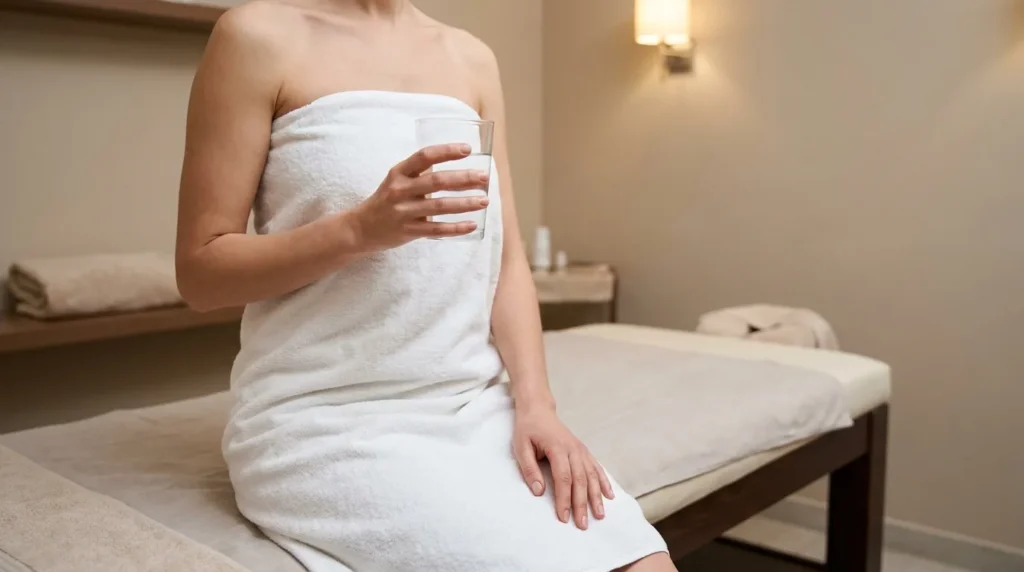
What to do after a deep tissue massage comes down to three things in the first 24 hours: drink more water than usual, keep moving gently, and skip the gym. Soreness for one to two days is normal. In Dubai’s heat, the hydration part matters more than the guides written for cooler climates suggest.
What to do after a deep tissue massage in the first two hours
The two hours straight after the table are the ones people get wrong. Sustained pressure has just been applied to muscle and connective tissue, circulation to those areas has increased, and blood pressure often dips slightly. Standing up fast and heading into traffic is the wrong move.
Sit up slowly and take a few minutes in the room before getting dressed. Drink the water the therapist offers, then drink more in the car. Eat something light if the session ran through a mealtime: low blood sugar and a post-massage pressure drop together are what make people feel woozy in the lift.
Keep the rest of the day light. A therapist working deep enough to reach the inner layers has created a small amount of controlled tissue stress, and the body treats that the way it treats a moderate workout. How long should you rest after a deep tissue massage is a fair question with a short answer: the remainder of that day, and 24 hours before anything strenuous.
Book the last appointment of your day rather than the middle one. A deep tissue session followed by three hours in an office chair undoes much of the work, and Dubai traffic between 5pm and 8pm turns a relaxed drive home into a tense one.
What to expect after a deep tissue massage, hour by hour
Most guides give an unordered list of tips. What people want is a clock, because the question underneath is always the same: is this normal, and when does it stop? What to expect after a deep tissue massage follows a fairly predictable curve.
| Window | What is normal | What to do |
|---|---|---|
| 0 to 2 hours | Loose, slightly heavy limbs, mild light-headedness, warmth in the worked areas | Sit up slowly, water, light food, no driving straight away if you feel woozy |
| 2 to 12 hours | Deep ache building, similar to the day after a hard session at the gym | Warm shower, gentle walk, keep drinking, a full night of sleep |
| 12 to 48 hours | Peak soreness, stiffness on waking, occasional light bruising | Gentle movement, heat on stiff areas, a cold pack on anything hot or puffy, no heavy training |
| 48 to 72 hours | Soreness fading, range of movement noticeably better than before | Return to normal training, stretch the areas that were worked |
Soreness peaking around the second morning rather than immediately is the pattern to expect, and it mirrors delayed onset muscle soreness after unfamiliar exercise. A much longer curve means the session went deeper than the tissue was ready for, which is worth saying out loud next time. Venues across the deep tissue massage listings in Dubai vary in how firmly their therapists work by default.
What should you not do after a deep tissue massage
The avoid list is shorter than the internet suggests, and only a few items on it are genuinely evidence-led. What should you not do after a deep tissue massage divides into things that slow recovery and things that simply waste the session.
| Avoid | For how long | Why |
|---|---|---|
| Heavy training, lifting, hard cardio | 24 hours | Loads tissue that is already recovering and brings the soreness back for longer |
| Alcohol | Rest of the day | Works against rehydration when fluid balance is already shifted |
| Very hot baths, sauna, steam | A few hours | Adds heat and fluid loss on top of tissue that is already inflamed |
| Long sitting in one position | Rest of the day | Tightness returns fastest in the position that caused it |
| A second deep session | At least a week | Tissue needs the recovery window to adapt rather than accumulate stress |
Nothing on that list is permanent, and none of it requires buying anything. Notice what is not on it: stretching helps, a warm shower is fine, and a slow walk beats lying still all evening. Browsing the massage and spa directory for a venue that runs late is more useful than any recovery product.
Rehydrating in a Dubai summer takes more than a glass of water
Every aftercare guide says drink water. Almost all of them are written for climates where a person starts the day already hydrated. In Dubai between May and September, most people do not, and the standard advice is calibrated too low.
Two things stack here. Heat pulls fluid out on the walk from the car park to the spa door, and indoor air conditioning is dry enough to keep pulling it out all day. A person leaving a session at 8pm in August has usually been in fluid deficit since lunchtime. Our other massage and spa guides return to this point, because it is the one piece of aftercare the climate genuinely changes.
Practical version: drink through the evening rather than downing half a litre in the car, and include electrolytes if the session was long or you trained that morning. Laban, a sports drink, or a pinch of salt in water all work. Plain water alone, in volume, on a depleted system mostly ends up as trips to the bathroom.
What to do the day after a deep tissue massage
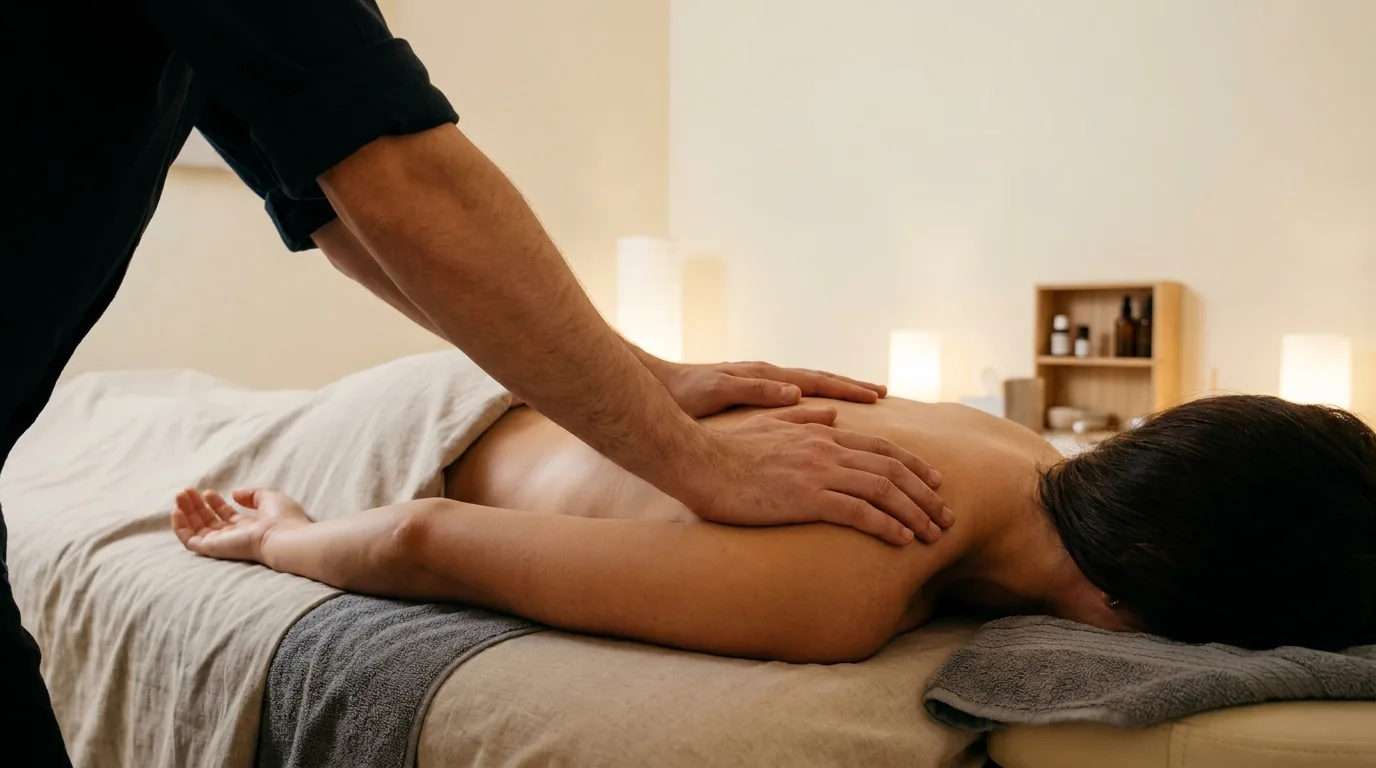
Day two is when most of the value is either kept or lost, and it gets almost no coverage. What to do the day after a deep tissue massage is mostly about movement quality rather than rest.
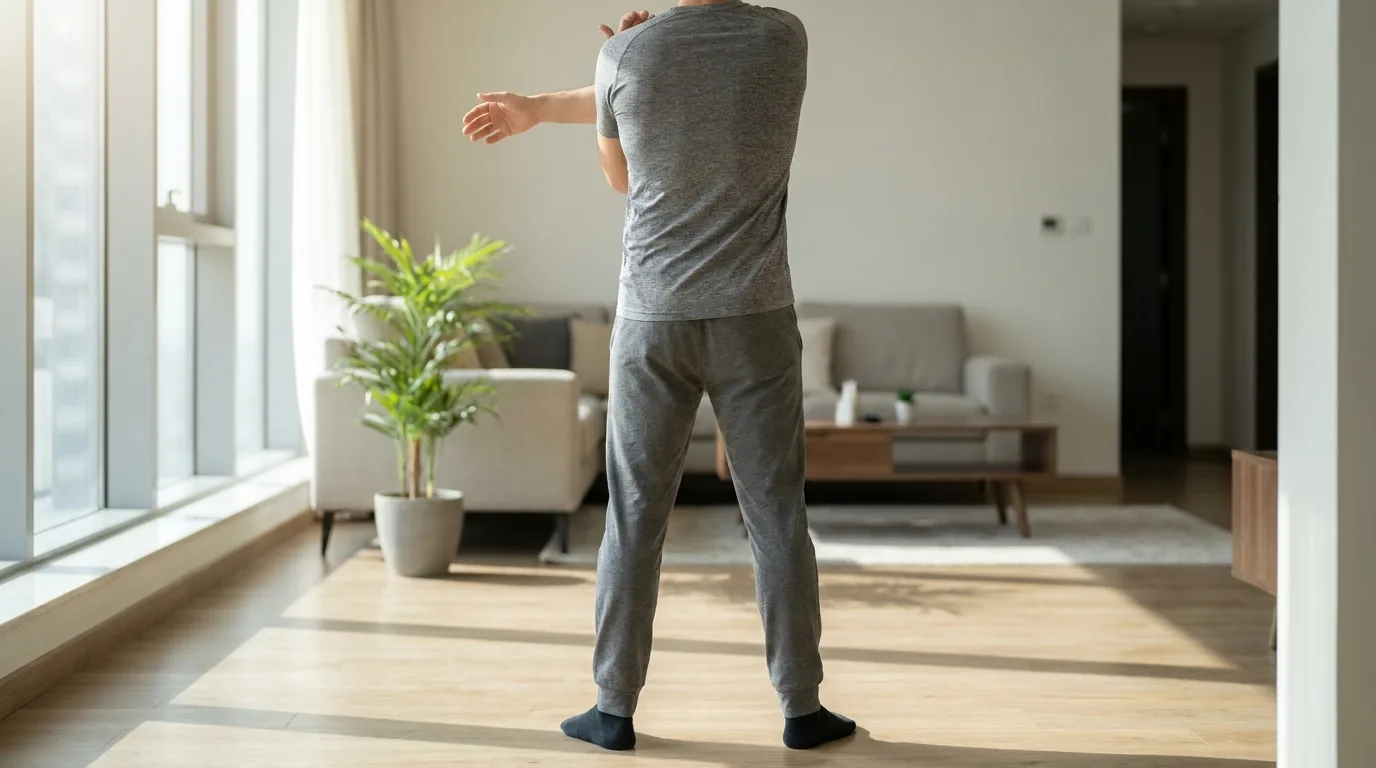
Move early. Ten minutes of walking before the working day, even indoors along a mall corridor, resets the tissue that stiffened overnight. Then stretch the areas that were worked, holding each position long enough to feel it release rather than bouncing. The same principle applies after a sports massage, and athletes tend to be better at this part than office workers.
Keep the water going for a second day and eat normally, including protein, since the tissue is repairing. Return to training at roughly 70 percent of usual load, and treat sharp pain during that session as a reason to stop.
Soreness, bruising, and the signs that are not normal
Dull, spread-out ache across the worked area is the expected outcome. It should be improving by the second evening and largely gone by the third day. Anything fitting that description needs no action beyond the basics above.
Bruising after deep tissue massage happens, and it is more common in people who bruise easily, who take blood thinners, or whose therapist worked harder than the tissue was ready for. A few small marks that fade over a week are unremarkable. Widespread bruising means the pressure was too high, and the fix is to say so at the next booking. The massage therapists listed across Dubai differ in how they calibrate pressure, and a good one adjusts on feedback.
A short list justifies a call to a doctor rather than a therapist: pain that is sharp, localised, and worsening after 48 hours; numbness, tingling, or weakness in a limb; swelling or heat in one calf; fever.
In Dubai, clinical care sits with a clinician holding a Dubai Health Authority professional licence, while the spa or salon itself operates on a Department of Economy and Tourism trade licence. Any venue offering medical grade treatment holds a DHA health licence on top of that. A massage therapist is not the person to diagnose a swollen, warm calf.
Heat, steam, and the hammam question
This one is specific to the region and comes up constantly. Spa packages in Dubai routinely pair a massage with a hammam, a steam room, a sauna, or a pool session, and the order matters more than most booking pages let on.
Heat before deep tissue work is useful: it warms the tissue, so a therapist reaches the deeper layers with less discomfort. Heat straight after is the version to avoid for the first few hours, because it adds fluid loss on top of the inflammation already there. If a package puts the hammam last, ask to swap the order. The same logic applies after a Swedish massage, though the effect is milder.
A warm shower is a different thing from a sauna and is fine the same evening. Beach and pool sun the same afternoon is worth skipping in summer, purely on the fluid maths.
What the toxin story gets wrong
Almost every aftercare article repeats a version of the same claim: massage releases toxins, and water flushes them out. It is a tidy story and it is not what happens. No specific toxin has been identified, measured, or cleared in this way, and the phrase mostly survives because it makes the water advice easy to remember.
What actually happens is less dramatic and more useful. Sustained pressure on muscle and fascia shifts fluid between tissue compartments and increases local circulation. The soreness afterwards resembles the response to unfamiliar exercise, which is why it peaks on the second day and fades on the third. Water helps because you are genuinely low on fluid, not because you are detoxing.
Correcting this rather than repeating it is part of the same standard behind how we rank salons. The evidence review on massage therapy shows what the research does and does not support. The practical difference: if a therapist tells you severe soreness is toxins leaving the body, treat it as a sign the pressure was too high.

Popular massage and spa venues in Dubai
On the first floor of Dubai Festival City Mall, Heal Spa runs aromatherapy, deep tissue, hot stone and sports massage alongside couples massage, reflexology, a Moroccan bath and IPL hair removal. It's rated from reviews.Reviewers describe some of the best massages they've had in Dubai here, with the therapists praised for reading pressure correctly and adjusting through the session rather than working to a fixed routine. The space itself comes up as clean and calm, and the team is described as consistently friendly across a large number of reviews.Booking ahead is worth it, and outdoor and on-site services are available. The venue has gender-neutral toilets and wheelchair-accessible parking, entrance, seating and toilet facilities throughout.
Sweet Violet Beauty Salon LLC is a massage spa in Business Bay, at The Prism, rated from reviews. Treatments include deep tissue, Swedish, sports, hot stone and traditional Thai massage, aromatherapy massage, couples massage, therapeutic massage, reflexology, the Moroccan bath, plus threading, eyebrow threading, waxing and facials.Reviewers consistently describe the massage therapists as highly skilled, singling out deep tissue and sports massage for genuinely relieving tension rather than a generic rubdown. Several clients book the team for events and repeat visits, and the overall experience is described as relaxing and professional from start to finish.The salon offers on-site services and wheelchair-accessible parking. Appointments are recommended.
On the HC floor of the Grand Excelsior Hotel on Kuwait Street in Al Mankhool, Lavana Spa Bur Dubai offers Swedish massage, deep tissue massage, Moroccan bath and reflexology, rated from reviews. Swedish massage comes up repeatedly as a highlight, with reviewers describing sessions as deeply relaxing against a calm, soothing atmosphere throughout the spa. Front-desk staff are also praised for recommending the right treatment based on what a client is looking for, rather than defaulting to a standard package. The spa is wheelchair accessible, including parking, entrance and toilet, and appointments are recommended ahead of a visit, opening from 10am. Good for anyone in Al Mankhool after a proper unwind rather than a rushed treatment.
Al Rashaqa Spa is near Lamcy Plaza in Al Karama, rated from reviews for traditional Thai massage, Moroccan bath, hot stone massage, reflexology and aromatherapy treatments. Feedback on the spa is mixed. Some reviewers describe the space as clean with a good, professional massage, while others report a less consistent experience with staff on the day of their visit. Given that spread of feedback, confirming treatment details directly with the spa before booking is a sensible precaution. The venue operates 24 hours and offers on-site services, making it an option outside typical salon hours. Best booked in advance for a specific treatment, given the mixed feedback on consistency, and requesting the same therapist on a return visit is a reasonable way to get a result closer to what you expect.
Touch Life Spa sits inside TIME Oak Hotel & Suites in Barsha Heights, rated from reviews. Reviewers consistently describe a calm, clean and welcoming atmosphere, with attentive, professional staff who take time over every detail. Several guests single out the massage treatments and Turkish hammam for easing tension and back pain, and describe the whole visit as well organised and hygienic from start to finish. The treatment menu runs from deep tissue, hot stone, Swedish and Thai reflexology massage to aromatherapy, back, scalp and sports massage, alongside gel pedicures, manicures and yoga classes. The spa is wheelchair accessible throughout, with an accessible car park, entrance, seating and toilet, and appointments are recommended given its popularity in the Barsha Heights hotel district.
When to book the next session
The aftercare window and the booking interval are connected. If soreness clears inside 48 hours and the looseness lasts a week or more, the pressure and the spacing are both right. If the ache is still there on day four, the next session should be later and lighter.
For most people working through chronic tension, every two to four weeks is a sensible rhythm, tightening during a flare-up and widening once things settle. The full breakdown sits in our guide to how often to book deep tissue work. A 60 minute session in Dubai runs roughly AED 250 to AED 800 by venue tier, so the interval has a budget consequence too.
Salons in Dubai lists 145 massage and spa venues across the city, which is enough range to move to a therapist who works at a pressure that suits you rather than tolerating one who does not.Browse all 145 Massage Spas providers on our directory.


