



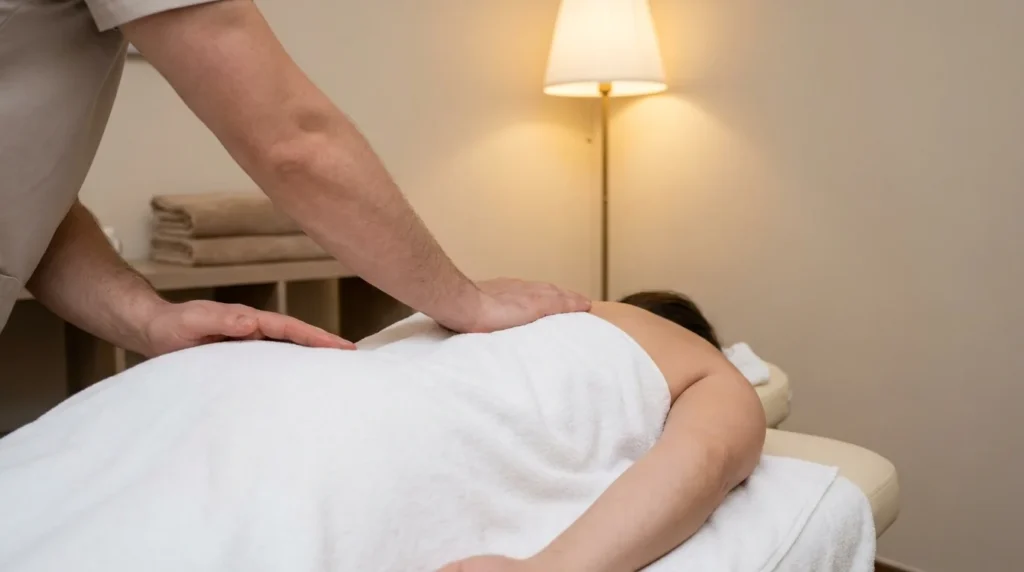
When a deep tissue massage is treating an active problem, book it every one to two weeks. When it is holding a baseline, every four to six weeks is enough. How often deep tissue massage should repeat is meant to change as the problem resolves. A 60 minute session in Dubai costs roughly AED 250 to AED 800.
How often should you get a deep tissue massage?
There is no single interval, because the right gap tracks the reason for booking rather than the treatment itself. Someone working through a pain flare needs a tighter deep tissue massage schedule than someone keeping everyday tension down. Most therapists work to four broad patterns, and clients move between them over a year rather than sitting in one forever.
| Goal | Typical interval | What the schedule is doing |
|---|---|---|
| Chronic pain or an old injury | Every 1 to 2 weeks at first | Working the same area often enough that the tissue does not fully reset between sessions |
| Athletes in a training block | Every 1 to 2 weeks | Clearing training load before it turns into a strain, timed away from race day |
| Desk-based neck and shoulder tension | Every 2 to 3 weeks | Matching the pace at which posture rebuilds the same tight pattern |
| General maintenance and stress | Every 4 to 6 weeks | Holding a baseline rather than treating a problem |
Frequency rises with the size of the problem and falls once it is under control, so the interval is meant to change over time.
The 48 hour soreness test that sets your next booking
Guides usually end this question with advice to listen to your body, which is true and useless. There is a more concrete test. A deep tissue massage creates a small amount of muscle soreness, the same delayed onset soreness following a hard gym session, and it normally peaks around 24 to 48 hours and clears by 72.
Use that window as the signal. If soreness clears within two days and the original tightness stays away for at least a week after, the interval is right. If soreness lingers past three days, the last session was too deep, too long, or too soon, so push the next one back or book it lighter. If tightness returns within 48 hours, the gap is too long and the underlying cause is winning.
Tracking two dates in a notes app for a month settles the question faster than any general rule: the day soreness ended, and the day the original tension came back.
Deep tissue massage for back pain and neck pain: how the schedule differs
The two most common reasons Dubai clients book a deep tissue massage land on different schedules, because the tissue involved behaves differently.
Deep tissue massage for back pain usually starts at every one to two weeks. The lower back sits under large muscle groups carrying load all day, so change comes slowly and needs repetition.
Evidence here is modest. American College of Physicians guidance lists massage as an option for acute and subacute back pain rather than chronic, so the schedule works best running beside physiotherapy or strengthening. Related work on the hips and glutes often matters more than the sore spot itself, which is why a sports massage session sometimes suits the same client better.
Deep tissue massage for neck pain responds faster and needs less force. The muscles are smaller and closer to the surface, and the trigger is usually posture rather than load. Every two to three weeks is a common starting point, dropping to monthly once the pattern breaks.
A 2016 review of four US studies found massage gave short-term relief of neck pain when sessions were long enough and frequent enough, which is the clearest published signal that spacing matters. A focused neck and shoulder massage is often the better booking than a full body session, since the same money buys more time on the area that hurts.
From loading phase to maintenance: how the interval should change
A schedule that never changes is a sign nobody is measuring anything. How often deep tissue massage is booked should move through two stages.
- Loading phase. Three to six sessions at every one to two weeks, aimed at one complaint. Scar tissue from an old injury and long-standing adhesions in the connective tissue get worked here, and progress should be visible session to session.
- Maintenance phase. Once pain is down and range of motion is back, the gap widens to every three to six weeks. The goal shifts from fixing something to stopping it returning.
Moving to maintenance too early shows up as the same complaint returning a month later. Staying in the loading phase after the problem resolves mostly costs money. A therapist who never proposes widening the gap between deep tissue massage appointments is worth questioning.
Is two deep tissue massages a week too much?
For most people, yes. Two deep tissue massage sessions in seven days leave no recovery window, and the second appointment lands while the tissue is still settling from the first. Soreness compounds, and the result is being sore more often than loose.
There are narrow exceptions. Athletes inside a heavy block and people in structured rehabilitation run twice weekly for a defined period, with shorter sessions on different areas. Twice a week as an open-ended habit is a different thing, and a lighter Swedish massage is the better second booking when the aim is stress rather than tissue work.
Side effects of deep tissue massage, and what they say about frequency
The common side effects of deep tissue massage are mild and short: soreness for a day or two, occasional bruising, tiredness, and sometimes a headache. Their pattern is the most honest feedback available on whether the schedule fits.
- Soreness clearing in 24 to 48 hours. Normal, and the interval is working.
- Bruising after most sessions. The pressure is too high for the current frequency. Ask for less depth before stretching the gap.
- Fatigue lasting more than a day. Usually dehydration or too long a session. Dubai heat and air conditioning both dry the body out fast.
- Sharp pain during the session. Not a frequency question at all. Speak up during the appointment, because a good massage therapist adjusts pressure immediately.
Persistent inflammation, numbness, or pain lasting beyond three days is worth a doctor’s opinion rather than a change to how often deep tissue massage is booked.
What each schedule costs in Dubai
Frequency is a budget decision as much as a clinical one, and almost no guide does that arithmetic. Across the city, salonsindubai.ae lists 145 massage and spa venues, and a 60 minute deep tissue session sits at AED 250 to AED 800 by tier and area.
| Tier | Typical price | Duration | Room | Products | Staff experience | Best for |
|---|---|---|---|---|---|---|
| Budget | AED 170 to 280 | 30 to 60 min | Mobile, single therapist | Generic oil set, basic linens | Independent or smaller home-service brands | Price-conscious bookers |
| Mid | AED 280 to 450 | 60 to 90 min | Mobile, established brand | Branded oils, fresh linens, music setup | Trained therapists, fixed treatment menu | Most regular bookings |
| Premium | AED 450 to 800+ | 90 min+ | Mobile, hotel-caliber setup | Imported oils, ambient lighting, candle and speaker setup | Certified specialists, 5+ years tenure | Anniversaries, post-flight, specialty |
Browse all 59 mid-tier Massage Spas providers on our directory.
Turning the per-session price into a monthly figure changes which schedule is realistic. The table below uses the same AED 250 to AED 800 band.
| Schedule | Sessions a month | Monthly spend |
|---|---|---|
| Weekly | 4 | AED 1,000 to AED 3,200 |
| Every 2 weeks | 2 | AED 500 to AED 1,600 |
| Every 3 weeks | 1.5 | AED 375 to AED 1,200 |
| Every 4 weeks | 1 | AED 250 to AED 800 |
| Every 6 weeks | 0.7 | AED 175 to AED 560 |
Most people who cannot keep a weekly schedule are describing a budget limit rather than a clinical one. A shorter 30 minute deep tissue massage focused on one area is the usual way to keep frequency up without the monthly cost.
Venues across Dubai carry deep tissue massage on the standard menu, so the choice comes down to area, therapist experience, and how easy the place is to reach on a weekday evening.

Popular massage and spa venues in Dubai
On the HC floor of the Grand Excelsior Hotel on Kuwait Street in Al Mankhool, Lavana Spa Bur Dubai offers Swedish massage, deep tissue massage, Moroccan bath and reflexology, rated from reviews. Swedish massage comes up repeatedly as a highlight, with reviewers describing sessions as deeply relaxing against a calm, soothing atmosphere throughout the spa. Front-desk staff are also praised for recommending the right treatment based on what a client is looking for, rather than defaulting to a standard package. The spa is wheelchair accessible, including parking, entrance and toilet, and appointments are recommended ahead of a visit, opening from 10am. Good for anyone in Al Mankhool after a proper unwind rather than a rushed treatment.
Al Rashaqa Spa is near Lamcy Plaza in Al Karama, rated from reviews for traditional Thai massage, Moroccan bath, hot stone massage, reflexology and aromatherapy treatments. Feedback on the spa is mixed. Some reviewers describe the space as clean with a good, professional massage, while others report a less consistent experience with staff on the day of their visit. Given that spread of feedback, confirming treatment details directly with the spa before booking is a sensible precaution. The venue operates 24 hours and offers on-site services, making it an option outside typical salon hours. Best booked in advance for a specific treatment, given the mixed feedback on consistency, and requesting the same therapist on a return visit is a reasonable way to get a result closer to what you expect.
Soul Senses Spa is a spa and wellness club in Green Community Village, Dubai Investments Park, rated from reviews.Reviewers describe the deep tissue massage as genuinely therapeutic, with therapists who focus on real problem areas and take time before and after a session to help guests settle in and unwind. The atmosphere is consistently called calm and peaceful, and the team is praised for accommodating last minute bookings and remembering what regular guests prefer.The extensive menu covers aromatherapy massage, body scrub, body wraps, detox programs, hot stone massage, Moroccan bath, reflexology, sauna, scalp massage, Swedish massage, Thai reflexology, Turkish hammam and yoga classes. On site services are available, with wheelchair accessible parking, entrance and toilet.
Niyama Spa is on Level 1 of the Hilton Garden Inn Hotel near Mall of the Emirates, rated from reviews. The spa focuses on massage and body treatments, including deep tissue, Swedish, hot stone and traditional Thai massage, alongside reflexology, aromatherapy and Turkish hammam.Reviewers consistently praise the therapists for skilled, attentive massages, with several describing sessions as the best they have had while travelling. Guests mention feeling genuinely listened to, with therapists adjusting pressure and technique to address specific concerns such as lower back tension.Appointments are recommended given the spa's popularity. With wheelchair-accessible facilities and gender-neutral toilets on site, it suits guests looking for a dedicated, focused massage and hammam experience rather than a full beauty menu.
Recovery Rooms By DXB Sports Massage is a massage therapy service in Al Quoz, rated from reviews. Treatments include deep tissue, therapeutic, Swedish, aromatherapy and traditional Thai massage, hot stone massage, hand massage, reflexology, hair mask and Moroccan bath, with a focus on sports and injury recovery work.Reviewers consistently mention real relief from ongoing pain and sports injuries, with several describing therapists who explain the issue clearly and adjust technique to the specific problem rather than running a generic massage. A number of reviewers also highlight the option of a therapist coming to a client's home, which they say makes booking a session considerably easier.Appointments are required. Suits clients dealing with a specific sports injury or ongoing pain rather than a general relaxation massage.
The wider massage and spa directory and the full Dubai salon directory cover every listed option, including venues that specialise in deep tissue treatment. Every venue listed holds a valid DET trade licence, and any clinic offering medical grade treatment must also hold a DHA health licence, which is the check worth making before committing to a repeat booking.
When a longer gap is the right call
Some conditions turn the answer from an interval into a conversation with a doctor. A deep tissue massage carries real risk for a short list of people, and frequency makes it worse.
- Osteoporosis or fragile bones, where repeated pressure raises fracture risk
- Blood clots, a clotting disorder, or blood thinning medication
- Uncontrolled high blood pressure or a heart condition
- Recent surgery, fractures, open wounds, or skin that bruises easily
- Some cancers, where the oncology team sets the rules
- Fibromyalgia and inflammatory arthritis, where firm pressure can trigger a flare and lighter work at a wider spacing usually suits better
- Pregnancy, where a pregnancy massage with a trained therapist is the appropriate booking
This guide is general information rather than medical advice. Anyone with a health condition or on prescription medication should clear a regular schedule with their doctor first.
What to expect after a deep tissue massage, session by session
Knowing what to expect after a deep tissue massage makes the frequency question easier, because the answer changes as the body adapts.
After a first deep tissue massage, soreness is usually the strongest it will be. Muscles carrying tension for years are worked for the first time, and 24 to 48 hours of ache is normal. Circulation to the area improves within hours, which is part of why the soreness feels different from an injury.
By the third or fourth session, most people report less soreness and a longer window before tightness returns. That lengthening window is the sign the interval can widen. Hydration matters more than any other aftercare step, and drinking properly on the day of the appointment and the day after shortens the ache.
By the maintenance stage, a deep tissue massage should feel firm but not punishing, and the day after should feel normal. A session still leaving someone wrecked six months in usually means the pressure never got dialled back as the tissue changed. On where firm stops and too much begins, see how much a deep tissue massage should hurt.

Building a deep tissue routine that fits a Dubai year
The city changes the rhythm in a few practical ways, and a schedule ignoring them tends to collapse by month three.
Desk-heavy work in Business Bay and DIFC pushes the neck and shoulder pattern hard, so many office-based clients settle on deep tissue massage every three weeks rather than monthly. Long-haul flying, common in a hub city, adds a session after a long sector, because seven hours sitting still reproduces the stiffness of a bad week at a desk.
Summer changes hydration rather than frequency. The same interval works, but water intake around the appointment matters more when outdoor time and air conditioning both pull fluid. Ramadan shifts timing more than spacing, with many venues moving heavier appointments to late evening.
Before committing to a recurring deep tissue massage booking, the directory’s ranking method explains what the listings are ordered by, and home massage in Dubai is the usual fallback when a commute keeps killing the appointment. Book the same slot every cycle. That one habit keeps more schedules alive than any amount of choosing the right interval.


