



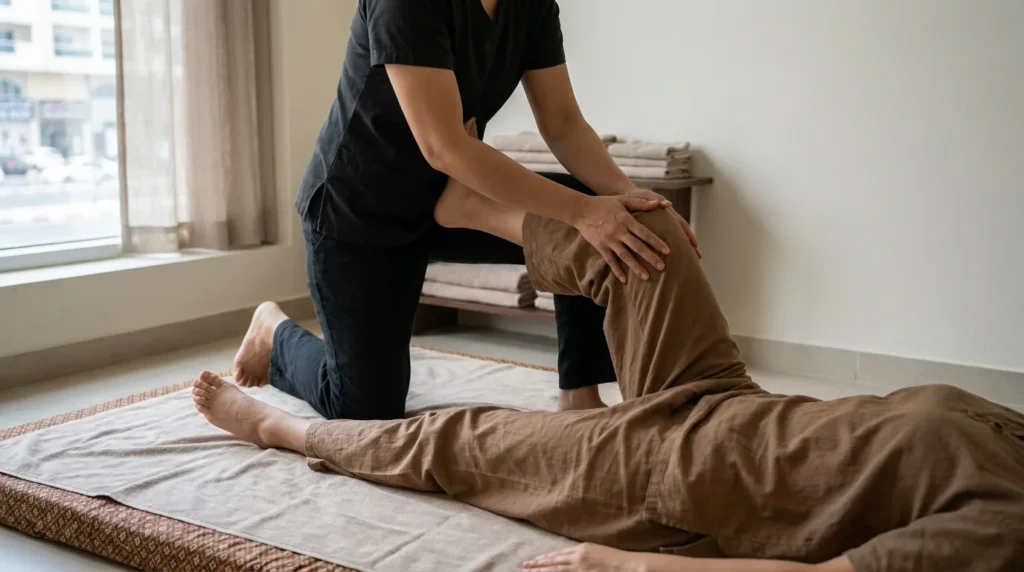
Learning how to do Thai massage starts on a floor mat. The receiver stays fully clothed, no oil is used, and the giver applies slow compression along the body’s sen lines with palms, thumbs, forearms and feet, then guides the receiver through assisted yoga stretches. A full session runs 60 to 120 minutes.
What you need before you start
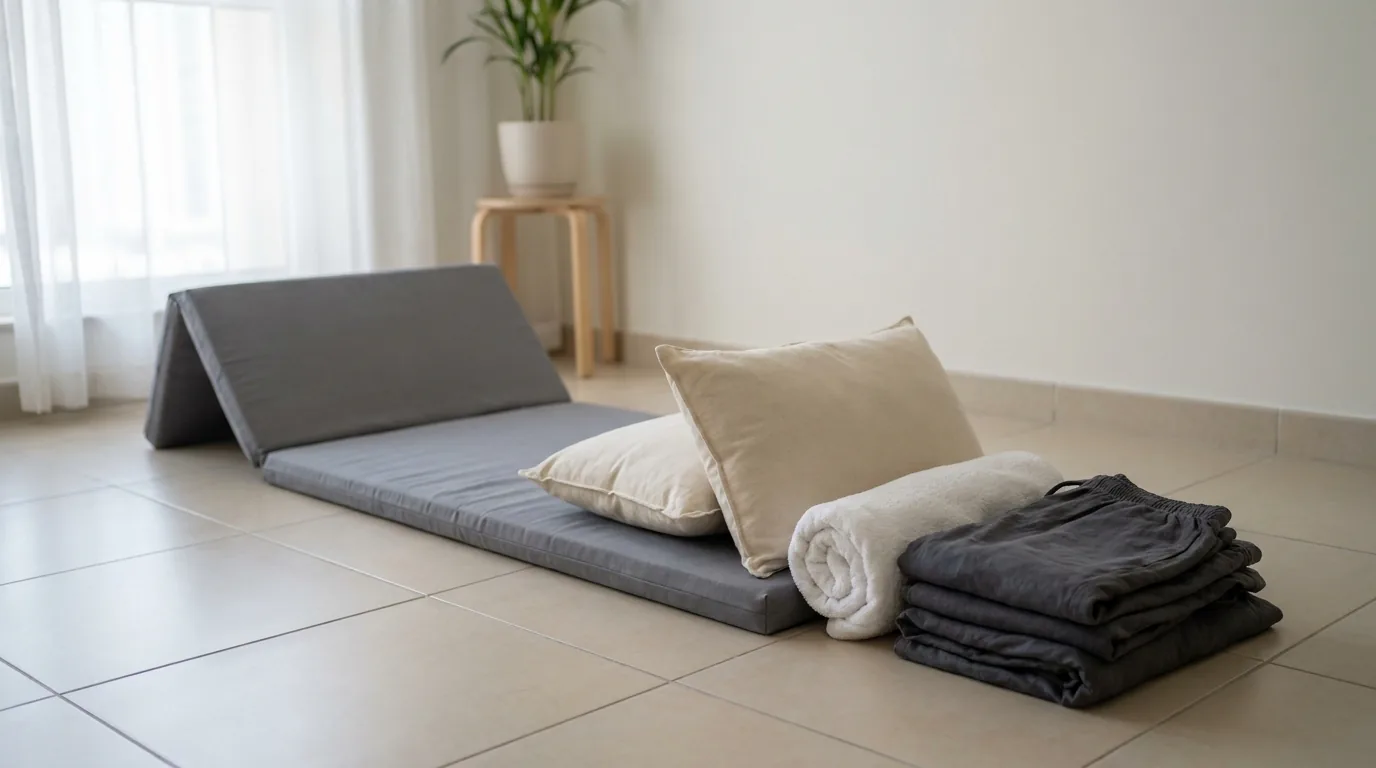
Three things decide whether a Thai massage works: a firm surface, loose clothing on both people, and clear floor to move around the receiver. A bed fails the first test, because mattress springs absorb the downward pressure the technique depends on and the receiver feels a fraction of what is applied.
| What you need | Why it matters | Workable substitute |
|---|---|---|
| Firm floor mat | Sends the giver’s body weight into muscle instead of soaking it up | Doubled yoga mat, folded duvet, thin foam mattress |
| Loose clothing on both people | The receiver’s hip and shoulder have to open fully in the stretches | Cotton joggers and a soft tee |
| Two metres of clear floor | The giver moves around all four sides during a full sequence | Push the coffee table back and work along the longest wall |
| Cushion and rolled towel | Support the neck and the top knee in side lying positions | Two folded bath towels |
Oil, candles and music change nothing about the mechanics, and oil in particular makes palm compression slip, which is why traditional Thai massage is given dry. Nails short, watches and rings off.
How to do Thai massage step by step
The order below follows the standard Thai massage floor sequence used in Thailand: feet, then legs, hips and back, then arms, neck and head. Working upward lets the receiver settle before anything demanding happens near the spine.
- Open at the feet. Kneel at the receiver’s feet while they lie face up. Press both soles with flat palms for a minute so they register the pressure and pace before anything moves.
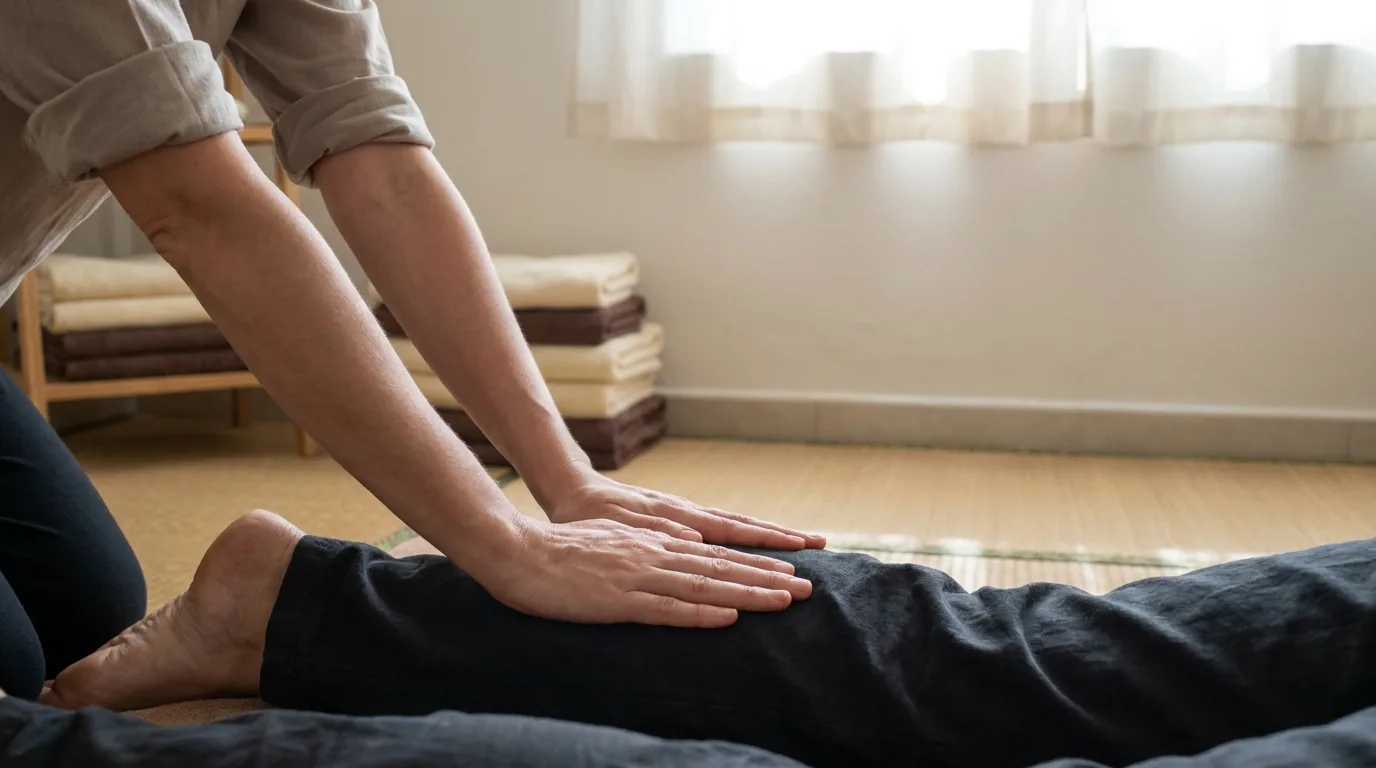
- Walk the leg lines. Thumb press up the inside of the calf and thigh, then the outside, pausing three to five seconds on each point. Keep the arms straight and lean forward, so the pressure arrives as body weight rather than grip.
- Mobilise the ankles and hips. Rotate each ankle both ways, then draw each knee towards the chest and circle the hip joint. Slow circles, no force.
- Move into the first stretches. Single leg hamstring raise, then the figure four hip opener. Take each one to the point of resistance, hold, and release on the receiver’s out breath.
- Turn the receiver onto their side. Side lying opens the hip, the outer thigh and the shoulder blade at once. Support the head with a cushion and the top knee with a rolled towel.
- Work the back face down. Palm press either side of the spine, never on it, travelling from the lower back to the shoulders. Add forearm pressure through the glutes and the backs of the thighs where the muscle is thick.
- Open the shoulders and arms. Press from wrist to shoulder along the arm lines, using thumbs on the forearm and elbows nowhere near the joint, then take the arm into a supported overhead stretch.
- Finish seated. Bring the receiver up to sitting, press the shoulders, rotate the spine gently in both directions, and close with light pressure at the base of the skull.
A full pass through all eight runs about 90 minutes at an unhurried pace, so beginners should cut it to feet and legs and spend 40 minutes there instead. Rushing to fit everything in produces the outcome the tradition is built to avoid, a receiver who braces for the whole session. The traditional Thai massage listings show which Dubai venues run this dry floor sequence rather than an oil variant.
The five core Thai massage techniques
Every sequence is assembled from the same five actions, and knowing what each is for stops a session becoming a random tour of the body.
| Technique | What the giver does | What it is for |
|---|---|---|
| Palm compression | Straight arms, body weight dropped through a flat palm, three to five seconds per point | Broad release along the sen lines, and the way most sections open and close |
| Thumb pressing | Both thumb pads walking a line, roughly one thumb width apart | Precise point work on the legs, arms and feet, the element closest to acupressure |
| Forearm and elbow work | Rolling the forearm, or sinking an elbow slowly into thick muscle | Depth through glutes, hamstrings and shoulders without wearing out the hands |
| Joint mobilisation | Circling ankles, knees, hips and shoulders, plus gentle traction | Restoring range of motion before any stretch is attempted |
| Assisted stretching | Moving the receiver into supported positions and holding them | Building flexibility in muscle and connective tissue, the part often called assisted yoga |
Two rules govern all five. Pressure travels through bone and body weight, never through gripping fingers, which is what keeps a giver’s hands usable over years. And nothing presses directly on the spine, kneecaps, throat or the back of the knee. The guide to Thai massage in Dubai covers how Dubai studios sequence the same five actions commercially.
Thai foot massage, the sequence to learn first
A Thai foot massage is the shortest complete routine in the tradition and the sensible place to begin. It needs no floor space, works with the receiver in an armchair, and carries little injury risk because the joints are small.
Work one foot at a time for around 15 minutes. Warm the foot between both palms, thumb walk the sole from heel to toe in three lines, circle each toe, press into the arch, then squeeze firmly up the calf. A wooden stick is traditional for the deeper sole points, though a thumb does the same job. The Thai reflexology listings cover Dubai venues offering this as a standalone 30 or 45 minute treatment.
Foot work also solves the space problem: a thai foot massage can be practised on a sofa, and very few Dubai apartments have two spare metres of clear floor.
Adapting the technique to a Dubai apartment
Working out how to do Thai massage at home in Dubai comes down to surface, temperature and space. Guides written elsewhere assume a carpeted spare room and a futon, and local housing supplies neither by default.
Floors here are usually porcelain tile or marble over concrete, and that surface punishes the giver’s knees long before it bothers the person lying down. The mat has to be wide enough for both people rather than sized to the receiver, or a second folded blanket laid along the kneeling side.
Air conditioning is the second issue. A room held at 20 degrees keeps muscle tight and makes every stretch feel harsher than the pressure warrants. Raising the thermostat to 24 or 25 for the session, and covering the receiver’s arms and feet between sections, does more for the result than any change of technique. Walk into the treatment rooms at massage and spa venues and they are noticeably warmer than the reception area for the same reason.
Third, the heat outside leaves people dehydrated without registering it, so water an hour beforehand and again afterwards.
In an apartment that takes direct sun, run the session late evening or early morning. A room still catching up from 30 degrees makes the stretch section uncomfortable for both people.
Where beginners go wrong
The failure modes repeat, and every one of them has a mechanical cause.
- Working on a bed. The mattress takes the load, the receiver feels almost nothing, and the giver compensates by pushing harder with the arms. This alone explains most flat home sessions.
- Pressing with the fingers. Gripping wears out thumb joints within a few sessions. The pressure should arrive because the hips moved forward over straight arms.
- Pushing past resistance. A partner will usually stay quiet rather than interrupt, so ask before each stretch and stop at the first firm end point.
- Going too fast. Three to five seconds per point reads as hurried in practice, and beginners typically hold for one.
- Pressing the spine. Palm and forearm work sits either side of the spine on muscle, never on the vertebrae.
- Skipping the joint work. Stretching a hip that has not been circled first is what leaves a receiver sore the next day.
Bed work and finger pressure account for most of the gap between a home attempt and a paid session, and the rest correct themselves within a few tries. Beginners chasing depth reach for force instead: a deep tissue massage gets its depth from slow sustained pressure on one point, and blending that into a Thai sequence is what leaves people aching.
When not to do Thai massage on someone
Thai massage moves real force through joints and connective tissue, so the list of people it should not be used on runs longer than for an oil massage. Skip the session, or send the person to a clinician first, in any of these cases.
- Pregnancy at any stage, unless the giver is trained in prenatal work
- Osteoporosis or any diagnosed bone density problem
- Recent surgery, a fracture, or a joint replacement
- A herniated disc, or numbness travelling down a leg
- Active cancer treatment, unless the treating team has cleared massage
- Blood clots, or medication that thins the blood
- Fever, active infection, or broken skin in the area
- Uncontrolled high blood pressure
Two more are easy to miss. Sciatica shows up as lower back pain and responds badly to aggressive hip stretching, and anyone left with tension headaches or a stiff neck for more than two days should be worked far more gently. Where a condition sits near this list, the sensible route is a qualified Thai massage therapist rather than a partner at home.
Doing this for money in the UAE
Practising Thai massage on a partner or a family member at home is private. Charging for it is not, and that line is where people learning the technique most often get their information wrong.
A massage business in Dubai needs two separate permissions. The Department of Economy and Tourism issues the trade licence that lets the business operate and defines what it may sell. The Dubai Health Authority licenses the health side: the facility, and every therapist working inside it. A therapist without a DHA licence is unlicensed here whatever qualification they hold from abroad, and the venue carries the liability. Home visits sit under the same two rules, so a mobile therapist should hold a DHA licence and work for a DET licensed business.
None of that restricts learning the sequence or using it at home for free. It restricts advertising it, charging for it, and working out of a venue.
Learning it properly, or booking a session instead
Nuad Thai, the practice’s Thai name, was added to the UNESCO list of intangible cultural heritage in 2019, and the Wat Pho school in Bangkok remains the reference curriculum. Formal training there runs from a five day introduction to a 300 hour certificate, and several Dubai studios run weekend workshops for non professionals. Video showing how to do Thai massage step by step gets a beginner to a competent foot and leg routine, while supervision carries them to a full body one.
For most people the comparison is cost. The directory lists 313 Dubai venues offering traditional Thai massage, and booking a therapist to come to the apartment falls into the bands below. The Thai spa guide covers what a venue visit includes instead.
| Tier | Typical price | Duration | Room | Products | Staff experience | Best for |
|---|---|---|---|---|---|---|
| Budget | AED 170 to 280 | 30 to 60 min | Mobile, single therapist | Generic oil set, basic linens | Independent or smaller home-service brands | Price-conscious bookers |
| Mid | AED 280 to 450 | 60 to 90 min | Mobile, established brand | Branded oils, fresh linens, music setup | Trained therapists, fixed treatment menu | Most regular bookings |
| Premium | AED 450 to 800+ | 90 min+ | Mobile, hotel-caliber setup | Imported oils, ambient lighting, candle and speaker setup | Certified specialists, 5+ years tenure | Anniversaries, post-flight, specialty |
Browse all 59 mid-tier Massage Spas providers on our directory.
Home practice costs a mat and two cushions, spent once, then costs time: reaching the standard of a 60 minute paid session takes months, which is why most people who start learning end up doing both. The ranking method sets out how listings are ordered, and the massage and spa section covers the city’s other modalities.

Popular massage and spa venues in Dubai
On the first floor of Dubai Festival City Mall, Heal Spa runs aromatherapy, deep tissue, hot stone and sports massage alongside couples massage, reflexology, a Moroccan bath and IPL hair removal. It's rated from reviews.Reviewers describe some of the best massages they've had in Dubai here, with the therapists praised for reading pressure correctly and adjusting through the session rather than working to a fixed routine. The space itself comes up as clean and calm, and the team is described as consistently friendly across a large number of reviews.Booking ahead is worth it, and outdoor and on-site services are available. The venue has gender-neutral toilets and wheelchair-accessible parking, entrance, seating and toilet facilities throughout.
Sweet Violet Beauty Salon LLC is a massage spa in Business Bay, at The Prism, rated from reviews. Treatments include deep tissue, Swedish, sports, hot stone and traditional Thai massage, aromatherapy massage, couples massage, therapeutic massage, reflexology, the Moroccan bath, plus threading, eyebrow threading, waxing and facials.Reviewers consistently describe the massage therapists as highly skilled, singling out deep tissue and sports massage for genuinely relieving tension rather than a generic rubdown. Several clients book the team for events and repeat visits, and the overall experience is described as relaxing and professional from start to finish.The salon offers on-site services and wheelchair-accessible parking. Appointments are recommended.
On the HC floor of the Grand Excelsior Hotel on Kuwait Street in Al Mankhool, Lavana Spa Bur Dubai offers Swedish massage, deep tissue massage, Moroccan bath and reflexology, rated from reviews. Swedish massage comes up repeatedly as a highlight, with reviewers describing sessions as deeply relaxing against a calm, soothing atmosphere throughout the spa. Front-desk staff are also praised for recommending the right treatment based on what a client is looking for, rather than defaulting to a standard package. The spa is wheelchair accessible, including parking, entrance and toilet, and appointments are recommended ahead of a visit, opening from 10am. Good for anyone in Al Mankhool after a proper unwind rather than a rushed treatment.
Al Rashaqa Spa is near Lamcy Plaza in Al Karama, rated from reviews for traditional Thai massage, Moroccan bath, hot stone massage, reflexology and aromatherapy treatments. Feedback on the spa is mixed. Some reviewers describe the space as clean with a good, professional massage, while others report a less consistent experience with staff on the day of their visit. Given that spread of feedback, confirming treatment details directly with the spa before booking is a sensible precaution. The venue operates 24 hours and offers on-site services, making it an option outside typical salon hours. Best booked in advance for a specific treatment, given the mixed feedback on consistency, and requesting the same therapist on a return visit is a reasonable way to get a result closer to what you expect.
Touch Life Spa sits inside TIME Oak Hotel & Suites in Barsha Heights, rated from reviews. Reviewers consistently describe a calm, clean and welcoming atmosphere, with attentive, professional staff who take time over every detail. Several guests single out the massage treatments and Turkish hammam for easing tension and back pain, and describe the whole visit as well organised and hygienic from start to finish. The treatment menu runs from deep tissue, hot stone, Swedish and Thai reflexology massage to aromatherapy, back, scalp and sports massage, alongside gel pedicures, manicures and yoga classes. The spa is wheelchair accessible throughout, with an accessible car park, entrance, seating and toilet, and appointments are recommended given its popularity in the Barsha Heights hotel district.


