



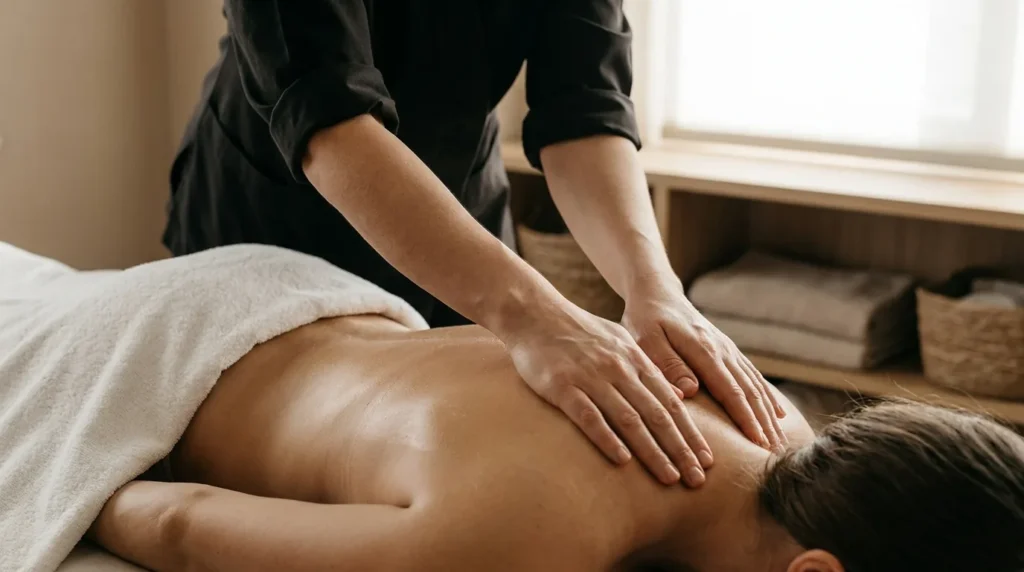
Swedish massage meaning comes down to one idea: it is the classic, full-body relaxation massage that most spa menus treat as the default. A therapist works the whole body with oil, using five core strokes at light to moderate pressure to ease muscle tension and calm the nervous system. In Dubai a standard 60-minute session runs roughly AED 200 to AED 450, rising to around AED 700 at hotel spas.
What does Swedish massage mean?
Swedish massage is the Western style of soft-tissue massage built around long, flowing hand movements over oiled skin. When a menu lists it without any other label, this is the treatment most people picture: a calm room, a draped client face-down on a heated table, and a therapist moving methodically from the back down to the legs and up to the neck. The pressure stays in the relaxation range rather than the intense, targeted range of clinical bodywork.
The name refers to a method, not a single fixed routine. Two clients can both book the treatment and get slightly different sessions depending on the therapist, the oil, and how much kneading versus gliding each body needs that day. What stays constant is the goal. Swedish massage aims to relax muscle tissue, improve circulation, and lower stress, which is why it sits at the centre of almost every spa list in the city.
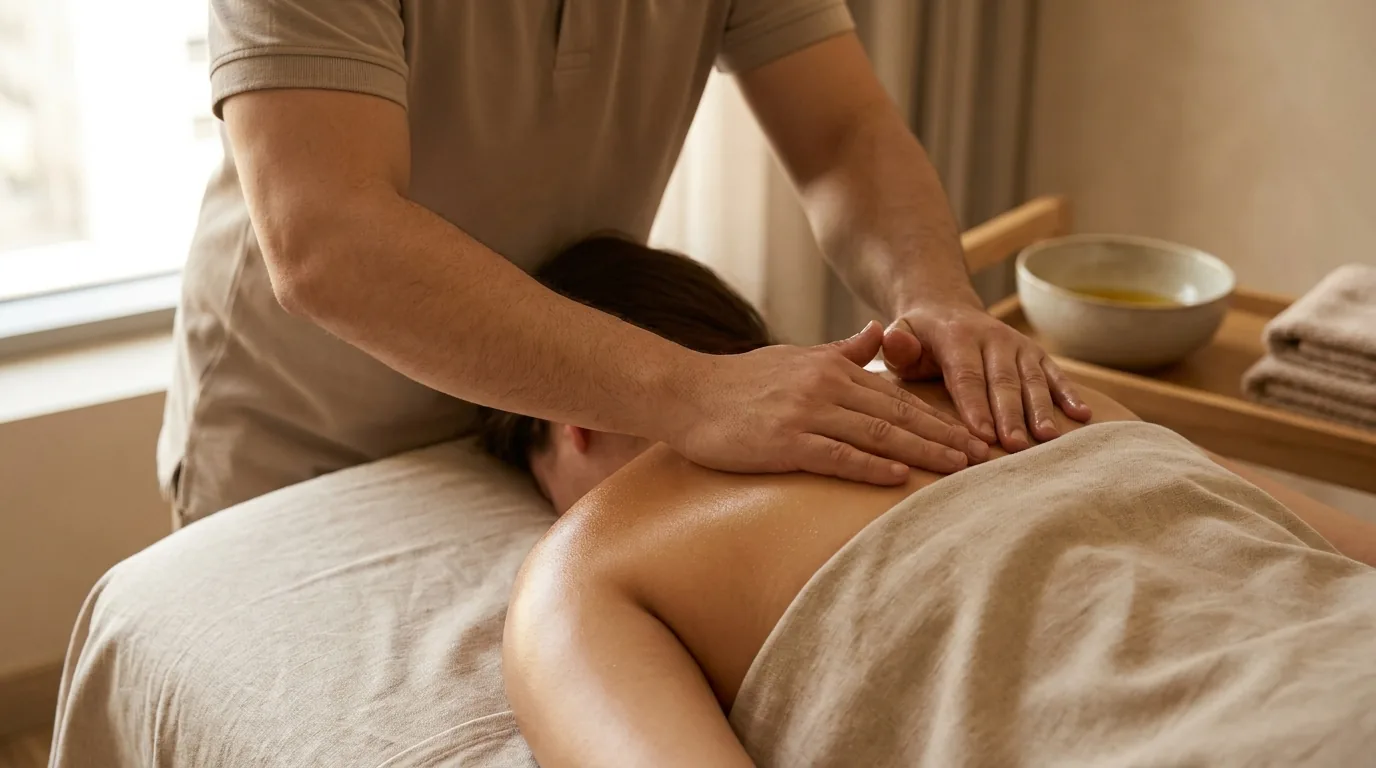
If you are deciding between treatments for the first time, the Swedish massage option is the safest starting point. It suits sensitive bodies, first-timers, and anyone who wants to leave calmer rather than worked-over. From there, heavier or more specialised styles make more sense once you know how your body responds to gentle pressure.
Where the Swedish massage name comes from
The term traces back to early 19th-century Sweden and a movement teacher named Pehr Henrik Ling. Ling built a system he called the Swedish Movement Cure, which combined gymnastics, stretching, and hands-on manipulation of the body to improve health. His work spread across Europe and gave the broad approach its national label, which is how “Swedish” became attached to the style.
The hands-on strokes most spas use today were organised later by a Dutch physician, Johann Georg Mezger. Mezger described the core movements with French terms that therapists still learn by name. So the meaning has two roots: a Swedish movement tradition that gave the style its identity, and a clinical framework that gave the strokes their vocabulary. Knowing this clears up a common assumption that the treatment was invented as a single technique in one place.
The five strokes behind the name
The substance of Swedish massage is a set of five named strokes. A therapist blends them across a session, spending more time on whichever the body needs. Together they are what people actually mean when they describe the treatment as classic or relaxing.
- Effleurage: long gliding strokes that warm the tissue, spread the oil, and open and close most sections of the body.
- Petrissage: kneading, rolling, and squeezing of muscle, similar to working dough, to release deeper tension.
- Friction: firmer circular pressure with the thumbs or fingertips on specific knots and tight bands.
- Tapotement: light rhythmic tapping or chopping with the edges of the hands to stimulate the muscle.
- Vibration: a fine shaking or trembling movement that helps loosen and settle the area at the end.
None of these is unique to one country. What is distinctive is the order and the gentle-to-moderate pressure that keeps the experience comfortable. A skilled therapist reads the body and adjusts, so the same five movements feel different on tight shoulders than on a relaxed lower back.
What a full-body Swedish massage includes
So what is a swedish full body massage in practice? A full-body session covers the back, shoulders, neck, arms, hands, legs, feet, and usually the scalp, worked one region at a time. The client lies on a padded table under a towel or sheet, and only the area being treated is uncovered at any moment. The therapist applies oil or lotion so the strokes glide without pulling the skin.
The face, chest, and intimate areas are not part of the treatment. Reputable venues follow strict draping, which means the body stays covered except for the section under the therapist’s hands. A standard full-body appointment lasts 60 minutes, with 90-minute versions adding time on problem areas or a scalp and foot focus. Pressure is checked early and adjusted, so speak up if you want it lighter or firmer.
Most of the benefit comes from the steady, repetitive movement over large muscle groups. By the end, the aim is looser muscle tissue, better blood flow, and a clear drop in stress. That whole-body, low-intensity coverage is what separates a Swedish session from a targeted treatment on a single sore spot.
What Swedish massage is not
Because the treatment is full-body and uses oil, the name is sometimes misread. Swedish massage is a regulated wellness treatment focused on relaxation and circulation, carried out by a trained therapist under professional draping. It is not an adult service, and any venue implying otherwise is not offering the genuine treatment.
It is also not the same as deep, clinical bodywork. The pressure is deliberately moderate, so a Swedish session is the wrong choice if your goal is to break down chronic knots or rehabilitate an injury. For that you would book a firmer style. Understanding what the treatment is not makes it easier to pick the right service and the right venue in a city with hundreds of options.
How Swedish massage differs from deep tissue, aromatherapy, and hot stone
The clearest way to fix the meaning is to set the treatment beside the styles it is most often confused with. Each shares the same table and oil but changes one variable: pressure, scent, or heat.
| Style | Pressure | Main goal | Best for |
|---|---|---|---|
| Swedish | Light to moderate | Whole-body relaxation, circulation | First-timers, stress relief |
| Deep tissue | Firm to intense | Release chronic knots, recovery | Tight, overworked muscles |
| Aromatherapy | Light to moderate | Relaxation plus essential-oil effect | Mood, calm, gentle sessions |
| Hot stone | Light to moderate | Heat to melt tension faster | Cold-prone, deep relaxation |
Aromatherapy and hot stone are often Swedish massage with an added layer: scented oils in one case, heated stones in the other. Deep tissue is the real departure, trading comfort for intensity. If you are unsure, start Swedish and adjust from there.
Getting a licensed Swedish massage in Dubai (and what it costs)
Massage in Dubai is regulated, and the licensing tells you a venue is legitimate. A genuine spa holds a DET trade licence from Dubai’s Department of Economy and Tourism to operate, plus a Dubai Health Authority (DHA) health licence covering the treatment and the people delivering it. Before you book, it is worth confirming a venue is a verified, licensed provider rather than an informal operation.
The directory lists 145 licensed massage and spa venues across Dubai, so there is no shortage of vetted options. You can browse them all through the main salon directory or read how each listing is checked on the ranking methodology page. For at-home sessions, mobile therapists cover most residential areas, explained in the guide to home massage in Dubai.
Prices track the venue tier and the area. Expect budget rooms and neighbourhood spas at the lower end, mid-range day spas in the middle, and hotel and resort spas at the top. Many venues offer ladies-only rooms and female therapists, which is worth requesting when you book.
| Tier | Typical price | Duration | Room | Products | Staff experience | Best for |
|---|---|---|---|---|---|---|
| Budget | AED 170 to 280 | 30 to 60 min | Mobile, single therapist | Generic oil set, basic linens | Independent or smaller home-service brands | Price-conscious bookers |
| Mid | AED 280 to 450 | 60 to 90 min | Mobile, established brand | Branded oils, fresh linens, music setup | Trained therapists, fixed treatment menu | Most regular bookings |
| Premium | AED 450 to 800+ | 90 min+ | Mobile, hotel-caliber setup | Imported oils, ambient lighting, candle and speaker setup | Certified specialists, 5+ years tenure | Anniversaries, post-flight, specialty |
Browse all 59 mid-tier Massage Spas providers on our directory.
Demand clusters in a handful of areas, with the densest options shown below. The same massage and spa venues run across budget and premium tiers depending on the neighbourhood.
| Neighborhood | Providers | Dominant tier | Typical AED range |
|---|---|---|---|
| Business Bay | 24 | Mid | AED 280 to 450 |
| Deira | 19 | Budget to mid | AED 200 to 380 |
| Al Barsha 1 | 11 | Mid | AED 280 to 450 |
| Barsha Heights | 8 | Mid | AED 280 to 450 |
| Jumeirah | 5 | Premium | AED 380 to 800+ |
| Mira | 5 | Mid | AED 280 to 450 |
| Al Mankhool | 4 | Budget to mid | AED 200 to 380 |
| Bur Dubai | 4 | Budget to mid | AED 200 to 380 |
| Jumeirah Beach Residence | 4 | Mid to premium | AED 280 to 600 |
| Sheikh Zayed Rd | 4 | Mid to premium | AED 280 to 700 |

Popular massage and spa venues in Dubai
On the first floor of Dubai Festival City Mall, Heal Spa runs aromatherapy, deep tissue, hot stone and sports massage alongside couples massage, reflexology, a Moroccan bath and IPL hair removal. It's rated from reviews.Reviewers describe some of the best massages they've had in Dubai here, with the therapists praised for reading pressure correctly and adjusting through the session rather than working to a fixed routine. The space itself comes up as clean and calm, and the team is described as consistently friendly across a large number of reviews.Booking ahead is worth it, and outdoor and on-site services are available. The venue has gender-neutral toilets and wheelchair-accessible parking, entrance, seating and toilet facilities throughout.
Sweet Violet Beauty Salon LLC is a massage spa in Business Bay, at The Prism, rated from reviews. Treatments include deep tissue, Swedish, sports, hot stone and traditional Thai massage, aromatherapy massage, couples massage, therapeutic massage, reflexology, the Moroccan bath, plus threading, eyebrow threading, waxing and facials.Reviewers consistently describe the massage therapists as highly skilled, singling out deep tissue and sports massage for genuinely relieving tension rather than a generic rubdown. Several clients book the team for events and repeat visits, and the overall experience is described as relaxing and professional from start to finish.The salon offers on-site services and wheelchair-accessible parking. Appointments are recommended.
On the HC floor of the Grand Excelsior Hotel on Kuwait Street in Al Mankhool, Lavana Spa Bur Dubai offers Swedish massage, deep tissue massage, Moroccan bath and reflexology, rated from reviews. Swedish massage comes up repeatedly as a highlight, with reviewers describing sessions as deeply relaxing against a calm, soothing atmosphere throughout the spa. Front-desk staff are also praised for recommending the right treatment based on what a client is looking for, rather than defaulting to a standard package. The spa is wheelchair accessible, including parking, entrance and toilet, and appointments are recommended ahead of a visit, opening from 10am. Good for anyone in Al Mankhool after a proper unwind rather than a rushed treatment.
Al Rashaqa Spa is near Lamcy Plaza in Al Karama, rated from reviews for traditional Thai massage, Moroccan bath, hot stone massage, reflexology and aromatherapy treatments. Feedback on the spa is mixed. Some reviewers describe the space as clean with a good, professional massage, while others report a less consistent experience with staff on the day of their visit. Given that spread of feedback, confirming treatment details directly with the spa before booking is a sensible precaution. The venue operates 24 hours and offers on-site services, making it an option outside typical salon hours. Best booked in advance for a specific treatment, given the mixed feedback on consistency, and requesting the same therapist on a return visit is a reasonable way to get a result closer to what you expect.
Touch Life Spa sits inside TIME Oak Hotel & Suites in Barsha Heights, rated from reviews. Reviewers consistently describe a calm, clean and welcoming atmosphere, with attentive, professional staff who take time over every detail. Several guests single out the massage treatments and Turkish hammam for easing tension and back pain, and describe the whole visit as well organised and hygienic from start to finish. The treatment menu runs from deep tissue, hot stone, Swedish and Thai reflexology massage to aromatherapy, back, scalp and sports massage, alongside gel pedicures, manicures and yoga classes. The spa is wheelchair accessible throughout, with an accessible car park, entrance, seating and toilet, and appointments are recommended given its popularity in the Barsha Heights hotel district.


