


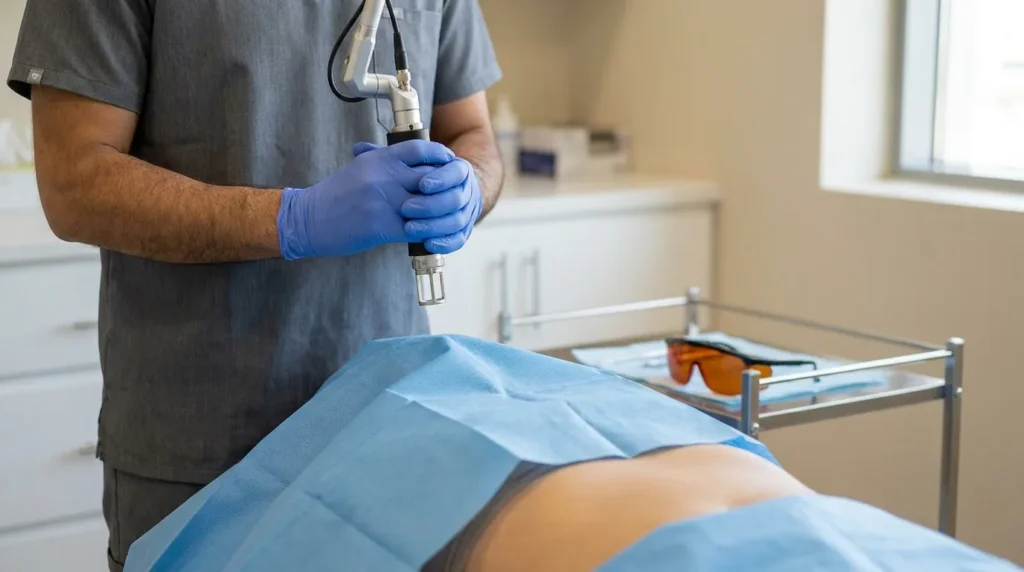
Laser treatment for stretch marks fades them rather than erasing them, with published improvement running 20 to 60 percent over a full course. Dubai clinics charge roughly AED 800 to AED 2,500 per session, and most people need three to six. The right device depends on mark colour and your skin type.
This guide is general information, not medical advice. Laser resurfacing is a regulated cosmetic-medical treatment in Dubai: consult a DHA-licensed clinic about your suitability and risks before booking.
Does laser remove stretch marks, or only fade them?
Fading is the honest answer. A stretch mark is a scar in the dermis where collagen and elastin tore under rapid stretching, and no wavelength rebuilds torn skin into skin that was never torn. Laser treatment rebuilds collagen around the scar, flattens the surface, and pulls the colour closer to the skin beside it.
The American Society for Dermatologic Surgery puts the realistic range at 20 to 60 percent improvement in appearance across a series of sessions, with results that hold but sometimes need a maintenance visit. Where you land inside that band depends on how old the marks are and how your skin heals.
So when people ask “does laser remove stretch marks”, they usually mean visibility in normal light. On that measure, a good course of laser treatment makes marks harder to notice at conversational distance. It rarely makes them impossible to find.

Popular skin and aesthetic clinics in Dubai
Luerur Aesthetic Clinic is a skin care and aesthetic clinic in Al Barsha, on 39th Street behind Saudi German Hospital. It is rated from reviews.Reviewers describe a doctor who explains options clearly and only recommends a procedure when it is genuinely needed, with specific praise for natural looking results after a filler dissolving treatment and for a targeted acne programme that visibly improved skin. As with any aesthetic or medical treatment, outcomes and experiences can vary between visits, so a thorough consultation to set expectations before booking is worth doing.The clinic offers a broad range of treatments, from Botox injections, dermal fillers, chemical peels and skin rejuvenation to laser hair removal, microdermabrasion, PRP therapy, FUE hair transplant and surgical procedures such as rhinoplasty, liposuction and tummy tuck. The venue has on-site appointments, gender-neutral toilets and wheelchair-accessible parking, entrance and seating.
In Al Habtoor Business Tower in Dubai Marina, Cosmesurge Clinic offers botox injections, dermal fillers, body contouring, chemical peels, laser hair removal, rhinoplasty, liposuction and FUE hair transplant among other cosmetic and dermatology treatments. It is rated from reviews.Reviewers consistently describe the doctors as attentive and compassionate, noting that treatment recommendations are conservative rather than pushed, and several return year after year for ongoing skin care. The clinic itself is noted for a modern, welcoming atmosphere with views over the marina.The clinic has on-site services with a wheelchair-accessible entrance, car park, seating and toilet, plus gender-neutral toilets. It suits Dubai Marina residents and visitors researching cosmetic treatments, laser hair removal or dermatology consultations, with a consultation typically recommended before committing to any treatment plan.
Glow Aesthetics Dermatology Clinic is in Al Attar Business Centre in Al Barsha, offering botox injections, dermal fillers, chemical peels, microneedling, laser and IPL hair removal, skin tightening, scar treatment and pigmentation treatment. It is rated from reviews.Reviewers consistently praise the honesty of the medical guidance, noting that the team recommends only what is genuinely needed rather than upselling treatments. The clinic is described as professional and welcoming from arrival, with several highlighting fair pricing relative to the standard of care.The clinic has on-site services with a wheelchair-accessible entrance, car park and toilet. It suits patients across Dubai researching skin treatments, anti-aging facials or laser hair removal, with a consultation recommended to discuss the right treatment plan.
Derma 247 Laser Clinic is a skin and laser clinic in Nadd Al Hamar, rated from reviews. Treatments cover laser and IPL hair removal, botox injections, dermal fillers, chemical peels, pigmentation treatment, skin rejuvenation and tattoo removal.Reviewers consistently mention feeling well informed before and during laser sessions, with practitioners who explain each step in plain terms and check in throughout rather than rushing through the appointment. That attentiveness comes up often enough to be a genuine pattern rather than a one-off.The clinic runs by appointment, with on-site services and a fully wheelchair-accessible setup including gender-neutral toilets. It suits anyone after laser or aesthetic treatments who wants a clinical, unhurried approach rather than a quick in-and-out visit.
IV Wellness Lounge is on Marble Walk in Zaa'beel Second, DIFC, rated from reviews. Alongside its IV therapy sessions, the lounge offers detox programmes, lymphatic drainage, massage therapy, meditation sessions, yoga classes, anti-aging facials, chemical peel, dermal fillers, botox injections and laser hair removal.IV therapy is what reviewers talk about most, describing sessions as gentle and comfortable with a noticeable lift in energy afterward. The space itself gets repeated praise too, called calming, clean and beautifully designed rather than clinical, and reviewers consistently describe the staff as attentive and quick to explain what each session involves. The on-site cafe also gets a mention for a good drink after a session.With on-site services and a wheelchair-accessible car park and entrance, the lounge suits a considered wellness visit in DIFC.
The four laser families, and what each one is built for
Clinics use the word “laser” as though it named one machine. Laser treatment covers at least four families, and they behave differently enough that the name on your consultation form changes the outcome.
| Laser family | What it does | Suits | Typical downtime |
|---|---|---|---|
| Pulsed dye, around 585 nm | Targets the blood vessels that make fresh marks look red | New red or purple striae | One to two days of flushing |
| Non-ablative fractional, 1540 to 1550 nm | Heats columns of dermis without breaking the surface | Most marks, widest range of skin types | Two to four days of redness |
| Ablative fractional CO2, 10,600 nm | Removes columns of tissue and forces a full repair response | Deep, mature white marks | Five to ten days of healing |
| Picosecond | Very short pulses working more by pressure than by heat | Blending colour and polishing texture | One to three days |
Good laser treatment plans read as a sequence rather than a menu. Red marks often start with pulsed dye, then move to fractional work once the redness settles.
Non-ablative fractional is the family Fraxel devices belong to, and it is the default across most Dubai clinics because it handles a wide range of skin without the healing burden of ablative work. Ablative CO2 laser stretch marks protocols sit at the aggressive end: better on old white marks, longer recovery, higher pigment risk.
Pico laser stretch marks claims are the newest of the four, and the published evidence behind them is thinner than the evidence behind fractional resurfacing, so treat a pico-only recommendation as a question worth pressing. Comparing what laser skin resurfacing clinics actually run tells you which wavelengths sit near you.
Best laser treatment for stretch marks: how the match is made
There is no single best laser treatment for stretch marks, and a clinic that names one before looking at your skin is describing the device it owns. The match runs on three inputs, in this order.
Colour comes first. Red and purple marks still carry active blood vessels, which gives pulsed dye something to target. White marks have finished remodelling, so the job shifts to rebuilding volume and texture, which is fractional territory. Which approaches beat lasers for particular marks sits in our guide to stretch mark removal options.
Age comes second. Marks under about a year respond faster and need fewer sessions. Beyond that, expect a longer course for the same visible change.
Body area comes third. Abdomen and thighs cover large surfaces and cost more per visit because more passes are needed. Ask the skin specialists you shortlist to price by area, because a per-session quote means little until you know how much skin it covers.
What skin type IV to VI changes about the settings
Skin type decides more of this than most clinic pages admit. Melanin absorbs laser energy, so a setting that is routine on pale skin can trigger post-inflammatory hyperpigmentation on brown skin: a dark patch that outlasts the stretch mark you came in to treat.
On Fitzpatrick IV and above, careful laser treatment changes four things. It leans toward non-ablative fractional over ablative CO2. It drops the density and energy per pass, then adds sessions to compensate. It stretches the interval between visits so pigment can settle. And it starts with a test patch, several weeks before anything else. Adding microneedling between visits keeps progress moving at lower thermal load.
A clinic offering you the same laser treatment protocol it would offer anyone is not treating your skin. The American Academy of Dermatology is clear that in-clinic procedures reduce the appearance of stretch marks without removing them, and that expectation matters more when pigment risk is higher.
Inside a single laser session
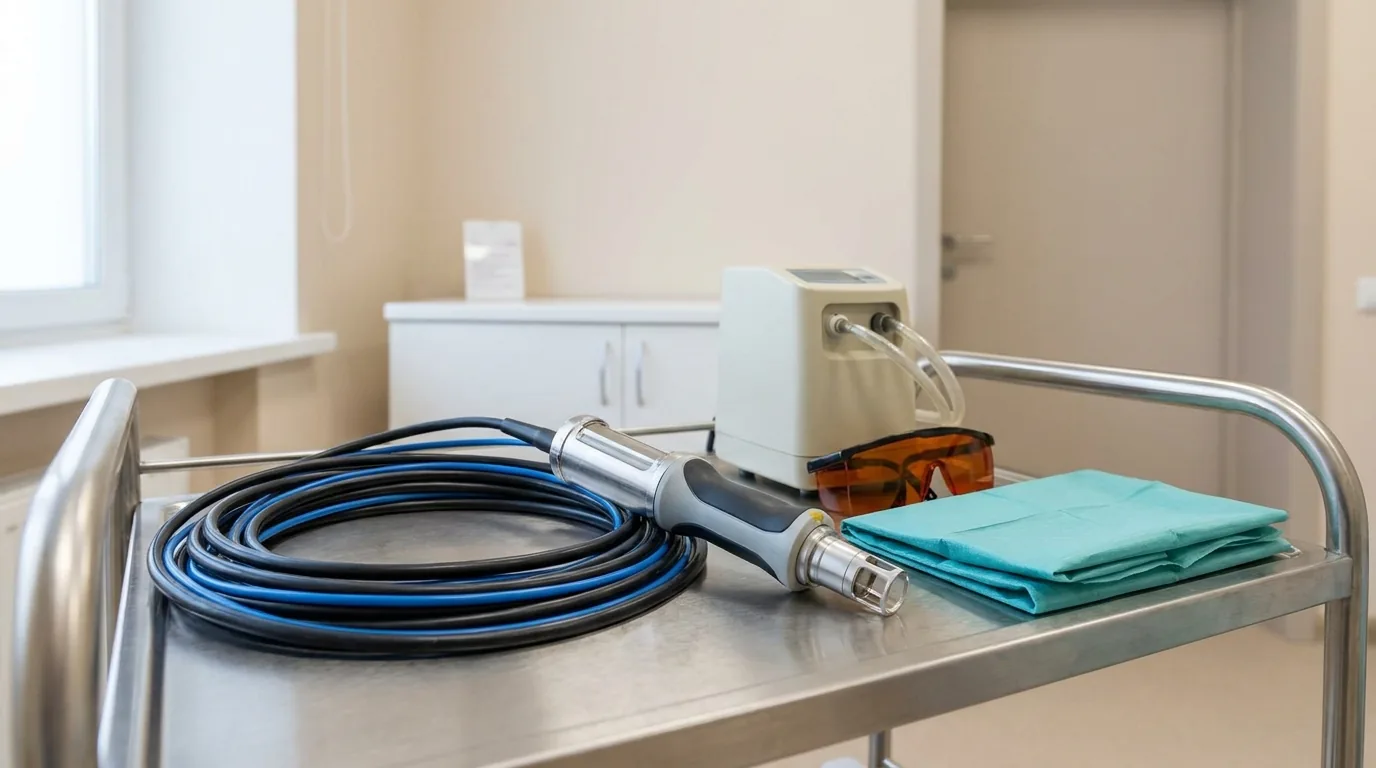
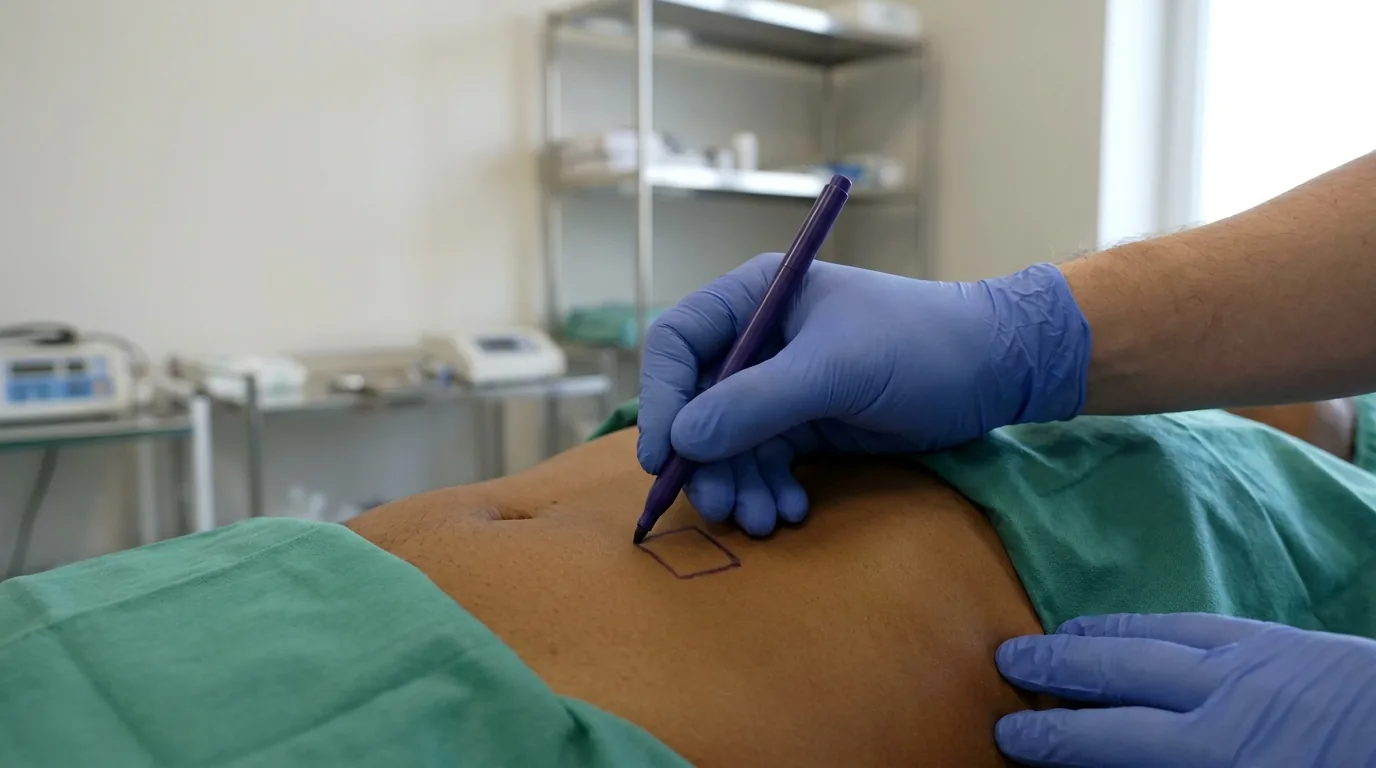
A laser treatment appointment runs 30 to 60 minutes for one area, and most of that is preparation. Numbing cream goes on 30 to 45 minutes before the first pass, the area is cleaned, and eye protection goes on for everyone in the room.
The laser treatment itself takes a few minutes per area. Most people describe fractional passes as hot rubber bands snapping against the skin, tolerable with numbing and a cooling device. Afterwards the skin looks sunburnt and feels tight. That flush fades over four to eight hours, and a sandpaper texture can persist for days. Skin rejuvenation clinics send you home with a bland moisturiser.
How many sessions, and when results actually show
Three to six visits at four to six week intervals is the standard course of laser stretch mark removal, and older white marks push toward the top of that range. Some protocols run longer: the ASDS notes series of up to 20 sessions where marks are extensive.
The lag catches people out. Collagen remodelling continues for three to six months after the last laser treatment, so the result you judge at week four is not the result you paid for. Take your before photographs on day one and hold your verdict until three months after the final visit.
Plateau is the other thing to plan for. If nothing has shifted after three sessions, the device or the settings are wrong for your marks, and a fourth identical session rarely fixes that.
Stretch mark laser cost in Dubai, and what moves it
Stretch mark laser cost in Dubai sits at the upper end of the wider treatment market. Across all methods, single sessions run AED 500 to AED 3,000, with most single-area appointments landing between AED 800 and AED 1,500. Laser treatment usually prices from AED 800 to AED 2,500 per area, so a six-session course on a large area can reach five figures.
Four variables set the price. Area size dominates, since an abdomen takes several times the passes a pair of hips needs. Device family comes next, because ablative platforms bill higher per visit. Then seniority, as a physician-led list price sits above a nurse-led one. Our guide to stretch marks treatment in Dubai breaks the wider cost picture down by method.
Two questions are worth asking before you pay for anything. Get the course total in writing rather than the per-session rate, because six visits turn a comfortable number into an uncomfortable one. Then ask what the clinic does if progress stalls at session three.
Browse all 17 Aesthetic Salons providers on our directory.
Who is licensed to fire a medical laser in Dubai
Dubai splits the paperwork in two, and the gap between the halves is where the risk sits. A trade licence from the Department of Economy and Tourism (DET) registers the business and says nothing about clinical scope. Laser treatment with a medical-grade device needs the second half as well: a Dubai Health Authority (DHA) facility licence for the premises, and a separate DHA professional licence held by whoever presses the pedal.
That split explains most of the price gap you see advertised. Venues carrying the DET trade licence alone are limited to non-medical skin work, so a fractional resurfacing offer at salon rates points to a scope problem. Our directory lists 17 aesthetic clinics across the city, and every entry in the aesthetic clinic directory shows its category.
Verification takes a minute. Search the operator’s name on the DHA Sheryan portal and read the licence status yourself. A clinic that will not name the person treating you has already answered the more important question.
When laser is the wrong call
Laser treatment suits stable marks on stable skin. Several situations make it a poor choice, at least for now:
- Marks less than about six weeks old, which are still changing on their own.
- Recently tanned skin, from sun or a booth, which raises burn and pigment risk sharply.
- Pregnancy and breastfeeding, where clinics defer as a matter of routine.
- Isotretinoin in the last six months, which changes how skin heals.
- A personal history of keloid or hypertrophic scarring.
- An expectation of erasure, which no device on the market delivers.
Loose abdominal skin after pregnancy is its own category. Laser tightens texture and removes no excess skin, so a clinic promising a flat abdomen from a course is overselling. Our listing standards explain what we check before a venue appears in the directory.
Aftercare through a Dubai summer
Fresh laser treatment leaves skin photosensitive for weeks, and Dubai delivers months of strong sun in a row. That turns the calendar into part of the plan rather than an afterthought.
- Keep the treated area out of direct sun and covered with fabric, not just sunscreen, for the first two weeks.
- Use a broad-spectrum SPF 50 on exposed treated skin once the surface settles, and reapply through the day.
- Skip the pool, the beach, the sauna and hot yoga for a week: chlorine, salt and heat all irritate healing skin.
- Moisturise twice a day for the whole course, which the ASDS recommends throughout treatment.
- Start a course in autumn or winter where you can, so the healing weeks fall outside peak summer.


