


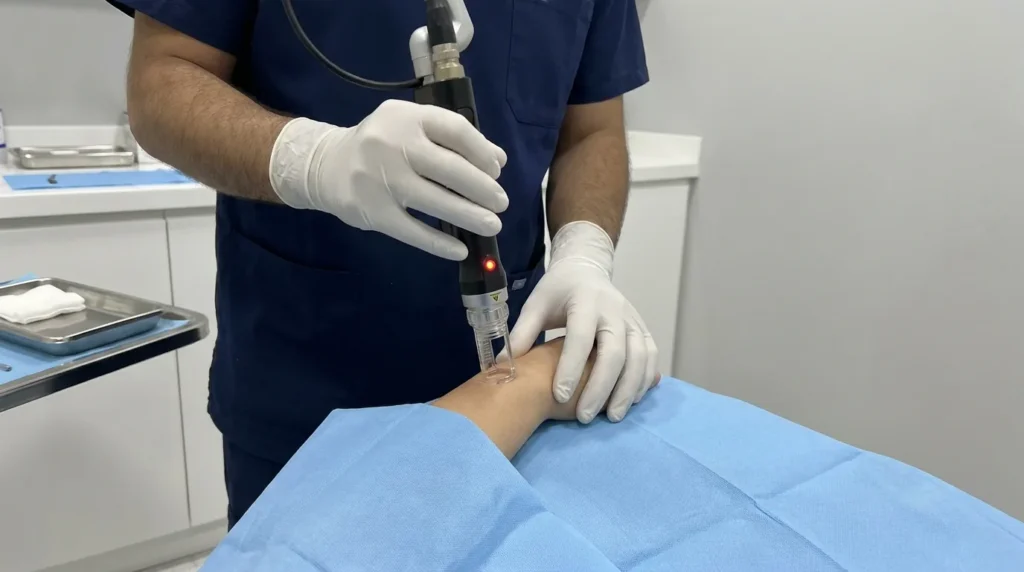
Stretch mark removal describes a set of treatments that fade the marks rather than erase them. Laser resurfacing, microneedling and prescription retinoids soften colour, texture and depth across several sessions. How much they achieve depends mostly on age: fresh red marks respond well, and mature white ones respond slowly.
This guide is general information, not medical advice. Laser resurfacing, microneedling and clinical peels are regulated cosmetic-medical treatments in Dubai: consult a DHA-licensed clinic about your suitability and risks before booking.
What stretch mark removal can and cannot do
A stretch mark is a scar. It forms in the dermis when skin is pulled or released faster than its collagen and elastin can follow, and the American Academy of Dermatology classifies the result as permanent, like any other scar. That single fact reframes the category.
A 2019 review in the Indian Dermatology Online Journal surveyed every published modality and concluded that no fully effective treatment has emerged. What treatment does reliably change is narrower and still worth having. Colour moves closer to the surrounding skin, surface texture smooths, and the depression lifts as new collagen fills it. The marks catch less light, so they read as fainter under overhead lighting and in photographs.
Read a clinic’s promises against that benchmark and the sales language separates from the science quickly. Bodies including the American Academy of Dermatology describe percentage improvement, never removal. A consultation promising clearance is selling something the evidence does not support.
Striae rubra and striae alba: why mark colour changes the plan
Dermatologists split striae into two stages, and the split is visible in a mirror. Early marks are pink, red or purple, and are classed as striae rubra. Older marks are pale, silver or white, and are classed as striae alba. If the stage is still unclear, the guide to the types of stretch marks walks through three checks that date a mark at home.
Under a microscope the difference is structural. In the red stage the epidermis is close to normal and the dermis is swollen and inflamed, with blood vessels sitting near the surface. That inflammation is why the marks look red, and it is also why they respond: an active repair process is already running, and treatment adds to it. In the white stage the epidermis has thinned and flattened, the rete ridges are blunted, and hair follicles and sweat glands are absent from the scar. The repair process has finished, so treatment has to restart something that has settled.
The practical consequence is a timing rule that almost no product marketing mentions. The same device, on the same body, does measurably more in the months while marks are still coloured than it will years later. If you are weighing whether to act now or wait, you are deciding how much of the result to give away.
How to remove stretch marks: the approaches with real evidence
Six approaches carry published evidence. Most clinics combine two rather than run one alone.
| Approach | What it does | Works best on | Realistic expectation |
|---|---|---|---|
| Prescription retinoids (tretinoin) | Stimulates fibroblasts to raise dermal collagen | Red marks under about 12 months old | Modest fading over months of nightly use. Not for use in pregnancy. |
| Cosmetic topicals (glycolic acid, ascorbic acid, hyaluronic acid) | Surface exfoliation and hydration | Very early marks, and prevention | Evidence is thin and effects are small. Cheap to try, easy to over-promise. |
| Microneedling (percutaneous collagen induction) | Micro-channels into the papillary dermis trigger a healing and collagen response | Both stages, and darker skin tones | Gradual texture improvement over a course. Lower pigment risk than ablative lasers. |
| Fractional laser resurfacing | Columns of controlled thermal injury drive collagen remodelling | Texture and depth, both stages | The most studied option. Needs several sessions and carries downtime. |
| Radiofrequency and microneedle RF | Heats the dermis to tighten and remodel without breaking the surface | Laxity around the marks | Useful in combination. Less standalone evidence than lasers. |
| Chemical peel and microdermabrasion | Removes upper skin layers to even surface tone | Shallow marks and surrounding tone | Blends rather than rebuilds. Often a support act, not the main treatment. |
Read down the last column and one pattern stands out: every credible option describes improvement in degrees, and the two device-led rows are the ones that change structure rather than surface. NHS guidance reaches the same conclusion about the creams and lotions sold for this purpose, noting that most carry little evidence behind their claims.
Laser stretch mark removal, device by device
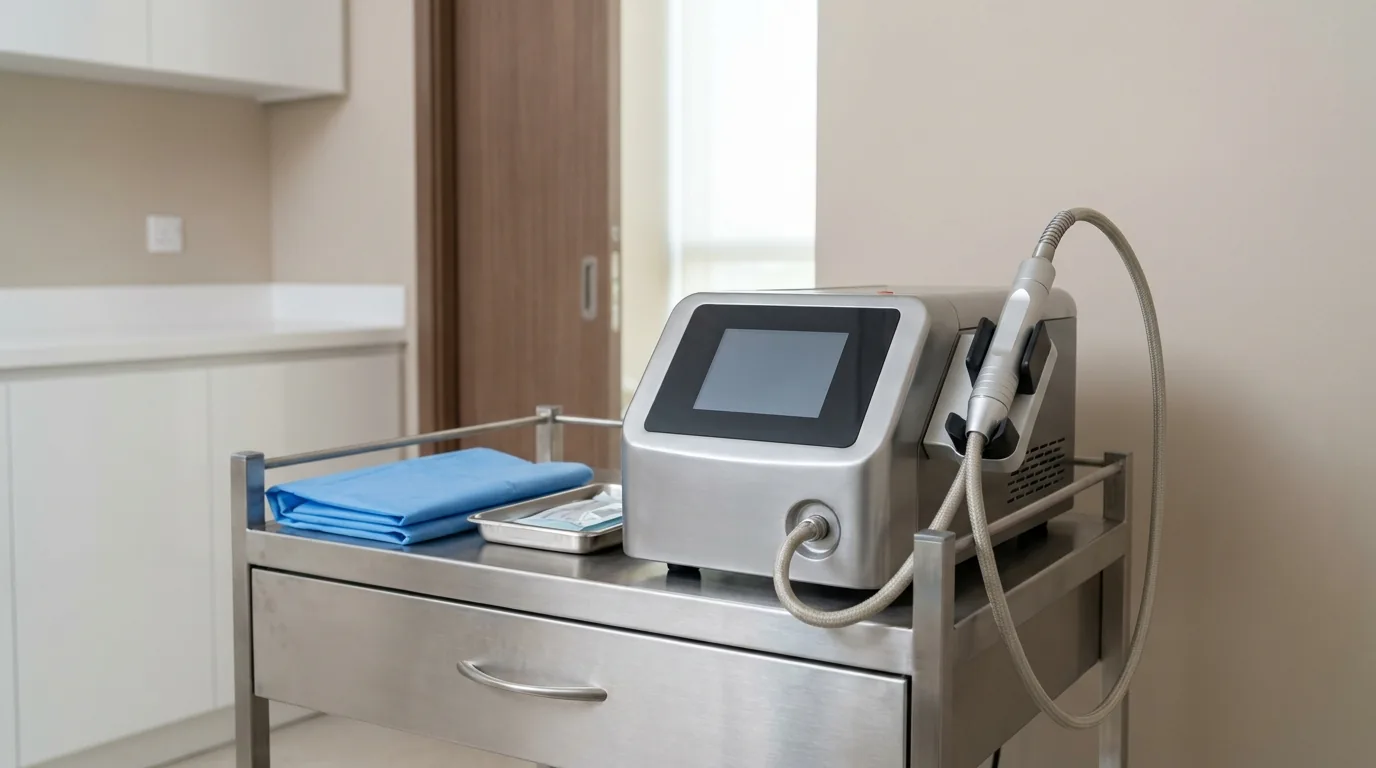
Laser stretch mark removal is not one procedure. Clinics run several wavelengths, and they behave differently enough that the device on the consultation form matters.
Ablative fractional CO2 at 10,600 nm removes columns of tissue and forces a full remodelling response. The 2019 review found it more effective on mature marks than on red ones, which reverses the usual pattern and makes it a serious option for older marks. It also carries the most downtime. Non-ablative fractional erbium glass at 1540 nm and 1550 nm, the family Fraxel devices sit in, heats the dermis without breaking the surface; one case series ran five sessions at four-week intervals and recorded smaller marks at both one month and one year. Head to head, the two families came out roughly equal on results, with the non-ablative option better tolerated. Pulsed dye laser at 585 nm targets the blood vessels that make red marks red, and pairs with fractional work rather than replacing it.
So the best laser treatment for stretch marks is decided by the marks, not by the brochure. Red marks with visible vessels point toward pulsed dye, alone or first. Mature white marks with a textural dip point toward fractional resurfacing. A clinic that offers only one device will fit the marks to the device it owns. Browsing laser skin resurfacing providers across several venues shows which wavelengths are actually available before a consultation. For the device families in more depth, including how skin type changes the settings, see our guide to laser treatment for stretch marks.
How to remove old stretch marks once they turn white
Old stretch mark removal is the harder half of the job, and it is where most disappointment lives. A white mark presents two separate problems: a texture problem, because the dermis is thinned and depressed, and a colour problem, because the scar holds less pigment than the skin around it. One treatment rarely fixes both.
Knowing how to remove old stretch marks therefore means sequencing. Collagen-building work handles texture: fractional resurfacing, microneedling, or the two combined. Pigment needs a different tool. Targeted phototherapy has been studied for exactly this, with one small study reporting better than 51 percent improvement in pigmentation across nine participants after up to ten weekly sessions. Roughly half saw temporary darkening as a side effect, and biopsy showed no change to collagen, which confirms it repigments without rebuilding. Platelet-rich plasma has also outperformed 0.1 percent tretinoin cream on white marks in one direct comparison, though that work awaits larger trials. Some clinics add a light chemical peel between device sessions to even the surrounding tone so the contrast reads as smaller.
What a full course of stretch marks treatment involves
A realistic stretch marks treatment plan is a course, not an appointment. Expect a consultation with a skin assessment, a patch test, and a baseline photograph. Sessions are usually spaced four to six weeks apart to let collagen remodelling run its cycle, and published protocols commonly cover three to six sessions before the result is judged.
The visible change lags the treatment. Collagen laid down after a session keeps maturing for three to six months, so the honest review point sits well after the final visit. Downtime varies by device: non-ablative sessions typically mean a day or two of redness, ablative fractional work means a week or more of visible healing, and microneedling sits between the two. If you are booking around a wedding or a holiday, count backwards using the slower number.

Deeper skin tones and the pigment risk worth planning for
This is the section most global guides skip, and it matters more in Dubai than in most cities. Ablative fractional CO2 carries a documented risk of pigmentary dyschromia alongside redness, pain and crusting, and the 2019 review flags this specifically as a concern in Fitzpatrick skin types IV to VI. A large share of Dubai residents sit in exactly that range.
The workaround is device selection rather than avoidance. Microneedling stimulates collagen without the pigment-triggering heat load, which is why it appears so often in protocols for deeper tones, and non-ablative fractional settings can be dialled down. A test patch in a hidden area, reviewed four to six weeks later, is the single most useful safeguard. Post-inflammatory darkening after energy-based work is a known pattern rather than a rare accident, which is why hyperpigmentation treatment and melasma treatment so often follow the same devices around this region. Clinics with skin specialists on staff tend to be more cautious with settings on deeper tones.
Who is licensed to perform these treatments in Dubai
Two separate licences sit behind a legal laser or microneedling session in Dubai, and they are issued by different authorities. The venue needs a trade licence from the Department of Economy and Tourism (DET), which permits it to operate as a business. The clinical work needs health regulation from the Dubai Health Authority (DHA), which licenses both the facility and the individual practitioner for the procedures they perform.
The distinction is easy to miss on a shop front. A beauty salon holding a DET trade licence alone is licensed to trade, not to operate a medical laser or run a prescription-strength peel. Ask to see the DHA facility licence and the practitioner’s own DHA licence; it settles the question in a minute. Our listing standards explain how venues are recorded, and the aesthetic clinic directory covers 17 venues across the city.

Popular aesthetic and skin clinics in Dubai
Luerur Aesthetic Clinic is a skin care and aesthetic clinic in Al Barsha, on 39th Street behind Saudi German Hospital. It is rated from reviews.Reviewers describe a doctor who explains options clearly and only recommends a procedure when it is genuinely needed, with specific praise for natural looking results after a filler dissolving treatment and for a targeted acne programme that visibly improved skin. As with any aesthetic or medical treatment, outcomes and experiences can vary between visits, so a thorough consultation to set expectations before booking is worth doing.The clinic offers a broad range of treatments, from Botox injections, dermal fillers, chemical peels and skin rejuvenation to laser hair removal, microdermabrasion, PRP therapy, FUE hair transplant and surgical procedures such as rhinoplasty, liposuction and tummy tuck. The venue has on-site appointments, gender-neutral toilets and wheelchair-accessible parking, entrance and seating.
In Al Habtoor Business Tower in Dubai Marina, Cosmesurge Clinic offers botox injections, dermal fillers, body contouring, chemical peels, laser hair removal, rhinoplasty, liposuction and FUE hair transplant among other cosmetic and dermatology treatments. It is rated from reviews.Reviewers consistently describe the doctors as attentive and compassionate, noting that treatment recommendations are conservative rather than pushed, and several return year after year for ongoing skin care. The clinic itself is noted for a modern, welcoming atmosphere with views over the marina.The clinic has on-site services with a wheelchair-accessible entrance, car park, seating and toilet, plus gender-neutral toilets. It suits Dubai Marina residents and visitors researching cosmetic treatments, laser hair removal or dermatology consultations, with a consultation typically recommended before committing to any treatment plan.
Glow Aesthetics Dermatology Clinic is in Al Attar Business Centre in Al Barsha, offering botox injections, dermal fillers, chemical peels, microneedling, laser and IPL hair removal, skin tightening, scar treatment and pigmentation treatment. It is rated from reviews.Reviewers consistently praise the honesty of the medical guidance, noting that the team recommends only what is genuinely needed rather than upselling treatments. The clinic is described as professional and welcoming from arrival, with several highlighting fair pricing relative to the standard of care.The clinic has on-site services with a wheelchair-accessible entrance, car park and toilet. It suits patients across Dubai researching skin treatments, anti-aging facials or laser hair removal, with a consultation recommended to discuss the right treatment plan.
Derma 247 Laser Clinic is a skin and laser clinic in Nadd Al Hamar, rated from reviews. Treatments cover laser and IPL hair removal, botox injections, dermal fillers, chemical peels, pigmentation treatment, skin rejuvenation and tattoo removal.Reviewers consistently mention feeling well informed before and during laser sessions, with practitioners who explain each step in plain terms and check in throughout rather than rushing through the appointment. That attentiveness comes up often enough to be a genuine pattern rather than a one-off.The clinic runs by appointment, with on-site services and a fully wheelchair-accessible setup including gender-neutral toilets. It suits anyone after laser or aesthetic treatments who wants a clinical, unhurried approach rather than a quick in-and-out visit.
Novomed - Aesthetica is an aesthetic and plastic surgery clinic in Umm Suqeim 3, rated from reviews. The clinic's range spans injectables such as Botox and dermal fillers, body contouring and surgical procedures including liposuction, tummy tucks, breast augmentation and rhinoplasty, skin treatments such as chemical peels and laser resurfacing, hair transplants and tattoo removal. Many reviewers describe a highly professional, attentive consultation experience and results that met or exceeded expectations, with the clinic's aesthetic doctors singled out for precision and a natural-looking approach. A small number of reviews raise concerns about the number of sessions needed for tattoo removal and about cost, so it is worth agreeing the full treatment plan and pricing in detail before starting a course of sessions. The clinic has a wheelchair-accessible car park and entrance.
Browse all 17 Aesthetic Salons providers on our directory.
Permanent stretch mark removal: what the phrase actually covers
Permanent stretch mark removal is a marketing phrase rather than a clinical one. The improvement from collagen remodelling is durable, so a mark that fades after a completed course generally stays faded. The scar itself remains in the dermis. Some clinics file the work under stretch marks rejuvenation rather than removal, which sits closer to what the treatments actually deliver. New marks can also form later if rapid weight change or a hormonal shift stretches the skin again, and no completed course prevents that.
Sun, sweat and keeping results through a Dubai summer
Aftercare carries more weight in this climate, because ultraviolet exposure is the fastest way to lose a pigment result that took months to earn.
- Apply broad-spectrum SPF 50 daily to any treated area that will see daylight, and keep it up through the full course and for several months afterwards.
- Keep your treated skin out of pools and the sea for 48 hours after microneedling and up to a week after ablative laser work; chlorine and salt both irritate a healing barrier.
- Skip the gym for 24 to 48 hours after microneedling. Sweat on open micro-channels in summer humidity raises infection risk.
- Leave retinoids and acids off the treated area for about a week either side of a session unless your clinic instructs otherwise.
- Photograph the area in the same light every four weeks. Gradual change is hard to judge from memory, and your own photographs decide whether a course is worth continuing.


