


The best treatment for melasma on the face is a layered plan, not a single fix: daily broad-spectrum SPF, a prescription topical such as hydroquinone or azelaic acid, and a gentle in-clinic procedure like a superficial chemical peel or low-energy laser only if pigment persists. Most people in Dubai pay AED 449 to AED 5,000 across a full course.
This guide is general information, not medical advice. Melasma is a regulated cosmetic-medical condition in Dubai. Prescription creams, chemical peels, and laser are clinical treatments: consult a DHA-licensed dermatologist about your skin type, suitability, and risks before starting any plan.
What causes melasma on the face
Melasma is a chronic pigment disorder. Overactive pigment cells called melanocytes push out extra melanin, leaving symmetrical brown or grey-brown patches on the cheeks, forehead, upper lip, and bridge of the nose. Three triggers drive it: ultraviolet light, heat, and hormones.
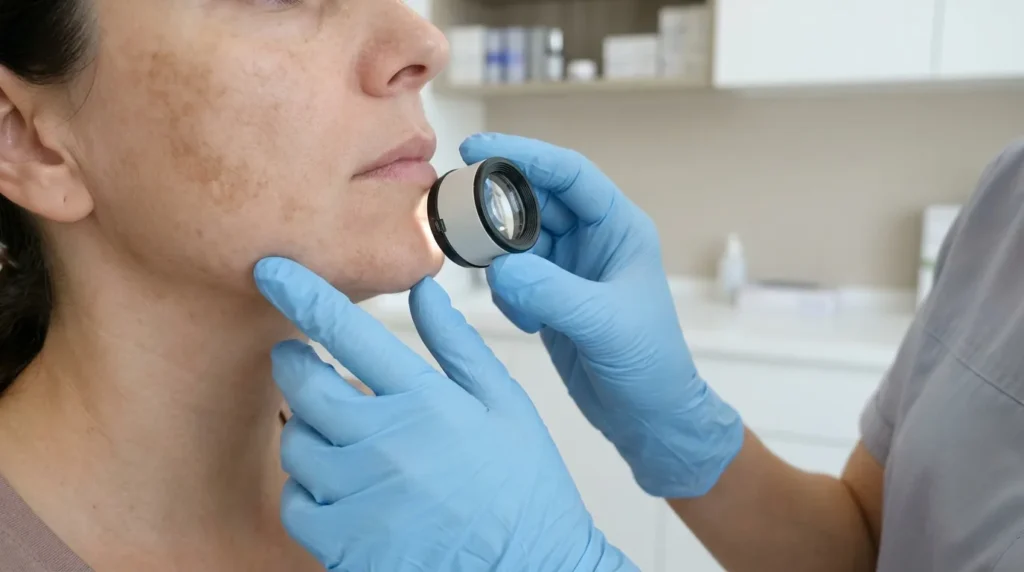
Sun exposure is the main one, which matters in Dubai where UV stays high most of the year. Hormonal shifts from pregnancy, the contraceptive pill, or hormone therapy explain why melasma is far more common in women. Because the patches are deep and stubborn, melasma needs steady management rather than a one-off cure, and it sits within the wider category of pigmentation treatment a clinic offers. A dermatologist confirms the diagnosis, sometimes with a Wood’s lamp, and rules out other pigment problems before treatment begins.
What is the best treatment for melasma on the face?
There is no single best treatment that works for everyone. The right plan depends on how deep the pigment sits, your skin tone, and what triggered it. A dermatologist usually works through three levels in order, stepping up only when the previous level stalls.
- Foundation (everyone): strict daily sun protection. Nothing else holds without it.
- First line: prescription topical creams, used for short, supervised cycles.
- Stubborn cases: in-clinic chemical peels or carefully chosen low-energy laser, layered on top of creams and SPF.
This order matters because melasma reacts badly to heat and aggressive treatment. Starting with a strong laser before settling the pigment with creams and sun protection often makes the patches worse, not better. The table below sets out which option suits which case.
| Approach | Best for | How it works | Pace of results |
|---|---|---|---|
| Sun protection + topicals | Mild to moderate, first attempt | Blocks UV, slows pigment production | Slow, 8 to 12 weeks |
| Chemical peels | Surface pigment that resists creams | Exfoliates pigmented skin cells | Gradual, over a course |
| Low-energy laser | Deep, resistant patches | Targets pigment with controlled energy | Gradual, high relapse risk |
| Oral tranexamic acid | Widespread cases, doctor-led | Calms pigment signalling from within | Slow, prescription only |
The takeaway: build from the bottom up. Skipping the foundation is the most common reason melasma treatment fails.
First-line topical treatments that fade melasma
Prescription creams are the proven first step for melasma on the face. A dermatologist matches the active ingredient to your skin and supervises how long you use it, because some of these are meant for short cycles only. The best cream for melasma is usually a prescription one, not an over-the-counter pick.
| Ingredient | What it does | Notes |
|---|---|---|
| Hydroquinone | The most effective single agent; blocks pigment formation | Short cycles only, under supervision |
| Triple combination cream | Hydroquinone, a retinoid, and a mild corticosteroid together | Strongest topical; short-term use |
| Azelaic acid | Calms inflammation and curbs overactive pigment cells | Well tolerated, safe in pregnancy |
| Tranexamic acid | Reduces pigment signalling; topical or oral | Oral form is prescription only |
| Kojic acid | Gentle pigment inhibitor, often paired with others | Good for sensitive skin |
| Cysteamine | Fades pigment with results near hydroquinone | Suited to longer-term use |
Over-the-counter options help too. Niacinamide slows how pigment moves into skin cells, and a stable vitamin C serum supports the prescription plan. These are gentler, so they work slowly and suit maintenance rather than clearing deep patches on their own. A retinoid at night speeds cell turnover and helps the actives work, but it also raises sun sensitivity, which makes the next step non-negotiable.
Sun protection: the base every melasma plan needs
Sun protection is the single most important melasma treatment, and the one people skip. Melasma is driven by UV and heat, so any cream or laser result fades fast without daily defence. In Dubai’s climate this is the make-or-break habit.
- Use a broad-spectrum sunscreen of SPF 30 or higher, every day, indoors and out.
- Choose a mineral formula with zinc oxide or titanium dioxide; tinted versions also block visible light, which worsens melasma.
- Reapply every two to three hours when you are outside or near windows.
- Add a wide-brimmed hat and shade during peak Gulf sun hours.
Treat sunscreen as the treatment, not an add-on. It is what keeps every other step from going to waste.
In-clinic procedures for stubborn melasma
When sun protection and creams are not enough, a dermatologist may add an in-clinic procedure. These come second, never first, and they are layered on top of the topical plan rather than replacing it. On the face, the rule is gentle and conservative, because melasma flares when the skin is overheated.
Chemical peels
A chemical peel for melasma uses superficial glycolic or salicylic acid to lift away pigmented surface cells over a short course. Peels suit surface pigment that resists creams and are usually the first procedure tried, since they carry less heat risk than laser. Ask the clinic whether a chemical peel course or a single session fits your skin.
Laser and light therapy
Only specific low-energy devices are safe for melasma, such as Q-switched and picosecond lasers set conservatively. They target deeper pigment without the aggressive heat that triggers a relapse. Melasma laser treatment is reserved for resistant patches, and even then the pigment often returns without ongoing topicals and SPF. Some clinics combine it with laser skin resurfacing protocols for layered cases.
Microneedling
Microneedling creates tiny channels that help pigment-fading serums absorb and can support a combination plan. It is an add-on, not a standalone cure.
One caution matters most in this region. Darker skin tones, common across the Gulf and South Asian communities in Dubai, carry a higher risk of post-inflammatory hyperpigmentation, where the treatment itself leaves new dark marks. A clinician experienced with deeper skin types should set the energy and pick the device, which is exactly why melasma laser is clinic-only work handled by skin specialists rather than general salons.
Melasma treatment in Dubai runs through skin and aesthetic clinics rather than general salons, because peels, laser, and prescription creams need licensed clinical staff. Pigment conditions overlap, so the same clinics also handle wider hyperpigmentation treatment such as sunspots and post-acne marks. The venues below rank by directory rating and review volume, scored against our ranking method.

Popular skin and aesthetic clinics in Dubai
Luerur Aesthetic Clinic is a skin care and aesthetic clinic in Al Barsha, on 39th Street behind Saudi German Hospital. It is rated from reviews.Reviewers describe a doctor who explains options clearly and only recommends a procedure when it is genuinely needed, with specific praise for natural looking results after a filler dissolving treatment and for a targeted acne programme that visibly improved skin. As with any aesthetic or medical treatment, outcomes and experiences can vary between visits, so a thorough consultation to set expectations before booking is worth doing.The clinic offers a broad range of treatments, from Botox injections, dermal fillers, chemical peels and skin rejuvenation to laser hair removal, microdermabrasion, PRP therapy, FUE hair transplant and surgical procedures such as rhinoplasty, liposuction and tummy tuck. The venue has on-site appointments, gender-neutral toilets and wheelchair-accessible parking, entrance and seating.
In Al Habtoor Business Tower in Dubai Marina, Cosmesurge Clinic offers botox injections, dermal fillers, body contouring, chemical peels, laser hair removal, rhinoplasty, liposuction and FUE hair transplant among other cosmetic and dermatology treatments. It is rated from reviews.Reviewers consistently describe the doctors as attentive and compassionate, noting that treatment recommendations are conservative rather than pushed, and several return year after year for ongoing skin care. The clinic itself is noted for a modern, welcoming atmosphere with views over the marina.The clinic has on-site services with a wheelchair-accessible entrance, car park, seating and toilet, plus gender-neutral toilets. It suits Dubai Marina residents and visitors researching cosmetic treatments, laser hair removal or dermatology consultations, with a consultation typically recommended before committing to any treatment plan.
Glow Aesthetics Dermatology Clinic is in Al Attar Business Centre in Al Barsha, offering botox injections, dermal fillers, chemical peels, microneedling, laser and IPL hair removal, skin tightening, scar treatment and pigmentation treatment. It is rated from reviews.Reviewers consistently praise the honesty of the medical guidance, noting that the team recommends only what is genuinely needed rather than upselling treatments. The clinic is described as professional and welcoming from arrival, with several highlighting fair pricing relative to the standard of care.The clinic has on-site services with a wheelchair-accessible entrance, car park and toilet. It suits patients across Dubai researching skin treatments, anti-aging facials or laser hair removal, with a consultation recommended to discuss the right treatment plan.
Derma 247 Laser Clinic is a skin and laser clinic in Nadd Al Hamar, rated from reviews. Treatments cover laser and IPL hair removal, botox injections, dermal fillers, chemical peels, pigmentation treatment, skin rejuvenation and tattoo removal.Reviewers consistently mention feeling well informed before and during laser sessions, with practitioners who explain each step in plain terms and check in throughout rather than rushing through the appointment. That attentiveness comes up often enough to be a genuine pattern rather than a one-off.The clinic runs by appointment, with on-site services and a fully wheelchair-accessible setup including gender-neutral toilets. It suits anyone after laser or aesthetic treatments who wants a clinical, unhurried approach rather than a quick in-and-out visit.
IV Wellness Lounge is on Marble Walk in Zaa'beel Second, DIFC, rated from reviews. Alongside its IV therapy sessions, the lounge offers detox programmes, lymphatic drainage, massage therapy, meditation sessions, yoga classes, anti-aging facials, chemical peel, dermal fillers, botox injections and laser hair removal.IV therapy is what reviewers talk about most, describing sessions as gentle and comfortable with a noticeable lift in energy afterward. The space itself gets repeated praise too, called calming, clean and beautifully designed rather than clinical, and reviewers consistently describe the staff as attentive and quick to explain what each session involves. The on-site cafe also gets a mention for a good drink after a session.With on-site services and a wheelchair-accessible car park and entrance, the lounge suits a considered wellness visit in DIFC.
You can also browse the full list of skin specialists on our directory:
Browse all 56 Skin Care Salons providers on our directory.
What melasma treatment costs in Dubai
Melasma is a course, not a one-visit fix, so budget for several sessions plus prescription creams. A cream-led plan sits at the budget end, while layered peel-and-laser protocols with a specialist dermatologist reach the premium tier.
| Tier | Typical price | Duration | Room | Products | Staff experience | Best for |
|---|---|---|---|---|---|---|
| Budget | AED 449 to AED 900 | 30 to 45 min | Standard clinic room | Prescription creams, single peel | GP or aesthetician under supervision | Shallow, early melasma; cream-led plans |
| Mid | AED 900 to AED 2,500 | 45 to 60 min | Dedicated treatment room | Peels plus low-energy laser course | Dermatologist or trained aesthetician | Combination plans; stubborn patches |
| Premium | AED 2,500 to AED 5,000+ | 60 min plus review visits | Private dermatology suite | Advanced laser, tranexamic acid, full plan | Specialist dermatologist | Resistant or widespread melasma |
Browse all 14 budget-tier Skin Care Salons providers on our directory.
Prices shift by area. Clinics in premium districts such as Jumeirah and Downtown sit higher, often AED 900 to AED 5,000 for a full protocol, while clinics in Deira, Bur Dubai, and Al Karama tend to come in lower, around AED 300 to AED 1,600 for the same plan.
Is melasma treatment regulated in Dubai?
Yes. Melasma treatment is regulated cosmetic-medical care, so where you go matters as much as what you choose. A clinic offering peels, laser, or prescription creams needs two approvals to operate legally.
- A trade licence from the Department of Economy and Tourism (DET), which permits the business to operate.
- A health facility licence from the Dubai Health Authority (DHA), with DHA-licensed clinicians performing the clinical work. Most melasma care is delivered by aesthetic clinics holding both approvals.
Prescription-strength hydroquinone and oral tranexamic acid are issued by a licensed doctor, not bought over the counter or online. Before booking, confirm the clinic is DHA-licensed and ask who performs the procedure. The directory only lists licensed skin and aesthetic providers, which removes the guesswork.
What to expect and how long results take
Melasma fades slowly, and patience is part of the treatment. Topicals usually need eight to twelve weeks before a clear change shows, and in-clinic procedures work over a course rather than a single visit. A typical journey looks like this.
- Consultation: a dermatologist examines the patches, checks your skin type, and identifies triggers.
- Foundation phase: daily SPF plus a prescription cream for a set cycle.
- Review: the clinic assesses progress and decides whether a peel or laser is needed.
- Maintenance: ongoing sun protection and gentler topicals to hold results and limit relapse.
Because melasma is chronic, maintenance never fully stops. The patches can return with sun, heat, or hormonal changes, so the plan shifts to keeping them faded rather than expecting a permanent cure. Gentle facial treatments can support the upkeep between dermatology reviews.
Common melasma mistakes to avoid
- Skipping daily sunscreen, which undoes every other step.
- Jumping straight to laser before settling the pigment with creams and SPF.
- Buying unregulated skin-whitening creams online instead of a prescribed plan.
- Choosing a clinic on price alone without checking DHA licensing.
- Expecting a permanent cure rather than steady, managed fading.
- Stopping treatment the moment patches lighten, which invites a fast relapse.


