



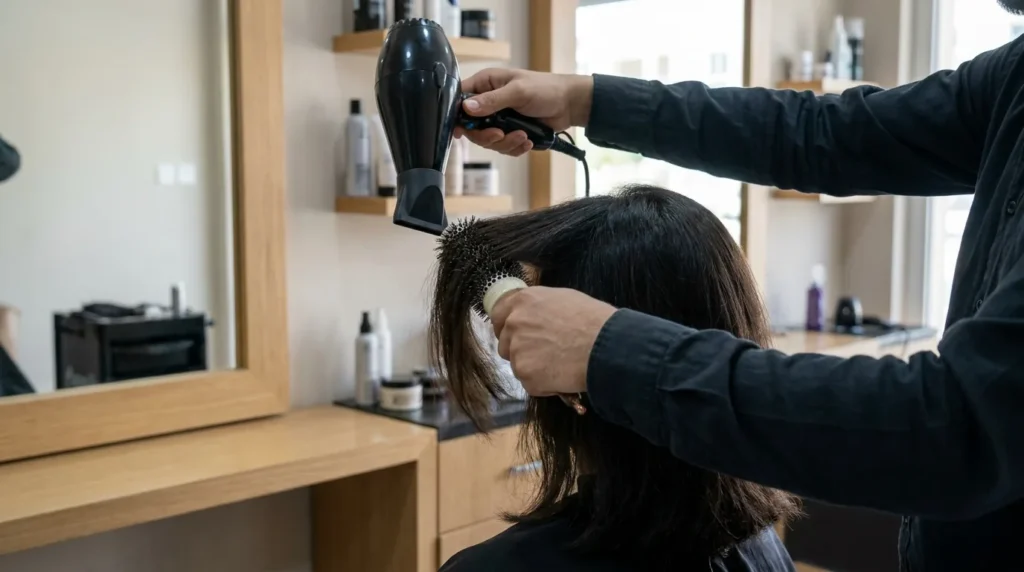
Can I blow dry dry hair? Yes, with two adjustments. Hair that is already dry takes heat without the cooling effect water gives it, so the strand reaches the airstream temperature faster. Hold the dryer about 15 cm away, keep it moving, and use a heat protectant even on day two. Distance matters more than wetness.
What changes once the water is gone
Wet hair carries its own brake. Water sitting on and inside the strand absorbs energy as it evaporates, which keeps the surface well below the temperature of the air leaving the dryer. Once that water is gone, so is the brake. The same setting that felt mild on damp hair now puts full heat onto the cuticle.
The cuticle is the layer doing the protecting. It is a shell of overlapping keratin scales wrapped around the cortex, sealed by a thin lipid film and bound by the cell membrane complex. Heat lifts and cracks those scales. Laboratory work on hair dryers found no damage to the cortex at any temperature, which is why heat shows up as roughness, dullness and frizz long before anything snaps. That is the risk profile when you blow dry dry hair: the surface, not the structure.
So the honest answer to can I blow dry dry hair is that the technique carries the risk, not the timing. Styling second-day hair for ten minutes at a sensible distance does less to the strand than gripping soaking wet hair with a brush for forty. What follows is the version that keeps the cuticle intact, and the checks hair salons in Dubai run before putting a client under a dryer at all.
Is it better to blow dry hair wet or dry?
Neither state is safe on its own, and each fails differently. Wet hair is soft and swollen: a strand can absorb close to a third of its own weight in water, and that swelling stretches the internal structure until brushing or high heat breaks it. Dry hair holds its shape but has nothing left to absorb the heat, so the surface scorches instead. Anyone choosing to blow dry dry hair is trading one failure mode for the other.
The window most stylists work in sits between the two. Rough dry or air dry to roughly 80 percent, then finish with the dryer while the hair is barely damp. That gives enough water to reset the hydrogen bonds that hold a style, and not enough to leave the strand swollen and fragile. That window does not exist when you blow dry dry hair, which is why distance and heat setting carry the whole load.
| Hair state | What actually goes wrong | Safer move |
|---|---|---|
| Soaking wet | Swollen strand plus brush tension equals mid-length breakage | Squeeze out with a microfiber towel and wait |
| About 80 percent dry | Little goes wrong: this is the working window | Full styling with a round brush and nozzle |
| Already dry | No evaporation, so surface temperature climbs fast | Mist lightly, drop the heat, add distance |
Read across the table and the pattern is simple: wet hair fails from tension, dry hair fails from temperature, and the fix for each is the opposite of the other.
How to blow dry dry hair without scorching it
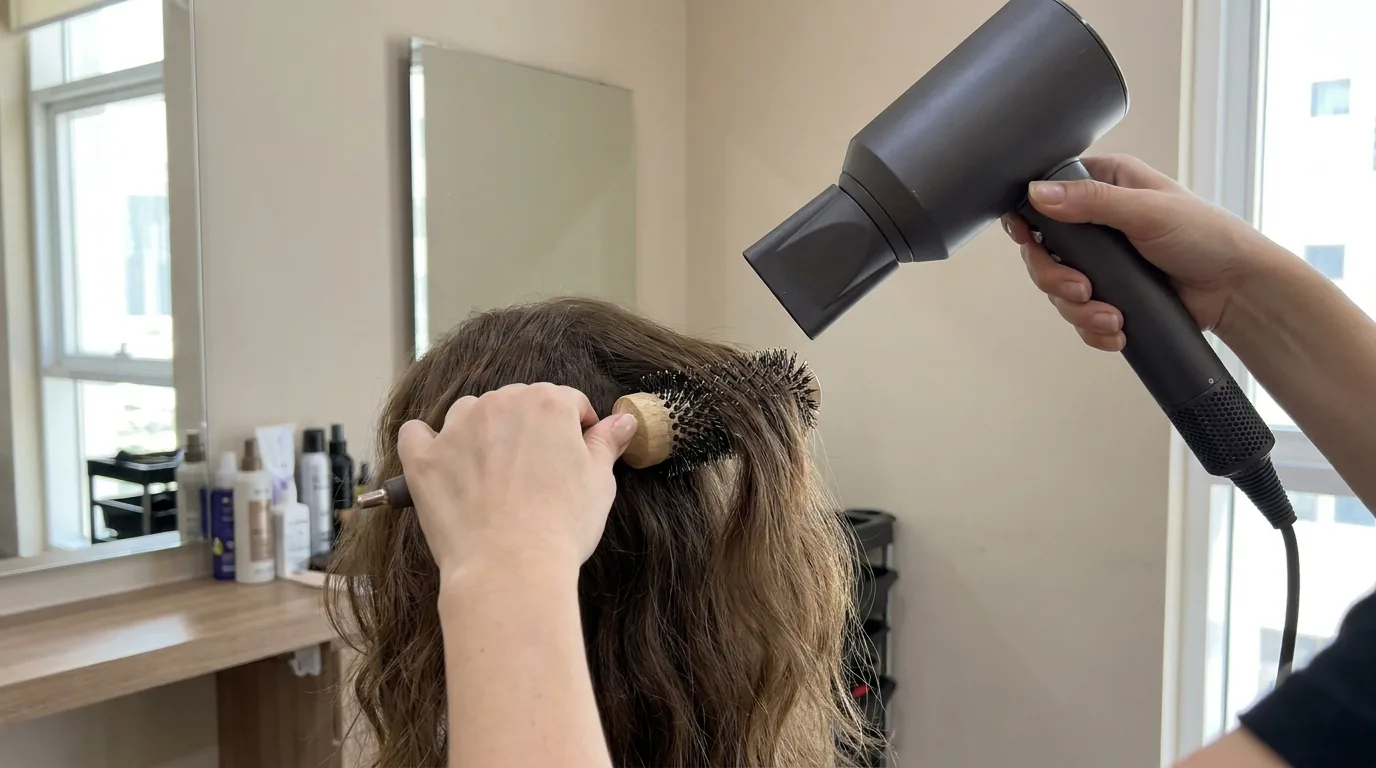
Styling on day two is a different job from drying. The hair only needs shape, so most of the dryer time goes into tension and airflow rather than into removing water. The routine below is how to blow dry dry hair for shape, not for water removal.
- Mist, do not soak. A few passes with a spray bottle on the sections being restyled brings back a little of the buffer and lets the shape actually set.
- Use heat protectant on dry hair too. Most people apply it out of the shower and skip it the next day, which is the day the strand has no water to hide behind.
- Fit the nozzle. A concentrator points the air down the cuticle instead of blasting it open, and it keeps stray heat off the scalp.
- Drop the heat, keep the airflow. Medium heat with the fan high moves as much air without the temperature spike.
- Work in sections. Four to six clipped sections mean each one gets a short pass instead of the same patch being reheated while the rest waits.
- Never park the nozzle. Continuous motion is what keeps peak temperature off any single spot.
- Finish on cool. The cool shot closes the cuticle and locks the shape, and it costs about twenty seconds.
Ten minutes of that is a refresh. Thirty minutes of hot air chasing a style that will not hold is where damage accumulates, and it usually means the hair needed washing rather than restyling. Stylists work the same order on the chair, so how often you blow dry dry hair matters as much as the sequence. Technique is one of the things assessed in our salon ranking method.

Popular hair salons in Dubai
Collective is a hair salon inside the MAG Warehouses complex in Al Quoz Industrial Area 2, rated from reviews. Services cover hair colouring, balayage, hair highlights, hair extensions, keratin treatment, ladies haircuts, blow dry, bridal makeup, manicures, gel pedicures and waxing services. Several reviewers like the modern, classy interior and mention stylists using Dyson equipment for finishing, with one client describing a playful, well judged cut from a stylist who listened closely to the brief. Feedback on colour work is more mixed, with one detailed report describing hair damage and billing disagreements after a balayage and toner service, so it makes sense to agree the full scope and price before any colour treatment begins. The salon has a toilet on site along with wheelchair-accessible parking and entrance.
Version Francaise is a hairdressing salon inside the Marriott Harbour Hotel and Suites in Dubai Marina, offering haircuts, hair colouring, highlights, hair extensions, keratin treatment, blow dry styling, threading, manicures and nail art. It is rated from reviews.Reviewers consistently describe the salon as welcoming, with several returning for years and calling it their regular salon for haircuts and colour treatments. The team is praised for professionalism, attention to detail and a warm welcome from arrival to the end of the appointment.The salon has free Wi-Fi, on-site services, a wheelchair-accessible entrance, car park and toilet, plus gender-neutral toilets. It suits residents and hotel guests in Dubai Marina after a haircut, colour service or hair treatment appointment, with appointments recommended given the salon's loyal following.
Locks By Lou Lou is a hair salon on Al Wasl Road in Jumeirah, rated from reviews. Reviewers consistently praise the colour work, from balayage and highlights to root touch ups, and several mention hair extensions that look natural rather than obviously fitted. Clients also note that stylists take time to understand what they want before starting and explain aftercare so hair stays in good condition afterwards.Beyond colour, the salon offers blow dry, keratin treatment, hair extensions, manicure, gel pedicure, microneedling and anti-aging facial treatments. The entrance is wheelchair accessible and there is an on-site toilet.Appointments are recommended, particularly for colour and extension work, and the salon suits clients looking for an ongoing colourist relationship rather than a single visit.
Version Francaise Pour Elle is a hairdresser and beauty salon on Al Wasl Road, Al Safa 2, rated from reviews. Services span hair colouring, balayage, highlights, extensions, keratin treatment and blow dry, ladies' haircuts, beard trim, manicure, gel nails, gel pedicure, eyelash extensions, anti-aging facials and waxing.Reviewers consistently praise the colour and highlight work, describing meticulous stylists who take the time to understand what a client wants even when it is hard to explain. The salon is also noted for its cleanliness, product quality and reasonable prices, with several reviewers mentioning the owner is regularly on site overseeing the team and the client experience.Free Wi-Fi and parking are available. Suits clients after precise colour work from a team that takes the time to get it right.
Trinity Hair Salon is a hair salon in Al Barsha South, based at Danube Resortz, rated from reviews.Colour work is what reviewers talk about most, with several describing years of trust in the stylists for balayage, highlights and full colour changes, including recovering from a previous bad dye job elsewhere. The salon also offers ladies haircuts, blow dries, hair treatment and a back massage, plus manicures and pedicures. More than one reviewer describes the atmosphere as warm and modern with a good energy, and says they would not trust anyone else with their hair colour.There is a toilet on site, the salon offers on-site services, and a wheelchair-accessible car park makes it an easy stop for residents around Al Barsha South.
Browse all 1,784 Blow Dry providers on our directory.
How far to hold the dryer, measured in degrees
Distance is the one variable with published numbers behind it. A dermatology trial shampooed and dried hair tresses 30 times at set distances and measured what the surface reached, and the gap between a lazy grip and a controlled one turned out to be enormous.
| Distance from hair | Surface temperature | What it did to the strand |
|---|---|---|
| 5 cm | 95°C | Heaviest surface damage, with colour lightening after 10 sessions |
| 10 cm | 61°C | Moderate cuticle disruption |
| 15 cm | 47°C | Least dryer damage of the three |
| Room air, no dryer | 20°C | Only group with cell membrane complex damage |
The last row is the one people find surprising. Leaving hair to dry in the air was gentler on the surface but was the only condition that damaged the internal glue between cuticle layers, because the strand stayed swollen for longer. The trial concluded that a dryer held at 15 cm and kept moving does less harm than letting hair dry naturally (Annals of Dermatology).
A spread hand is roughly that distance, which makes it easy to check without measuring. Anyone who plans to blow dry dry hair often should treat that hand span as the fixed part of the routine and let heat setting, product and speed vary around it.
Does blow drying cause hair loss?
Not in the way the question usually means. Heat acts on the hair shaft, which is dead protein, while shedding starts at the follicle under the scalp. The same split applies when you blow dry dry hair: the strand takes the hit and the follicle is untouched. Breakage from repeated heat produces short, uneven pieces that stand up at the crown and read as thinning in the mirror, but the follicle keeps producing.
There is a quick way to tell the two apart. Pick up a strand from the floor or the brush and look at the root end. A shed hair comes out full length with a small pale bulb attached. A broken piece is shorter than the rest of the hair and has no bulb, just a blunt or split end.
A brush full of the second kind points at heat, tension and product. It responds to a protein treatment for hair and lower temperatures rather than to a hair loss consultation.
Two genuine risks sit alongside that. Constant pulling at the hairline with a round brush contributes to traction alopecia over years, and holding a hot nozzle against the scalp can irritate or burn the skin, which no styling result is worth. Dermatology bodies group heat styling with bleaching and tight styles as habits that damage hair rather than as a cause of baldness (American Academy of Dermatology). Shedding that continues for months belongs with a doctor, not with a different dryer.
Why the dry blow dry is a Dubai habit
Residents here blow dry dry hair more often than the technique’s reputation suggests, and the climate explains most of it. Summer humidity collapses a smooth finish within a day, air conditioning pulls moisture out of the lengths overnight, chlorine and gym sessions leave hair clean but flat, and dust after a shamal settles on the roots.
The maths also nudges people towards it. A salon blow dry in Dubai runs AED 150 to 350 at mid tier venues, from AED 40 at budget bars and above AED 350 at premium suites, so stretching one appointment across three days with a quick restyle at home is the cheaper habit. salonsindubai.ae lists 167 hair salons across Dubai, and the busy ones book out on Thursday and Friday evenings.
Dubai water is hard, which leaves mineral residue that makes hair feel coarse and tempts another round of heat to smooth it. A weekly hair mask or a clarifying wash does that job without the dryer, and a scalp treatment is the better answer when the roots go greasy faster than the lengths go limp.
Restyling before an evening out in July, when humidity peaks after sunset, buys a couple of hours at most. Book the blow dry closer to the event, or set the style with cool air and pins instead.
Who should leave the dryer alone
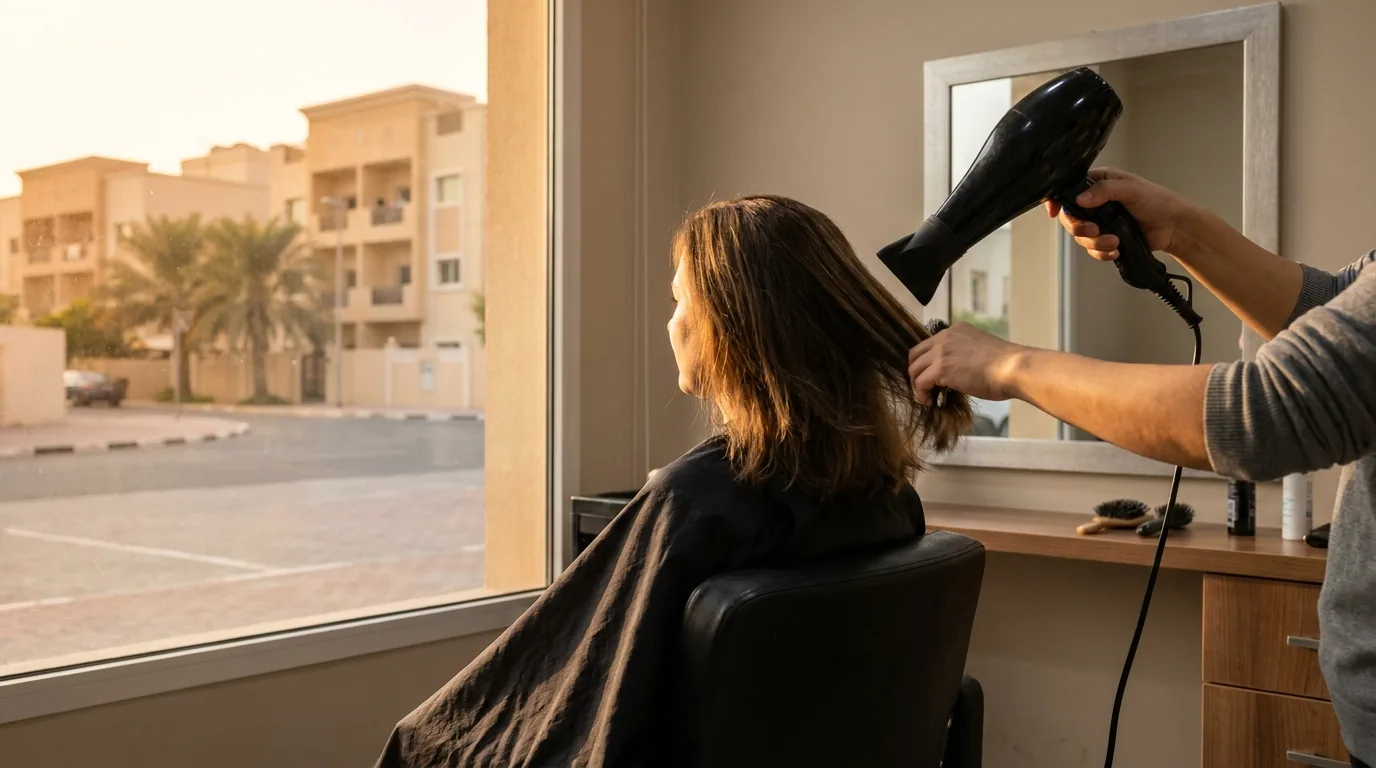
Some hair cannot absorb a second heat session in the same week, and pushing it is how a maintenance habit turns into a salon repair bill. For the groups below, the answer to can you blow dry dry hair is no, or at least not this week.
- Bleached or highlighted hair. Lightening already opens the cuticle, so heat compounds damage the strand cannot repair.
- Fine or low density hair. Less mass means less thermal buffer, and breakage shows immediately at the ends.
- Chemically straightened or permed hair. The bonds have been rearranged once, and heat on dry hair can pull the result out of shape.
- Extensions and bonded systems. Heat near the attachment point weakens tape and keratin bonds.
- Active shedding or a sore, flaking scalp. Treat the scalp first, then style.
When hair in one of those groups needs reviving, a salon service beats another pass with the dryer. Options and price bands sit in our guide to hair treatments in Dubai, and more of the same reading sits in the hair section.
Every salon in the city trades on a DET trade licence. Any venue offering treatments that go beyond styling into clinical scalp or hair loss work needs a DHA health licence as well, so it is worth asking which one a venue holds before booking anything described as medical.
For a straightforward finish rather than a repair, the service itself is listed as a standard blow dry at most venues, usually 30 to 45 minutes.


