


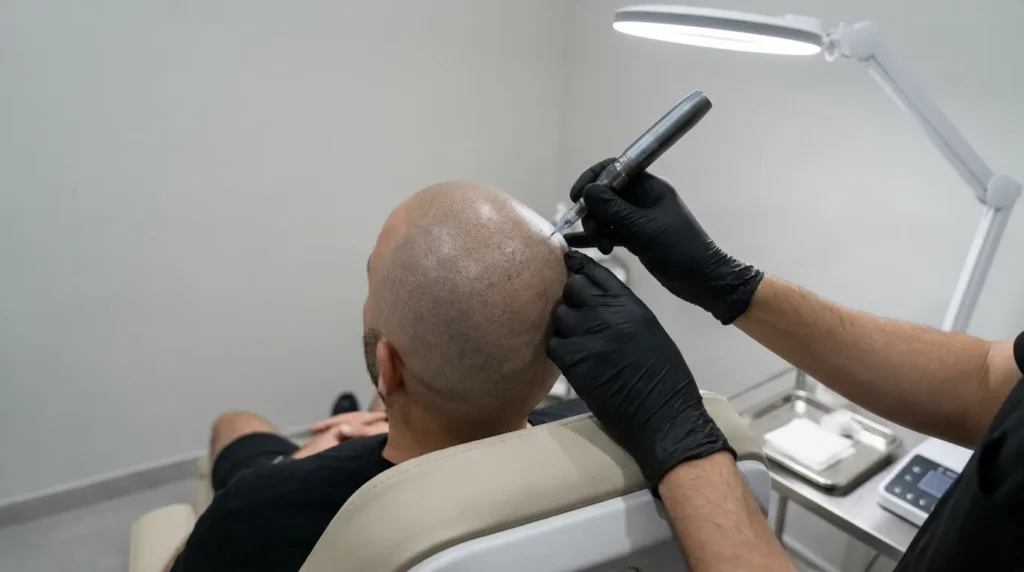
A hair tattoo in Dubai costs AED 1,500 to 4,000 for a hairline, AED 4,000 to 8,000 for crown density, and AED 10,000 or more for a full shaved-head look. The technique is scalp micropigmentation: pigment dots placed in the skin across two to four sessions. It does not regrow hair.
This guide is general information, not medical advice. Scalp micropigmentation places pigment into living skin and carries real infection and allergy risk. Ask a DHA-licensed clinician or a licensed practitioner about your own suitability before booking.
What a hair tattoo actually is, and what people call it
Scalp micropigmentation places tiny dots of pigment into the upper layer of the scalp so the skin reads as short stubble from normal viewing distance. Clinical reviews describe the dots as under one millimetre across, placed with one or three pronged needles in a stippling pattern rather than in lines. Placed randomly they mimic follicle openings. Placed in rows they look drawn on.
The naming is messy because the market grew out of two industries at once. Searches for hair tattoo Dubai and scalp micropigmentation Dubai return the same six studios. Listings also use hair micropigmentation, scalp pigmentation, and micro pigmentation as two words. Someone with a fully shaved head usually searches for a bald hair tattoo. SMP in Dubai is the shorthand every studio uses in person.
One distinction matters more than the vocabulary. SMP hair work uses pigment formulated to sit shallower than body tattoo ink and to fade rather than migrate. A standard tattoo studio using standard ink on a scalp is a different procedure with a different failure pattern.
What a hair tattoo costs in Dubai
Three things move the scalp micropigmentation cost in Dubai: how much scalp needs covering, how experienced the artist is, and whether the work is a first course or a repair of someone else’s. Dubai providers publish figures from AED 500 for a single small area up to AED 16,300 for a staged full-scalp course. Clinics that price per session rather than per course sit at the top of that spread.
| Tier | Typical price | Duration | Room | Products | Staff experience | Best for |
|---|---|---|---|---|---|---|
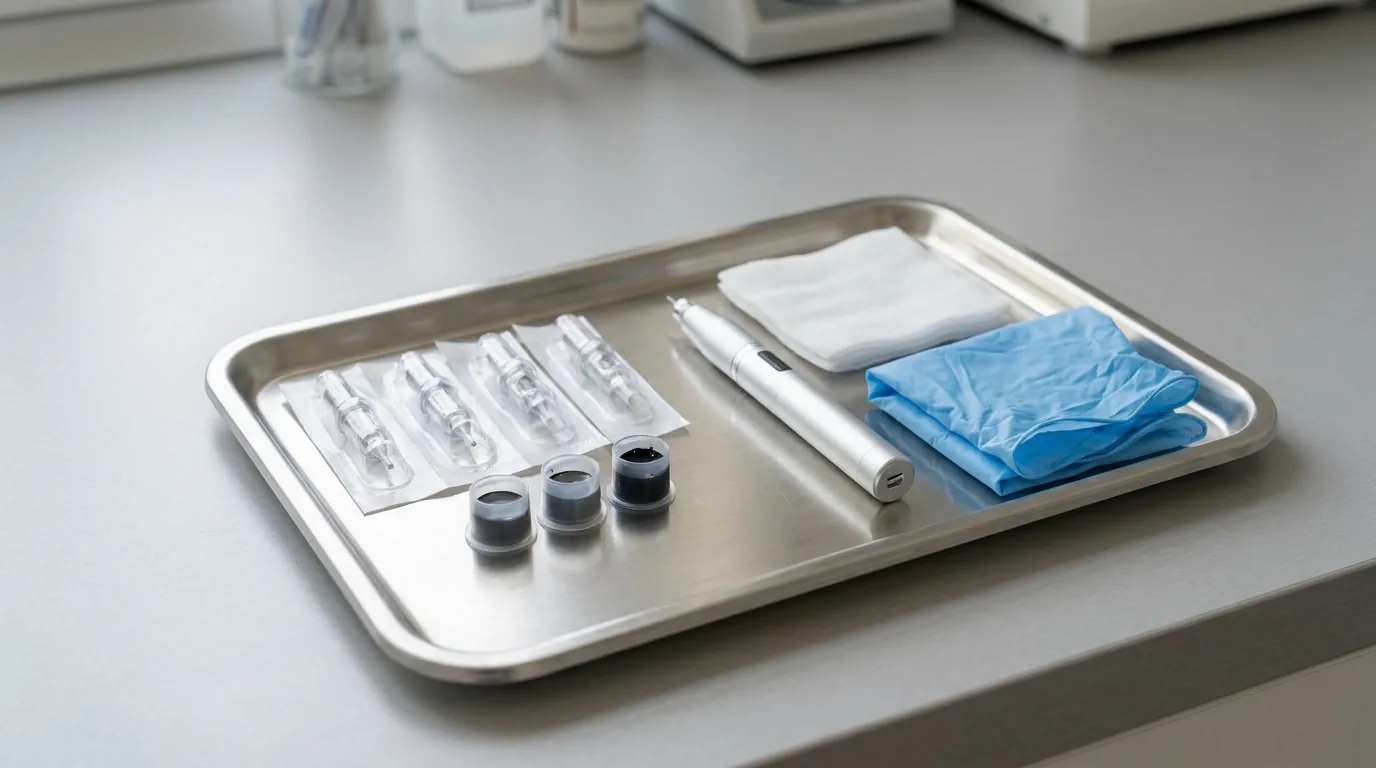
| Entry | AED 1,500 to 4,000 | 2 to 3 sessions, 2 to 3 hours each | Permanent-makeup studio or salon treatment room | Standard SMP pigment, single-use cartridge needles | Junior to pro artist, under 1,000 treatments | Hairline only, one bald patch, or a small scar |
| Mid | AED 4,000 to 8,000 | 3 sessions, 3 to 4 hours each | Dedicated SMP studio or aesthetic clinic room | Matched pigment blend, patch test, topical anaesthetic | Pro artist, over 1,000 treatments | Crown and mid-scalp density, receding hairline |
| Premium | AED 10,000 to 16,300 | 3 to 4 sessions, 4 to 5 hours each | Clinic treatment room with a named master artist | Multi-shade custom blend, staged density build | Master artist or clinic director | Full shaved-head look, transplant scar camouflage, repair work |
Those bands assume a complete course rather than one appointment. Studios quoting per session start around AED 6,000 with a senior artist and AED 8,000 with a named director, so a three-session hair tattoo course with the most expensive artist in the city can pass AED 20,000. Expect a non-refundable booking deposit of around AED 1,000, which comes off your final total. Consultations and patch tests are usually free, and the Dubai salon directory is a reasonable place to compare who offers one.
The ten-year cost, not the sticker price
Every Dubai provider quotes the course. None of them quotes the decade, which is the number worth knowing, because pigment fades and the work needs topping up. A hairline course looks cheap next to a transplant until the third top-up lands.
| Item | Entry course | Premium course |
|---|---|---|
| Initial course (two to four sessions) | AED 2,500 | AED 14,000 |
| Top-up at year 4 | AED 800 | AED 3,500 |
| Top-up at year 8 | AED 800 | AED 3,500 |
| Ten-year total | AED 4,100 | AED 21,000 |
Top-up pricing is not published by most Dubai studios, so the figures above assume a single-session refresh at roughly a quarter to a third of the course price, which is what studios quote verbally. Get your top-up rate in writing at the consultation, before the first session. A studio unwilling to put a refresh price on paper is telling you something.
Who is legally allowed to do scalp micropigmentation in Dubai
Two licences sit behind any legitimate provider, and they do different jobs. The venue needs a trade licence from Dubai’s Department of Economy and Tourism, which is what makes the business itself legal to operate. Separately, the Dubai Health Authority regulates health facilities and the practitioners inside them.
Where a specific SMP provider sits between those two depends on how the service is registered. Some operate as beauty or permanent-makeup salons under a DET trade licence with a health permit for the procedure. Others run inside DHA-licensed clinics with clinical oversight. Both routes exist in Dubai and both can be legitimate. Neither of them is optional.
What you check is simple. Ask to see the venue’s DET trade licence and ask which DHA permit or licence covers the person holding the needle. A studio doing this properly will answer in seconds. Pigment goes into your living skin, so needle handling, single-use cartridges and waste disposal are health matters, not styling preferences. A hair tattoo is closer to a minor clinical procedure than to a haircut.
Are hair tattoos halal?
This is the question Dubai searchers ask that the international SMP industry answers badly or skips. It deserves a straight explanation of where the disagreement actually sits, rather than a yes or a no from a website.
Scholars looking at cosmetic pigment work tend to weigh two separate things. The first is permanence: rulings that restrict tattooing generally address permanent alteration, and SMP pigment fades over years rather than staying fixed, which is why some scholars treat it differently from a conventional tattoo. The second is whether the pigment forms a barrier that stops water reaching the skin during wudu. Pigment placed within the skin, rather than coated on top of it, does not form a surface layer.
Opinions genuinely differ, and they differ by school and by scholar rather than by clinic. Any studio giving a firm religious ruling on its own sales page is outside its competence. Readers who want a position they can rely on should put the question to a qualified scholar or the UAE’s official fatwa service, describing the procedure accurately: semi-permanent pigment placed in the dermis, fading over four to six years.
How many sessions, and how long a hair tattoo lasts
SMP in Dubai lands in a narrow band on both counts. Expect two to four sessions, most commonly three, at two to five hours each. Studios space them roughly ten to fourteen days apart, or spread your course across six to eight weeks, so the scalp heals and the artist can judge the true settled shade before adding density.
The sessions are sequential by design. The first lays a light base, which looks darker than the final result until it heals. The second builds density and corrects spacing. A third blends and finishes. Anyone promising a finished head in one appointment is either working on a very small area or cutting the healing step.
On longevity, Dubai studios quote four to six years before a hair tattoo needs a visible top-up, and one clinic quotes six to eight. Treat the lower end as your planning number. Clinical work on scalp pigmentation found noticeable fading at eight to ten months when technique or pigment choice was poor, so the published range describes good work, not average work.
What Dubai sun does to the pigment
Ultraviolet light breaks pigment down, and this is the one variable a Dubai client controls badly. A shaved scalp is the most sun-exposed skin on your body, and Dubai delivers strong UV for most of the year. Two people can get an identical hair tattoo from the same artist and be four years apart on when they need a refresh, purely on hat and sunscreen habits.
Pigment choice compounds it. A clinical study of the technique found that plain black pigment shifted to a bluish grey within about six months, while blended shades held their tone. A good artist mixes to skin and hair colour instead of reaching for black. Ask what shade is going in and why, and be wary of a studio that treats pigment as one product.
Practical version: keep your scalp out of direct sun for the first three to four weeks entirely, then use daily sunscreen or a hat on the crown. This is the difference between a four-year result and a seven-year one.
SMP or a hair transplant
These solve different problems and the honest framing is not which is better. A transplant moves living follicles and grows real hair you can style at length. Hair micropigmentation adds no hair at all; it reduces the contrast between scalp and remaining hair so thinning stops reading as thinning.
A hair tattoo suits a shaved or very short style, a scalp with too little donor hair for surgery, alopecia areata or diffuse thinning, and camouflage over an old FUE or FUT scar. It also gets used on top of surgery, adding apparent density between grafted follicles. If you are weighing the surgical route, read the detail on cost and method in the guide to hair transplant in Dubai rather than deciding from this page.
Between the two sits a third group of treatments aimed at keeping the hair you still have, including PRP hair treatment. Pigment and surgery both work around hair loss. Neither slows it, so an SMP hairline drawn at twenty-five can end up floating above a scalp that kept receding.
What to expect at an SMP appointment
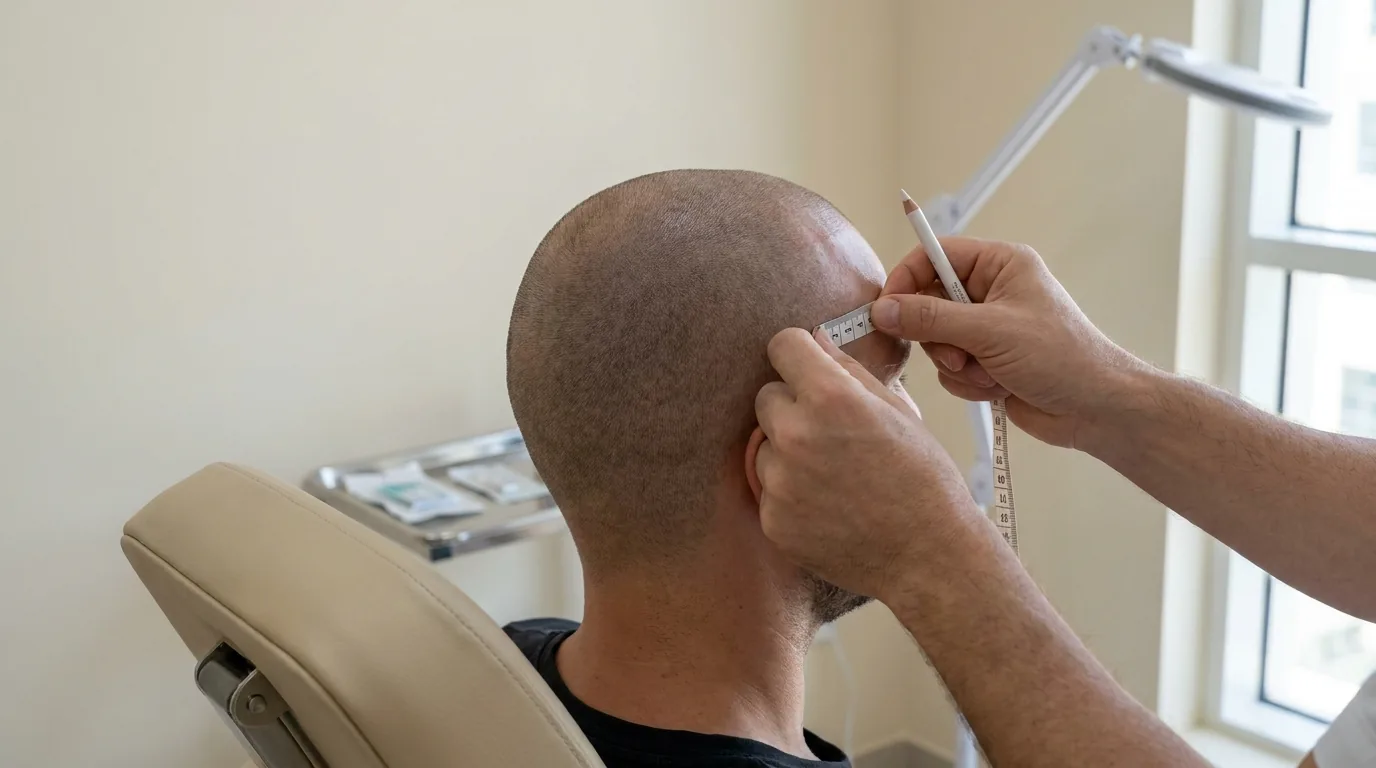
Your consultation comes first and should include a patch test, since pigment allergy is uncommon but real. Providers in Dubai generally offer both free. Photographs, skin tone matching and hairline measurement happen here, and the hairline is the decision to slow down on. Artists usually place a conservative line on the first pass and drop it lower on a later session if you want, because a hairline set too low ages badly and is difficult to undo.
On the day, your scalp is cleaned and a topical anaesthetic applied. Needles run 0.20 to 0.35 millimetres and are single-use. Most clients describe pressure and buzzing rather than pain, sharper over bone at the temples and hairline. Sessions run two to five hours with breaks.
Afterwards, keep your scalp dry for several days, skip the gym while it settles, do not shave for four to five days, and leave the itch alone. Full colour settles over two to three weeks and your final shade will be lighter than day one.
How to vet an SMP artist in Dubai
Portfolio quality varies far more than price does in this market, and the gap between competent and excellent shows up years later rather than on the day. Six checks separate them.
- Ask for healed photographs at three months and beyond, not day-one shots. Fresh work looks good on everyone.
- Ask how many hair micropigmentation treatments the artist has personally completed. Dubai studios grade their own staff by this number and price accordingly, so the question is fair and they expect it.
- Look for before and after images on a skin tone like yours. Contrast behaves differently across skin tones and a portfolio of one tone proves less than it looks.
- Confirm the venue’s DET trade licence and the DHA permit covering the procedure and the practitioner.
- Get your shade plan and your top-up price in writing before session one.
- Check the studio does repair work. Artists who fix other people’s SMP hair work have seen every failure mode and tend to place a more conservative hairline.
Reviews help, with a caveat: most SMP reviews are posted within days of a session, long before fading or colour shift appears. Weight the older reviews heavily. The same logic sits behind how listings are ranked across this directory, where review volume and recency both count.
What goes wrong, and what it costs to fix
Regret searches sit right alongside the buying ones, which tells you something about the failure rate at the cheap end. Four problems account for most of it.
- Colour shift to blue or grey. Caused by pure black pigment or placement too deep. Documented in clinical work at around six months.
- Dots too large or too even. Reads as a pattern at conversational distance instead of stubble.
- A hairline set too low or too straight. The most common regret, and the hardest to reverse.
- Blowout. Pigment spreading under the skin into a blur rather than holding as a dot.
Fixing any of these costs more than the original work. Options are laser removal across several sessions before re-pigmenting, or a repair artist working over the top with corrective shading. Laser on a scalp is slow, and removal runs across multiple sessions rather than one. Budget a repair at one and a half to two times a first course, and expect your result to be good rather than invisible.
Where to look for a hair tattoo provider in Dubai
The scalp micropigmentation Dubai market is small and specialised, so your search works differently from booking a haircut. Providers split across dedicated SMP studios, permanent-makeup salons, and aesthetic clinics that added it to a hair-loss line. Very few general salons keep it on the menu at all.
This directory lists too few SMP studios to publish a ranked shortlist that would be honest. What it does hold is 17 aesthetic salons across Dubai, plus separate listings for skin specialists and hair salons, and a small set of venues tagged for scalp micropigmentation specifically. Being listed is not evidence a venue performs the procedure, so confirm the service and the licence directly before you book.
Browse all 17 Aesthetic Salons providers on our directory.


