


The frizzy hair meaning is simple: it is hair whose strands stop lining up with each other, so instead of falling in one smooth direction they lift, twist, and stand apart. That fuzzy, irregular halo usually appears when the hair’s outer layer is raised and moisture moves in and out of the strand unevenly. It can show up on curly hair and on straight hair alike.
What does frizzy hair mean?
Frizz is a texture, not a hair type. The frizzy hair meaning that most people use describes strands that refuse to align into one cohesive shape. Some hairs project away from the main body of hair, others curl off on their own, and the result reads as fuzzy or puffy rather than sleek.
This is why frizz is not only a curly-hair issue. Straight hair can look frizzy when short, lifted strands stick up along the part. Tightly coiled hair can look smooth and frizz-free when every strand follows the same pattern. Frizz is about alignment, not curl.
So when someone asks what is frizzy hair, the honest answer is that it is a state any head of hair can drift into, depending on its structure and what the air, water, and styling around it are doing.
What frizzy hair looks like
There are two everyday versions of frizz, and telling them apart helps you understand your own hair. Hair researchers studying how women describe healthy hair found the same two patterns again and again.
| Type of frizz | What you see | Most common on |
|---|---|---|
| Surface frizz | Short strands sticking up at the part and along the length, projecting away from the main hair | Straight or fine hair trying to hold a smooth style |
| Pattern frizz | Wavy or curly strands that do not clump into a defined wave or curl, so the curl looks undefined and fuzzy | Wavy and curly hair without natural curl definition |
Both look like a loss of order. The fix is different for each, which is the first reason a single anti-frizz product works for one person and disappoints another.
The science: what happens inside a frizzy strand
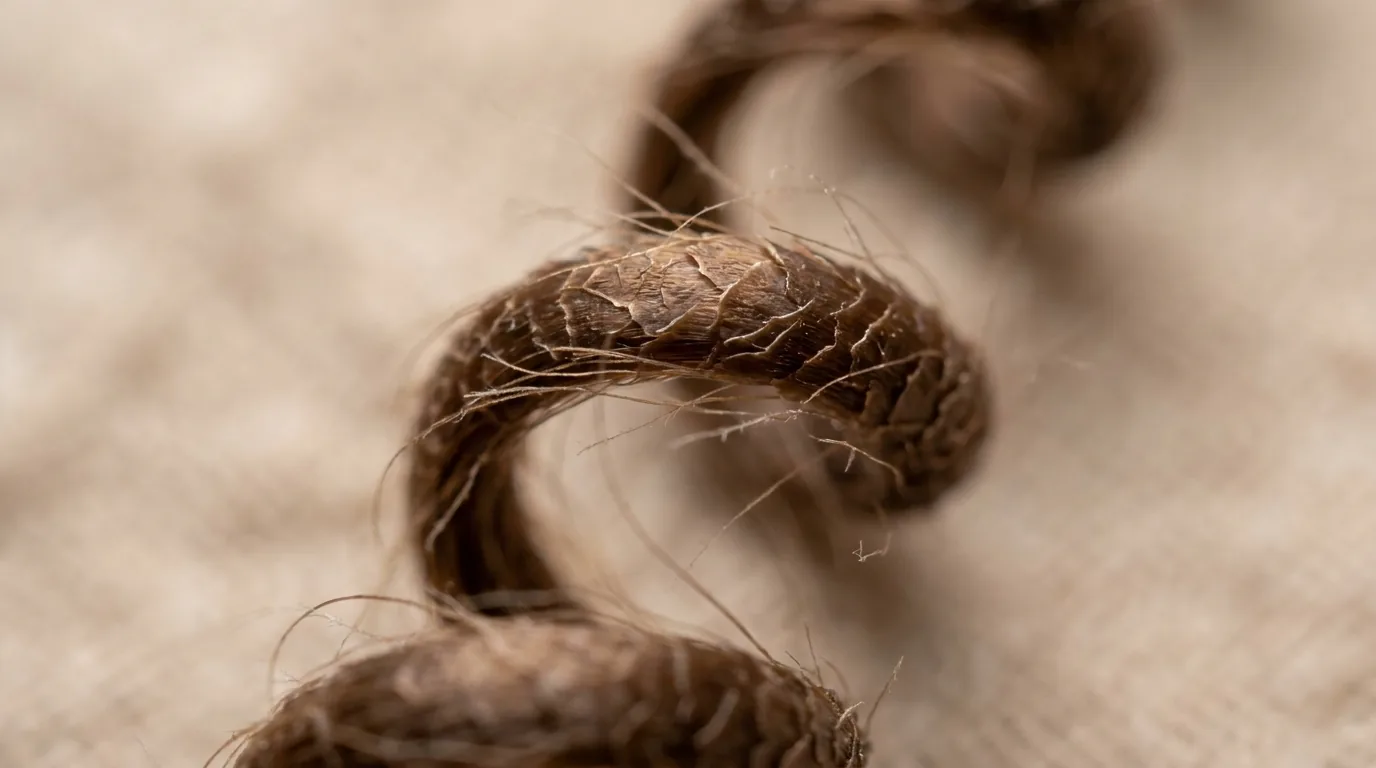
Every hair has an outer layer called the cuticle, a stack of overlapping scales that lie flat on healthy hair and reflect light. Underneath sits the cortex, the thick core of keratin protein that holds most of the hair’s strength and shape. When the cuticle stays flat and closed, it acts as a moisture barrier and the strand looks smooth.
Frizz starts when that cuticle lifts or chips. A raised cuticle lets water pass in and out freely, so dry hair pulls moisture from the air around it. As water enters, the proteins in the cortex swell, and because different proteins along the strand absorb water differently, the hair twists and bends in an uneven way. Humidity does the same thing from the outside by disrupting the hydrogen bonds that hold your hair’s styled shape, which is why a blow-dry collapses the moment you step into damp air.
Two more traits decide how strongly your hair reacts. Porosity is how easily the cuticle lets water through; high-porosity hair frizzes faster because its scales are more open. Sebum, the natural oil from your scalp, coats and smooths the strand, but on curly hair it struggles to travel down the bends, leaving the lengths drier and more frizz-prone. This mix of cuticle, cortex, hydrogen bonds, porosity, keratin, and sebum is the real engine behind frizz, and it explains why hair behaves so differently from one person to the next. A salon that handles a lot of textured hair, like many of the established hair salons in Dubai, will read these traits before recommending anything.
If you want a professional read on your hair’s texture and porosity before you buy products, a stylist can assess it in person. The hair salons below are pulled live from our directory and ranked by verified rating and review volume.

Popular hair salons in Dubai
Collective is a hair salon inside the MAG Warehouses complex in Al Quoz Industrial Area 2, rated from reviews. Services cover hair colouring, balayage, hair highlights, hair extensions, keratin treatment, ladies haircuts, blow dry, bridal makeup, manicures, gel pedicures and waxing services. Several reviewers like the modern, classy interior and mention stylists using Dyson equipment for finishing, with one client describing a playful, well judged cut from a stylist who listened closely to the brief. Feedback on colour work is more mixed, with one detailed report describing hair damage and billing disagreements after a balayage and toner service, so it makes sense to agree the full scope and price before any colour treatment begins. The salon has a toilet on site along with wheelchair-accessible parking and entrance.
Version Francaise is a hairdressing salon inside the Marriott Harbour Hotel and Suites in Dubai Marina, offering haircuts, hair colouring, highlights, hair extensions, keratin treatment, blow dry styling, threading, manicures and nail art. It is rated from reviews.Reviewers consistently describe the salon as welcoming, with several returning for years and calling it their regular salon for haircuts and colour treatments. The team is praised for professionalism, attention to detail and a warm welcome from arrival to the end of the appointment.The salon has free Wi-Fi, on-site services, a wheelchair-accessible entrance, car park and toilet, plus gender-neutral toilets. It suits residents and hotel guests in Dubai Marina after a haircut, colour service or hair treatment appointment, with appointments recommended given the salon's loyal following.
Locks By Lou Lou is a hair salon on Al Wasl Road in Jumeirah, rated from reviews. Reviewers consistently praise the colour work, from balayage and highlights to root touch ups, and several mention hair extensions that look natural rather than obviously fitted. Clients also note that stylists take time to understand what they want before starting and explain aftercare so hair stays in good condition afterwards.Beyond colour, the salon offers blow dry, keratin treatment, hair extensions, manicure, gel pedicure, microneedling and anti-aging facial treatments. The entrance is wheelchair accessible and there is an on-site toilet.Appointments are recommended, particularly for colour and extension work, and the salon suits clients looking for an ongoing colourist relationship rather than a single visit.
Version Francaise Pour Elle is a hairdresser and beauty salon on Al Wasl Road, Al Safa 2, rated from reviews. Services span hair colouring, balayage, highlights, extensions, keratin treatment and blow dry, ladies' haircuts, beard trim, manicure, gel nails, gel pedicure, eyelash extensions, anti-aging facials and waxing.Reviewers consistently praise the colour and highlight work, describing meticulous stylists who take the time to understand what a client wants even when it is hard to explain. The salon is also noted for its cleanliness, product quality and reasonable prices, with several reviewers mentioning the owner is regularly on site overseeing the team and the client experience.Free Wi-Fi and parking are available. Suits clients after precise colour work from a team that takes the time to get it right.
Trinity Hair Salon is a hair salon in Al Barsha South, based at Danube Resortz, rated from reviews.Colour work is what reviewers talk about most, with several describing years of trust in the stylists for balayage, highlights and full colour changes, including recovering from a previous bad dye job elsewhere. The salon also offers ladies haircuts, blow dries, hair treatment and a back massage, plus manicures and pedicures. More than one reviewer describes the atmosphere as warm and modern with a good energy, and says they would not trust anyone else with their hair colour.There is a toilet on site, the salon offers on-site services, and a wheelchair-accessible car park makes it an easy stop for residents around Al Barsha South.
Browse all 167 Hair Salons providers on our directory.
What causes frizzy hair
According to cosmetic chemist Randy Schueller, frizz has three root causes: genetics, damage, and humidity. Most real-world frizz is a blend of all three rather than one acting alone.
| Cause | How it creates frizz |
|---|---|
| Genetics | Wavy and curly hair whose strands do not clump into a defined pattern reads as frizzy. The spiral shape also blocks sebum from reaching the ends. |
| Humidity | Airborne moisture enters the strand, swells the cortex unevenly, and breaks the hydrogen bonds holding a smooth style. |
| Damage | Heat styling, harsh chemicals, rough brushing, and harsh shampoos chip the cuticle and snap strands. Shorter broken hairs spring out from the main body. |
Damage is the cause you control most. Direct heat from a flat iron on wet hair can boil the water inside the fibre and form tiny bubbles that weaken it. Combing curly hair when it is bone dry breaks up the curl clumps and puffs the hair out. Chemical services such as relaxers and over-processed colour also lift and weaken the cuticle, so booking hair colouring with a stylist who protects the hair matters more than the shade itself.
Why Dubai’s climate brings out frizz
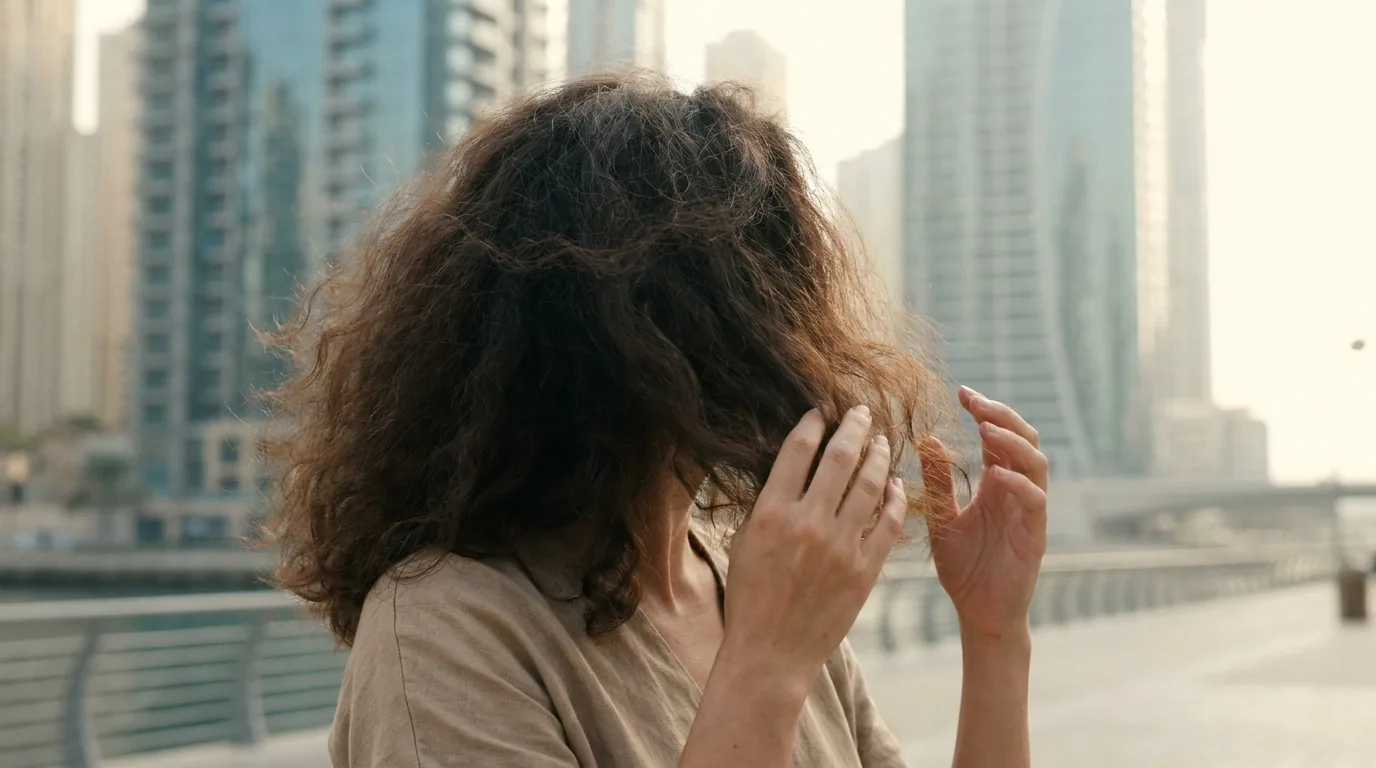
Dubai stacks several frizz triggers on top of each other, which is why hair that behaved at home can change here. The coastal air holds high humidity for much of the year, and that airborne moisture is exactly what swells the cortex and lifts a smooth blow-dry into frizz within minutes of stepping outside.
Indoors works against you in the opposite direction. Constant air conditioning pulls moisture out of the air and out of your hair, leaving the cuticle dry and thirsty, so it grabs humidity the moment you go back outside. Hard tap water leaves mineral residue that roughens the cuticle further, and strong year-round sun degrades the protein in the strand. The swing between dry, cooled rooms and humid streets keeps the cuticle opening and closing all day.
Frizz vs damage vs your natural curl
People often label all frizz as damage, but the three states call for different responses. Use this quick read to place your own hair before you spend on products or treatments.
| If your hair is… | You will usually see… | What it points to |
|---|---|---|
| Dry and frizzy | Frizz worsens in humidity, hair feels rough, drinks up oil quickly | High porosity and a lifted cuticle, often fixable with hydration and friction control |
| Damaged and frizzy | Split ends, breakage, short broken hairs springing out, frizz after heat or bleach | Cuticle damage from heat or chemicals; needs repair and a styling reset |
| Naturally curly and frizzy | Curls present but undefined, frizz without obvious damage | A curl pattern that does not clump on its own; needs definition, not repair |
The naturally curly case is the one most often misread. Curly hair that lacks definition is frequently mistaken for damaged hair when nothing is wrong with it. A hair mask helps the dry case, while a true repair plan suits the damaged case, and these are not the same routine.
Is frizzy hair a sign of unhealthy hair?
Not necessarily. Frizz is widely read as a sign of unhealthy hair, but it is often just dryness or an undefined curl rather than real damage. Healthy hair that is naturally curly or simply dehydrated can frizz, and damaged hair can be coaxed temporarily smooth, so frizz alone is not a reliable health verdict.
Frizzy hair is also not strictly dry or oily. The same strand can be oily at the roots, where sebum sits, and dry and frizzy through the lengths, where that oil never reaches. What you are usually seeing is uneven moisture, not a single oily-or-dry state. The honest signals of damage are breakage, split ends, and roughness, not the presence of frizz on its own.
Managing frizz versus embracing it
Once you understand the frizzy hair meaning, you have two valid choices: smooth it or wear it. Many people now embrace natural frizz as volume and texture, and there is nothing unhealthy about that. If you prefer a sleeker finish, the whole job is keeping the cuticle flat and limiting how much moisture moves in and out.
That comes down to a few principles rather than one miracle product. A leave-in conditioner keeps the cuticle hydrated between washes. Serums and lightweight oils coat the strand and lock moisture in while keeping humidity out, and silicones such as dimethicone are used in many smoothing products precisely because they repel water. Cutting friction helps too: a microfiber towel and a silk or satin pillowcase stop the cuticle from lifting while your hair is wet or while you sleep. For longer-lasting smoothness, salon options like keratin treatment, hair smoothing, a blow-dry finish, or a split-end treatment address frizz at different levels. Before booking any of them, it is worth reading how we screen providers on our salon ranking method page.


