



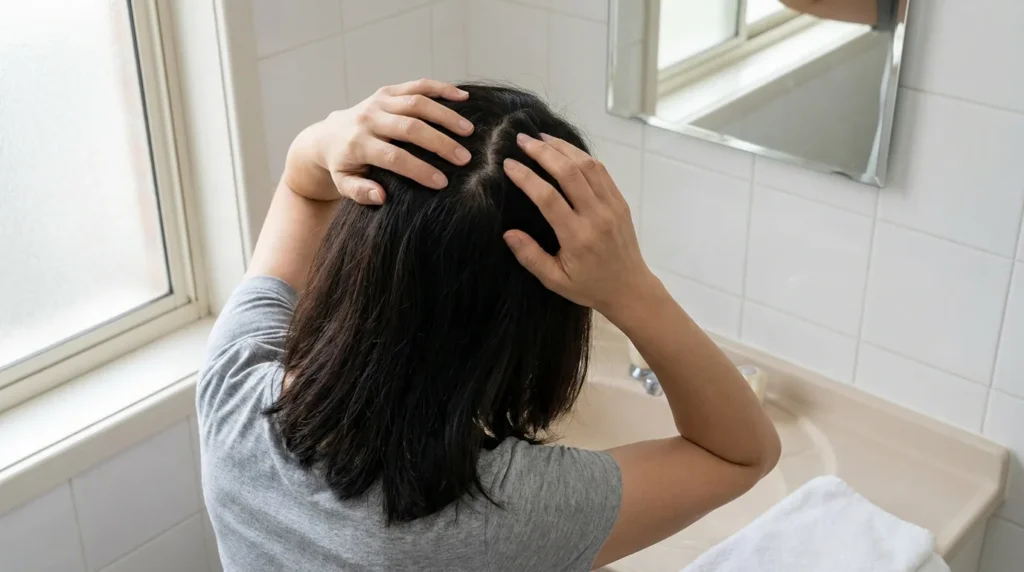
How to stop hair loss and regrow hair naturally comes down to three moves: find and fix whatever triggered the shedding, protect the follicles still growing, then give the hair cycle three to six months to answer. Scalp massage, rosemary oil and topical caffeine carry the strongest research behind them. Everything else is slower or thinner on proof.
That timeline is the part most guides skip. Hair grows roughly one centimetre a month, and a follicle pushed into its resting phase will not restart on demand. Nothing you apply this week shows up in the mirror before month four. Readers in Dubai searching for a faster answer usually end up paying for a salon treatment that was never going to fix the underlying cause.
What natural regrowth can and cannot do
Efforts to stop hair loss and regrow hair naturally only work on follicles that are still alive and still cycling. Where a follicle has scarred over or shrunk to the point of producing nothing, no oil, supplement or massage brings it back. That single distinction decides whether the next six months of effort pay off.
Three situations respond well. Telogen effluvium, the diffuse shedding that follows illness, crash dieting, childbirth or a stressful relocation, usually reverses once the trigger passes. Deficiency driven shedding reverses when the deficiency is corrected. Early pattern thinning, where hairs are getting finer but still present, can be slowed and partly reversed.
Two situations do not. Scarring alopecias destroy the follicle permanently. Advanced pattern baldness, where the scalp is smooth and shiny with no fine hairs at all, has nothing left to work with. In both cases the honest answer is that a clinic conversation beats another attempt to regrow hair naturally at home.
Eight natural methods to stop hair loss, ranked by evidence
Most listicles order the natural remedies for hair growth and thickness by popularity rather than by proof. Below they run in order of the studies behind them, strongest first, which is the ranking that matters if you want to stop hair loss inside a sensible timeframe. Timelines assume daily or near daily use.
| Method | What the research actually shows | Realistic timeline |
|---|---|---|
| 1. Scalp massage | Small trials link a few minutes of daily scalp massage to thicker strands after about 24 weeks. Of everything here, scalp massage for hair growth has the best ratio of evidence to cost. | 4 to 6 months |
| 2. Rosemary oil | A six month randomised trial found rosemary oil matched 2% minoxidil on hair count in pattern loss, with less scalp itching. | 6 months |
| 3. Topical caffeine | One of the better studied topicals. Appears to extend the anagen growth phase and counter the effect of DHT at the follicle. | 4 to 6 months |
| 4. Red light therapy | Low level laser devices carry regulatory clearance for pattern loss and show measurable density gains in controlled studies. | 4 to 6 months |
| 5. Correcting low ferritin | Low iron stores are a common and reversible cause of diffuse shedding, particularly in menstruating women. | 3 to 6 months after levels normalise |
| 6. Correcting low vitamin D | Deficiency is associated with shedding and is common among people who spend most daylight hours indoors, which describes much of working Dubai. | 3 to 6 months |
| 7. Saw palmetto | Blocks DHT weakly. A two year head to head with finasteride left saw palmetto well behind, though a minority of men did improve. | 6 months or longer |
| 8. Pumpkin seed oil | One small 24 week trial reported an increase in hair count. Promising rather than established. | 6 months |
The pattern worth noticing: the top four act on the follicle directly, while five and six simply remove a brake. Nothing on this list works in weeks, which is the usual reason people decide they cannot regrow hair naturally and quit at week six.
Four popular remedies with thin evidence
These appear in almost every home remedy roundup and have almost no controlled research behind them for regrowth specifically.
- Onion juice. One small study on patchy alopecia areata, not pattern loss. The smell is the least of the problems with extrapolating from it.
- Coconut oil. Genuinely reduces protein loss from the hair shaft, which cuts breakage. Breakage and shedding are different problems, and coconut oil does nothing for the second.
- Aloe vera. Soothes an irritated or flaky scalp, which helps if inflammation is part of the picture. No regrowth evidence.
- Castor oil. Thick enough to coat and protect strands. No trial supports the regrowth claims attached to it.
Using them is harmless. Relying on them instead of testing for a cause costs you months.
How long it takes to regrow hair naturally
Every hair on your head sits in one of three phases: growing, transitioning or resting. Roughly 85% are growing at any moment, and that growth phase runs two to six years. Resting hairs sit tight for about three months before they fall and a new hair pushes through. When something knocks a large batch of hairs into the resting phase at once, the shedding you notice happens two to three months after the event that caused it, not the week of it.
That lag runs in both directions, and it sets the floor on how fast anyone can regrow hair naturally. Fixing the cause today shows up as reduced shedding around month three, and as visible new hair some time after that.
| Point in time | What is happening | What you can see |
|---|---|---|
| Weeks 0 to 8 | Resting hairs already committed to falling continue to fall on schedule. | Nothing. Shedding may even look worse. |
| Month 3 | Shedding rate drops if the trigger has genuinely been removed. | Less hair in the drain. No new length. |
| Months 4 to 6 | New hairs enter the growth phase and break the scalp surface. | Short wispy hairs along the hairline and part. |
| Months 6 to 9 | New hairs thicken and reach a few centimetres. | Density starts reading differently in photographs. |
| Month 12 | Full assessment point for any regrowth plan. | Roughly 12 centimetres of new growth where it worked. |
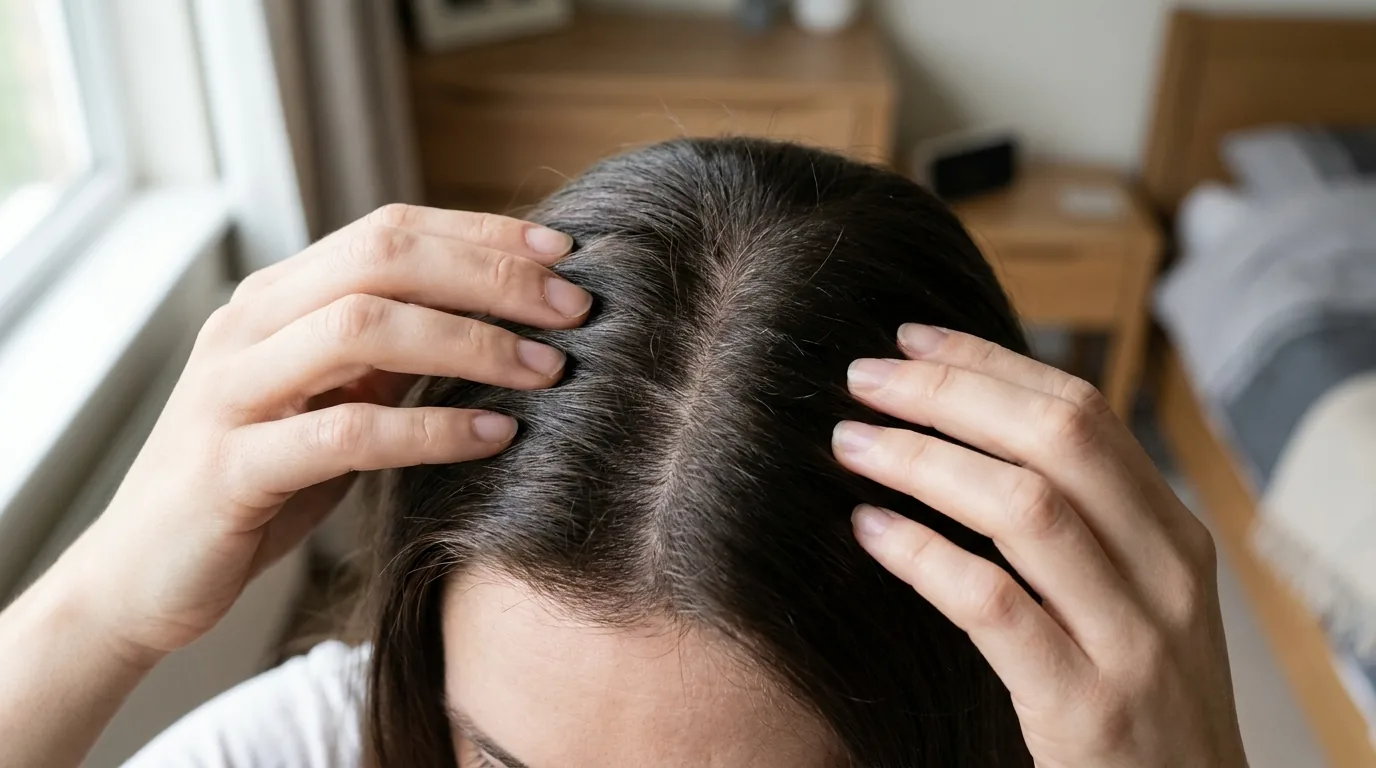
Photograph the same section of scalp, in the same light, on the first of each month. Memory is a poor judge of density and three months of slow progress reads as failure without a reference shot.
Four blood tests to run before you start
Buying supplements before testing is guesswork. Two of the most common reversible causes are invisible without a blood draw, which makes this panel the cheapest step in any plan to stop hair loss. Most Dubai clinics and labs run this panel without a referral for a modest fee.
- Ferritin. Iron stores, not haemoglobin. Ferritin can sit low enough to drive shedding while a standard blood count still reads normal.
- Vitamin D. Widely low among people who commute between an air conditioned flat, a car and an office, which is most of the city for most of the year.
- Thyroid function. Both an underactive and an overactive thyroid cause diffuse hair loss, and both are straightforward to treat once identified.
- Full blood count. Catches anaemia and other systemic causes that no topical treatment will touch.
Take the results to a doctor rather than self prescribing. High dose iron without a deficiency is harmful, and high dose biotin is known to interfere with some blood assays, so tell the lab which supplements you are already taking.
What Dubai living does to your scalp
None of the local environmental factors cause genuine hair loss. Genetics, hormones and deficiencies do that work. What the climate here does is add breakage and dryness on top of whatever is already happening, which makes thinning look worse than it is and makes it harder to judge whether an attempt to regrow hair naturally is working.
Mineral residue from tap water leaves strands feeling coarse and snapping more easily; a weekly clarifying wash handles it. Year round air conditioning pulls moisture from the scalp. Pool chlorine strips the cuticle if you swim often. Strong sun dries the shaft the same way it burns skin, so a hat earns its place on long days outdoors. And a flaky, inflamed scalp is worth treating properly, since persistent irritation is its own obstacle to regrowth. The guide to clearing dandruff covers that separately.
Relocating deserves its own mention. A move brings a new diet, new water, a new climate and a stack of stress at the same time, and that combination is a classic trigger for temporary shedding that settles once life stabilises.
Natural methods next to minoxidil and clinic treatments
Minoxidil comes up in every search for this topic, so it is worth placing honestly. It has more evidence behind it than any natural method, it is sold over the counter here, and it requires indefinite use because stopping returns the scalp to where it would have been. Many people also shed harder for the first six to eight weeks on it, which is expected and not a sign it is failing.
| Approach | Best suited to | What to expect |
|---|---|---|
| Natural methods | Telogen effluvium, deficiency driven shedding, early thinning, general scalp health | Slow gains, low cost, very low risk, no commitment |
| Minoxidil | Pattern loss that is actively progressing | Stronger evidence, indefinite use, an initial shedding phase |
| Clinic treatments | Established pattern loss where follicles have miniaturised | Higher cost, licensed clinics only, results measured in months |
These are not mutually exclusive. Correcting a deficiency and massaging the scalp costs nothing extra alongside a medical treatment, and the two address different parts of the problem. If a clinic route interests you, the explainer on what PRP hair treatment involves sets out what the procedure actually does before you price it.
When natural methods will not work
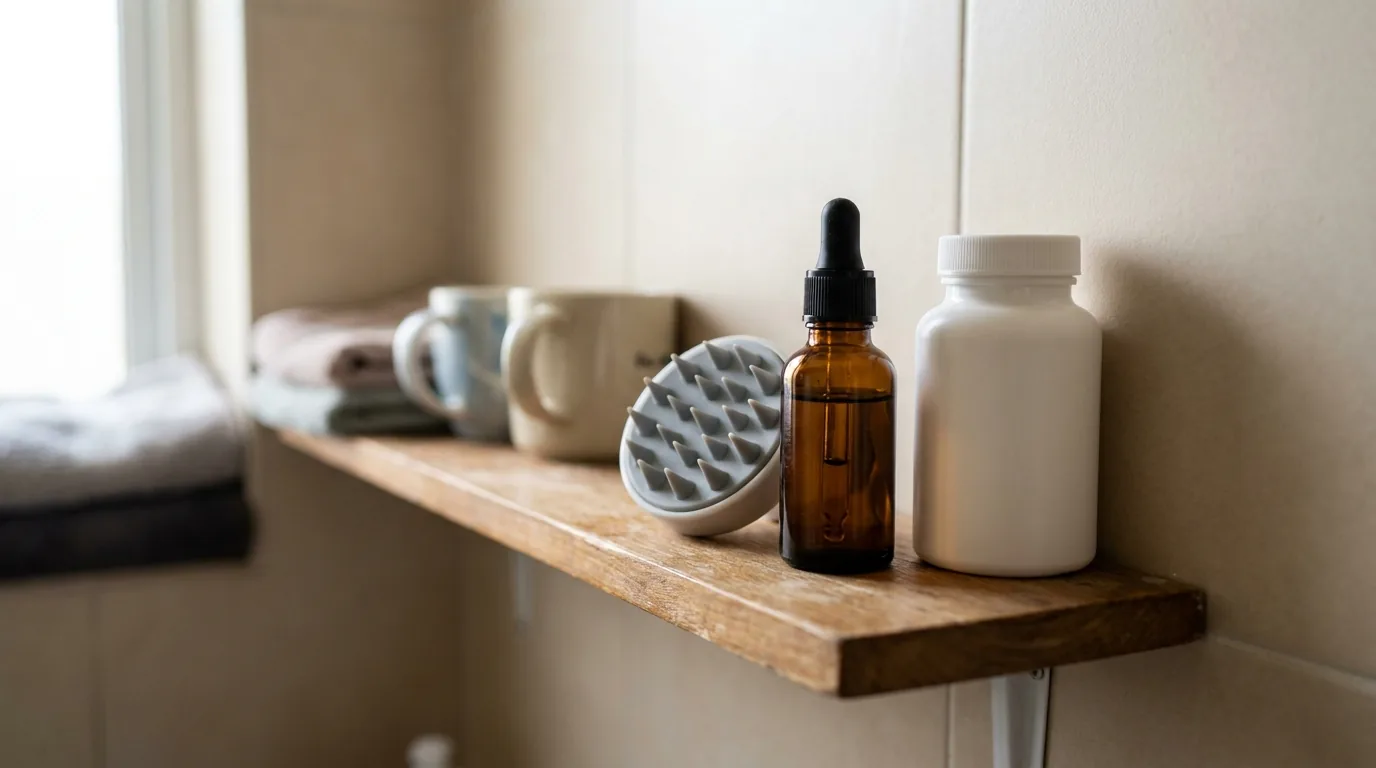
Six months of consistent effort is a fair trial. Past that, these signs point away from home remedies and towards a diagnosis.
- Round bald patches with clean edges, which suggest alopecia areata rather than gradual thinning.
- A visibly receding hairline or a widening part that keeps advancing despite treatment.
- Scalp pain, burning, scaling or pustules, all of which need a medical look rather than an oil.
- Sudden heavy shedding with no obvious trigger in the preceding three months.
- Hair loss alongside fatigue, weight change or irregular periods, which points at something systemic.
- Smooth shiny scalp with no fine hairs, meaning the follicles have already gone.
Anyone treating hair loss medically in Dubai works under a Dubai Health Authority licence for the clinic and the practitioner, on top of the Department of Economy and Tourism trade licence every business holds. A hair salon holds the trade licence but not the health licence, which is the practical line between a scalp treatment and a medical one. Ask to see both before any procedure involving needles, injections or prescription products. Guidance on the site’s editorial policies explains how listings are checked.
Where to book a professional scalp treatment in Dubai
A salon scalp treatment will not stop hair loss on its own. What it does well is clear buildup, calm irritation and give you a professional pair of eyes on a scalp you cannot see properly yourself, which is a reasonable complement to the home routine above.
Expect AED 100 to AED 600 for a scalp treatment or hair spa, with most mid-tier sessions at AED 200 to AED 350 and more where a brand ritual or a longer massage is included. salonsindubai.ae lists 167 hair salons across the city, and the scalp treatment listings narrow that to venues that offer the service specifically. Browsing hairdressers by area is the faster route if convenience matters more than specialism, and the roundup of hair treatments available in Dubai compares what each one is actually for.
Browse all 167 Hair Salons providers on our directory.


