



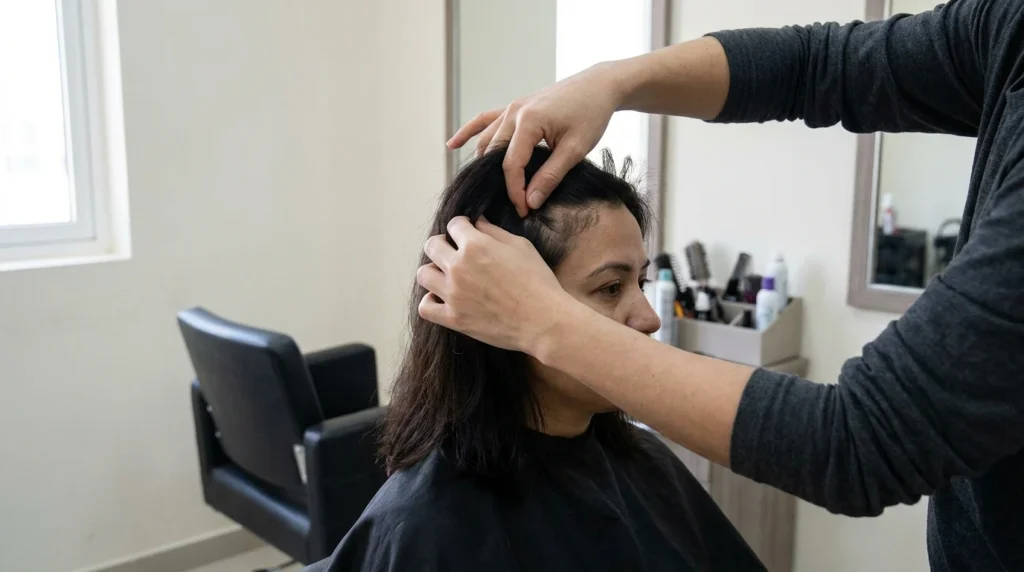
How long does postpartum hair loss last? For most women the heavy shedding runs about three to six months and finishes somewhere between six and twelve months after birth. Fullness usually returns by the baby’s first birthday. Regrowth, though, keeps going long after the shedding itself has stopped.
This page is general information, not medical advice. In Dubai, a salon works under a Department of Economy and Tourism trade licence, which covers cutting, colouring, styling and scalp care. Anything that involves a diagnosis, bloodwork or a prescription sits with a practitioner licensed by the Dubai Health Authority, working inside a DHA-licensed facility.
Two clocks are running, and only one of them is shedding
Most guides answer with a single number, which leaves readers confused at month ten when the brush is clean but the mirror still shows thin temples. Two separate processes are being reported as one.
Clock one is shedding. Pregnancy holds an unusual share of hair in its growing phase, and after delivery those strands release together over a few months. Once the backlog clears, this clock stops. Dermatologists call the pattern telogen effluvium, and it is excessive shedding rather than true hair loss.
Clock two is regrowth. It starts later and runs much slower. A hair released in month four begins its new growing phase weeks afterwards, then adds length at roughly a centimetre a month. Getting a 15cm fringe back to blending length is a job measured in years, whatever the shedding is doing.
So a woman at month nine can be finished with the falling-out stage and still see a halo of short flyaway pieces along her hairline. Both are true at once, and reading them as one timeline is what makes an ordinary recovery feel stalled.
When postpartum hair loss peaks, and when it actually stops
The sequence is consistent enough across clinical sources to plan around. One question dominates the search data: when does postpartum hair loss peak. The answer arrives earlier than most people expect.
| Months after birth | What is happening | What you notice |
|---|---|---|
| 0 to 2 | Estrogen falls back toward pre-pregnancy levels; hair moves into its resting phase | Usually nothing yet |
| 2 to 4 | The rested hair starts releasing | Handfuls in the shower drain, strands on the pillow |
| About 4 | Shedding peaks | The worst week; often the point women start searching |
| 4 to 6 | Shedding slows; new growth begins underneath | Thin temples, a visible parting, short new hairs |
| 6 to 12 | Shedding ends; density starts rebuilding | The brush clears, the regrowth halo appears |
| 12 and beyond | New growth gains length | Fullness returns, short pieces gradually blend |
Months separate the falling-out stage from the looking-normal-again stage, and that gap is ordinary.
The American Academy of Dermatology puts the peak at about four months after giving birth, with normal growth back by the child’s first birthday. Cleveland Clinic frames the shedding phase as under six months. A 2024 survey published in Medicine put the whole episode at roughly six months to a year. Those ranges differ because they measure different clocks.
Does everyone get postpartum hair loss? Close to it. Around 92 percent of the women in that survey reported at least some shedding, so the useful question is how long yours runs rather than whether it happens.
Why your timeline runs longer than your friend’s
Two mothers with the same due date can finish shedding four months apart, and the variation is not random. The best evidence comes from that same questionnaire study of 331 postpartum women in Japan, which asked what separated the women who shed from the women who did not.
Two factors came out as independent predictors: preterm labour, and how long breastfeeding continued. Women who stopped breastfeeding between six and twelve months had close to six times the odds of postpartum shedding compared with women who stopped at or before six months. The proposed mechanism is simple. Breastfeeding suppresses the return of normal ovarian cycling, which keeps estrogen lower for longer, which keeps the shedding trigger switched on.
That finding explains most of the spread in real timelines, and I have yet to see it mentioned in a popular guide. Read it carefully, though: the study describes an association in one cohort, and the researchers did not recommend weaning to protect hair. It gives you a reason your clock might run long, not an instruction.
Delivery method is a different story. One of the most-searched variants of this question is postpartum hair loss after c section, and the evidence does not single it out. The same study measured delivery details and landed on breastfeeding duration and preterm labour, not on how the baby arrived. A caesarean by itself is not the reason hair is falling out.
Genetics, thyroid function and iron stores shift the picture too. Shedding that predates the pregnancy sits underneath the postpartum episode rather than being replaced by it, so your recovery will not track anyone else’s.
Postpartum hair loss after 1 year: normal, or a signal
This is where the two-clock distinction earns its keep. Postpartum hair loss after 1 year means two very different things depending on which clock you are describing.
If the shedding stopped months ago and what remains is thin-looking density plus a fringe of short regrowth, you are on schedule. Those short hairs at the hairline are visible proof that the follicles restarted. They look like a problem and they are the opposite of one.
Still losing noticeable amounts daily at twelve months is a different conversation. The AAD’s guidance for new mothers is that hair which has not regained its fullness after a year is worth taking to a dermatologist, because something else may be driving it. Cleveland Clinic sets the flag earlier, at six months of continued shedding, and names two usual culprits: iron deficiency and thyroid disease. Both are common after pregnancy, both show on a blood test, and both are treatable once identified.
In Dubai that assessment belongs to a DHA-licensed clinician inside a DHA-licensed facility. A salon holding only a DET trade licence can cut, colour and treat your scalp, and it cannot order bloodwork or make the call. Knowing which door you need saves a wasted appointment, and our ranking methodology explains how we separate the two.
Does postpartum hair loss grow back, and how fast
Yes. Does postpartum hair loss grow back fully is the more precise question, and for most women the answer is also yes, with one caveat: a minority notice their hair sits slightly finer than before pregnancy and stays that way.
The speed is the part worth planning around. Assume roughly a centimetre a month:
- Six months of regrowth is about 6cm, which reads as baby-hair fluff standing up at the parting.
- Twelve months is about 12cm, enough to lie flat but still visibly shorter than the rest.
- Two years is usually where new growth blends into a mid-length cut unaided.
Nothing on a salon menu speeds up a follicle. What a good stylist can do is make the mismatch less obvious while it happens, which counts for a lot when you check the mirror every morning.
What Dubai adds to the timeline
The biology is the same in every city. The conditions around it are not, and three local factors make an ordinary recovery look worse than it is.
Dubai’s tap water is hard, and mineral deposit builds on the hair shaft over weeks. It does not cause shedding. It does leave regrowth dull, rough and prone to snapping at the ends, so hair that is genuinely coming back can read as hair that is still going. A filtered shower head is the cheapest fix available.
Heat is the second factor. Between the climate and the air conditioning, most residents wash more often than they would elsewhere, and more washes mean more blow-drying. New regrowth is fine and easy to break, and breakage at the hairline gets mistaken for continued shedding.
Sun is the third. Strong UV degrades the hair shaft, and the short new pieces at the crown take the most of it because they sit exposed, so a hat on the school run is not vanity here.
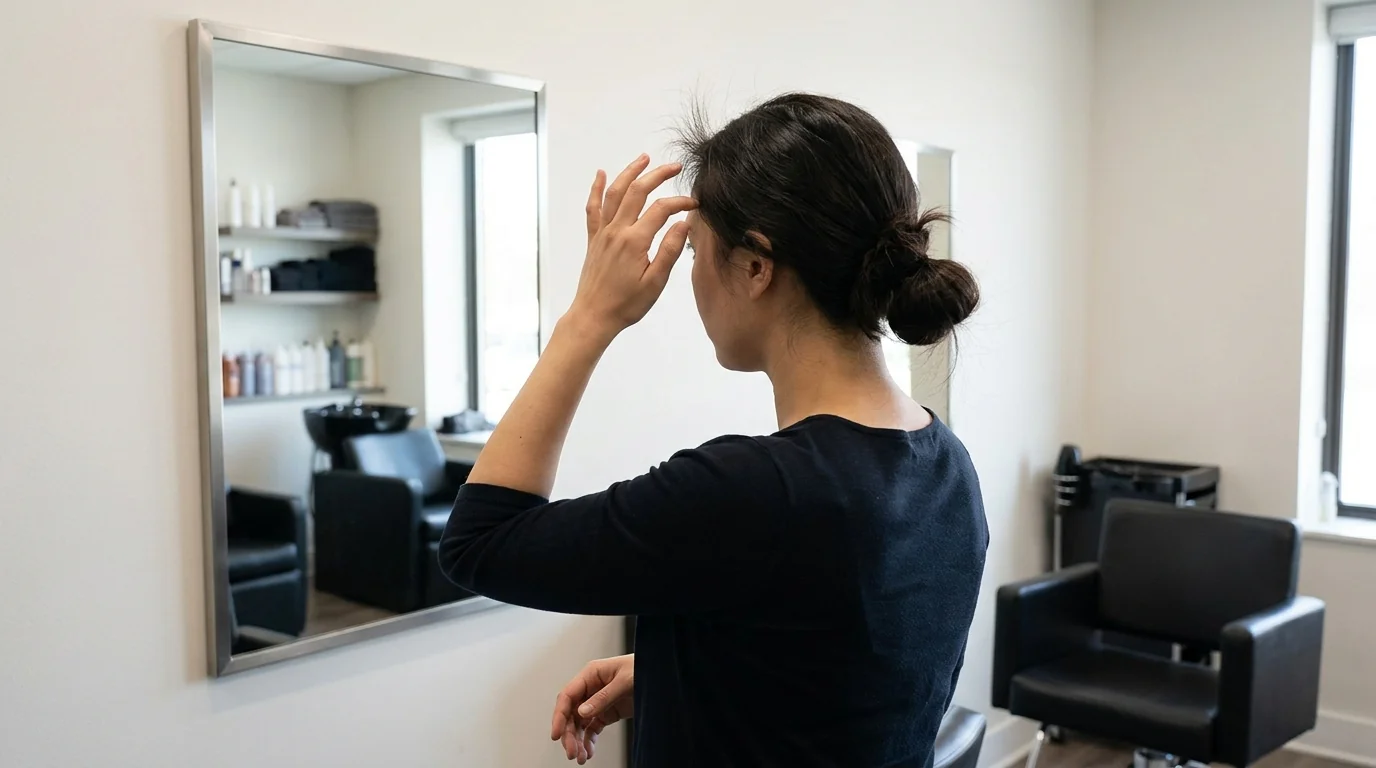
Cuts, colour and styling that carry you through
The waiting period is the part nobody plans for, and it is where a salon has a legitimate role: managing appearance while biology does its work.
Taking overall length off is the most effective single move. Shorter hair carries more visual weight per strand, which is why dermatologists routinely suggest it to new mothers, and it halves drying time. A blunt line at the ends does more for perceived density than any product. A soft fringe or face-framing layer is the other standard answer, because it gives the regrowth at your hairline somewhere to belong. Ask for the shortest layer to be cut near the length your regrowth has already reached.
Colour is safe here, and useful. Fine, low-contrast highlights near the parting break up the line of visible scalp, which is usually what makes thinning read in photographs. Book a hair colouring appointment with a colourist who works low-contrast, and skip anything that needs a rigid parting to look right. A regular ladies haircut every eight to ten weeks does more than any single treatment.
A scalp treatment earns its place for a narrower reason than the marketing suggests. It will not change your shedding timeline. It clears the product and mineral build-up that flattens fine regrowth, and a clean scalp makes new growth look better. Our guide to frizzy hair treatment covers the flyaway texture that comes with it.
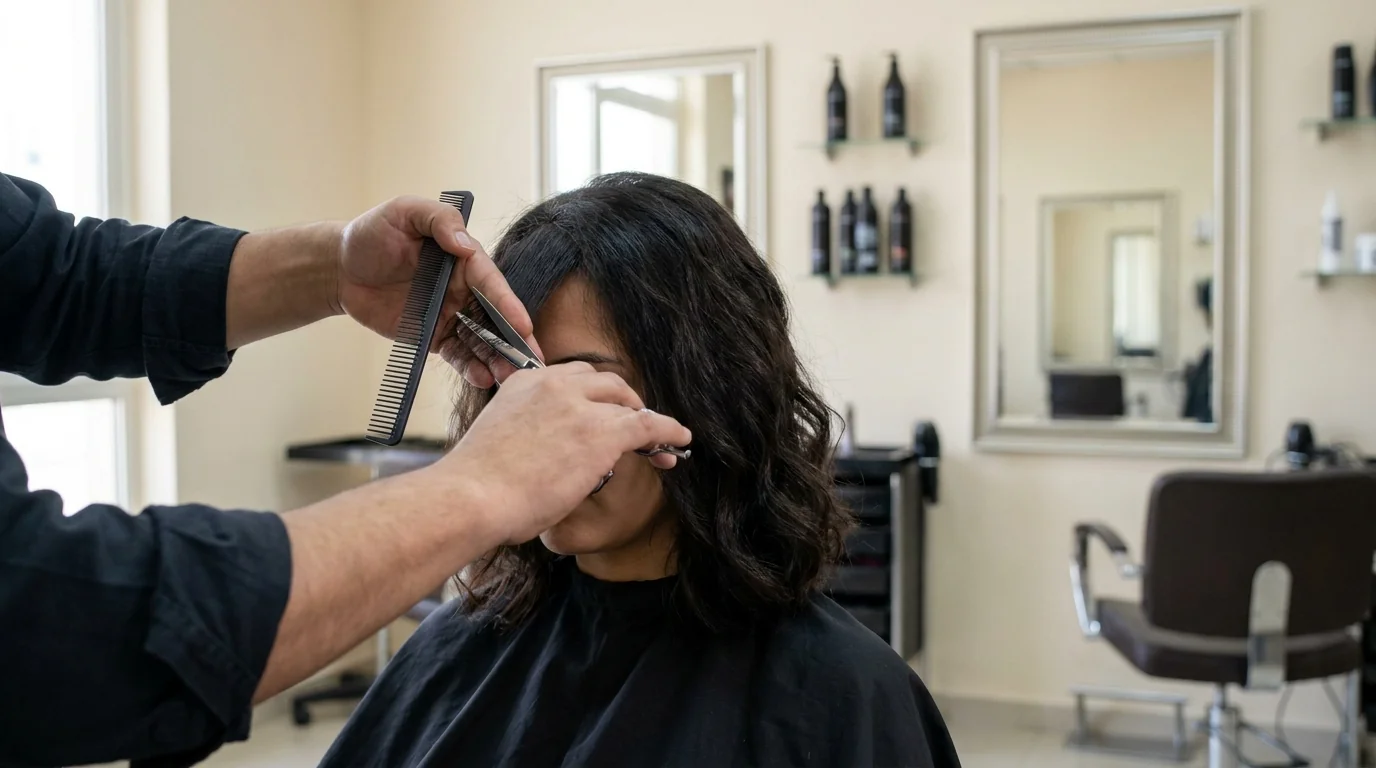
The directory lists 167 hair salons across Dubai. The venues below rank on rating and review volume, not on anything they paid for.

Popular hair salons in Dubai
Collective is a hair salon inside the MAG Warehouses complex in Al Quoz Industrial Area 2, rated from reviews. Services cover hair colouring, balayage, hair highlights, hair extensions, keratin treatment, ladies haircuts, blow dry, bridal makeup, manicures, gel pedicures and waxing services. Several reviewers like the modern, classy interior and mention stylists using Dyson equipment for finishing, with one client describing a playful, well judged cut from a stylist who listened closely to the brief. Feedback on colour work is more mixed, with one detailed report describing hair damage and billing disagreements after a balayage and toner service, so it makes sense to agree the full scope and price before any colour treatment begins. The salon has a toilet on site along with wheelchair-accessible parking and entrance.
Version Francaise is a hairdressing salon inside the Marriott Harbour Hotel and Suites in Dubai Marina, offering haircuts, hair colouring, highlights, hair extensions, keratin treatment, blow dry styling, threading, manicures and nail art. It is rated from reviews.Reviewers consistently describe the salon as welcoming, with several returning for years and calling it their regular salon for haircuts and colour treatments. The team is praised for professionalism, attention to detail and a warm welcome from arrival to the end of the appointment.The salon has free Wi-Fi, on-site services, a wheelchair-accessible entrance, car park and toilet, plus gender-neutral toilets. It suits residents and hotel guests in Dubai Marina after a haircut, colour service or hair treatment appointment, with appointments recommended given the salon's loyal following.
Locks By Lou Lou is a hair salon on Al Wasl Road in Jumeirah, rated from reviews. Reviewers consistently praise the colour work, from balayage and highlights to root touch ups, and several mention hair extensions that look natural rather than obviously fitted. Clients also note that stylists take time to understand what they want before starting and explain aftercare so hair stays in good condition afterwards.Beyond colour, the salon offers blow dry, keratin treatment, hair extensions, manicure, gel pedicure, microneedling and anti-aging facial treatments. The entrance is wheelchair accessible and there is an on-site toilet.Appointments are recommended, particularly for colour and extension work, and the salon suits clients looking for an ongoing colourist relationship rather than a single visit.
Version Francaise Pour Elle is a hairdresser and beauty salon on Al Wasl Road, Al Safa 2, rated from reviews. Services span hair colouring, balayage, highlights, extensions, keratin treatment and blow dry, ladies' haircuts, beard trim, manicure, gel nails, gel pedicure, eyelash extensions, anti-aging facials and waxing.Reviewers consistently praise the colour and highlight work, describing meticulous stylists who take the time to understand what a client wants even when it is hard to explain. The salon is also noted for its cleanliness, product quality and reasonable prices, with several reviewers mentioning the owner is regularly on site overseeing the team and the client experience.Free Wi-Fi and parking are available. Suits clients after precise colour work from a team that takes the time to get it right.
Trinity Hair Salon is a hair salon in Al Barsha South, based at Danube Resortz, rated from reviews.Colour work is what reviewers talk about most, with several describing years of trust in the stylists for balayage, highlights and full colour changes, including recovering from a previous bad dye job elsewhere. The salon also offers ladies haircuts, blow dries, hair treatment and a back massage, plus manicures and pedicures. More than one reviewer describes the atmosphere as warm and modern with a good energy, and says they would not trust anyone else with their hair colour.There is a toilet on site, the salon offers on-site services, and a wheelchair-accessible car park makes it an easy stop for residents around Al Barsha South.
Mistakes that make the wait feel longer
- Counting strands. A normal scalp holds 80,000 to 120,000 hairs and releases up to 100 a day at baseline. Counting the ones in the drain tells you nothing and raises anxiety that is already high: 73 percent of the women with shedding in that survey reported anxiety or stress about it.
- Buying a treatment for a hormonal process. Serums and thickening systems do not shorten the shedding clock. Spend the money on the cut.
- Pulling it back tightly. Tight buns and high ponytails add tension where regrowth is most fragile, and sustained traction causes a separate loss that does not resolve on its own.
- Waiting past the flags. Heavy shedding still going at six months, a widening parting, or bald patches rather than diffuse thinning all warrant a clinician, not more patience.
- Comparing to the pregnancy photo. Pregnancy hair was borrowed, not earned, and your baseline is what you had before conception. Our explainer on pregnancy hair loss covers how the borrowing works.
Frequently asked questions
Browse the full directory of hair salons in Dubai or filter every listed venue by area and rating across all salons.
Browse all 50 mid-tier Hair Salons providers on our directory.


