


Is hair loss due to hard water reversible? In almost every case, yes. Mineral deposits settle on the outside of the strand and cause breakage, and breakage grows out. The follicle keeps working underneath, so density returns once the deposits clear. Expect condition to improve within four to six weeks.
What hard water does to your hair
Water hardness measures dissolved calcium and magnesium, and neither mineral ever reaches the follicle. Both stay on the outside of the strand. Hair loss due to hard water is therefore a surface story from beginning to end, and that single fact decides how it finishes.
Understanding how hard water affects hair starts at the cuticle, the layer of overlapping scales wrapped around every strand. Calcium and magnesium react with the surfactants in shampoo and leave an insoluble film. Calcium carbonate settles alongside it. The strand keeps its internal structure and loses its slip.
A rough surface changes everything downstream. Wet hair tangles harder, the comb pulls, and pieces snap mid-length instead of sliding apart. Lather drops, so most people use more shampoo and scrub the scalp harder. Colour reads flat because a mineral film scatters light. Over several months the mid-lengths thin visibly, and most people file the result under hair loss due to hard water.
How to tell if the water is actually to blame
Four checks separate hair loss due to hard water from everything else, and together they take about a minute and cost nothing.
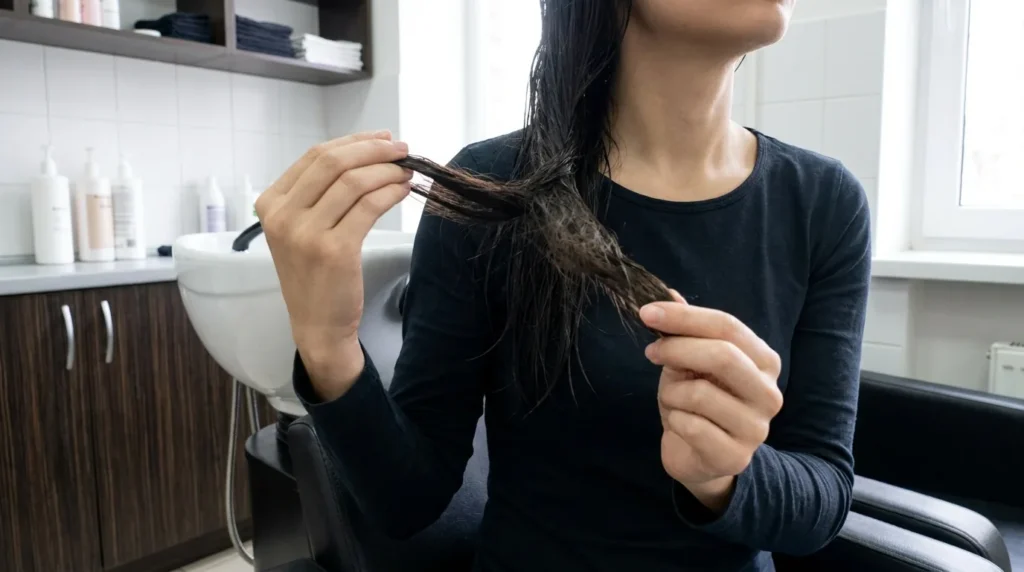
Start with the strand itself. Pick a fallen hair off the shoulder and look at the ends under a lamp. A tiny pale bulb on one end means the strand completed its growth cycle and left the follicle on schedule. Two ragged, uneven ends and no bulb means it snapped. Snapped strands are the signature of hard water. Bulbs point at a cause the water cannot explain, and the fix is on a different track entirely.
Then look at length. Short broken pieces standing up around the crown and hairline are breakage, the pattern that fits hair loss due to hard water. Whole long strands carrying bulbs are shedding instead. Most people find some of each, so the question is which type dominates the brush.
The third check is the travel test. Spend two weeks somewhere with a different water supply and pay attention by the end of the trip. Hair that feels softer and combs more easily away from home has been telling you something. Hair that behaves identically has a cause travelling with you.
The fourth check is the bathroom, where soap that will not lather, white scale on the shower screen and a furred kettle element all point the same way.
Timing matters as much as the signs. Surface damage from water builds slowly over months. Shedding that jumps within a few weeks almost always traces to something systemic, and washing habits are rarely the culprit.
Does hard water cause hair loss? What the one controlled study found
Almost every guide on hair loss due to hard water repeats that hardness weakens the fibre itself. Exactly one controlled experiment has tested that claim, and the result rarely gets quoted.
Researchers at PSG Institute of Medical Sciences published it in the International Journal of Trichology in 2013. They took hair from 15 volunteers, split each sample in two, and soaked one half in hard water at 212.5 ppm calcium carbonate and the other in distilled water at 10 ppm. Ten minutes, alternate days, 30 days. Then they measured both halves on an INSTRON universal strength tester.
Tensile strength came back at 105.28 for the hard water group and 103.66 for distilled, with a p value of 0.858. Elasticity came back at 37.06 against 36.84, p value 0.874. The authors concluded that water hardness does not interfere with the tensile strength or elasticity of hair. They added one caveat worth keeping: a higher salt load or a longer exposure could change the finding.
That result reframes the question. The fibre held its strength even at a hardness level classed as very hard, so what people experience is a surface deposit plus the rougher handling it provokes. Surface deposits wash off, which is the mechanical reason hair loss due to hard water recovers rather than settles in.
Why Dubai hard water hair complaints are so common
The standard hardness scale comes from the United States Geological Survey and sorts water into four bands.
| Total hardness (mg/L as calcium carbonate) | Classification |
|---|---|
| 0 to 60 | Soft |
| 61 to 120 | Moderately hard |
| 121 to 180 | Hard |
| Over 180 | Very hard |
Those bands come from the USGS Water Science School, and they describe water that has picked up minerals by moving through rock. Dubai does not work that way. The city drinks desalinated seawater, which arrives from the plant stripped of almost everything dissolved, then gets blended and stabilised before it enters the network. The World Health Organization treats the blending of final waters as a core control step in desalinated supply.
So the local mineral load is engineered rather than inherited, and hair loss due to hard water in Dubai is rarely driven by hardness alone. Complaints here come from a stack. Residual chlorine sits in the supply. Water waits in rooftop and basement tanks through 45C summers. Showers run long and hot. Air conditioning pulls moisture out of hair for 20 hours a day. Add year-round UV and pool chlorine and the surface takes a beating from five directions at once.
That stack matters for the fix. A shower filter removes one input. It cannot repair a cuticle already roughened by heat styling or bleach, which is why a filter alone disappoints so many people who buy one expecting a cure.
How long hair loss due to hard water takes to reverse
Nobody publishes a recovery timeline for hair loss due to hard water, which leaves readers guessing. The clock below is built from two known quantities: how fast a chelating wash lifts mineral deposits, and how fast scalp hair grows, which is roughly 1.25 cm a month.
| Stage | Timeframe | What changes |
|---|---|---|
| Mineral film lifts | 1 to 2 chelating washes | Lather returns, hair feels lighter, colour looks less dull |
| Handling improves | 2 to 6 weeks | Less tangling, fewer snapped pieces on the brush and pillow |
| Clean growth visible | 6 to 12 weeks | Roughly 2 to 4 cm of undamaged hair at the roots |
| Damaged length gone | 18 to 24 months | Shoulder-length hair fully replaced by new growth |
The last line does the most work: reversal means the damaged length grows out and gets cut off. A strand that has already snapped will not re-lengthen from the break, so regular trims do more than any bottle. The improvement visible in weeks is real, and full-length recovery still runs on the growth cycle.
Anyone dealing with heat or colour damage on top of the mineral load should expect the slower end of that range, and professional treatment shifts the middle stages rather than the last one. Menus vary widely on this, so it is worth checking which hair salons in Dubai list a bond or protein service alongside conditioning.
The fixing order that works
Sequence matters more than product choice when reversing hair loss due to hard water. Removing the deposits before adding moisture means the conditioner reaches the cuticle instead of sitting on top of a mineral film.
- Chelate first. A chelating shampoo carries a binding agent such as EDTA that grips calcium and magnesium and carries them down the drain. A clarifying shampoo strips product residue and does far less to metals. Use a chelating formula once, then weekly for a month, then monthly.
- Rebuild moisture the same day. Follow every chelating wash with a deep conditioning mask through the mid-lengths and ends. Chelating agents leave the cuticle open and thirsty.
- Cut the mechanical load. Detangle with a wide-tooth comb from the ends upward, blot with a microfibre towel, and drop daily heat styling. Roughened hair breaks under handling that smooth hair shrugs off.
- Reduce the input. A shower filter, shorter and cooler showers, and a final rinse from filtered water all lower the mineral dose reaching the scalp.
- Keep acid rinses in perspective. Diluted apple cider vinegar flattens the cuticle for a day or two and adds shine. It does not bind metals, so it supports the routine without replacing step one.
- Reassess at six weeks. If the brush is no cleaner by then, the water was not the main driver.
Oiling before a wash sits outside that sequence and still earns a place, because a pre-wash oil coats the shaft and slows water uptake, so fewer dissolved minerals get inside. The effect is small and it compounds with consistency.
Where a salon fits into the fix
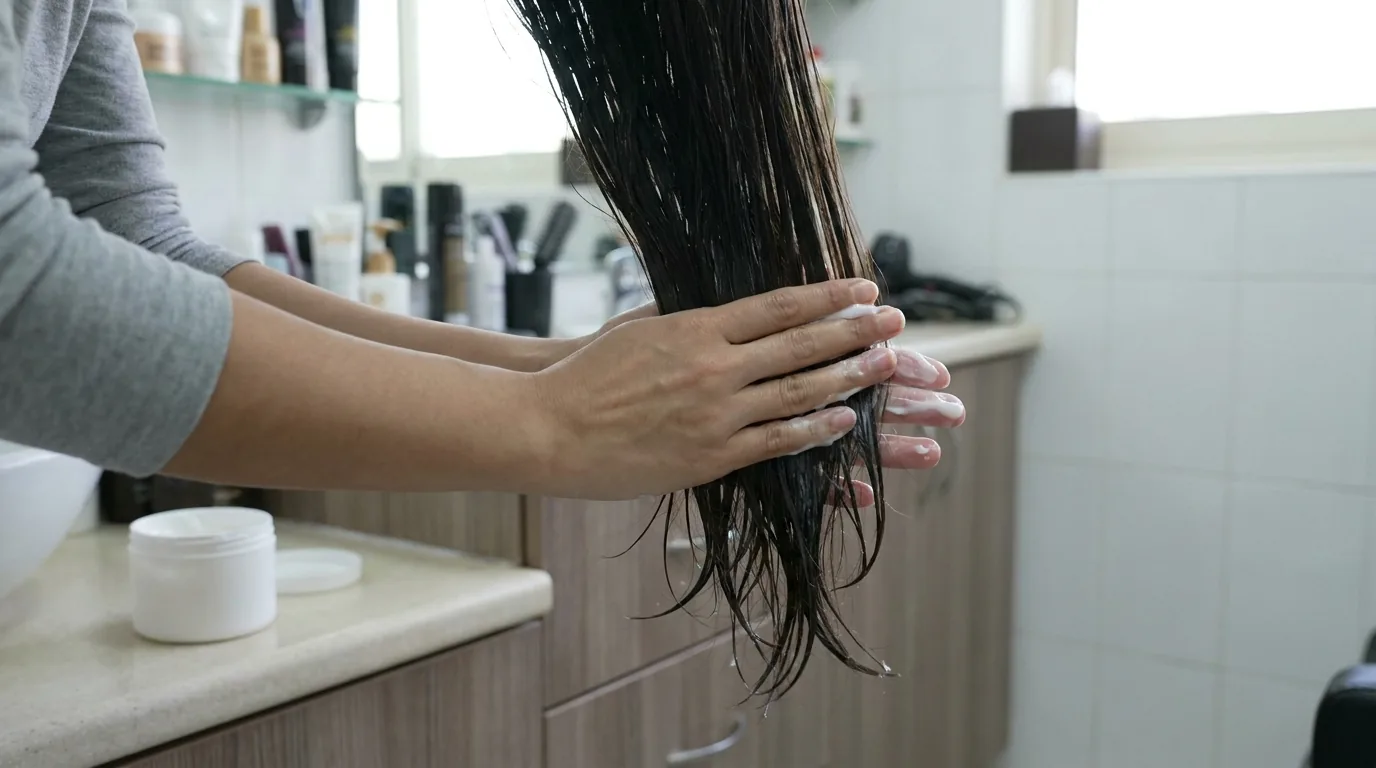
One salon appointment compresses the first month of treating hair loss due to hard water at home. A professional detox or clarifying wash followed by a deep treatment under heat removes more buildup in an hour than a domestic shower manages in four weeks, and a stylist can read breakage off the mid-lengths under salon lighting faster than anyone can at a bathroom mirror.
A scalp treatment is worth adding when flaking or tightness came along with the roughness. What a salon cannot do is treat medical hair loss, so a widening parting or thinning temples belongs with a clinician instead. The listings below are ranked by the same objective rule for every venue, explained in how the directory ranks salons.
The directory lists 167 hair salons across Dubai, and most of the mid-range ones carry a clarifying or detox wash on the menu.Browse all 167 Hair Salons providers on our directory.

Popular hair salons in Dubai
Collective is a hair salon inside the MAG Warehouses complex in Al Quoz Industrial Area 2, rated from reviews. Services cover hair colouring, balayage, hair highlights, hair extensions, keratin treatment, ladies haircuts, blow dry, bridal makeup, manicures, gel pedicures and waxing services. Several reviewers like the modern, classy interior and mention stylists using Dyson equipment for finishing, with one client describing a playful, well judged cut from a stylist who listened closely to the brief. Feedback on colour work is more mixed, with one detailed report describing hair damage and billing disagreements after a balayage and toner service, so it makes sense to agree the full scope and price before any colour treatment begins. The salon has a toilet on site along with wheelchair-accessible parking and entrance.
Version Francaise is a hairdressing salon inside the Marriott Harbour Hotel and Suites in Dubai Marina, offering haircuts, hair colouring, highlights, hair extensions, keratin treatment, blow dry styling, threading, manicures and nail art. It is rated from reviews.Reviewers consistently describe the salon as welcoming, with several returning for years and calling it their regular salon for haircuts and colour treatments. The team is praised for professionalism, attention to detail and a warm welcome from arrival to the end of the appointment.The salon has free Wi-Fi, on-site services, a wheelchair-accessible entrance, car park and toilet, plus gender-neutral toilets. It suits residents and hotel guests in Dubai Marina after a haircut, colour service or hair treatment appointment, with appointments recommended given the salon's loyal following.
Locks By Lou Lou is a hair salon on Al Wasl Road in Jumeirah, rated from reviews. Reviewers consistently praise the colour work, from balayage and highlights to root touch ups, and several mention hair extensions that look natural rather than obviously fitted. Clients also note that stylists take time to understand what they want before starting and explain aftercare so hair stays in good condition afterwards.Beyond colour, the salon offers blow dry, keratin treatment, hair extensions, manicure, gel pedicure, microneedling and anti-aging facial treatments. The entrance is wheelchair accessible and there is an on-site toilet.Appointments are recommended, particularly for colour and extension work, and the salon suits clients looking for an ongoing colourist relationship rather than a single visit.
Version Francaise Pour Elle is a hairdresser and beauty salon on Al Wasl Road, Al Safa 2, rated from reviews. Services span hair colouring, balayage, highlights, extensions, keratin treatment and blow dry, ladies' haircuts, beard trim, manicure, gel nails, gel pedicure, eyelash extensions, anti-aging facials and waxing.Reviewers consistently praise the colour and highlight work, describing meticulous stylists who take the time to understand what a client wants even when it is hard to explain. The salon is also noted for its cleanliness, product quality and reasonable prices, with several reviewers mentioning the owner is regularly on site overseeing the team and the client experience.Free Wi-Fi and parking are available. Suits clients after precise colour work from a team that takes the time to get it right.
Trinity Hair Salon is a hair salon in Al Barsha South, based at Danube Resortz, rated from reviews.Colour work is what reviewers talk about most, with several describing years of trust in the stylists for balayage, highlights and full colour changes, including recovering from a previous bad dye job elsewhere. The salon also offers ladies haircuts, blow dries, hair treatment and a back massage, plus manicures and pedicures. More than one reviewer describes the atmosphere as warm and modern with a good energy, and says they would not trust anyone else with their hair colour.There is a toilet on site, the salon offers on-site services, and a wheelchair-accessible car park makes it an easy stop for residents around Al Barsha South.
Signs the cause sits somewhere else
Hair loss due to hard water has a narrow signature, and several patterns fall outside it. Each of those carries a different clock and a different route.
- Most shed hairs carry a pale bulb, which places the event at the follicle rather than on the strand.
- The parting widens or the temples recede while the length stays strong.
- Shedding spikes two to three months after childbirth, a fever, surgery, a crash diet or a period of heavy stress.
- Round patches of smooth scalp appear.
- The scalp hurts, burns or shows shiny areas where hair used to grow.
Any of those calls for a dermatologist rather than a shower filter. Blood work for ferritin, vitamin D and thyroid function is a common first step, and clinical options such as PRP only make sense once a diagnosis exists.
Two licences matter when booking that appointment in Dubai. Every salon operates on a trade licence from the Department of Economy and Tourism, which covers cosmetic hair services and nothing beyond them. Any clinic offering medical hair-loss treatment must additionally hold a Dubai Health Authority health-facility licence, and the treating doctor must hold a DHA practitioner licence. Both are worth confirming before payment, because a DET trade licence on its own does not authorise medical treatment.


