



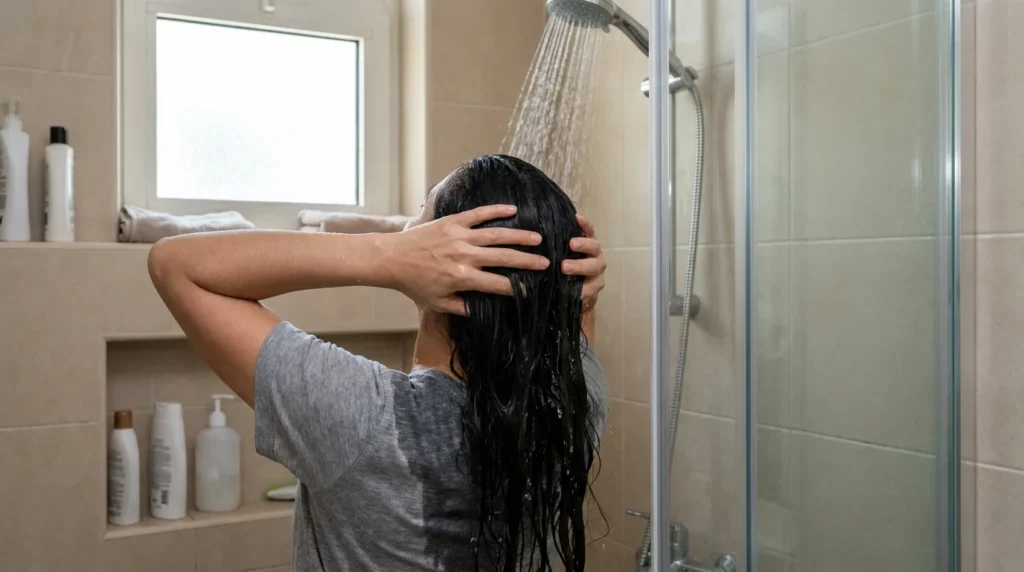
Is hard water bad for hair? For most people, mildly. Dissolved calcium and magnesium leave a film that dulls shine, roughens texture and makes strands tangle. The one controlled test of the question found no loss of strength in the fibre itself. The visible trouble shows up in porous, colour-treated and long hair first.
That gap between how hard water feels and what it measurably does is where most advice goes wrong. Water hardness gets blamed for thinning, for permanent damage, for hair that never recovered. The chemistry is narrower than that, and knowing where it stops changes what is worth buying.
Signs of hard water on hair, and what they rule out
Mineral residue announces itself in the shower before it shows in the mirror. Shampoo stops foaming the way it used to. Wet hair squeaks, then feels coated rather than slippery. Conditioner sits on the surface instead of sinking in.
| What you notice | What it points to | What it does not mean |
|---|---|---|
| Shampoo barely lathers | Calcium and magnesium binding the surfactant before it can foam | The shampoo has gone off |
| Hair feels coated and stiff when wet | Insoluble mineral salts settling on the cuticle | Protein overload |
| Dull tone, no shine under light | A rough surface scattering light instead of reflecting it | Permanent colour damage |
| Short broken pieces on the shoulders | Breakage along the length, usually from combing a tangled coat | Loss from the root |
| Blonde or ash tone turning warm | Metals depositing on porous, lightened lengths | A bad colour appointment |
The fourth row is the one worth checking properly. A broken piece is short, blunt at both ends and has no pale bulb. A shed strand is full length with a small white bulb at the root end, and it was going to fall anyway. Counting the wrong one starts a panic that a filter cannot fix, so it helps to know how much hair fall is normal before reading anything into a shower drain.
Deposit first, damage second
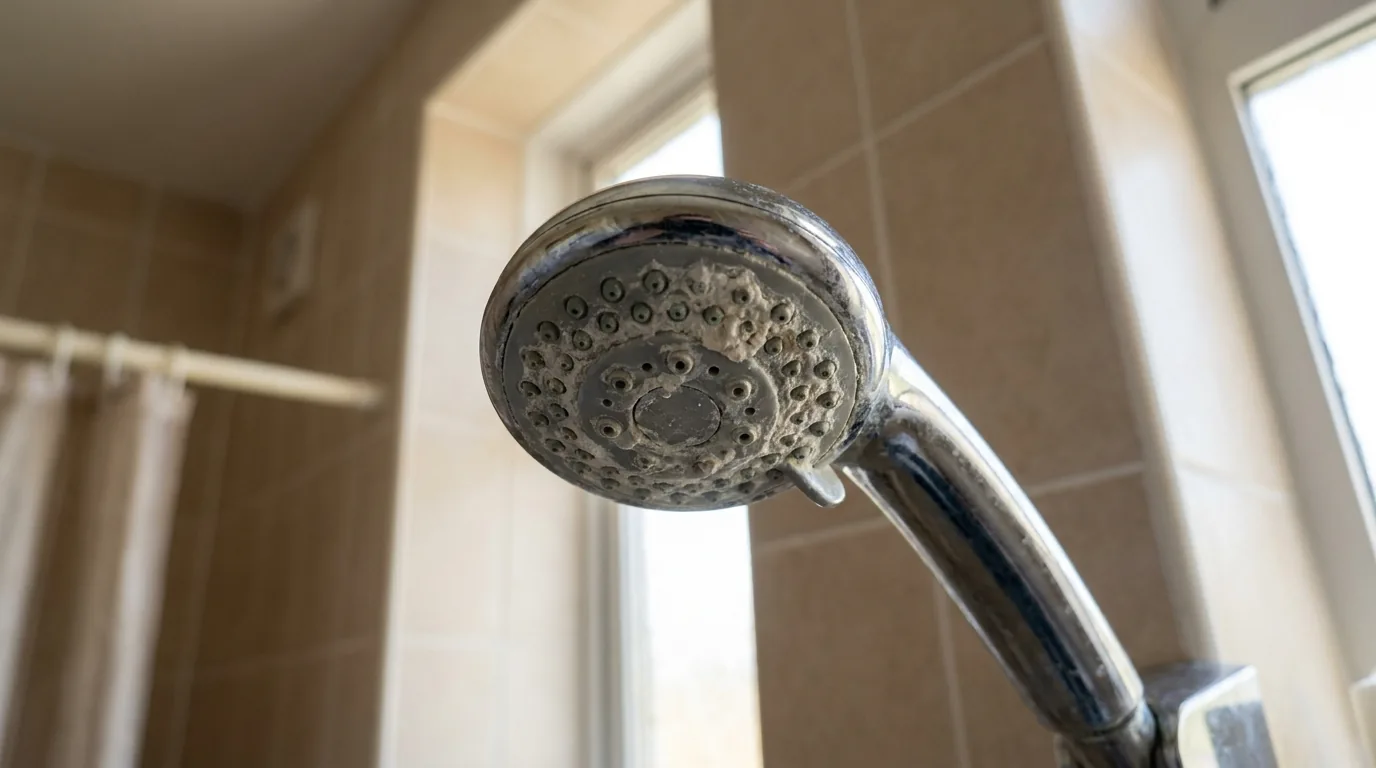
Hard water is water carrying dissolved calcium and magnesium. When those minerals meet the surfactants in shampoo, they react and form salts that will not rinse away cleanly. Those salts settle on the outside of the strand, along the overlapping scales of the cuticle. That is a coating. It is not an attack on the keratin underneath.
The distinction matters because it has been measured. Researchers publishing in the International Journal of Trichology soaked hair samples from 15 volunteers in water at 212.5 ppm calcium carbonate, ten minutes at a time on alternate days for 30 days, and compared them against samples soaked in distilled water. Tensile strength came back statistically unchanged, and so did elasticity. The fibre was no weaker after a month of hard water than after a month of pure water.
The same team was careful about the limits of that result. Higher mineral loads, or much longer exposure, could produce a different result. What the study rules out is the simple version of the story, where hard water quietly eats through hair.
So where does hard water damage on hair actually come from? Mostly from what the coating provokes. Coated hair tangles, and tangled hair gets combed harder. It looks dull, so it gets more product. It feels heavy, so it gets washed more often and hotter. Each of those is a mechanical stress on a cuticle that is already rough. The water sets up the problem and the handling delivers it.
Whose hair hard water is actually bad for
Two people in the same building can rinse in identical water and reach opposite conclusions. The variable is the hair, not the plumbing. Minerals need somewhere to lodge, and some cuticles offer far more of it than others.
| Hair profile | Why it shows up here first |
|---|---|
| Bleached, highlighted or chemically straightened | The cuticle sits raised and porous, so minerals lodge instead of rinsing off |
| Blonde, ash or pastel tones | Deposited metals read as warmth, and the shift is visible within weeks |
| Long hair | The ends have been through every wash for years and have the least cuticle left |
| Fine hair | A film that a coarse strand shrugs off is enough to flatten a fine one |
| Curly and coily hair | Slip is what keeps a curl detangling safely, and residue removes it |
| Short, uncoloured, coarse hair | Barely registers it, and often reports no problem at all |
This is why the answer splits. Someone with virgin hair cut to the jaw may genuinely notice nothing. Someone maintaining cool blonde through Dubai summer is fighting the deposit every fortnight. Anyone booking regular colour services sits in the second group by default, which is worth factoring into the maintenance budget rather than treating as bad luck.
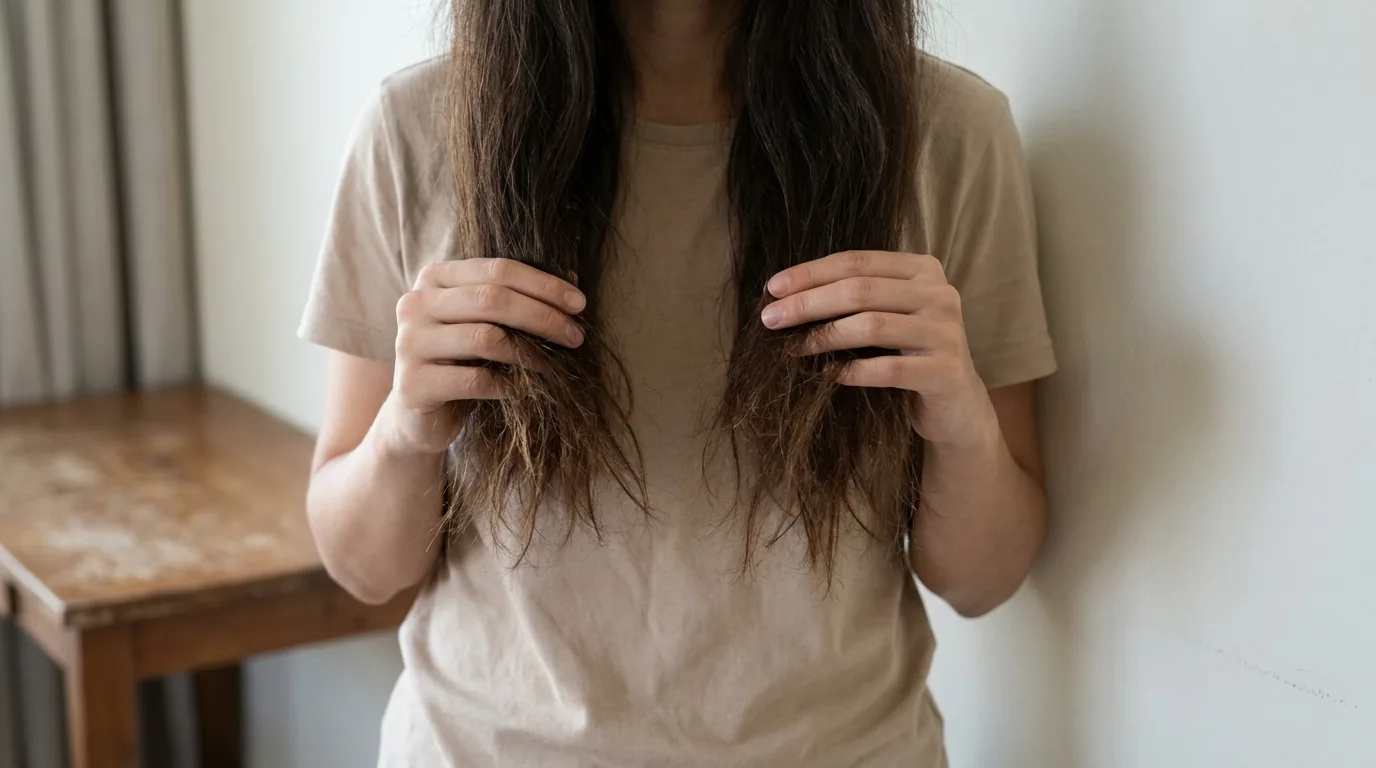
Is it okay to wash your hair with hard water?
Yes. There is no health reason to avoid it, and no evidence that ordinary tap hardness weakens hair. Is hard water bad for your hair in the sense that it will ruin it? No. In the sense that it makes hair harder to keep looking good, and quietly raises the cost of doing so, it is a real nuisance worth managing.
The practical move is to change the routine rather than the water supply. A residue that builds over weeks comes off with the right wash, and hair that is detangled gently stops paying the mechanical tax described above. Most people get further with a better conditioner and a slower comb than with hardware.
Hard water, dandruff and an itchy scalp
The scalp is skin, and it responds to residue the way any skin does. Mineral deposits plus leftover surfactant can leave it tight, itchy and prone to fine flaking, particularly when air conditioning is already pulling moisture out of the air for most of the day.
What hard water does not do is cause dandruff. True dandruff is driven by Malassezia yeast and an inflammatory response to it, and no mineral in tap water starts that process. Hard water makes an existing flaking problem look worse and feel itchier, which is a meaningful difference when choosing what to treat. Persistent flaking that survives a change of shampoo is worth taking to a professional, and salons offering scalp treatments can clear buildup even when the underlying cause needs separate attention.
What hard water damage on hair does not include
Three claims travel with this topic that the chemistry does not support.
- It does not reach the follicle. Calcium and magnesium sit on the outside of a strand that is already dead by the time it leaves the scalp. Nothing in a shower rinse penetrates to the growing part.
- It does not cause pattern hair loss. Androgenetic thinning is hormonal and genetic. Water hardness has no role in it, and no filter will change its course.
- It is not permanent. The deposit lifts with the right wash, and any mechanical damage below that grows out with the hair. Readers who have already lost density and want the timeline should start with whether hair loss from hard water reverses, which covers the attribution test and the recovery clock in full.
Ruling those three out leaves a smaller and more solvable problem: a surface coating that changes how hair behaves, on hair that is otherwise healthy.
What cuts the damage in a Dubai building
Dubai drinks desalinated seawater, and minerals are added back during treatment before the supply is distributed. What arrives at any particular shower head also depends on the building, since water sits in storage tanks and travels through pipework of varying age before it reaches a bathroom. The useful measurement is the one in your own flat, not a figure quoted for the city.
Four habits do most of the work.
- Use a chelating or clarifying wash every two to four weeks. These are formulated to bind minerals and carry them off, which ordinary shampoo cannot do. More often than that strips the hair for no gain.
- Condition every single wash. Slip is the defence against the combing damage that does the real harm, and regular deep conditioning treatments hold it far better than a rinse-out alone on porous lengths.
- Detangle wet, with product, from the ends up. Dry-brushing a coated tangle is where most breakage happens.
- Treat a shower filter as helpful, not curative. It reduces one input. It cannot repair a cuticle already roughened by bleach, heat or years of sun.
Book the chelating wash before a colour appointment, not after. Lifting mineral buildup first gives the colourist a cleaner surface to work on, and blonde and ash tones hold truer for it.
Anywhere a treatment gets booked, the licensing question is simple. A salon operates on a Department of Economy and Tourism trade licence, which covers cosmetic hair and scalp work. Anything that crosses into diagnosing or medically treating hair loss belongs with a clinician holding a Dubai Health Authority licence instead. Directory listings on hairdressers and full-service salons flag which category a venue falls into, and how we rank salons sets out what gets checked before a venue appears.

Popular hair salons in Dubai
Collective is a hair salon inside the MAG Warehouses complex in Al Quoz Industrial Area 2, rated from reviews. Services cover hair colouring, balayage, hair highlights, hair extensions, keratin treatment, ladies haircuts, blow dry, bridal makeup, manicures, gel pedicures and waxing services. Several reviewers like the modern, classy interior and mention stylists using Dyson equipment for finishing, with one client describing a playful, well judged cut from a stylist who listened closely to the brief. Feedback on colour work is more mixed, with one detailed report describing hair damage and billing disagreements after a balayage and toner service, so it makes sense to agree the full scope and price before any colour treatment begins. The salon has a toilet on site along with wheelchair-accessible parking and entrance.
Version Francaise is a hairdressing salon inside the Marriott Harbour Hotel and Suites in Dubai Marina, offering haircuts, hair colouring, highlights, hair extensions, keratin treatment, blow dry styling, threading, manicures and nail art. It is rated from reviews.Reviewers consistently describe the salon as welcoming, with several returning for years and calling it their regular salon for haircuts and colour treatments. The team is praised for professionalism, attention to detail and a warm welcome from arrival to the end of the appointment.The salon has free Wi-Fi, on-site services, a wheelchair-accessible entrance, car park and toilet, plus gender-neutral toilets. It suits residents and hotel guests in Dubai Marina after a haircut, colour service or hair treatment appointment, with appointments recommended given the salon's loyal following.
Locks By Lou Lou is a hair salon on Al Wasl Road in Jumeirah, rated from reviews. Reviewers consistently praise the colour work, from balayage and highlights to root touch ups, and several mention hair extensions that look natural rather than obviously fitted. Clients also note that stylists take time to understand what they want before starting and explain aftercare so hair stays in good condition afterwards.Beyond colour, the salon offers blow dry, keratin treatment, hair extensions, manicure, gel pedicure, microneedling and anti-aging facial treatments. The entrance is wheelchair accessible and there is an on-site toilet.Appointments are recommended, particularly for colour and extension work, and the salon suits clients looking for an ongoing colourist relationship rather than a single visit.
Version Francaise Pour Elle is a hairdresser and beauty salon on Al Wasl Road, Al Safa 2, rated from reviews. Services span hair colouring, balayage, highlights, extensions, keratin treatment and blow dry, ladies' haircuts, beard trim, manicure, gel nails, gel pedicure, eyelash extensions, anti-aging facials and waxing.Reviewers consistently praise the colour and highlight work, describing meticulous stylists who take the time to understand what a client wants even when it is hard to explain. The salon is also noted for its cleanliness, product quality and reasonable prices, with several reviewers mentioning the owner is regularly on site overseeing the team and the client experience.Free Wi-Fi and parking are available. Suits clients after precise colour work from a team that takes the time to get it right.
Trinity Hair Salon is a hair salon in Al Barsha South, based at Danube Resortz, rated from reviews.Colour work is what reviewers talk about most, with several describing years of trust in the stylists for balayage, highlights and full colour changes, including recovering from a previous bad dye job elsewhere. The salon also offers ladies haircuts, blow dries, hair treatment and a back massage, plus manicures and pedicures. More than one reviewer describes the atmosphere as warm and modern with a good energy, and says they would not trust anyone else with their hair colour.There is a toilet on site, the salon offers on-site services, and a wheelchair-accessible car park makes it an easy stop for residents around Al Barsha South.
Frequently asked questions
Browse all 167 Hair Salons providers on our directory.


