


How much hair fall is normal sits in a range rather than a single figure: most people shed 50 to 150 strands a day from roughly 100,000 on the scalp. The number you see depends on how often you wash, how long your hair is, and what your body was doing three months ago.
Covering Dubai salons, I hear this question in the same shape almost every time: someone counts a shower drain, panics, and books a salon appointment for something a salon cannot answer. The timing is what most guides leave out. Hair shedding today was pushed into its resting phase two to three months back, so the trigger is rarely the thing that happened last week.
How much hair fall is normal in a day
The American Academy of Dermatology puts routine shedding at 50 to 100 hairs a day. Cleveland Clinic and Henry Ford Health both quote 50 to 150. Neither figure is wrong. The wider band accounts for hair length, wash frequency and seasonal variation, all of which move the count without anything being wrong at the root.
Set against roughly 100,000 hairs on an adult scalp, even 150 strands is a fraction of one percent. Around 90 percent of those hairs are growing at any moment, which is why routine hair fall never opens a visible gap. Each strand runs a cycle, and shedding is the end of that cycle rather than a fault in it.
| Phase | What happens | How long it lasts |
|---|---|---|
| Anagen | The hair follicle actively grows a strand, roughly one centimetre a month | 2 to 8 years |
| Catagen | Growth stops and the follicle begins to regress | About 2 to 3 weeks |
| Telogen | The strand rests, still anchored but no longer growing | 2 to 4 months |
| Exogen | The resting strand releases, which is the shed you notice | The shed itself |
A strand on your pillow finished a cycle that started years ago. Counting it tells you about the follicle’s timing rather than its health.
How to count what you are actually shedding
Guessing from the bathroom floor is the least reliable method there is. Three approaches turn hair fall into a number worth comparing.
The 60 second comb count. Comb dry hair from root to tip over a pale towel for one minute, then count what lands. Repeat on the same day each week. The single number matters far less than whether it climbs.
The wash day count. Collect everything from the drain, the towel and the comb on one wash, count it, then divide by the days since your last wash. That result is the figure to hold against the 50 to 150 band.
The Hair Shedding Visual Scale. A 2017 study in Dermatology and Therapy built a validated picture scale: nine photographed bundles running from 10 strands to 700, which women matched against their own daily shed. Scores of 1 to 4 sit in the normal range, and 5 to 9 indicate excessive shedding. Healthy women averaged about 2.4, while women with female pattern hair loss averaged about 7.1, and the scale tracked hand counting closely.
| Method | What it takes | Best for |
|---|---|---|
| 60 second comb count | One minute, a comb, a pale towel | Tracking a trend week to week |
| Wash day count | One wash, divided by days since the last one | Comparing against the 50 to 150 daily band |
| Hair Shedding Visual Scale | Matching your shed against a photographed bundle | A fast reading, and a shared reference for a clinician |
Whichever you pick, hold the same wash rhythm each time. Changing how often you wash moves the count more than most causes of hair fall do.

Why the shower drain exaggerates your hair fall
A released strand does not leave on its own schedule. It stays caught in the surrounding hair until water, shampoo and friction free it. Wash every third day and one shower delivers three days of shedding in a single handful.
Run the arithmetic against the daily band and the numbers stop looking alarming.
| Days since last wash | Strands in that one wash still inside the normal band |
|---|---|
| 1 day | 50 to 150 |
| 2 days | 100 to 300 |
| 3 days | 150 to 450 |
| 5 days | 250 to 750 |
Those are the daily figures multiplied out, not a separate clinical measurement, and a full drain after a long gap between washes is arithmetic rather than a warning. Our editorial policies set out how we separate sourced figures from calculations like this one.
Length adds to the illusion. Long strands tangle into a visible clump where the same number of short ones would rinse away unnoticed.
Pick one counting method and one wash rhythm, then hold both for a month. A trend line answers the question that a single count never will.
Normal hair loss per day for women and for men
The daily band does not change with sex. Searches split into normal hair loss per day female and normal hair loss per day male as though the figures differ, and they do not: 50 to 150 strands covers both.
What differs is the pattern behind it. Cleveland Clinic notes that men are more likely to experience hair loss overall, while women are more likely to see shedding spike around pregnancy and menopause, and over half of all women notice hair loss at some point. A 2017 study found women shed more on average, though the driver looked like styling practice rather than sex: anyone using tight styles and high heat sheds more.
Genetics and hormones set the pattern itself. Male pattern baldness shows as a receding hairline or crown thinning. Female pattern hair loss usually shows as a widening part with the hairline held. Both involve follicles shrinking over years, and neither reads as a spike in daily hair fall, which is why counting alone will not catch them.
Shedding, breakage or loss: how to tell them apart
Three different problems put hair in your hand, and one strand will usually tell you which you have.
Pick up a fallen hair and look at the end. A small pale bulb means the strand completed its cycle and released normally. No bulb, with a blunt or frayed end, means it snapped along the shaft. That is breakage, a hair care problem rather than a follicle problem.
| What you see | What it points to | First move |
|---|---|---|
| Full length strands with a pale bulb, more of them than usual | Telogen effluvium, excessive shedding after a trigger | Look back two to three months for the cause |
| Short broken pieces, no bulb, split or blunt ends | Breakage from heat, colour, tension or dryness | Change the routine before changing anything else |
| Widening part or crown thinning with a steady shed count | Pattern hair loss, follicles miniaturising | A clinician, since this one is progressive |
| Smooth round bald patches appearing quickly | Alopecia areata | A clinician, promptly |
Breakage is the most common false alarm. Regular colour, daily heat and tight styles weaken the shaft, and the pieces that snap off look exactly like loss in the mirror. A scalp treatment or a gentler hair colouring routine addresses that, while neither touches shedding driven from inside the body.
The two states carry different medical names. Excessive shedding after a trigger is telogen effluvium, and the hair grows back once the trigger clears. When something halts growth outright, as chemotherapy does, the term is anagen effluvium.
Signs your hair fall has crossed the line
A number on its own rarely settles the question. These signs carry more weight than any hair fall count.
- Your parting looks wider in the same mirror and the same light than it did six months ago.
- Your ponytail needs an extra turn of the band.
- Scalp shows through under bright overhead light where it did not before.
- Shedding has run heavy for longer than six months without settling.
- Hair comes away in clumps rather than loose strands.
- The scalp itches, hurts, flakes or scales alongside the shedding.
- Distinct patches appear rather than a general thinning.
Itching and flaking point at the scalp rather than the follicle. A persistent flake usually turns out to be dandruff rather than a shedding disorder, and it responds to a completely different routine.
The pull test is the check most guides recommend. Take a small section of clean, dry hair and tug gently from root to tip. One or two strands is routine. Consistently more than two or three across several sections is worth a consultation.
Its blind spot matters as much as the test. The Hair Shedding Visual Scale study noted that the pull test is not very sensitive, and that most women with female pattern hair loss or chronic telogen effluvium return a negative result while still shedding heavily. A clean pull test does not close the question.
What happened three months ago
Telogen effluvium runs on a delay. A trigger pushes a wave of growing hairs into the resting phase, and those hairs still have to finish resting before they release. The shed therefore arrives roughly two to three months after the event that caused it.
That delay sends most people looking in the wrong place. When hair fall picks up, the question worth asking is what changed a season ago.
- Childbirth. Shedding usually starts around two months after delivery and peaks near four, with fullness generally returning within six to nine months.
- A high fever, an infection or surgery.
- Rapid weight loss or a very restrictive diet.
- Stopping hormonal contraception.
- A sustained stretch of stress, whether from work, a move or a loss.
- Starting or stopping certain medicines, which is worth raising with the prescriber rather than acting on alone.
Hair fall that follows a trigger is self limiting in most cases. Once the cause passes, the cycle resets and the hair returns without any product doing the work.
What Dubai living changes about your hair fall
None of the biology above changes with the postcode. What changes is the set of triggers stacked on top, and how easy the result is to misread.
Local tap water is the usual suspect and the usual mistake. Dubai’s hard water leaves hair drier and rougher, which raises breakage. It does not reach the follicle and does not cause genuine hair loss, so the pieces it costs you are broken rather than shed.
Relocation is the more likely culprit. A move, a new job, visa paperwork and months of broken sleep add up to the sustained stress that triggers a shed, and the lag means it lands during the first year rather than the first weeks. Year round air conditioning dries the shaft, and chlorine and strong sun finish the job on coloured hair.
Living indoors in one of the sunniest cities on earth also has a habit of producing low vitamin D, which a blood test settles. Where hair fall turns out to be heavier than routine, the causes and fixes behind hair fall in Dubai is the sensible next read, while a scalp massage or regular conditioning helps the breakage side in the meantime.
Where to get hair fall assessed in Dubai
A salon cannot answer this question, and every stylist I have put it to says the same thing. They see the outside of the hair and can tell you the ends are breaking. Nobody working a chair can tell you whether your follicles are shrinking or your iron stores are low.
Two licences separate the two jobs. Every salon trading in Dubai holds a trade licence from the Department of Economy and Tourism, which authorises it to operate as a business. Diagnosing and treating hair loss is medical work, and it requires a practitioner and a facility licensed by the Dubai Health Authority. A DET trade licence on the wall says nothing about medical scope, so look for DHA licensing before accepting any assessment of why your hair is falling.
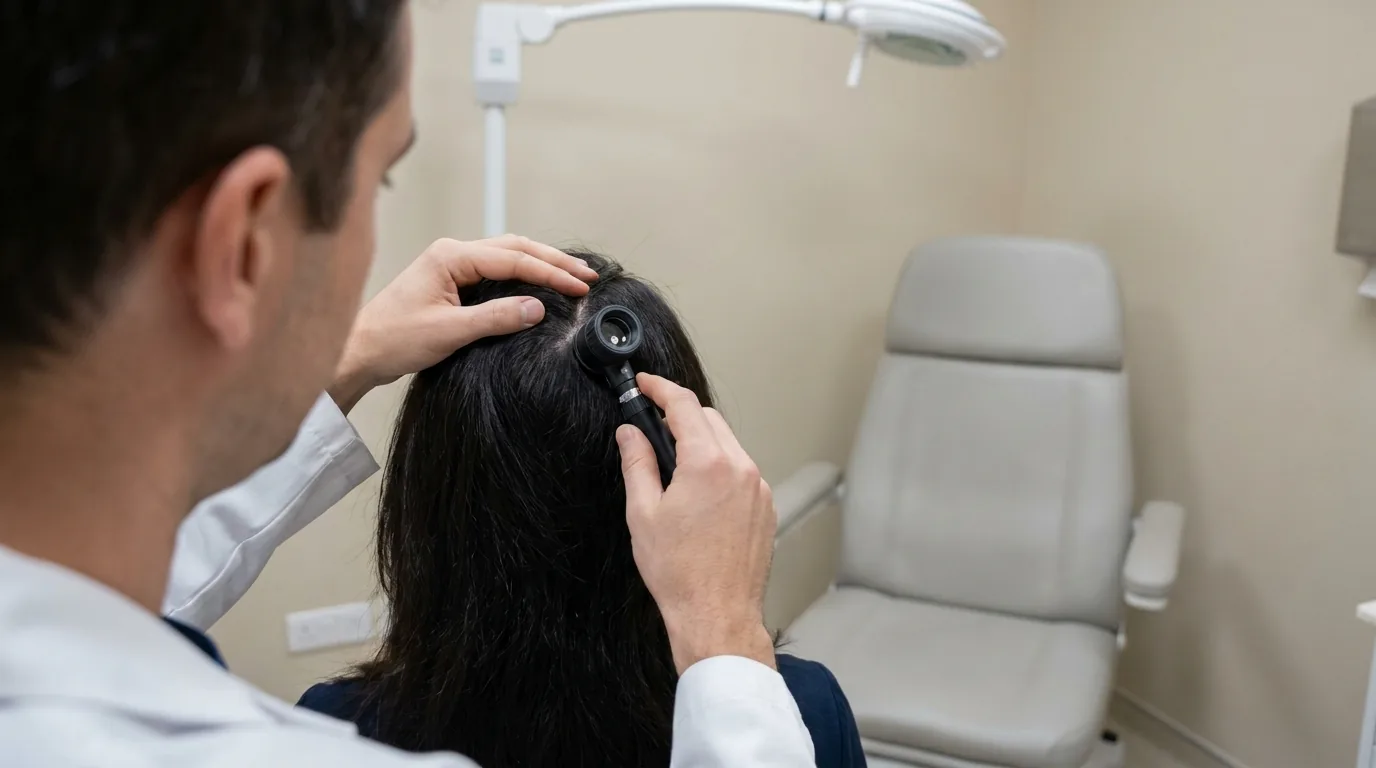
A first consultation with a dermatologist is usually straightforward: a history covering the last six months, a scalp examination, often trichoscopy, and blood tests where the picture suggests a deficiency. The directory lists 24 skin and dermatology venues in Dubai, which is a starting point for finding a licensed clinician rather than a recommendation of any one of them.
Browse all 24 Skin Specialists providers on our directory.
Where the diagnosis turns out to be pattern loss, the conversation usually moves to minoxidil or to PRP hair treatment, neither of which a salon provides. The skin specialists and hair salons sections list the venues.