



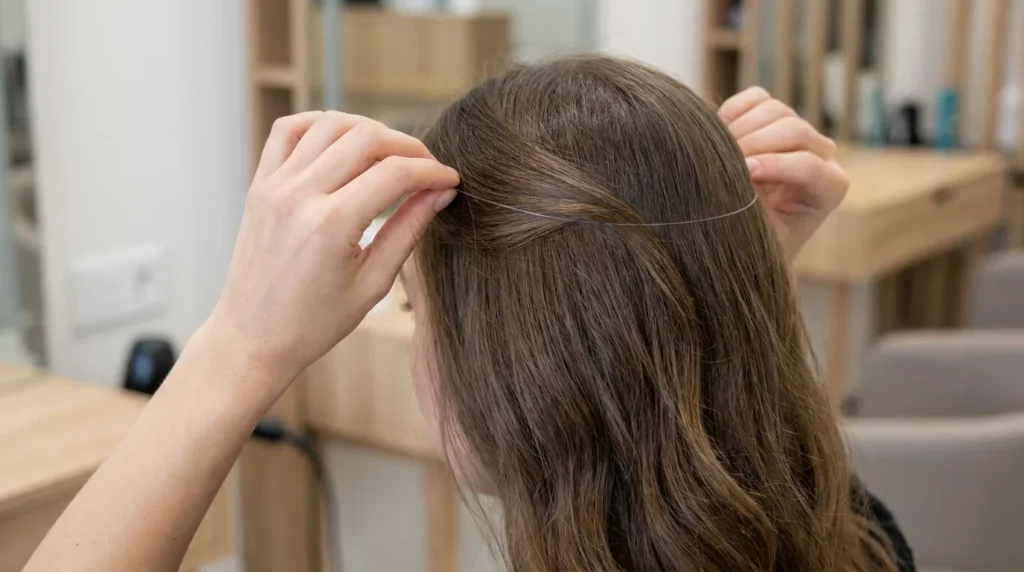
Halo hair extensions are a single weft of hair attached to a thin, clear wire that rests on the crown of your head like a hidden headband. There are no clips, no glue, and no bonds fixed to your own strands. They add instant length and volume in under a minute and cost roughly AED 150 to AED 700 to buy in Dubai.
What is a halo hair extension?
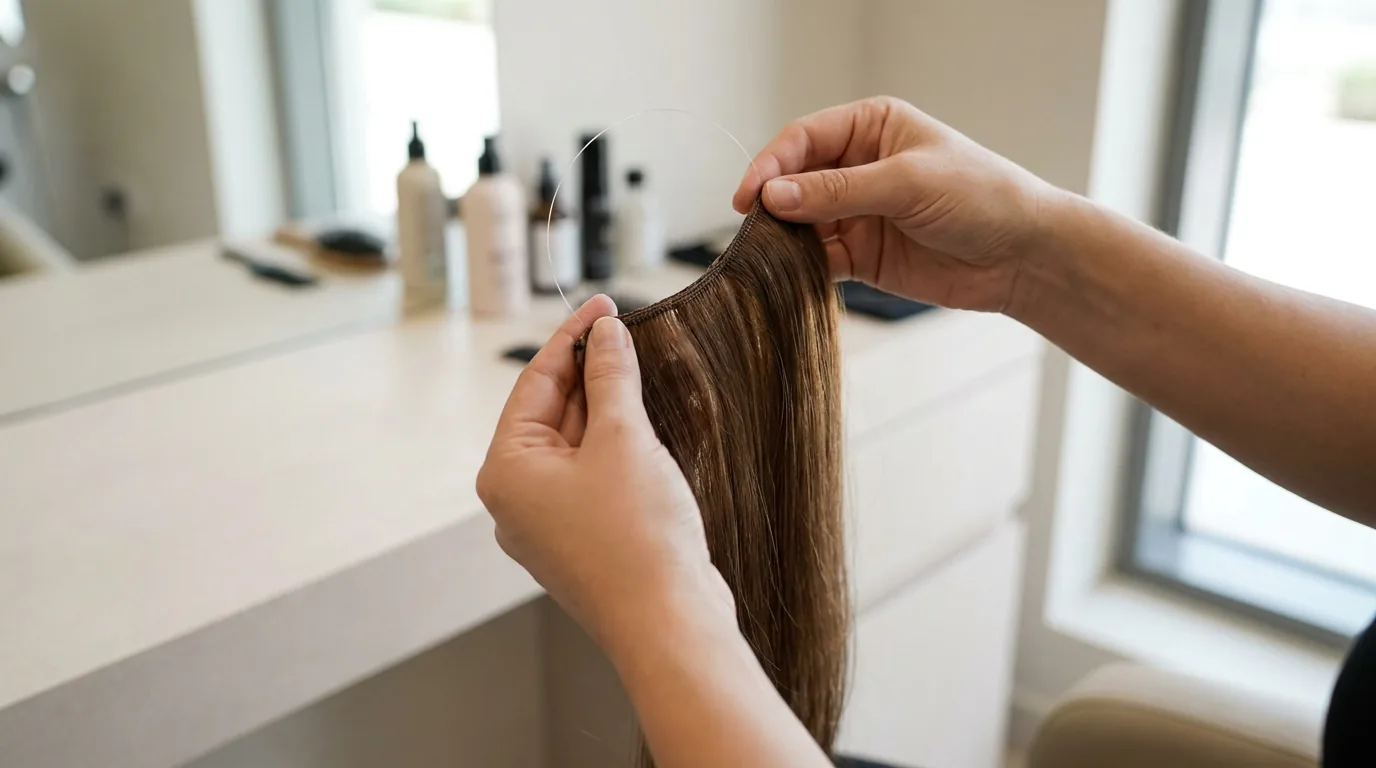
A halo is one continuous weft of hair sewn along the top into a loop. The front of that loop is a transparent wire, usually a fine nylon filament close to fishing line. The wire sits across the crown of your head, your natural hair falls over it, and the weight of the extension drapes down the back and sides. Worn correctly, the wire disappears under your own hair, which is where the headband comparison comes from.
The defining feature is what the halo does not do. It never grips an individual strand. Clip-in extensions snap onto sections of your hair, tape-in extensions sandwich your hair between adhesive wefts, and sew-in extensions stitch onto braided rows. A halo simply balances on the crown, so there is no pulling, no adhesive, and no salon bonding appointment. People often ask whether halo hair extensions are good for everyday use. For the right hair type they are one of the gentlest options available, and that is the heart of their appeal.
How a halo extension stays on your head
The clear wire is adjustable. You shorten or lengthen it so the band sits snugly across the crown without digging in. Once it is in place, your own hair covers the wire and holds the halo flat. Nothing clamps your scalp, so the hold comes from balance and the layer of natural hair on top rather than from tension on your roots.
Putting one in takes around 60 seconds once you have the knack:
- Detangle: brush your natural hair smooth with a wide-tooth comb so there are no knots to catch the wire.
- Section: lift the top crown layer of your hair and clip it forward out of the way.
- Place: rest the clear wire across your crown, roughly where a headband would sit, an inch or two back from your hairline.
- Cover: drop the crown layer back down over the wire so it hides completely.
- Blend: comb the halo into your own lengths, then style as normal. A human hair halo takes heat styling, so you can curl or straighten it to match your texture.
Who halo extensions suit (and who they do not)
Halo hair extensions for thin hair are the strongest use case. Because the weight loads onto the crown instead of clipping to fragile strands, fine and thinning hair gets volume without the tension that heavy clip-in sets put on the roots. Beginners do well with a halo too, since there is no technique to learn beyond combing it in. It also suits occasional wear: a wedding, a photo shoot, or an evening out where you want fuller hair for one day and your own hair back the next.
A halo is the wrong choice in a few cases. You need about six to eight inches of natural hair to cover the wire, so very short crops will not hide it. High ponytails and full updos expose the band, so clip-ins serve those styles better. And the halo adds density at the back and sides rather than across the front hairline, so anyone wanting uniform everyday thickness may prefer a permanent method.
Readers with alopecia or significant hair loss sometimes look at halos for coverage. A halo relies on a layer of your own crown hair to hide the wire, so it works for mild thinning but not for bare patches at the crown. A topper or wig is the better route there, and our guide to the best extensions for thin hair covers the gentler options in more detail.
Human hair vs synthetic halos
The biggest quality split is the hair itself. Remy human hair keeps the cuticles aligned in one direction, which is why it blends naturally, lasts longer, and can be heat styled and coloured like your own hair. Synthetic hair is a manufactured fibre. It holds a preset style well and costs far less, but most synthetic halos cannot take a hot tool, and they rarely pass as natural in bright light.
For halo hair extensions you will wear more than a handful of times, human hair is worth the extra outlay. The blend is better, the lifespan is longer, and you can restyle it whenever you change your own colour or cut. Synthetic suits a one-off costume or a single event on a tight budget, while salons that fit hair extensions across Dubai can match a human hair halo to your shade. Anyone choosing human hair halo extensions should look for the Remy label specifically, not just the words “real hair”, since non-Remy human hair tangles faster.
Halo vs clip-in, tape-in and sew-in extensions
Every extension method trades convenience against permanence. A halo wins on speed and gentleness; the bonded methods win on staying power and all-over density. This table sets the four side by side.
| Method | Application time | Damage risk | Reusable | Commitment |
|---|---|---|---|---|
| Halo | Under 1 minute | None | Yes | Take off daily |
| Clip-in extensions | 15 to 30 minutes | Low | Yes | Take off daily |
| Tape-in extensions | 1 to 2 hours | Moderate | Sometimes | 6 to 8 weeks |
| Sew-in extensions | 2 to 4 hours | Higher | Rarely | 6 to 10 weeks |
The practical read on halo vs clip-in extensions: a halo is faster and spreads weight more evenly, while a clip-in set gives you more placement control and handles updos. If you want fuller hair daily with zero salon visits, the halo is simpler. If you restyle into ponytails often, clip-ins flex more. For a full breakdown of every method, see our guide to the best hair extensions in Dubai.
What halo hair extensions cost in Dubai
Halo hair extensions cost less than most people expect, because the price is mostly the hair, not a salon procedure. In Dubai, synthetic halos sell for around AED 150 to AED 350, and Remy human hair halos run roughly AED 400 to AED 700 depending on length, weight, and brand. Weight matters as much as length: a heavier weft costs more and suits thicker hair, while a lighter weft suits fine hair. The guide below pairs hair thickness with the weft weight most salons recommend.
| Your natural hair | Recommended weft weight | Result |
|---|---|---|
| Fine or thin | 80 to 120g | Natural volume and length |
| Medium thickness | 120 to 160g | Noticeable fullness, still subtle |
| Thick | 160 to 200g and up | Enough density to blend heavier hair |
The optional extra is salon work. Colour matching, a blending cut, and a quick styling lesson typically add AED 100 to AED 400. That is separate from the permanent install fees a salon charges for tape or keratin extensions, which are a different service entirely. For a take-home halo, the salon spend at a Dubai hair salon is about getting the colour and cut right, not about fitting.
Where to get a halo fitted and colour-matched in Dubai
You can buy a halo online and wear it straight away, but a salon visit fixes the two things that make a halo look obvious: a colour mismatch and a blunt, unblended length. A stylist matches the weft to your mid-lengths and ends under natural light, then cuts the halo so it tapers into your own hair instead of sitting on top as a separate block. Hair salons in areas like Jumeirah commonly offer this short appointment. Many Dubai hair salons offer this as a short appointment.
Use a licensed salon for that work. A genuine Dubai salon holds a trade licence from the Department of Economy and Tourism (DET) and a health licence from the Dubai Health Authority (DHA), which together cover hygiene and staff standards. Salons listed across our Dubai directory are checked against that licensing baseline, and you can read how we rank salons for the full method. The directory currently lists 167 hair salons across the city that can colour-match and blend a halo for you.

Popular hair salons in Dubai
Collective is a hair salon inside the MAG Warehouses complex in Al Quoz Industrial Area 2, rated from reviews. Services cover hair colouring, balayage, hair highlights, hair extensions, keratin treatment, ladies haircuts, blow dry, bridal makeup, manicures, gel pedicures and waxing services. Several reviewers like the modern, classy interior and mention stylists using Dyson equipment for finishing, with one client describing a playful, well judged cut from a stylist who listened closely to the brief. Feedback on colour work is more mixed, with one detailed report describing hair damage and billing disagreements after a balayage and toner service, so it makes sense to agree the full scope and price before any colour treatment begins. The salon has a toilet on site along with wheelchair-accessible parking and entrance.
Version Francaise is a hairdressing salon inside the Marriott Harbour Hotel and Suites in Dubai Marina, offering haircuts, hair colouring, highlights, hair extensions, keratin treatment, blow dry styling, threading, manicures and nail art. It is rated from reviews.Reviewers consistently describe the salon as welcoming, with several returning for years and calling it their regular salon for haircuts and colour treatments. The team is praised for professionalism, attention to detail and a warm welcome from arrival to the end of the appointment.The salon has free Wi-Fi, on-site services, a wheelchair-accessible entrance, car park and toilet, plus gender-neutral toilets. It suits residents and hotel guests in Dubai Marina after a haircut, colour service or hair treatment appointment, with appointments recommended given the salon's loyal following.
Locks By Lou Lou is a hair salon on Al Wasl Road in Jumeirah, rated from reviews. Reviewers consistently praise the colour work, from balayage and highlights to root touch ups, and several mention hair extensions that look natural rather than obviously fitted. Clients also note that stylists take time to understand what they want before starting and explain aftercare so hair stays in good condition afterwards.Beyond colour, the salon offers blow dry, keratin treatment, hair extensions, manicure, gel pedicure, microneedling and anti-aging facial treatments. The entrance is wheelchair accessible and there is an on-site toilet.Appointments are recommended, particularly for colour and extension work, and the salon suits clients looking for an ongoing colourist relationship rather than a single visit.
Version Francaise Pour Elle is a hairdresser and beauty salon on Al Wasl Road, Al Safa 2, rated from reviews. Services span hair colouring, balayage, highlights, extensions, keratin treatment and blow dry, ladies' haircuts, beard trim, manicure, gel nails, gel pedicure, eyelash extensions, anti-aging facials and waxing.Reviewers consistently praise the colour and highlight work, describing meticulous stylists who take the time to understand what a client wants even when it is hard to explain. The salon is also noted for its cleanliness, product quality and reasonable prices, with several reviewers mentioning the owner is regularly on site overseeing the team and the client experience.Free Wi-Fi and parking are available. Suits clients after precise colour work from a team that takes the time to get it right.
Trinity Hair Salon is a hair salon in Al Barsha South, based at Danube Resortz, rated from reviews.Colour work is what reviewers talk about most, with several describing years of trust in the stylists for balayage, highlights and full colour changes, including recovering from a previous bad dye job elsewhere. The salon also offers ladies haircuts, blow dries, hair treatment and a back massage, plus manicures and pedicures. More than one reviewer describes the atmosphere as warm and modern with a good energy, and says they would not trust anyone else with their hair colour.There is a toilet on site, the salon offers on-site services, and a wheelchair-accessible car park makes it an easy stop for residents around Al Barsha South.
Browse all 167 Hair Salons providers on our directory.
Caring for a halo in Dubai’s climate
Dubai humidity is the one variable that catches halo wearers out. On a humid or windy day your natural hair can frizz while a smooth human hair halo stays sleek, and the texture gap makes the extension visible. The fix is to style both the same way: if you smooth your own hair, smooth the halo to match, and carry a little anti-frizz serum for touch-ups. Styling the halo on a stand first also spares your own hair the extra heat.
Cleaning is simple and infrequent, since the halo does not touch your scalp oils. A typical care routine:
- Wash only every 15 to 20 wears, in lukewarm water with a sulfate-free shampoo.
- Condition the mid-lengths and ends, never the wire seam.
- Detangle gently with a wide-tooth comb, working from the ends up.
- Air dry flat or on a hanger, out of direct sun, before storing.
- Store it in a satin or silk pouch, kept dry and away from heat.
People often ask how long halo hair extensions last. A Remy human hair halo holds up for 6 to 12 months of regular wear with that routine, and longer with occasional use. Synthetic halos wear out faster, usually inside 3 to 6 months, as the fibre loses its finish. Pairing a halo with a regular hair treatment keeps your own hair healthy enough to blend well.
The honest downsides of halo extensions
No method is perfect, and a halo has real trade-offs worth knowing before you buy. These are the complaints that come up most often from regular wearers:
- A bump at the back. The weft adds volume mainly at the crown and back, which can read as a slight ridge if the weight is too heavy for your hair.
- Pressure after a few hours. The wire is light, but some people feel a dull headache or tightness across the crown by the end of a long day.
- The wire shows if your parting slips. If the crown layer shifts, the clear wire can tangle into your own hair and become visible, so it needs a quick check through the day.
- Texture mismatch in humidity. Covered above, this is the main Dubai-specific issue and the reason curly or wavy wearers should match texture carefully.
- Less placement control. A single weft cannot be positioned piece by piece the way a multi-clip set can, so it is less flexible for elaborate styles.
Weighed against the zero damage and the 60-second application, most occasional and thin-haired wearers find halo hair extensions easy to live with. The honest answer to whether halo extensions are good is that they fit some hair and routines beautifully and frustrate others, which is why matching weight, length, and texture to your own hair matters so much.


