


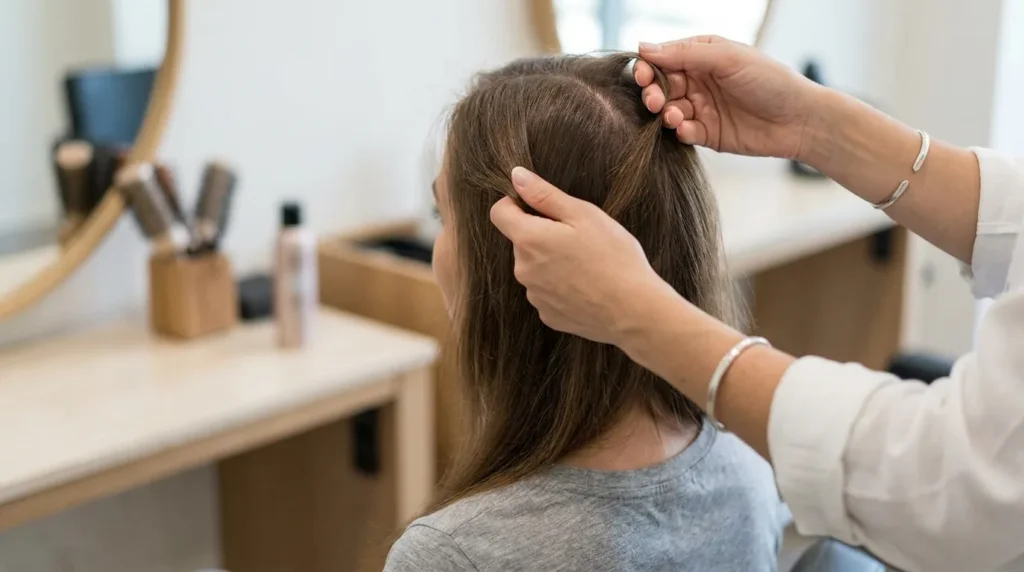
Which extensions are best for thin hair? Halo, tape-in, and hand-tied weft extensions suit thin hair best because they spread weight widely and lie flat without yanking fragile roots. In Dubai they run roughly AED 400 to AED 3,500 by method, with most fine-hair clients paying AED 800 to AED 1,800 at a mid-tier hair salon.
What “best for thin hair” actually means
Thin hair and fine hair are different problems, and the right extension answers both. Fine hair has a small individual strand diameter, so each hair is delicate. Thin hair means fewer strands per square inch, so the scalp shows through more easily. Many people have both at once. Density can also drop temporarily rather than permanently, which is what happens with pregnancy hair loss in the months after birth.
The risk with any extension on fragile hair is tension. Heavy wefts or tight bonds pull on the follicle, and sustained pulling can cause traction alopecia, a type of hair loss from constant strain. If shedding is already an issue, our guide on how to stop hair fall in Dubai covers the causes and what actually works. So “best for thin hair” comes down to three things: low weight, wide weight distribution, and a flat, undetectable attachment that hides under your own hair rather than peeking through it.
Remy human hair matters here too. Remy means the cuticles stay aligned in one direction, so the hair moves naturally and tangles less. On thin hair, a lightweight Remy set reads as your own hair far better than a cheap synthetic or non-Remy alternative. If you are still weighing the format, the full range of hair extensions in Dubai shows what local salons offer across every method.
Where the thinning is recent rather than lifelong, check the cause before covering it. Our guide to how much hair fall is normal sets out the daily shedding range and the signs that call for a clinician.
The best extension methods for thin hair
Three methods come up again and again as the best extensions for thin hair. Each trades off longevity against how much it leans on your natural strands.
Halo extensions
A halo sits on the crown like a headband, held by a clear wire that tucks under the top layer of your hair. Nothing clips, glues, or bonds to your strands, so there is zero pull on the follicle. You put it on in the morning and take it off at night. For very fine hair that cannot tolerate any tension, the halo is the safest entry point and the one most stylists suggest first. If you are new to them, our guide to what halo hair extensions are and how the wire works walks through the method in full.
Tape-in extensions
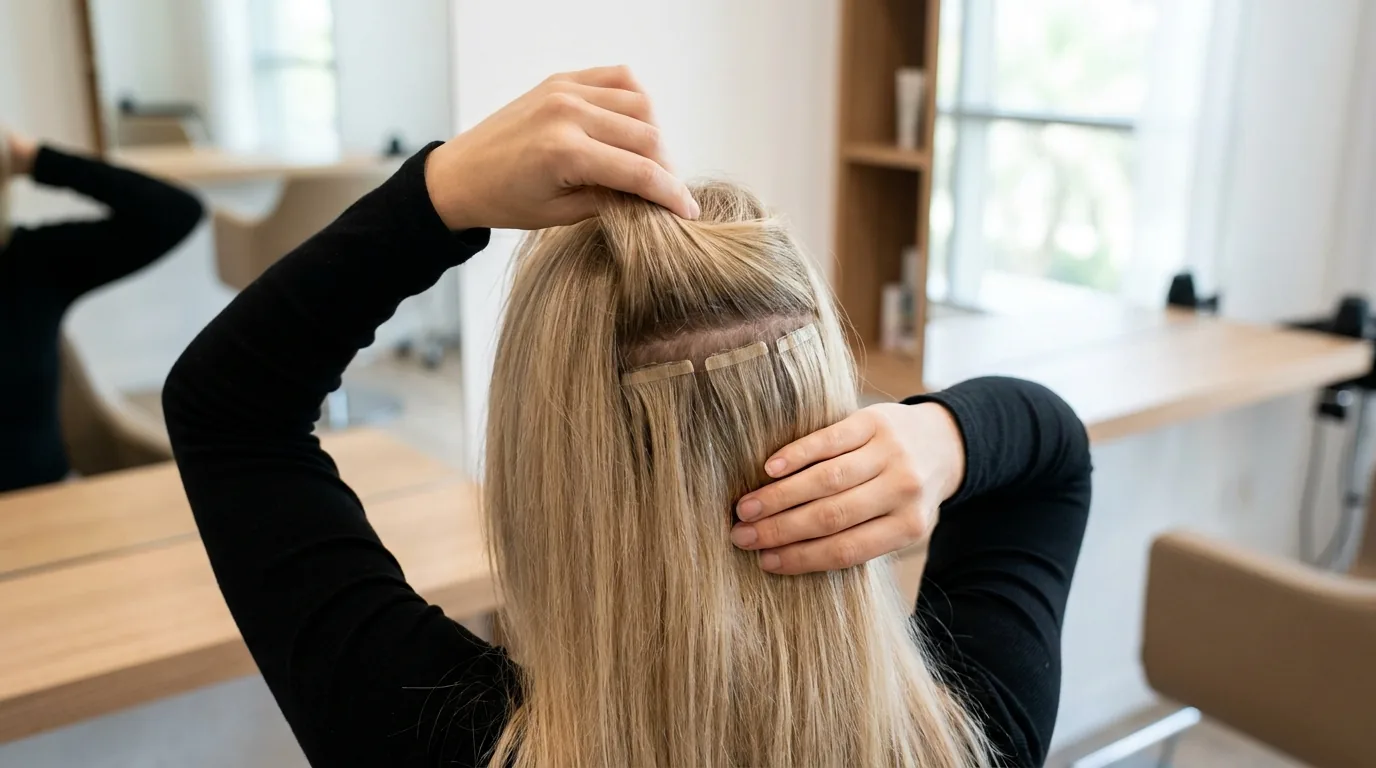
Tape-ins are thin wefts with a medical-grade adhesive strip that sandwiches a small section of your hair. They lie almost flat against the scalp and spread weight over a wide band, which keeps them comfortable on fine hair. A single-sided tape weighs less than a double-sided sandwich, so ask for single-sided panels if your hair is especially delicate. Tape-ins stay in for six to eight weeks before a reapplication.
Hand-tied weft extensions
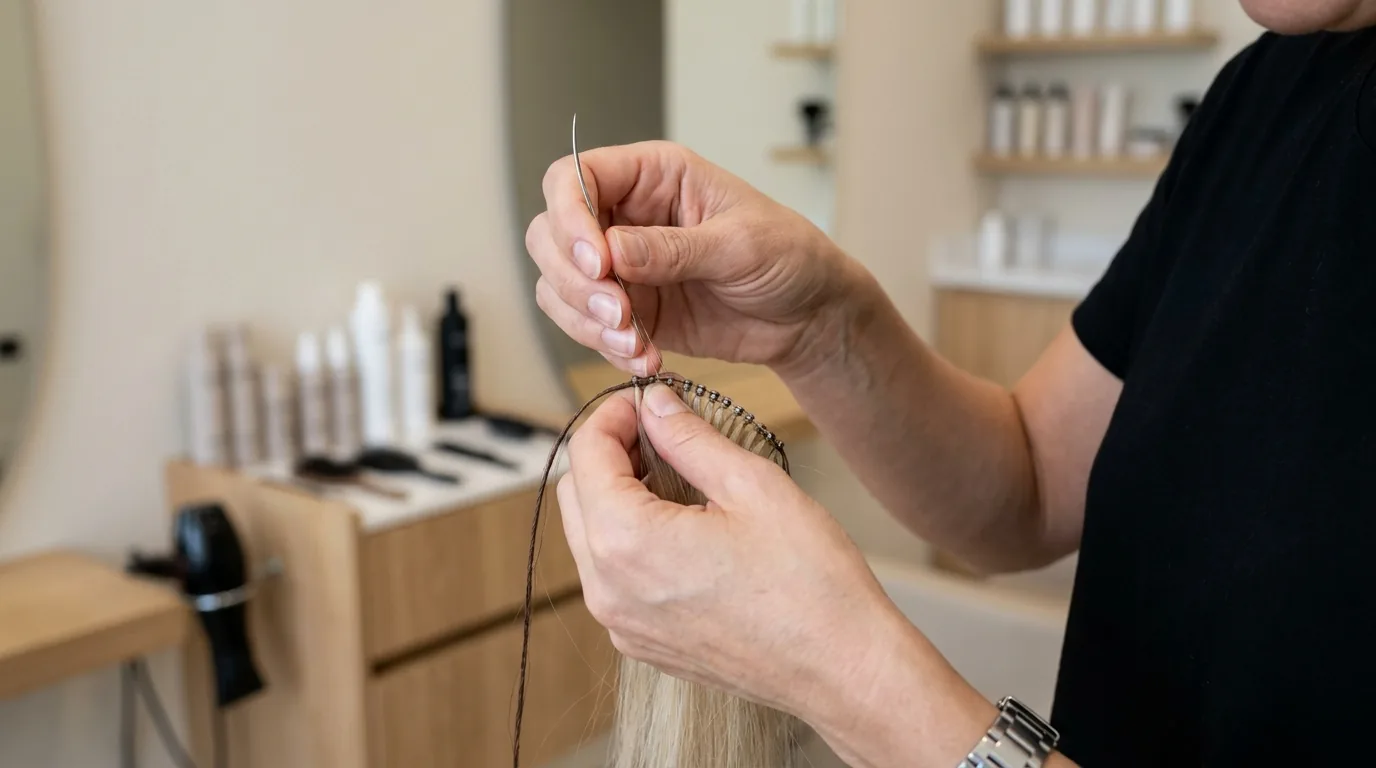
A stylist attaches tiny silicone-lined beads to rows of your hair, then sews lightweight wefts onto the beads by hand. No glue and no heat touch your hair. Because the weight rides along a whole row rather than a single point, hand-tied wefts feel light and flexible. They suit someone who wants a longer, semi-permanent look and is willing to book maintenance every six to eight weeks.
Methods to approach with caution on thin hair
Not every popular method makes a good extension for thin hair. Some concentrate weight or heat on a single strand, which fragile hair tolerates poorly. None are banned outright, but on thin hair they need an experienced stylist and honest expectations.
- Clip-in extensions: fine for occasional volume, but the clips grip one narrow line of hair, so daily wear on thin hair can stress that line over time. Treat them as event wear, not everyday wear, and browse salons offering clip-in extensions if you only need them for events.
- Micro ring and nano ring extensions: each strand of extension hair clamps to a small section of yours with a metal bead. The hold is secure, but the point load is high, and on thin hair that is a common route to breakage.
- Fusion and bonded extensions: keratin bonds applied with heat. The heat and the concentrated weight are hard on fine strands, and removal involves solvent that can dry the hair further.
- Sew-in wefts and weaves: these need a braided base, and thin hair rarely has enough density to anchor a braid without strain.
What hair extensions for fine hair cost in Dubai
Price depends on method, the amount of hair, and the salon tier. Halo sets sit at the lower end because they are a single purchased piece with little chair time. Hand-tied installs cost more because they are skilled, multi-hour work. The tiers below reflect what Dubai hair salons charge for fine-hair-friendly methods.
| Tier | Typical price | Duration | Room | Products | Staff experience | Best for |
|---|---|---|---|---|---|---|
| Budget | AED 400 to 1,200 | 60 to 120 min | Shared salon floor | Clip-in sets, entry tape-in, synthetic or lower-grade hair | Junior to mid technician | Occasion volume, first trial, no standing commitment |
| Mid | AED 1,200 to 3,000 | 90 to 180 min | Dedicated extension station | Remy human hair, tape-in, micro ring and nano ring sets | Trained extension technician | Everyday volume, year-round wear, reusable ring hair |
| Premium | AED 3,000 to 5,000 plus | 3 to 5 hours | Private suite or specialist studio | Double-drawn Remy, keratin bond, strand-by-strand colour match | Senior or master specialist | Seamless full-head length, longest wear before refit |
Budget rooms work for a halo or a small tape-in top-up. Mid-tier is where most fine-hair clients land for a full tape-in or hand-tied set with a stylist who understands tension. Premium covers signature salons with senior specialists and imported Remy hair.
Browse all 108 mid-tier Hair Extensions providers on our directory.
Top Dubai areas for hair extensions
Extension specialists cluster where demand and rents are highest, though every district has options across tiers. The table shows where Dubai salons offering extensions concentrate.
| Neighborhood | Providers | Dominant tier | Typical AED range |
|---|---|---|---|
| Jumeirah Lake Towers | 60 | Mid | AED 1,000 to 3,000 |
| Dubai Marina | 58 | Mid | AED 1,200 to 3,500 |
| Jumeirah | 42 | Premium | AED 1,500 to 5,000 |
| DIFC | 32 | Premium | AED 1,800 to 5,000 |
| Jumeirah 1 | 27 | — | — |
| Jumeirah Beach Residence | 26 | Mid | AED 1,200 to 3,500 |
| Downtown Dubai | 25 | Premium | AED 1,500 to 5,000 |
| Sheikh Zayed Rd | 22 | — | — |
| Business Bay | 18 | Mid | AED 1,000 to 3,000 |
| Deira | 18 | Budget | AED 400 to 1,800 |
| Al Barsha 1 | 16 | — | — |
| Al Karama | 12 | Budget | AED 400 to 1,500 |
Marina, Jumeirah, and Business Bay carry the most fine-hair specialists. Older districts like Deira and Al Karama run cheaper and still cover halo and tape-in work, just with fewer hand-tied specialists.
These hair salons rank highly across Dubai and handle extension work among their services. Use them as a starting point, then confirm fine-hair experience when you book.

Popular hair salons in Dubai
Collective is a hair salon inside the MAG Warehouses complex in Al Quoz Industrial Area 2, rated from reviews. Services cover hair colouring, balayage, hair highlights, hair extensions, keratin treatment, ladies haircuts, blow dry, bridal makeup, manicures, gel pedicures and waxing services. Several reviewers like the modern, classy interior and mention stylists using Dyson equipment for finishing, with one client describing a playful, well judged cut from a stylist who listened closely to the brief. Feedback on colour work is more mixed, with one detailed report describing hair damage and billing disagreements after a balayage and toner service, so it makes sense to agree the full scope and price before any colour treatment begins. The salon has a toilet on site along with wheelchair-accessible parking and entrance.
Version Francaise is a hairdressing salon inside the Marriott Harbour Hotel and Suites in Dubai Marina, offering haircuts, hair colouring, highlights, hair extensions, keratin treatment, blow dry styling, threading, manicures and nail art. It is rated from reviews.Reviewers consistently describe the salon as welcoming, with several returning for years and calling it their regular salon for haircuts and colour treatments. The team is praised for professionalism, attention to detail and a warm welcome from arrival to the end of the appointment.The salon has free Wi-Fi, on-site services, a wheelchair-accessible entrance, car park and toilet, plus gender-neutral toilets. It suits residents and hotel guests in Dubai Marina after a haircut, colour service or hair treatment appointment, with appointments recommended given the salon's loyal following.
Locks By Lou Lou is a hair salon on Al Wasl Road in Jumeirah, rated from reviews. Reviewers consistently praise the colour work, from balayage and highlights to root touch ups, and several mention hair extensions that look natural rather than obviously fitted. Clients also note that stylists take time to understand what they want before starting and explain aftercare so hair stays in good condition afterwards.Beyond colour, the salon offers blow dry, keratin treatment, hair extensions, manicure, gel pedicure, microneedling and anti-aging facial treatments. The entrance is wheelchair accessible and there is an on-site toilet.Appointments are recommended, particularly for colour and extension work, and the salon suits clients looking for an ongoing colourist relationship rather than a single visit.
Version Francaise Pour Elle is a hairdresser and beauty salon on Al Wasl Road, Al Safa 2, rated from reviews. Services span hair colouring, balayage, highlights, extensions, keratin treatment and blow dry, ladies' haircuts, beard trim, manicure, gel nails, gel pedicure, eyelash extensions, anti-aging facials and waxing.Reviewers consistently praise the colour and highlight work, describing meticulous stylists who take the time to understand what a client wants even when it is hard to explain. The salon is also noted for its cleanliness, product quality and reasonable prices, with several reviewers mentioning the owner is regularly on site overseeing the team and the client experience.Free Wi-Fi and parking are available. Suits clients after precise colour work from a team that takes the time to get it right.
Trinity Hair Salon is a hair salon in Al Barsha South, based at Danube Resortz, rated from reviews.Colour work is what reviewers talk about most, with several describing years of trust in the stylists for balayage, highlights and full colour changes, including recovering from a previous bad dye job elsewhere. The salon also offers ladies haircuts, blow dries, hair treatment and a back massage, plus manicures and pedicures. More than one reviewer describes the atmosphere as warm and modern with a good energy, and says they would not trust anyone else with their hair colour.There is a toilet on site, the salon offers on-site services, and a wheelchair-accessible car park makes it an easy stop for residents around Al Barsha South.
How Dubai’s climate affects extensions on thin hair
Dubai heat and humidity are hard on extension attachments, and fine hair feels it first. High humidity softens tape-in adhesive, so summer tape sets can loosen sooner than the usual six to eight weeks. Air-conditioned indoor air swings dry, which makes both your hair and the extension hair brittle if you skip conditioning.
Chlorine and salt water break down bonds and strip Remy hair of its shine. Sunscreen and some hair oils contain ingredients that degrade tape adhesive on contact. The practical fix on fine hair: rinse and dry after the pool or beach, keep heavy oils away from the attachment points, and book a maintenance check before the peak summer months if you wear tape-ins.
What to expect at a fine-hair extension appointment
A good appointment starts with a consultation, not the scissors. The stylist checks your density, your strand thickness, and any thinning at the crown or parting, then recommends a method and a realistic amount of hair. On thin hair, a careful stylist will often suggest less hair than you ask for, because overloading fragile roots is the fastest route to damage.
A halo fitting takes under an hour and is mostly colour matching and trimming. A full tape-in set runs one to two hours. A hand-tied install can take two to three hours. Expect a patch of aftercare advice at the end: which brush to use, how to sleep on it, and when to come back. Friday and weekend slots fill fast in Dubai, so book a weekday morning if you want the senior stylist. If you want the salon that does your wefts to also handle cuts and colour, our guide to the best hair salon in Dubai covers all-rounder options.
How to vet a hair extension salon in Dubai
Fine-hair extension work is a skill, not a product you buy off a shelf. These checks separate a salon that will protect your hair from one that will overload it.
- Confirm the salon holds a valid DET trade licence, the Dubai Economy and Tourism permit every legal salon must display.
- Check that the staff providing treatments are working under the salon’s DHA health licensing, the Dubai Health Authority standard for hygiene and practitioner conduct.
- Ask which method they recommend for your hair and why. A specialist who pushes the heaviest set without examining your density is a warning sign. Our notes on how we rank salons explain the signals that separate a careful provider from a careless one.
- Ask to see fine-hair before-and-after photos, not just thick-hair transformations.
- Confirm they use Remy human hair and ask about colour-matching and the maintenance schedule.
- Read recent reviews for mentions of breakage, slippage, or tension headaches, then shortlist from the wider pool of hair salons in Dubai before you commit.
Common mistakes to avoid with thin hair
- Choosing a method by price alone and ending up with heavy bonds your hair cannot carry.
- Asking for more hair than your density supports, which strains the follicle.
- Wearing daily clip-ins on the same narrow section until it thins further.
- Skipping the consultation and letting a stylist install without checking your scalp.
- Ignoring aftercare, then blaming the set when the attachment fails early in Dubai’s heat.
- Treating extensions as a fix for medical hair loss instead of seeing a clinician first.
Hair extensions versus other volume options
Extensions add length and body, but they are not the only route to fuller-looking thin hair. A hair topper covers crown thinning with a clip-on hairpiece and adds no length. If thinning is recent or patchy, a strengthening treatment may matter more than length.
Colour can fake density too. A soft balayage or well-placed hair colour adds depth and the illusion of fullness with zero added weight, which suits very fragile hair. A smoothing service like keratin treatment can also make thin hair sit fuller by taming frizz. Pick extensions when you want real length and overall volume, and your hair is healthy enough to carry a light set.
Aftercare and maintenance for fine hair
- Brush with a soft loop brush from the ends upward, holding the roots to avoid tugging the attachment.
- Condition the lengths and keep heavy products off the bonds or tape lines.
- Tie hair in a loose braid before sleeping to stop overnight tangling and pulling.
- Rinse and dry promptly after the pool, the sea, or a heavy sweat in Dubai’s heat.
- Keep maintenance appointments every six to eight weeks so bonds never get the chance to drag on growing-out hair.
Frequently asked questions
Shedding after a birth is a different situation again. Tension on regrowth that is already fragile is what turns a temporary shed into lasting damage, which is covered in how to prevent postpartum hair loss.


