


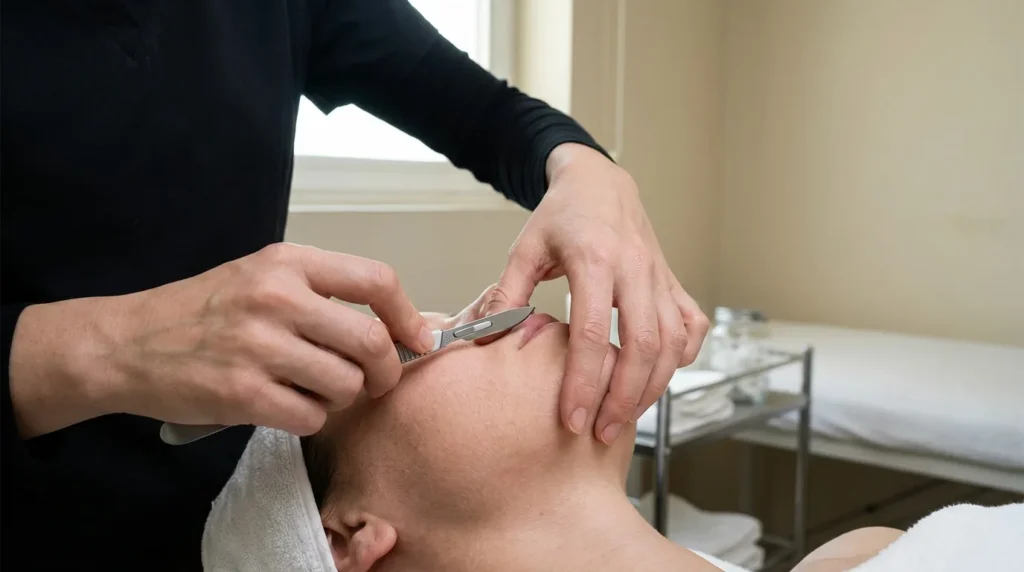
What is dermaplaning facial treatment? A therapist draws a sterile single-use blade across cleansed skin at a shallow angle, lifting dead surface cells and the fine vellus hair known as peach fuzz. A Dubai session runs 20 to 60 minutes, costs AED 75 to 500, and leaves no recovery time.
This guide is general information, not medical advice. Dermaplaning is a regulated cosmetic-medical treatment in Dubai: consult a DHA-licensed clinic about your suitability and risks before booking.
What a dermaplaning facial actually is
The treatment sits in the manual exfoliation family. A trained therapist holds the skin taut with one hand and moves a surgical-grade scalpel across it at roughly a 45-degree angle, working in short strokes over the cheeks, forehead, jaw and upper lip. Nothing is injected and nothing is abraded away by machine.
Two things come off in the same pass. The first is the stratum corneum, the layer of dead skin cells sitting on the surface. The second is vellus hair, the soft colourless down that catches powder and makes foundation sit unevenly. Removing both at once is why skin looks brighter within minutes rather than after a week of product use.
A standalone session is short. Many Dubai venues sell it as a 20-minute add-on before a mask, a peel or a hydrating facial, because freshly exfoliated skin takes serums in more readily. Booked alone it typically fills a 30 to 45-minute slot.
Two treatments share the name, and they are not the same
Search what is dermaplaning facial treatment and the first results describe a hospital procedure. Cleveland Clinic and Johns Hopkins both use dermaplaning to mean deep skin resurfacing with a dermatome, an oscillating instrument that shaves off far more tissue to soften pitted acne scars. That version involves numbing, scabbing, and weeks of staying out of the sun.
The dermaplaning facial sold in Dubai salons and skin care salons is the superficial cousin. Same principle, a fraction of the depth, no anaesthetic and no downtime. Reading recovery timelines written for the surgical version is the most common reason people arrive at a booking expecting either dramatic scar correction or two weeks of hiding indoors.
| Aspect | Dermaplaning facial | Medical dermaplaning |
|---|---|---|
| Instrument | Single-use sterile scalpel, handheld | Dermatome, oscillating blade |
| Depth | Dead surface cells and vellus hair | Multiple layers of skin |
| Setting | Facial bar, skin salon or aesthetic clinic | Dermatology or plastic surgery clinic |
| Recovery | Mild pinkness for a few hours | Swelling, scabbing, weeks of sun avoidance |
| Treats | Dull texture, peach fuzz, flaky patches | Deep or pitted acne scars |
Anyone booking through a salon menu in Dubai is almost certainly getting the first column.
What the blade removes, and what it leaves behind
Exfoliation is the whole mechanism. Clearing the dead layer lets moisturiser and active serums reach living skin instead of soaking into debris, and it clears the way for a light chemical peel if one follows in the same appointment.
What the blade cannot reach matters just as much. It works on the surface, so it does nothing for pigment sitting deeper in the skin, nothing for volume loss, and nothing for collagen. Hyperpigmentation, melasma and deep acne scars all need something that works below the surface, which is where peels, lasers and other facial treatments come in.
Fine lines look softer afterwards because the surface reflects light more evenly, not because any line has been filled. That distinction is worth holding on to when a menu promises anti-ageing results from a 30-minute appointment.
Does the hair grow back thicker?
No. Vellus hair regrows at the same colour, thickness and rate it had before, because a blade cuts the shaft above the skin and never touches the follicle that determines those things. Nothing about the treatment converts fine down into coarse hair.
Regrowth can feel different for a week or two. A hair cut straight across has a blunt tip instead of a tapered one, so it registers as stubbly under fingertips even though it is the same hair. That sensation fades as the tip wears.
One genuine limit applies. Dermaplaning suits fine vellus hair only. Coarse terminal hair on the upper lip or chin, which is common across the region, is better handled by threading, waxing or laser, and a therapist who agrees to blade it is working outside what the treatment does.
What a dermaplaning facial costs in Dubai
Pricing splits along three familiar lines. Promotional add-on rates start near AED 75 at high-volume salons, standalone sessions cluster between AED 150 and AED 300, and clinic-level appointments that pair the blade with medical-grade serums or a peel run from AED 300 upward. Booking platforms list Dubai sessions from AED 79, with clinic-level listings sitting at the top of the AED 300 to 500 band, which matches what venue price lists show.
| Tier | Typical price | Duration | Room | Products | Staff experience | Best for |
|---|---|---|---|---|---|---|
| Budget | AED 75 to 150 | 20 to 30 min | Shared or standard treatment room | Single-use sterile blade, basic cleanser | Beauty therapist | A quick add-on, peach-fuzz removal, smoother makeup base |
| Mid | AED 150 to 300 | 30 to 45 min | Private treatment room | Sterile blade plus a calming serum or mask finish | Trained esthetician | Standalone dermaplaning with a hydrating or LED add-on |
| Premium | AED 300 to 500+ | 45 to 60 min | Private clinic or facial-bar suite | Medical-grade serums, post-treatment SPF, optional peel pairing | Senior esthetician or DHA-licensed clinician | Dermaplaning paired with a facial, peel, or HydraFacial |
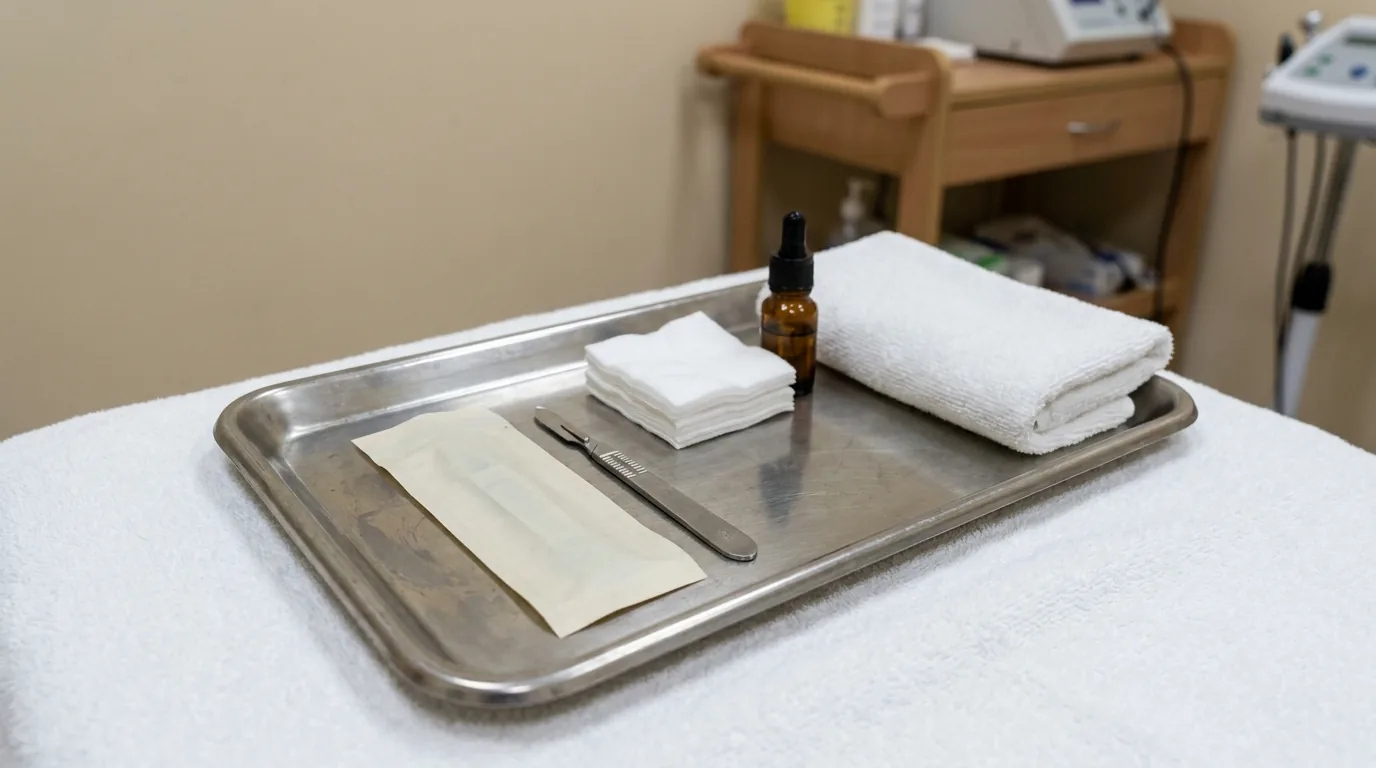
Watch what the price actually covers. A low headline number is often the blade alone with no serum, no mask and no SPF finish, while a higher one bundles dermaplaning inside a signature facial where it is one step of five. Neither is better value by default, but they are not comparable line items.
The downsides worth knowing before booking
Results are short. The glow tracks the skin turnover cycle, so three to four weeks is the realistic window before dead cells rebuild and the fuzz returns. Keeping the effect means rebooking roughly monthly, which turns a modest one-off price into a standing cost.
Side effects are usually mild and brief: pinkness, a warm or tingling feeling for a day or two, and occasional tenderness. Poor technique or a reused blade raises the stakes considerably, with infection, scarring and patchy pigment change all documented risks according to Cleveland Clinic.
Breakouts after a session are the other common complaint. Passing a blade over skin that is already inflamed can move bacteria across the face, which is why therapists work around active spots rather than through them.
Who should skip it
Inflammatory skin conditions rule the treatment out until they settle. Active acne, rosacea, eczema and psoriasis all involve compromised skin, and dragging a blade across it makes irritation worse rather than better. Sunburnt skin and open cold sores are the same story.
Anyone who has taken isotretinoin for severe acne is usually asked to wait six months after the final dose before any blade work, because the skin stays fragile long after treatment ends. Persistent breakouts are better served by acne treatment aimed at the cause.
Raised moles, skin tags and other growths need mapping before a session so the blade avoids them. Deeper skin tones carry a slightly higher risk of post-inflammatory pigment change from any resurfacing, which is a reason to ask about the therapist’s experience rather than a reason to rule the treatment out.
Salon or clinic, and what the licence tells you
Both settings offer it in Dubai, and the licence on the wall is the fastest way to read the difference. Every legitimate venue holds a trade licence from the Department of Economy and Tourism, which covers it as a business. A venue delivering treatments classed as medical also needs a facility licence from the Dubai Health Authority, with individually licensed practitioners working under it.
Superficial dermaplaning is generally delivered by trained estheticians in beauty settings, while deeper resurfacing belongs in a DHA-licensed clinic under a dermatologist. Asking which category a venue falls into, and what training the person holding the blade has, is a fair question that any reputable front desk answers without hesitation. The directory’s ranking and vetting method covers the same ground for every listing.
Sterility is the non-negotiable. A fresh blade should be opened in front of the client at the start of the session, and gloves should go on before anything touches the face. Across the full Dubai directory, 56 skin care salons are listed citywide, with facial bars, day spas and aesthetic clinics all carrying versions of the treatment.

Popular facial and skin clinics in Dubai
Skin Camouflage beauty therapists, fully licensed by the Dubai Health Authority, specialize in advanced skin treatments. Inkless Stretch Marks Removal effectively minimizes stretch marks without invasive procedures. Our Scalp Micropigmentation (Hair Tattoo) restores the look of fuller hair with precision pigmentation. The BB Glow Treatment achieves smooth, radiant skin that lasts.
Nova Clinic The Palm is a skin care clinic in Palm Jumeirah Mall by Dubai Retail, on the Palm Jumeirah, rated from reviews. Reviewers consistently describe a modern, extremely clean clinic where therapists explain each step of a facial treatment and leave skin feeling clean, fresh and glowing. Several also mention attentive, professional consultations that left them noticeably more comfortable and satisfied with their results. Treatments include acne treatment, anti-aging facials, body contouring, Botox injections, chemical peel, deep cleansing facial, dermal fillers, hair treatment, IPL and laser hair removal, microneedling, pigmentation treatment, PRP therapy, skin rejuvenation, skin tightening and tattoo removal. Appointments are recommended, and the clinic is wheelchair accessible with parking, entrance and toilet facilities on site at Nakheel Mall.
Glow Aesthetics Dermatology Clinic is in Al Attar Business Centre in Al Barsha, offering botox injections, dermal fillers, chemical peels, microneedling, laser and IPL hair removal, skin tightening, scar treatment and pigmentation treatment. It is rated from reviews.Reviewers consistently praise the honesty of the medical guidance, noting that the team recommends only what is genuinely needed rather than upselling treatments. The clinic is described as professional and welcoming from arrival, with several highlighting fair pricing relative to the standard of care.The clinic has on-site services with a wheelchair-accessible entrance, car park and toilet. It suits patients across Dubai researching skin treatments, anti-aging facials or laser hair removal, with a consultation recommended to discuss the right treatment plan.
Derma 247 Laser Clinic is a skin and laser clinic in Nadd Al Hamar, rated from reviews. Treatments cover laser and IPL hair removal, botox injections, dermal fillers, chemical peels, pigmentation treatment, skin rejuvenation and tattoo removal.Reviewers consistently mention feeling well informed before and during laser sessions, with practitioners who explain each step in plain terms and check in throughout rather than rushing through the appointment. That attentiveness comes up often enough to be a genuine pattern rather than a one-off.The clinic runs by appointment, with on-site services and a fully wheelchair-accessible setup including gender-neutral toilets. It suits anyone after laser or aesthetic treatments who wants a clinical, unhurried approach rather than a quick in-and-out visit.
Avoria Aesthetic Clinic is a skin care and medical aesthetics clinic in Al Barsha, rated from reviews. Treatments include Botox and dermal fillers, chemical peels, microneedling, laser hair removal, pigmentation and acne treatment, tattoo removal, electrolysis, lip blush and eyebrow microblading, plus body contouring and hair transplant procedures. Reviewers consistently describe a modern, spotless clinic with a calming atmosphere, and praise the team for explaining each treatment thoroughly before starting and taking time to listen to concerns. Laser hair removal sessions are described as comfortable and effective, and reviewers mention good results from HydraFacial treatments too, with outcomes generally meeting or exceeding expectations. Free underground parking is available, and the clinic has a wheelchair-accessible car park, entrance and toilet, all within the Deyaar Building unit that houses the clinic.
Browse all 56 Skin Care Salons providers on our directory.
Dermaplaning facial vs HydraFacial, peels and microdermabrasion
Four treatments get compared constantly because they all promise smoother skin, and only one of them removes hair.
| Treatment | How it works | Removes peach fuzz | Typical Dubai price |
|---|---|---|---|
| Dermaplaning facial | Manual blade across the surface | Yes | AED 75 to 500 |
| HydraFacial | Vacuum tip cleanses and infuses serum | No | AED 400 to 1,200 |
| Chemical peel | Acid solution loosens bonds between cells | No | AED 350 to 3,500 |
| Microdermabrasion | Crystals or a diamond tip sand the surface | No | AED 200 to 600 |
The blade is the only option in that group that clears facial hair, which is usually the deciding factor. For pigment or texture concerns that sit deeper, a chemical peel reaches further, and many Dubai venues run the two together in one appointment for that reason.
Aftercare in a city with year-round sun
Freshly exfoliated skin has lost its top defensive layer, and Dubai’s UV index sits high for most of the calendar. Broad-spectrum SPF 30 or above, applied every morning and topped up outdoors, matters more here than the same advice does in a temperate climate.
- Skip retinoids, acids and scrubs for three to five days so the surface can settle.
- Stay out of direct sun where possible for 48 hours, and keep sunscreen on afterwards.
- Leave saunas, hammams and chlorinated pools for two days.
- Go light on makeup for the first day, and use clean brushes when it goes back on.
- Moisturise more than usual, since air conditioning pulls water out of skin that is already bare.
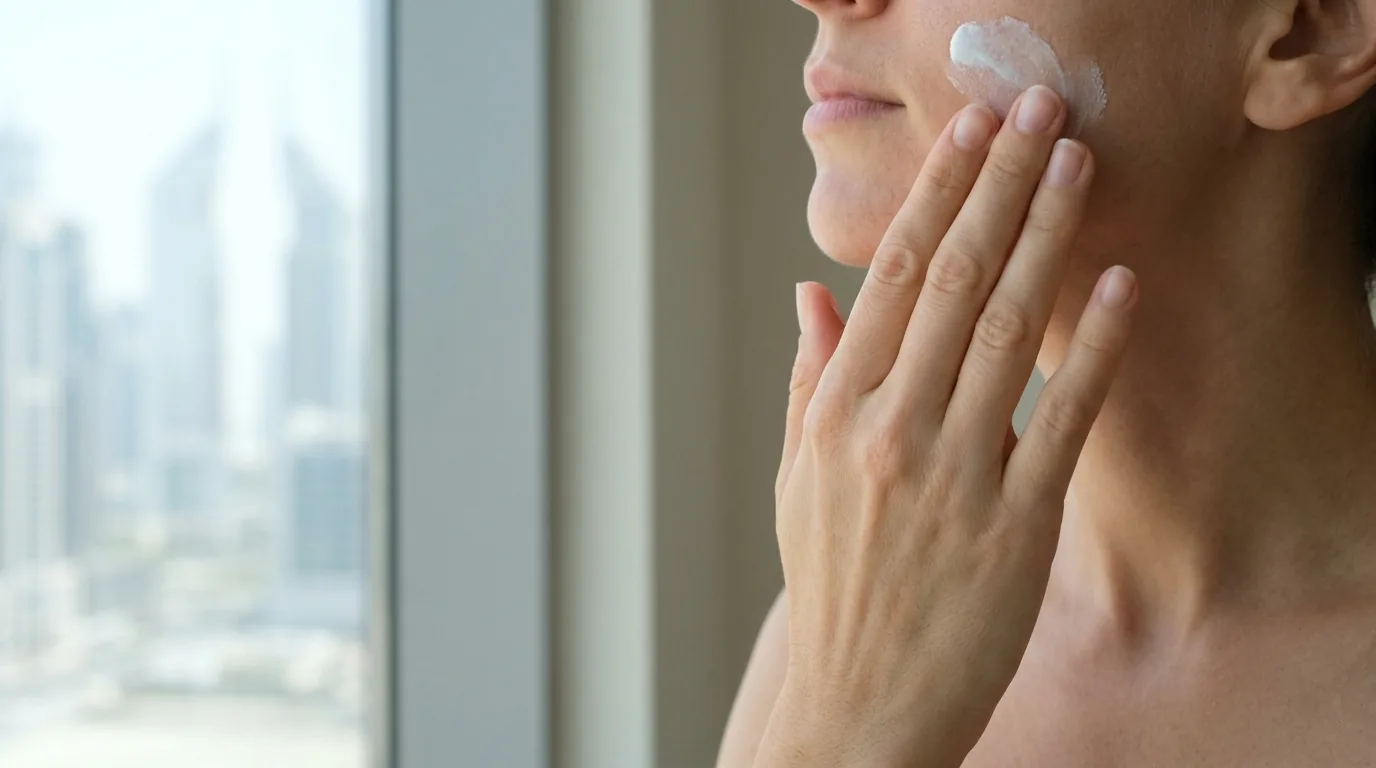
Book around events rather than into them. Pinkness settles within hours for most people, but scheduling a session two or three days before a wedding leaves room for skin that reacts more than expected. The same buffer logic applies to extractions and deep cleansing work.
Can you stop once you have started?
Yes, and stopping carries no penalty. Skin returns to the state it would have been in anyway, hair grows back exactly as it was, and nothing has been altered at follicle or dermal level to reverse. The idea that the treatment creates dependency comes from confusing a fading result with a rebound effect.
What stopping does mean is losing the effect. Roughly a month after the last session, dead cells and vellus hair are back to baseline, and makeup sits the way it did before. Anyone treating it as event preparation rather than routine maintenance can book once, skip a year, and book again with no loss of ground. Choosing between it and other options on a Dubai facial menu is a question of what the skin needs that month.


