



Does creatine cause hair loss? The current evidence says no for most people. A 2026 randomized controlled trial followed men for 12 weeks and found no change in DHT or hair when they took 5 grams a day. The worry traces back to a single 2009 study that measured hormones, not hair, and no trial has replicated it since.
What is creatine, and why is it blamed for hair loss?
Creatine is one of the most studied sports supplements in the world. Your body makes it from amino acids, and you also get it from meat and fish. Taken as creatine monohydrate, it helps muscle cells produce energy during short, hard efforts, which is why lifters and athletes use it for strength and recovery.
The hair loss fear is newer. It comes from one idea: that creatine might raise dihydrotestosterone, a hormone usually shortened to DHT. DHT is a stronger relative of testosterone. In people who are genetically prone to pattern baldness, DHT binds to hair follicles on the scalp and slowly shrinks them, a process called miniaturisation. The logic went, if creatine lifts DHT, and DHT shrinks follicles, then creatine could thin your hair. The leap from “could” to “does” is where the myth was born.
Where the creatine and hair loss rumour started
One study did the damage. In 2009, researchers gave a group of college rugby players creatine for three weeks and measured their hormones. DHT rose from 0.98 to 1.26 nmol/L. Both numbers sit inside the normal range, and the study never recorded a single player actually losing hair. It measured a hormone, not a hairline.
That nuance got lost. Headlines turned a small hormone shift into “creatine causes baldness”, and the claim spread through gym forums for over a decade. The honest summary is narrower: in one short study, a hormone linked to hair loss went up a little, in men who were already producing normal amounts.
What the research actually shows
Until early 2025, that 2009 rugby study was the only trial that had ever measured creatine’s effect on DHT. Twelve other trials looked at creatine and testosterone instead. Of those twelve, only two short trials, lasting six and seven days, reported any rise in testosterone, and none found a meaningful change.
Then the evidence improved. A 2026 randomized controlled trial recruited 45 resistance-trained men aged 18 to 40 and split them into a creatine group, taking 5 grams a day, and a placebo group, over a full 12 weeks. It is the first trial designed to track both DHT and hair-related outcomes at the same time. The result: no significant difference between the groups for any hormone or any hair measure. For a person taking a normal daily dose, that is the most direct answer science has produced so far.
| Study | What it measured | Finding |
|---|---|---|
| 2009 rugby trial | DHT, 3 weeks | DHT 0.98 to 1.26 nmol/L, both normal; no hair loss recorded |
| 12 testosterone trials | Testosterone | Only 2 short trials showed a rise; none significant |
| 2026 RCT (45 men) | DHT and hair, 12 weeks | No significant change in hormones or hair |
The takeaway is that no good evidence shows creatine causes hair loss. If you are already losing hair from genetics, no study proves creatine speeds it up either, though a cautious person with a strong family history may simply choose to skip it for peace of mind.
Should you stop taking creatine?
For most people, no. If you value the strength and recovery benefits, the science does not give you a reason to throw the tub away. Creatine monohydrate has a long safety record at 3 to 5 grams a day.
There is one sensible exception. If you already see a receding hairline or thinning at the crown and you have a clear family history of baldness, you are entitled to be cautious. The honest position is that creatine probably is not the cause, but the certainty is not absolute, so the choice is yours. A better use of energy is finding out what is actually driving the shedding, because pattern baldness is only one of several causes.
If hair loss worries you enough to question your supplements, that worry is the signal to get assessed. A short consultation can tell you whether you are dealing with genetics, a deficiency, or something else entirely, which matters far more than any single supplement.
The real causes of hair loss
Creatine sits near the bottom of the list of things that thin hair. The common drivers are more ordinary, and several are reversible once you name them.
- Genetics (androgenetic alopecia): male and female pattern baldness is the most common cause worldwide. This is the one DHT genuinely drives.
- Telogen effluvium: sudden, diffuse shedding triggered by stress, illness, surgery, crash dieting, or childbirth. It usually recovers once the trigger passes.
- Nutrient deficiencies: low iron, vitamin D, and zinc are frequent and fixable causes, covered below.
- Thyroid and hormonal shifts: an under or overactive thyroid, or post-pregnancy hormone changes, can both shed hair.
- Tight styling and harsh treatments: traction from tight ponytails, plus heat and chemical damage from frequent salon visits, weaken strands over time.
Dubai adds its own pressures. Hard tap water, heavy air-conditioning, summer sun, and the stress of a fast-moving expat life all show up in clinics as complaints of hair fall Dubai residents notice within months of arriving. A scalp condition like dandruff or chronic irritation can also worsen shedding, and a flaky scalp is worth treating in its own right. None of those is creatine, and most respond to the right treatment.
Which vitamin deficiency causes hair loss?
If you have asked which vitamin deficiency causes hair loss, the honest answer is that it is usually a mineral as much as a vitamin, and iron leads the list. Deficiencies matter because hair follicles are among the most metabolically active tissues in the body, so they feel a shortfall early.
Can lack of iron cause hair loss? Yes. Iron is the most consistently linked deficiency, especially in women. Reviews have found that women with hair loss are more likely to have low ferritin, the stored form of iron and often the first marker to drop. So can iron deficiency cause hair loss before you ever feel tired or look pale, and does iron deficiency cause hair loss that reverses once levels are restored? In many cases, yes on both counts, which is exactly why a blood test matters before you guess.
Can lack of vitamin D cause hair loss? The evidence links low vitamin D to telogen effluvium and to alopecia areata, an autoimmune form of patchy loss. Vitamin D deficiency is very common in Dubai, where strong sun pushes people indoors and covered clothing limits skin exposure, so does vitamin D deficiency cause hair loss that a local reader should rule out? It is worth a test, because it is both common here and easy to correct.
| Nutrient | Link to hair loss | Notes |
|---|---|---|
| Iron (ferritin) | Strongest deficiency link, especially in women | Low ferritin is often the first sign |
| Vitamin D | Linked to telogen effluvium and alopecia areata | Very common deficiency in the Gulf |
| Zinc | Deficiency linked to shedding | Test before supplementing |
| Biotin (B7) | Only helps if you are truly deficient | Real deficiency is rare; can skew lab tests |
| Vitamin A | Too much can cause shedding | More is not better |
One warning runs through all of this: more is not better. Over-supplementing, particularly with vitamin A or selenium, can cause the very shedding you are trying to stop. Test first, then correct only what is low. A daily multivitamin to “be safe” is rarely the answer, and a marketed hair loss shampoo Dubai pharmacies stock will not fix a deficiency that lives in your bloodstream. A medicated dandruff shampoo can help a flaky, irritated scalp, but that is a different problem from a nutrient shortfall or pattern baldness.
Which doctor to see for hair loss
Wondering which doctor to see for hair loss is the most useful question on this page, because the right diagnosis decides everything that follows. The specialist for hair and scalp problems is a dermatologist. Many people also ask which doctor to consult for hair loss when the cause is unclear: start with a dermatologist, and for a scalp-focused assessment, a trichologist who specialises in hair and scalp can complement that care.
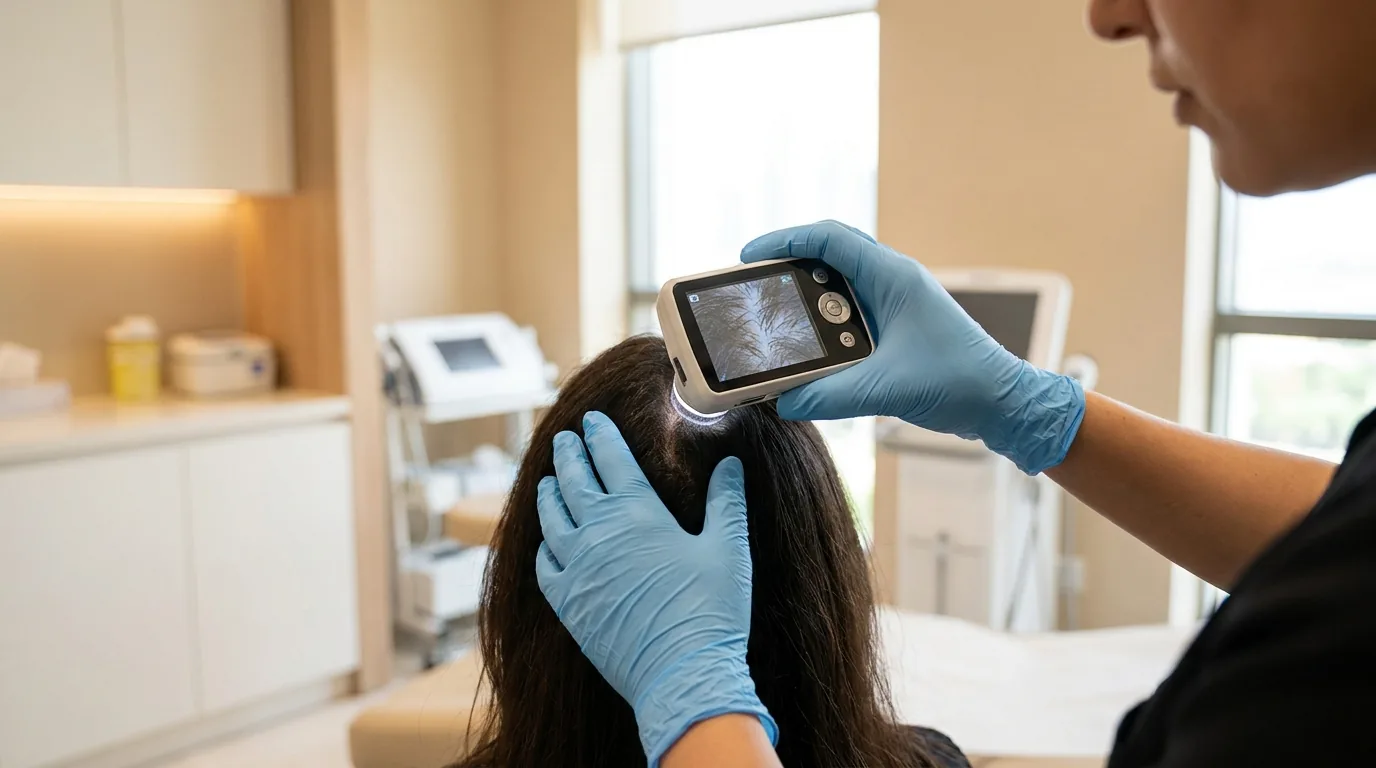
A sensible first step is a simple blood panel, often arranged through a family medicine doctor, covering iron and ferritin, vitamin D, thyroid function, and B12. Those results alone explain a large share of unexplained shedding. If the cause is not nutritional, a dermatologist can examine the scalp directly. A hair loss doctor Dubai patients see will typically use trichoscopy, a magnified scalp exam, and sometimes a small scalp biopsy to confirm the type of loss before recommending anything.
That diagnosis step is not a formality. One pattern dermatologists warn about is scarring, or cicatricial, alopecia, which can look exactly like ordinary pattern baldness but needs completely different treatment. People spend months on over-the-counter minoxidil with no result because the real condition was never identified. Seeing a hair loss specialist Dubai clinics employ, rather than self-treating, is what prevents that wasted time and money. A qualified hair loss dermatologist Dubai residents can book will confirm the type of loss before any treatment begins, which is the single biggest factor in whether that treatment works.
Hair loss treatment in Dubai
Once you know the cause, Dubai has a deep menu of options, and the city is well supplied with clinics. Effective hair loss treatment Dubai providers offer ranges from simple correction to clinical procedures, and the right one depends entirely on your diagnosis. Booking a hair loss consultation Dubai clinics provide is the gateway to all of it.
- Correct the deficiency: if bloods show low iron, vitamin D, or zinc, supplementing under guidance is the cheapest and most effective first move.
- Prescription medication: topical minoxidil and oral options like finasteride are first-line for pattern baldness, prescribed and monitored by a doctor.
- PRP therapy: platelet-rich plasma uses a concentrate from your own blood to stimulate follicles. Interest in PRP hair loss Dubai clinics offer has grown quickly as a non-surgical option.
- Mesotherapy and microneedling: micro-injections of vitamins and peptides, or a controlled scalp treatment, to support the follicles.
- Hair transplant: a surgical option for established pattern baldness, usually considered after other routes. See our guide to hair transplant in Dubai for how it works and what it costs.
| Treatment | Typical Dubai price (AED) | Best for |
|---|---|---|
| Blood test and consultation | 250 to 600 | Diagnosis first |
| PRP session | 800 to 2,000 | Early thinning, non-surgical |
| Mesotherapy session | 500 to 1,500 | Scalp nourishment |
| Hair transplant | 7,000 to 25,000+ | Established pattern baldness |
Prices vary by clinic, area, and the number of sessions, and all clinical treatment should run through a doctor, not a walk-in counter. For the full picture of clinical and salon-based options, browse hair treatment providers across the city. Any clinic offering medical hair treatment in Dubai must hold a Dubai Health Authority (DHA) health licence, and the business itself a Dubai Economy and Tourism (DET) trade licence. Checking both is a fast way to filter out anyone operating outside the rules. Steady hair growth Dubai patients hope for comes from matching the treatment to the diagnosis, not from chasing the most advertised procedure.
Browse all 24 Skin Specialists providers on our directory.
What to expect at a hair loss consultation
A first visit is mostly questions and looking, not treatment. Expect the doctor to ask how long the shedding has gone on, whether it is patchy or all over, your family history, recent stress, illness or diet changes, and any medication. This is where hair thinning Dubai newcomers often connect their shedding to a recent move, a crash diet, or a stressful job change.
Next comes the scalp exam, usually trichoscopy, and a referral for bloods if you have not had them. You will leave with a likely cause and a staged plan, often starting with correcting any deficiency and a topical, with procedures held in reserve. Reputable clinics will not push you toward an expensive procedure on the first visit before a diagnosis is settled.
This article is general information, not medical advice. Hair loss has many causes, and supplements, prescriptions, and procedures should be guided by a DHA-licensed doctor who has assessed you in person.
How to choose a hair loss clinic in Dubai
The market is crowded, so a few checks separate genuine medical care from a sales pitch.
- Confirm the licences: a valid DHA health licence for the clinic and a DET trade licence for the business. Both should be verifiable.
- Insist on diagnosis first: a clinic that recommends a procedure before examining your scalp or ordering bloods is selling, not diagnosing.
- Check who treats you: a qualified dermatologist or doctor should lead medical treatment, not a salesperson.
- Read recent reviews: look for consistent, recent feedback on results and honesty, not just star ratings. Our ranking methodology explains the signals that separate a strong listing from a weak one.
- Ask about realistic outcomes: good clinics set expectations and timelines; nobody honest promises a guaranteed regrowth.
You can browse skin and hair-loss clinics on our directory and cross-check each against these points before you book.
Common mistakes to avoid
- Blaming creatine and stopping it while the real cause, often genetics or low iron, goes untreated.
- Mega-dosing biotin or a multivitamin without a blood test, which rarely helps and sometimes harms.
- Buying an advertised shampoo and expecting it to fix a deficiency or pattern baldness.
- Self-treating with minoxidil for months without a diagnosis, when the condition may be something minoxidil cannot fix.
- Choosing a clinic on price or marketing instead of licence, diagnosis, and the doctor’s credentials.
- Waiting too long; most hair loss is easier to slow early than to reverse late.


