



6 habits explain most makeup damage: sleeping in it, dirty applicators, expired formulas, heavy layering, skipping sunscreen and the wrong texture for Dubai heat. Makeup damages skin far less often than the search results suggest, and fixing those six moves daily wear close to neutral.
Does makeup damage skin? Four different problems, one word
The word covers four separate problems, and they behave differently. Lumping them together is why the answer online swings between harmless and ruinous, and why nobody can agree on how much makeup damage is real.
Foundation, concealer and powder sit on the stratum corneum, the outermost layer of dead cells. They do not reach living tissue the way a peel or a laser does. What they can do is occlude, irritate or carry bacteria, and each of those has its own timeline.
| What people call damage | What is happening | How long it lasts |
|---|---|---|
| Clogged pores, blackheads, small bumps | Product plus oil plus dead cells blocking the follicle opening | Weeks, clears when the trigger stops |
| Redness, stinging, itching | Irritation or contact dermatitis, usually fragrance or a preservative | Days once the product is dropped |
| Tight, flaky, reactive skin | A stressed skin barrier, often from harsh removal rather than the makeup | Two to four weeks of gentle care |
| Dark patches after a breakout | Post inflammatory hyperpigmentation, a pigment response, not scarring | Months, faster with daily sunscreen |
Only the last one is slow to reverse, and it is a consequence of inflammation rather than of makeup sitting on skin. That distinction matters for anyone reading a blackhead removal guide and assuming their foundation caused permanent change.
Does makeup cause acne, or is something else doing it?
Cosmetics can trigger breakouts, and the condition has a clinical name. Acne cosmetica describes small, uniform bumps that appear where a product is applied, usually across the forehead, cheeks or jawline, without the deeper inflamed lesions of hormonal acne.
The American Academy of Dermatology sets out a plain test for it: stop the suspected product for two to three months and watch. Acne cosmetica clears when the pore clogging product goes. If the breakouts continue, something else is driving them, and searching does makeup cause acne will not find the cause. Hormones, diet, medication and the forehead acne pattern that comes from hair products all sit outside the makeup bag. Dubai residents dealing with persistent breakouts can browse acne treatment providers rather than cycling through more foundations.
Research supports a real but conditional link. A case control study indexed on PubMed Central found certain cosmetic categories raised acne risk, which is a long way from saying makeup causes acne in everyone who wears it.
The six habits that cause most of the harm
Every dermatology source on this question converges on behaviour rather than ingredients. When makeup damages skin, one of these six is almost always the route. They are ordered by how much damage they do.
- Sleeping in it. Eight hours of foundation plus the day’s oil and sweat is the single reliable way to clog pores. This is the habit worth fixing before any other.
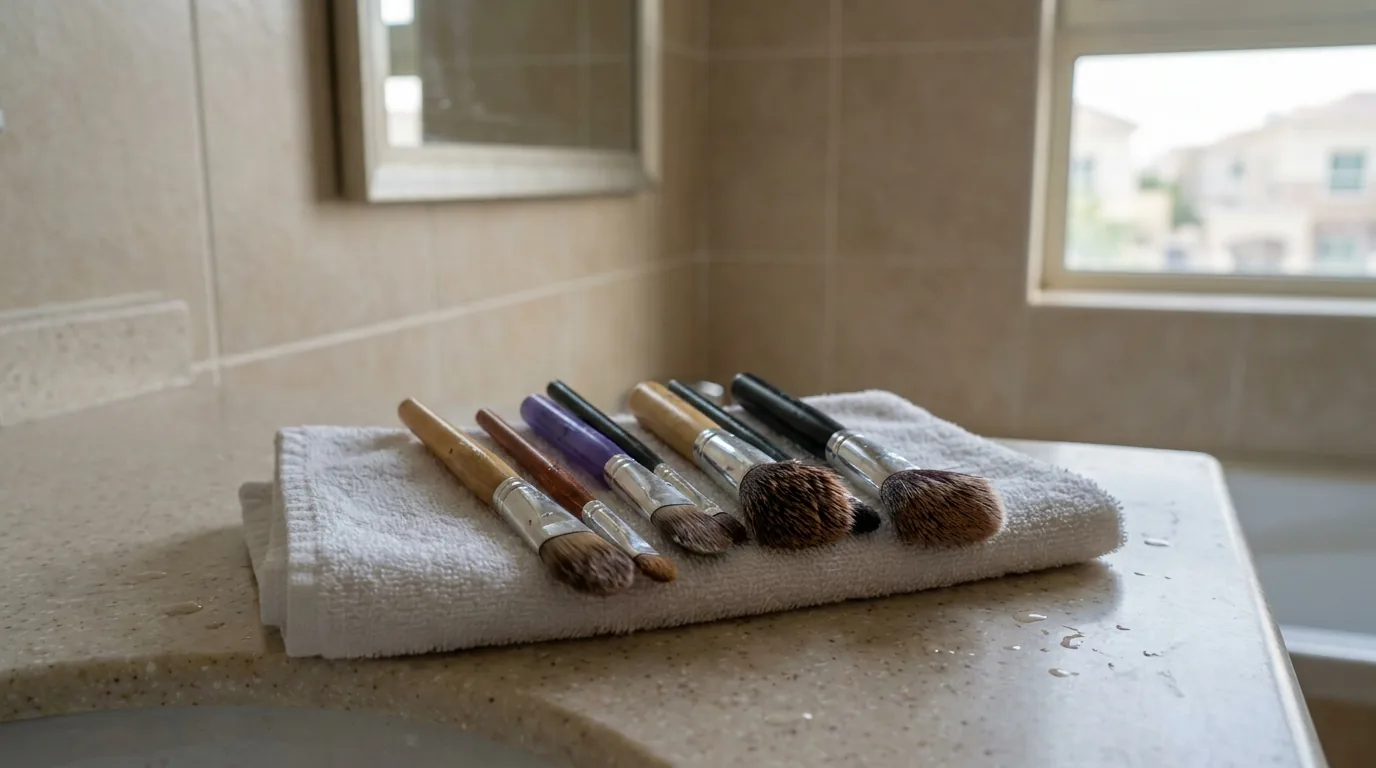
- Dirty brushes and sponges. Applicators collect oil, dead skin and bacteria, then redeposit them. Wash brushes weekly and replace sponges monthly.
- Expired products. Preservatives stop working. Mascara is the shortest lived at roughly three months, liquid foundation runs six to twelve, powders last longer.
- Heavy layering. Primer, full coverage base, cream contour and setting powder is a thick occlusive stack. Skin under it cannot shed normally.
- Skipping sunscreen. Foundation with an SPF claim is almost never applied thickly enough to deliver the number on the bottle. Sunscreen goes on first, as its own step.
- Wrong texture for the weather. A rich cream base built for a cold climate behaves differently at 40C.
Note what is absent from that list: any specific ingredient. Makeup damage is a routine problem rather than a chemistry problem, and the habits do the work.
Does makeup age your skin?
There is no good evidence that pigment and emollient sitting on the surface accelerates ageing. The concern is real, but the mechanism is indirect, and it runs through three routes rather than through the makeup itself.
The first is sun exposure. Anyone relying on a foundation SPF instead of sunscreen gets a fraction of the protection they think, and ultraviolet light remains the dominant driver of visible ageing. The second is mechanical: rubbing at the eye area every night to shift stubborn mascara stresses thin skin over years. The third is dehydration, which is where Dubai comes in.
So the honest answer to does makeup age your skin is that the routine around it can, and the product on its own does not.
What Dubai’s climate changes about the answer
Almost every dermatology guide on this topic is written for a temperate climate. Ask does makeup damage skin in a Gulf summer and the honest answer shifts, because wearing makeup every day at 40C is a different problem. Four local factors change the picture.
Heat and humidity raise sweat and sebum output, so a base that behaved on a mild day starts sliding by midday. The usual response is a longer wearing, more occlusive formula, which is habit four from the list above.
Air conditioning pulls the other way, leaving skin tight and dehydrated, which pushes people toward richer creams under the same heavy base. Fine dust adds a physical layer that traps everything underneath. And long social calendars mean full makeup worn fourteen hours at a stretch. Dubai’s skin care salons see the summer version of this every year.
In a Dubai summer, switch the base rather than adding to it. A lighter tinted fluid reapplied once beats a full coverage formula layered over midday shine, and it comes off with far less scrubbing at the end of a long day.
Reading the label: what non comedogenic makeup does and does not promise
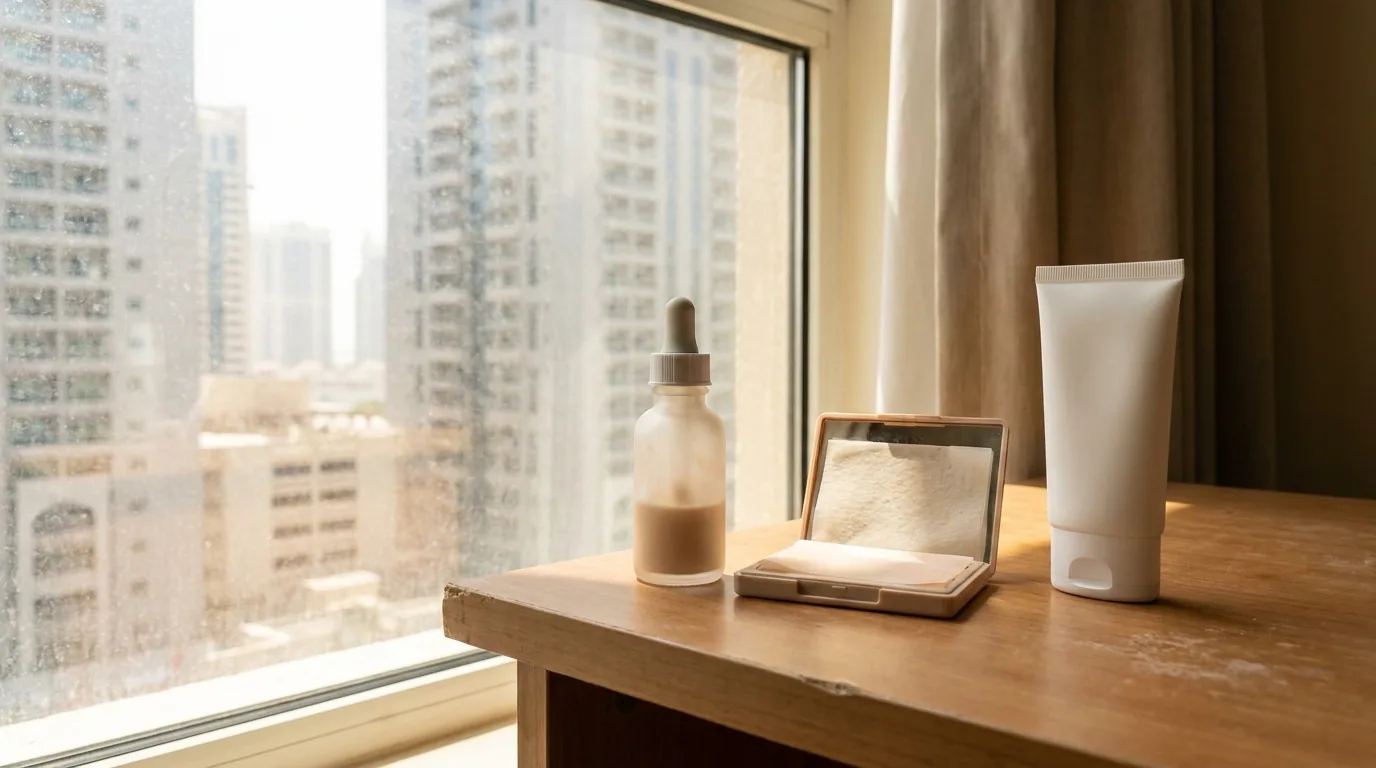
The term appears on most bases sold in the UAE and it is worth knowing what sits behind it. Non comedogenic is a marketing claim, not a regulated one. No standard test defines it, no authority certifies it, and formulas carrying the label still break some people out.
Comedogenicity ratings that circulate online trace back to rabbit ear studies from decades ago, run on single ingredients at high concentrations. A finished formula behaves differently from any one thing in it. Oil free is a similarly loose claim, since plenty of non oil ingredients still block pores.
None of that means the label is worthless, only that it cannot answer whether makeup damages skin on one particular face. What actually works is duller and more reliable:
- Patch test a new base on the jawline for a few days before committing a whole face to it.
- Change one product at a time, so a reaction points somewhere specific.
- Treat fragrance as the first suspect for stinging or redness, and a preservative as the second.
- Match texture to skin type and season rather than to the claim on the box.
Removing it properly, and why the second cleanse matters
Removal is where most of the avoidable damage happens, in both directions. Too little leaves product in the pores overnight. Too much, in the form of scrubbing with a rough cloth or a stripping foam, damages the barrier the makeup was never going to touch.
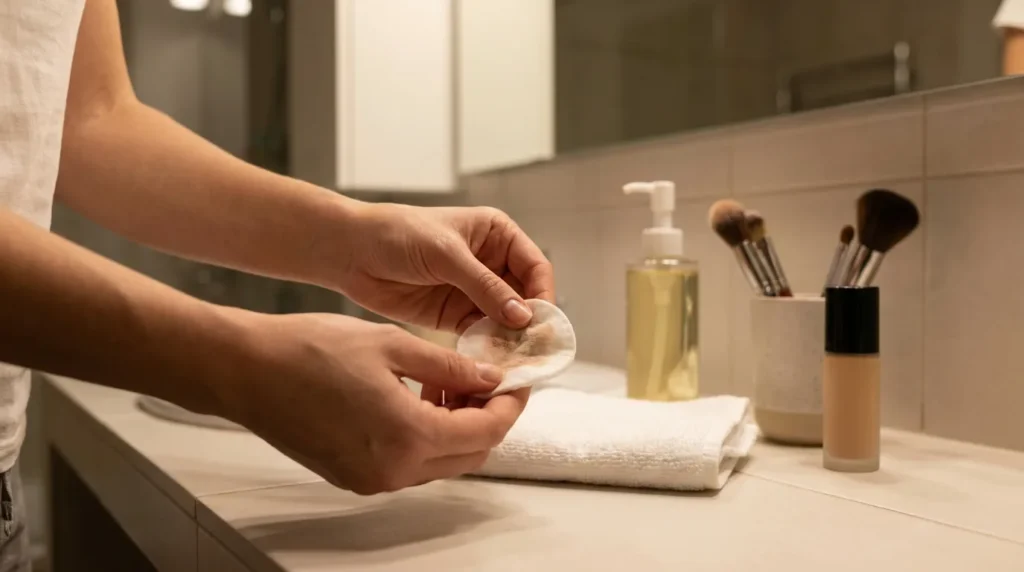
A workable sequence takes about ninety seconds. Start with an oil or balm cleanser worked over dry skin, which dissolves water resistant formulas without friction. Follow with a gentle water based cleanser to clear what the first step loosened. Micellar water is a reasonable substitute on a late night.
Around the eyes, hold a soaked pad in place for twenty seconds and let the product do the work rather than dragging. The waterline needs its own pass, since eyeliner sitting there blocks the oil glands along the lash base.
Makeup remover wipes are the weakest option and the most common one in a handbag. They smear as much as they lift. For anyone who wears a full base most days, a monthly professional cleanse is a reasonable addition; the directory lists facial treatments across the city at a wide range of price points.
Where professional application and skin treatments sit in Dubai
Dubai has an unusually large professional makeup market, driven by weddings, events and photography. Hygiene standards in a working studio are typically better than at a bathroom mirror, which is where most makeup damage starts: disposable applicators, decanted product, sanitised brushes between clients and proper skin prep.
Both makeup application and skin treatments sit inside the same venue category here. The directory lists 1,325 beauty salons in Dubai, and a large share of them offer bridal makeup alongside facials. Every one of them needs a DET trade licence to trade, and any treatment that crosses into medical territory, from injectables to clinical peels, needs DHA-licensed staff and a separately licensed facility. Asking to see both is normal and reasonable. The ranking behind the list below is explained in how we rank salons.

Popular beauty salons in Dubai
Salon Afrina Beauty & Henna is located on Level 1 of Etihad Mall on Al Khawaneej Road. It is rated from reviews, with a menu covering henna, manicure, gel pedicure, bridal makeup, hair colouring, blow dry, threading and waxing.Henna consistently comes up as the salon's standout service, with reviewers describing detailed designs recreated closely from a reference photo, alongside solid praise for the manicure and pedicure team. Makeup appointments also get a mention from longtime regulars who return to the same stylists year after year.On-site services cover the full treatment list, and the mall location means a toilet, wheelchair-accessible parking and an accessible entrance are all available. Walk-ins are accepted alongside booked appointments.
Vernie Beauty Salon Co is in Alnoor Tower on Marasi Drive in Business Bay, rated from reviews. Lash lamination and Russian manicure come up often as strong points, with reviewers pleased with both the finish and how thoroughly staff explained each step of the process before starting.The salon is regularly described as clean with a relaxing, well-designed interior, and several reviewers say it has become their regular stop for beauty treatments, praising the team as attentive, patient and detail-oriented. Services include ladies' haircuts, hair colouring, hair treatment, bridal makeup, eyebrow threading, gel pedicure, manicure, threading and waxing.The salon has a toilet on site and wheelchair-accessible parking.
Liks Nail is a nail and beauty salon in Business Bay, based at Iris Bay, rated from reviews for its treatments. Reviewers consistently praise the manicure and gel pedicure service, describing the technicians as detail oriented, patient and hygienic, with the work rarely feeling rushed and the finish holding up well. Several mention returning specifically for the same technician, and the salon itself is described as elegant, relaxing and spotless. Beyond manicures and gel pedicures, the salon offers chrome nails, nail extensions, Russian manicure, hair colouring and treatment, blow dry and ladies haircuts, alongside threading, eyebrow threading, waxing, bridal makeup and anti-ageing facials. On-site parking is available, and appointments are recommended given the demand for popular time slots.
I Luv Me Luxury Beauty Salon operates from Westburry Residence in Business Bay, offering hair, beauty and bridal services, rated from reviews.The salon offers hair colouring and treatments, blow dries, ladies' haircuts, bridal makeup, eyebrow threading, gel pedicures, manicures and waxing, and reviewers also mention massage treatments. Clients describe returning for years for hair and eyebrow work with the same trusted specialists, and one long time visitor from Spain calls it her preferred salon on every trip to Dubai.Free Wi-Fi is offered, with parking, entrance and toilet facilities accessible for wheelchair users. The welcoming reception team is mentioned often, making this a solid pick for repeat hair and beauty treatments for residents and visitors returning to Business Bay.
Your Vibe Beauty Salon is a beauty salon in Dubai Marina, rated from reviews. Reviewers consistently describe a warm, welcoming team and results they call perfect, from precise Russian manicures and pedicures to hair colouring and styling that left them planning repeat visits. Services include haircuts, balayage, highlights and colouring, hair extensions and keratin treatment, bridal makeup, eyebrow shaping, threading and tinting, eyelash extensions, gel nails, gel pedicure, nail art, waxing services and body wraps. A toilet is available on site, and appointments are required or recommended. Several reviewers mention returning specifically for this salon on trips back to Dubai, citing the friendly, professional staff throughout. A strong choice in Dubai Marina for nails, hair and bridal preparation together.
How long makeup damage takes to clear
Search results skip this one, and it has a reasonably concrete answer. Most makeup damage has a defined clock on it.
Skin renews on a cycle of roughly twenty eight days in healthy adults, slowing with age. Congestion from a bad month generally settles within four to six weeks once the trigger habit stops. Irritation and redness resolve faster, often inside a week. Post inflammatory hyperpigmentation is the slow one at three to twelve months, and daily sunscreen decides how fast it fades.
Nothing on that list requires a clinic. A deep cleansing facial can speed up the congestion stage by clearing what is already sitting in the pores, but skipping the habit that caused it does more.
When it is worth seeing a dermatologist
Most makeup damage resolves on its own once the habit changes, which is why the answer to whether makeup is bad for your skin is usually no. A few signs mean the problem is not the makeup bag.
- Breakouts that continue after two to three months without the suspected product.
- Deep, painful nodules rather than the small uniform bumps of acne cosmetica.
- Redness or swelling that spreads beyond where product was applied.
- Any reaction involving the eyelids or lips that does not settle in a few days.
The American Academy of Dermatology recommends professional assessment when acne persists despite removing likely triggers, since untreated inflammatory acne is what leaves marks. In Dubai that means a DHA-licensed clinician; the directory’s skin specialists category covers the venues that hold the relevant licensing.
Frequently asked questions
Browse all 1,325 Beauty Salons providers on our directory.


