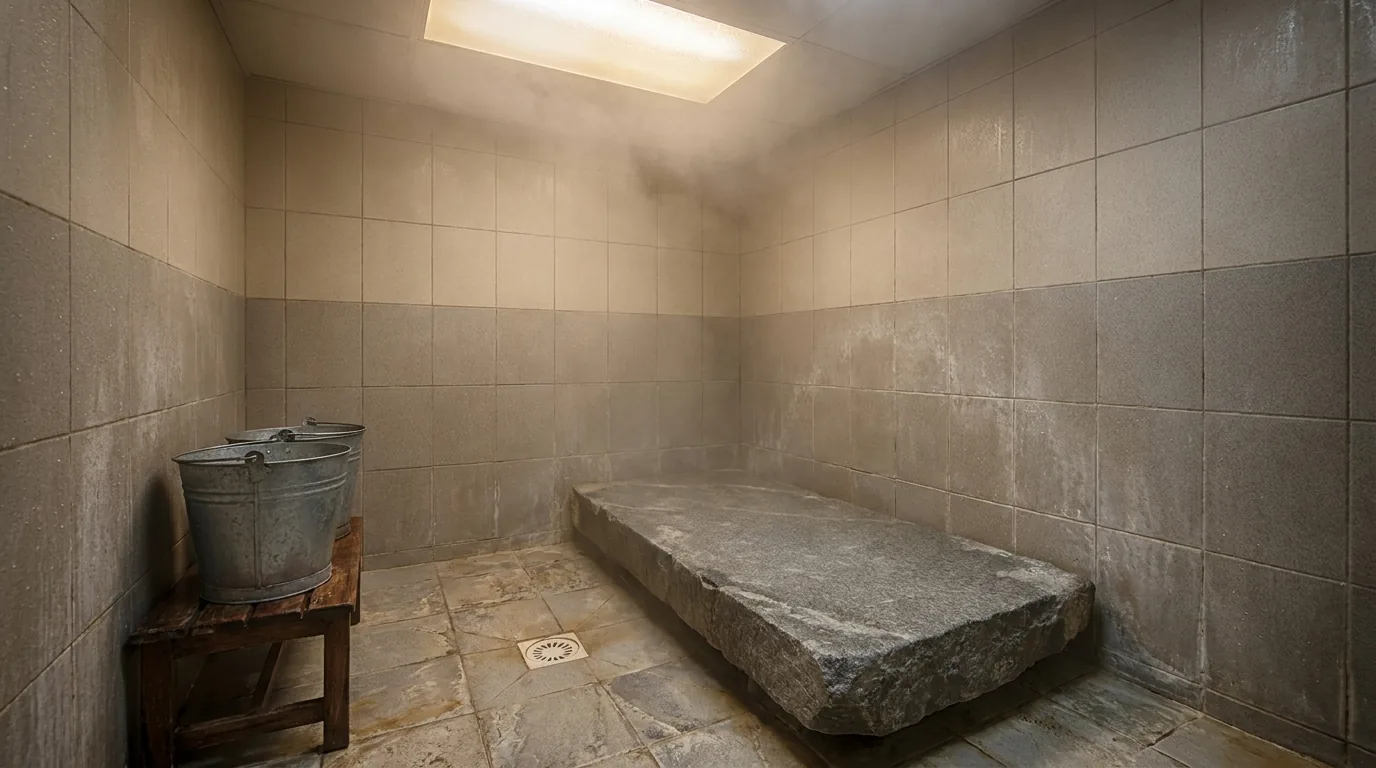


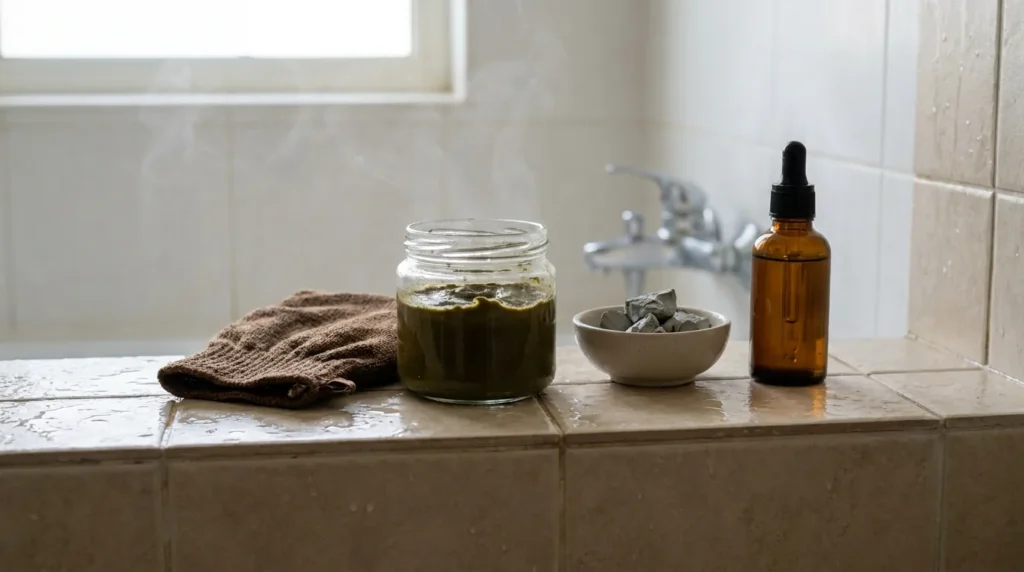
5 to 10 minutes of steam, then Moroccan bath soap on damp skin for another 5 to 10, then a complete rinse before the kessa glove touches anything: that is the order a hammam uses. Rinsing the black soap off first is the step most home guides skip, and it is what makes the scrub work.
What Moroccan bath soap actually is
Moroccan bath soap, called savon beldi or beldi soap in Morocco, arrives as a soft paste rather than a bar. It is made by blending crushed olives and olive oil with potash, which gives it a dark olive green colour close to black and a gel like texture that never sets hard. Jars sold in the UAE are often enriched with argan oil, eucalyptus or rose water on top of that olive base.
Moroccan bath soap works chemically rather than by abrasion. Olive oil and alkaline potash soften the outer layer of dead skin so that a kessa glove can lift it away a few minutes later. That is the whole logic of the hammam sequence, and it is why the soap is applied and then removed before any scrubbing begins.
One point of confusion is worth clearing up early. West African black soap is a different product, built on plantain and cocoa pod ash with shea butter and sold as a firm bar. Shops across Dubai use the words black soap for both, so check the ingredient list for olive paste when the Moroccan version is what a ritual calls for.
What to buy before you start
Moroccan bath soap does most of the work, but four items cover the full ritual and only the first two are essential. A whole kit fits in a small basket and lasts several months of weekly use.
| Item | What it does | Where to find it |
|---|---|---|
| Beldi black soap, 200 g to 250 g jar | Softens dead skin before exfoliation | Moroccan and Arabic grocers, larger supermarkets, UAE online marketplaces |
| Kessa glove | Lifts the softened skin away | Usually sold beside the soap in the same shops |
| Ghassoul clay, optional | Mineral mask applied after the scrub | Moroccan grocers and online sellers |
| Argan oil or a plain body oil | Restores the skin barrier at the end | Pharmacies and supermarkets |
Expect to pay roughly AED 25 to AED 100 for a 200 g jar of beldi soap in the UAE, with argan enriched and imported artisan brands sitting at the top of that range. Moroccan and Arabic grocers around Deira and Al Karama tend to carry the traditional plain version, while supermarket shelves lean towards the scented, packaged brands. Ghassoul clay, also written rhassoul, is a mineral clay mined in the Atlas Mountains of Morocco and used as a rinse off mask rather than a cleanser.
How to use Moroccan bath soap, step by step
The order below is the traditional hammam sequence, compressed into a bathroom at home. It takes about 40 minutes end to end.
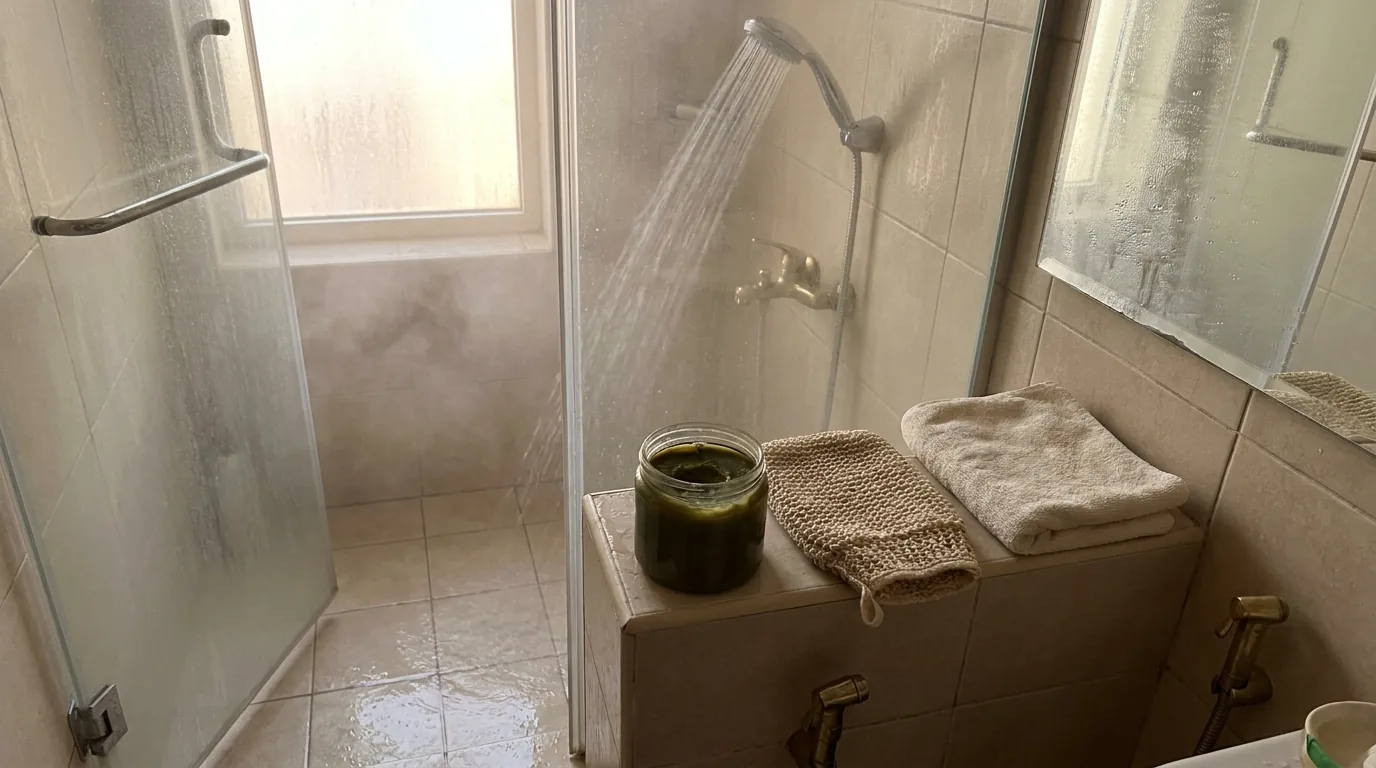
- Warm the skin. Run a hot shower with the door closed for five to ten minutes, or soak in a hot bath. Steam is what softens the surface layer, and skipping it is the single biggest reason a home attempt underperforms.
- Apply the soap to damp skin. Turn the water off. Spread a thin layer over the body in circular strokes, concentrating on knees, elbows, heels, forearms and back. Dry skin makes the paste drag and reduces the effect.
- Wait. Leave it on for five to ten minutes on normal skin, three to five on sensitive skin. Stay in the warm room while it sits.
- Rinse the soap off completely. Warm water, no soap residue left behind. This is the step casual guides get wrong by telling people to scrub with the paste still on.
- Scrub with the kessa glove. Work on wet skin in long firm strokes, limb by limb, and stop when the skin turns slightly pink. Greyish rolls lifting off are dead skin, and they are the point of the exercise.
- Rinse again, then apply clay if using it. Ghassoul goes on as a thin mask, stays for five minutes and rinses off before it dries tight.
- Finish with oil. Argan oil or any plain body oil on skin that is still damp, which traps the water rather than sealing dry skin.
Hair can join the ritual. A conditioning oil applied before the steam, then washed out after the body scrub, is the traditional way the sequence runs in Morocco. Learning how to use Moroccan bath soap is mostly a matter of respecting that order rather than mastering any technique.
How much to use and how long to leave it on
Quantity is where most people overshoot. Moroccan bath soap is concentrated, and a thick layer neither works faster nor rinses cleanly.
| Zone | How much paste | Leave on |
|---|---|---|
| Whole body | Roughly a tablespoon in total | 5 to 10 minutes |
| One limb | A heaped teaspoon | 5 to 10 minutes |
| Rough patches: knees, elbows, heels | A pea sized dab each, on top of the layer | 10 minutes |
| Face | A pea sized amount, thinned with water | 2 to 3 minutes |
| Sensitive or reactive skin | A thin film only | 3 to 5 minutes |
Leaving the paste on for 20 minutes or more does not deepen the exfoliation, it just leaves the skin tight and stripped afterwards. If the skin stings at any point, rinse immediately rather than waiting out the clock.
Using Moroccan bath soap on your face
Facial skin tolerates Moroccan bath soap, but on a shorter clock and with no glove. Thin a pea sized amount with water, work it over the face for a minute, leave it two to three minutes and rinse. The kessa stays on the body, since the weave is far too coarse for facial skin.
Patch test behind the ear or on the inner forearm 24 hours before the first facial use, particularly on skin that reacts to alkaline cleansers. Anyone using prescription retinoids, acids or an active acne treatment should keep the soap to the body. For a gentler alternative on the face, a fine grain body scrub formulated for facial use is the safer route.
How often you can repeat it in Dubai
Once a week suits most skin, and once every two weeks suits dry or sensitive skin. Moroccan bath soap on its own can be used more often than that, since the cadence limit comes from the kessa glove rather than the paste. Daily scrubbing removes skin faster than it rebuilds.
Dubai adds two variables. Air conditioning holds indoor humidity low for most of the year, so skin that would cope with weekly exfoliation in a humid climate often prefers a ten day gap here. Pool chlorine and sea salt do their own stripping, so a ritual planned for the same day as a long swim is worth moving. The American Academy of Dermatology recommends spacing mechanical exfoliation according to skin type and stopping if irritation appears, which is the same rule stated clinically.
Timing around other appointments matters more than the calendar. Leave 48 hours after waxing, laser hair removal or a spray tan before any scrub, and leave the same gap before a wax so the skin is not already raw. Booking a body scrub session and a home ritual in the same week doubles the exfoliation without doubling the benefit.
Apply the finishing oil while the skin is still wet from the last rinse. In an air conditioned Dubai bathroom the surface dries within a minute or two, and oil applied after that traps far less water.
Claims to ignore and mistakes that cost the result
Beldi soap is a good cleanser and a genuinely effective preparation step. It is also sold with claims it cannot support, and separating the two saves money and disappointment.
- Skin lightening. No soap permanently changes pigment. Exfoliation removes dull surface cells and the skin looks brighter for a few days, which is a different thing from treating pigmentation.
- Dark spot removal. Melasma and post inflammatory marks sit deeper than any scrub reaches, and they need a clinical route rather than a bathroom one.
- Detox. Sweating in steam does not clear toxins in any measurable sense. The steam earns its place by softening skin, which is enough.
- Scrubbing harder for better results. The glove is meant to lift loosened cells, not to abrade live skin. Raw and shiny is a sign to stop.
- Applying Moroccan bath soap to dry skin. It drags, it wastes product, and the softening effect largely fails to happen.
Two more mistakes belong on the list, and neither involves Moroccan bath soap itself. Leaving ghassoul clay on until it cracks dries the skin out rather than purifying it, and undiluted essential oils added to a bath can cause a reaction of their own.
Where the salon version differs
Searches for how to do moroccan bath in dubai split into two jobs: recreating the sequence at home, or booking the room where it is done properly. The home version reaches maybe 70 percent of the result, and the gap is mostly physical rather than skill based.
A spa runs a heated wet room at a temperature no bathroom reaches, which softens skin far more thoroughly than a steamy shower. A therapist scrubs the back, shoulders and other zones that are awkward to reach alone, and applies steady pressure that is hard to replicate one handed. Sessions across Dubai run from around AED 49 at neighbourhood salons to AED 1,500 at hotel spas, and the full Moroccan bath in Dubai guide breaks down what each band includes. A therapist also controls how long Moroccan bath soap sits before it comes off, which is easy to misjudge alone. The directory currently lists 454 venues offering the treatment, filterable through the Moroccan bath listings, the wider spas in Dubai pages and the massage and spa venues directory.

Popular spa and wellness venues in Dubai
On the first floor of Dubai Festival City Mall, Heal Spa runs aromatherapy, deep tissue, hot stone and sports massage alongside couples massage, reflexology, a Moroccan bath and IPL hair removal. It's rated from reviews.Reviewers describe some of the best massages they've had in Dubai here, with the therapists praised for reading pressure correctly and adjusting through the session rather than working to a fixed routine. The space itself comes up as clean and calm, and the team is described as consistently friendly across a large number of reviews.Booking ahead is worth it, and outdoor and on-site services are available. The venue has gender-neutral toilets and wheelchair-accessible parking, entrance, seating and toilet facilities throughout.
On the HC floor of the Grand Excelsior Hotel on Kuwait Street in Al Mankhool, Lavana Spa Bur Dubai offers Swedish massage, deep tissue massage, Moroccan bath and reflexology, rated from reviews. Swedish massage comes up repeatedly as a highlight, with reviewers describing sessions as deeply relaxing against a calm, soothing atmosphere throughout the spa. Front-desk staff are also praised for recommending the right treatment based on what a client is looking for, rather than defaulting to a standard package. The spa is wheelchair accessible, including parking, entrance and toilet, and appointments are recommended ahead of a visit, opening from 10am. Good for anyone in Al Mankhool after a proper unwind rather than a rushed treatment.
Touch Life Spa sits inside TIME Oak Hotel & Suites in Barsha Heights, rated from reviews. Reviewers consistently describe a calm, clean and welcoming atmosphere, with attentive, professional staff who take time over every detail. Several guests single out the massage treatments and Turkish hammam for easing tension and back pain, and describe the whole visit as well organised and hygienic from start to finish. The treatment menu runs from deep tissue, hot stone, Swedish and Thai reflexology massage to aromatherapy, back, scalp and sports massage, alongside gel pedicures, manicures and yoga classes. The spa is wheelchair accessible throughout, with an accessible car park, entrance, seating and toilet, and appointments are recommended given its popularity in the Barsha Heights hotel district.
Sea7 Spa, in The Binary by Omniyat, Business Bay, is rated from reviews. Alongside in-salon appointments, the spa offers outdoor and at-home visits, with one reviewer describing booking a couples massage at home after a long flight and being impressed with the therapists' technique.The treatment list spans deep tissue, aromatherapy and couples massage, body scrub, body waxing, French manicure, gel nails, eyebrow threading and tinting, and anti-aging facials. Reviewers who booked waxing or massage mention therapists taking their time rather than rushing through a treatment.There is a toilet on site, and the car park is wheelchair accessible. Appointments are recommended, and it suits clients who specifically want the option of a treatment at home or another location rather than only in-salon.
Luxe Spa Dubai in Wadi Al Safa 5 is rated from reviews. The spa offers Swedish, deep tissue, Thai and couples massage, aromatherapy, hot stone massage, reflexology, body scrub and a Moroccan bath, alongside nail services, spanning most massage styles under one roof.First-time visitors consistently mention therapists who explain the process clearly and check in throughout the session, helping nervous clients feel at ease. Reviewers describe the overall experience as professional, unhurried and attentive, with small touches like tea offered afterwards that make the visit feel considered rather than rushed.The spa has a wheelchair-accessible car park, entrance and toilet. Appointments are recommended, and it suits both first-timers and regulars after a calm, well-paced massage, particularly couples booking a joint session together.
Browse all 454 Moroccan Bath providers on our directory.
Two licences are worth confirming at reception before paying for any wet treatment. A Department of Economy and Tourism trade licence permits the business to operate at all, and a Dubai Health Authority licence covers the health and wellness category the treatment falls under. Numbers are normally displayed at the desk, and how listings are ranked explains the checks applied on this side.
Booked sessions run 45 to 90 minutes against roughly 40 minutes for the home sequence, and almost all of that extra time is heat rather than extra scrubbing.