



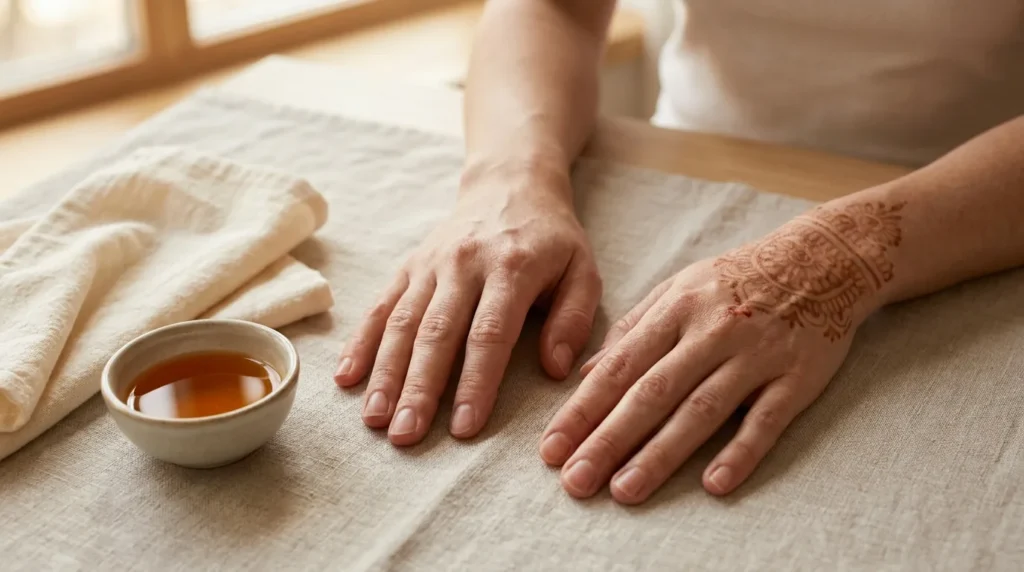
How to remove henna comes down to one fact: henna stains the dead surface layer of your skin, so you fade it, you do not erase it. Daily exfoliation, oils, and gentle lighteners speed the fade, and most stains clear in 4 to 14 days. The methods below work on hands, skin, hair, and brows.
Why henna is hard to remove
Henna, or mehndi, works by binding a pigment called lawsone to keratin in the outer skin layer, the stratum corneum. That bond is what makes the stain last one to three weeks while a pen mark washes off in seconds.
Because the colour sits inside dead skin cells rather than on top of them, no single wash lifts it. The honest answer to “can I remove henna in five minutes?” is no. You remove henna by helping those stained cells shed faster, and skin needs time to turn over. Fresh stains on thin skin fade quickest; thick palm and fingertip skin holds colour longest.
So treat removal as a fade you accelerate over a few days, not a one-step erase. That framing saves your skin from the aggressive scrubbing people try when they expect an instant result.
How to remove henna from your skin and hands
These home methods are ranked roughly by how well they work. Combine two or three for the fastest fade, and stop if your skin feels sore.
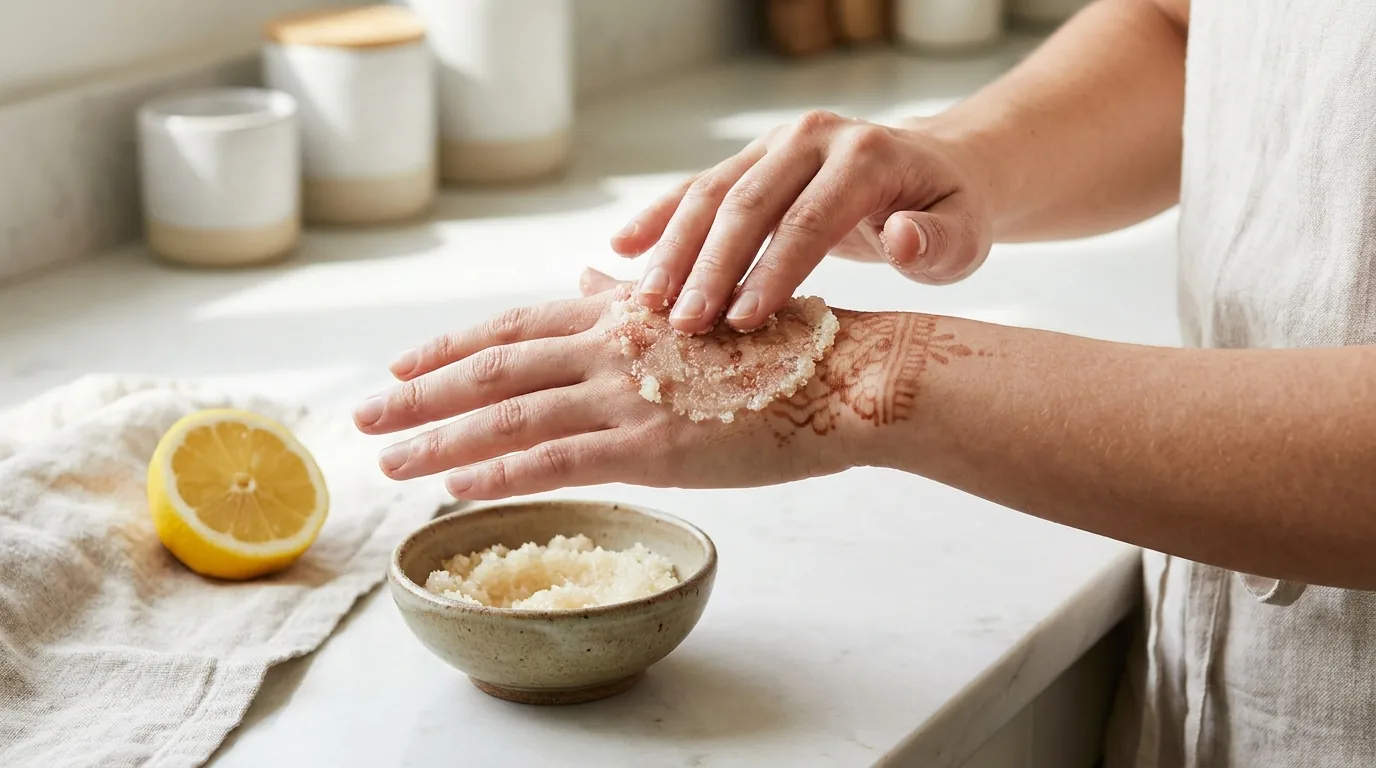
- Exfoliation. A sugar or salt scrub, a loofah, or an exfoliating glove sheds the stained surface cells. This is the most reliable method. Scrub gently for 30 seconds, rinse, and repeat once a day rather than scrubbing raw in one go.
- Oils. Coconut, olive, or baby oil loosens pigment while it moisturises. Massage oil into the design, leave it 10 to 15 minutes, then exfoliate. Oil is the gentlest option and the safest for sensitive skin.
- Lemon juice and baking soda. Mix lemon juice with a little baking soda into a paste. The citric acid lightens the stain and the baking soda exfoliates. Leave it two to three minutes, then rinse well. Skip this on broken or irritated skin.
- Warm saltwater soak. Soak your hands in warm water with a few tablespoons of salt for 15 to 20 minutes to soften the top layer, then follow with a scrub. Useful before any other method.
- Micellar water or oil-based makeup remover. Wipe over the design to lift loose pigment, especially on the face and around the brows where scrubbing is risky.
- Antibacterial soap and a scrub. Plain repeated hand-washing with a gritty soap fades a light stain over a day or two with no special products.
When people ask how to remove henna on hands, the answer is the same set of methods, with one wrinkle: the palm and finger creases hold colour longest. Focus your soak and scrub there, and accept that those areas fade last. A salon exfoliation treatment can speed a stubborn fade if home methods stall.
One method to use with care is rubbing alcohol. It does lift pigment, but it strips moisture and can sting, so dab it on, do not soak, and moisturise straight after. A professional body scrub is a gentler way to lift colour from a larger area.
Does toothpaste remove henna?
Toothpaste is the most-searched henna hack, so it deserves a straight answer. A whitening toothpaste can fade a light stain because it contains mild abrasives and sometimes baking soda, the same lifting agents in the methods above.
It is not a magic fix. Toothpaste works no better than a baking soda paste and can irritate skin with menthol or peroxide. If you want to try it, rub a pea-sized amount over the stain, leave it a few minutes, then rinse. Treat it as one mild exfoliant among several, not a shortcut.
How to remove henna from hair and eyebrows
Henna on hair and brows needs a softer approach than skin, because you cannot exfoliate either one.
For hair, an oil soak is the standard route. Saturate the hair in warm coconut or olive oil, cover it for an hour or longer, then shampoo. Repeat over several washes to draw out pigment gradually. A clarifying shampoo helps. Avoid harsh chemical strippers and never apply box dye over henna without a strand test, since the reaction can be unpredictable.
For henna brows, reach for an oil-soaked cotton pad or micellar water rather than a scrub, and dab gently. The skin around the eyes is thin, so patience beats pressure. If a brow stain came out too dark or uneven, a few oil applications over a day or two usually settle it.
Black henna: when removal is not the issue
Natural henna is reddish-brown and safe for most people. So-called black henna is different and matters for your health, not just your fade time. It often contains paraphenylenediamine, a chemical dye known as PPD that is added to darken the stain and speed it up.
PPD can trigger a delayed allergic reaction: redness, blistering, itching, or a raised outline of the design that appears days later. If that happens, removing the colour is not the priority. Stop using anything on the area, and see a doctor at a licensed clinic. In Dubai, cosmetic and skin clinics operate under a Dubai Health Authority (DHA) health licence alongside a Department of Economy and Tourism (DET) trade licence, so a DHA-licensed clinician is the right person to assess a skin reaction.
To avoid the problem, ask for natural henna only, and treat any “instant black” or “one-hour” henna with caution. A reddish stain that darkens over a day or two is the natural kind, the same plant-based paste covered in our guide to henna designs in Dubai.
How Dubai’s climate affects how henna fades
Dubai’s environment changes how fast a stain clears. Heat and sun deepen and set the colour, which is why mehndi applied before a summer event often comes out darker and lasts longer than expected. If you want a stain to fade, keep the area out of direct sun. For the opposite effect, our guide on how to make henna darker covers what deepens a stain.
Air conditioning is the quieter factor. Constant cool, dry indoor air slows skin turnover and leaves the surface dehydrated, so the stained cells shed more slowly. Pool chlorine and frequent hand-washing, both common here, do help fade a stain over time. The practical takeaway: exfoliate daily, moisturise daily, and the climate works with you rather than against you.
Where to get henna and mehndi in Dubai
If you would rather have henna applied professionally, or you want a stubborn or uneven stain assessed in person, Dubai has plenty of options. Henna and mehndi are usually offered at ladies beauty salons, often as part of bridal and party packages, so a beauty salon is the natural starting point.
You can browse beauty salons in Dubai to compare options across the city, then call ahead to confirm they offer henna, since not every venue does. For any skin reaction rather than a styling question, a licensed skin clinic is the safer call. Every listing is checked against our salon ranking method before it appears.
Browse all 1,325 Beauty Salons providers on our directory.
Across Dubai, salonsindubai.ae lists 1,325 beauty salons you can filter by area, rating, and price.
Aftercare for your skin
Every removal method strips some moisture, so aftercare keeps your skin comfortable while the stain finishes fading. For ongoing care, a skin care salon can build a routine for your skin type, and bridal makeup teams often handle henna for the same event.
For a closer look, see our guide to Makeup in Dubai: Prices, Types & How to Book a Makeup Artist (2026). · How to Remove Eyelash Extensions at Home: A Safe 2026 Guide · How to Remove Hair Color From Skin: A 2026 Dubai Guide · What to Do After a Deep Tissue Massage: The First 72 Hours
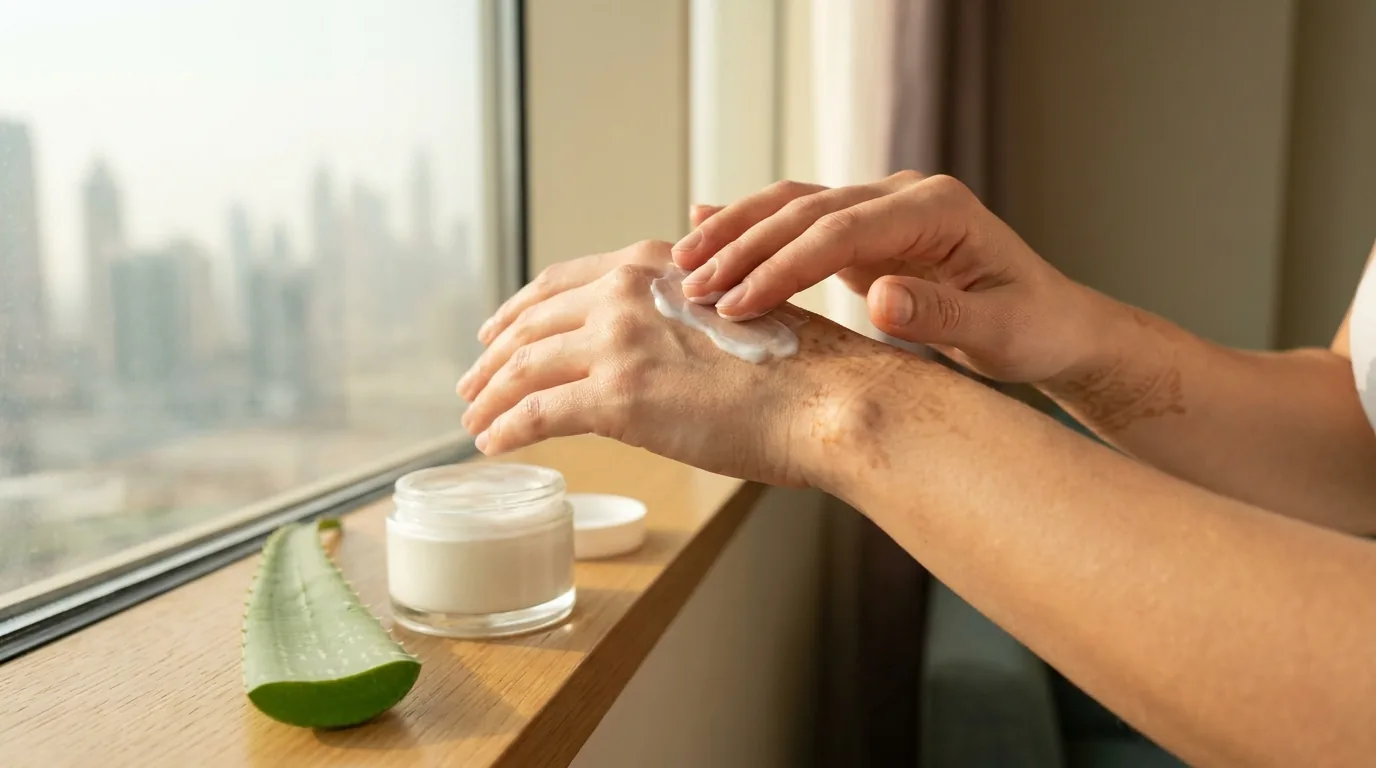
- Apply a thick moisturiser or aloe vera gel after each exfoliation session to calm and rehydrate the skin.
- For brows and the area around the eyes, use a light oil such as argan rather than a heavy cream; if you also shape the brows, book threading after the stain has settled, not before.
- Avoid back-to-back harsh methods in one day; alternate a scrub day with an oil-and-moisturise day.
- Stop and let the skin recover if you see redness, stinging, or flaking, especially in dry air conditioned rooms.
- Wear sunscreen on the area, since freshly exfoliated skin is more sensitive to Dubai sun.


