



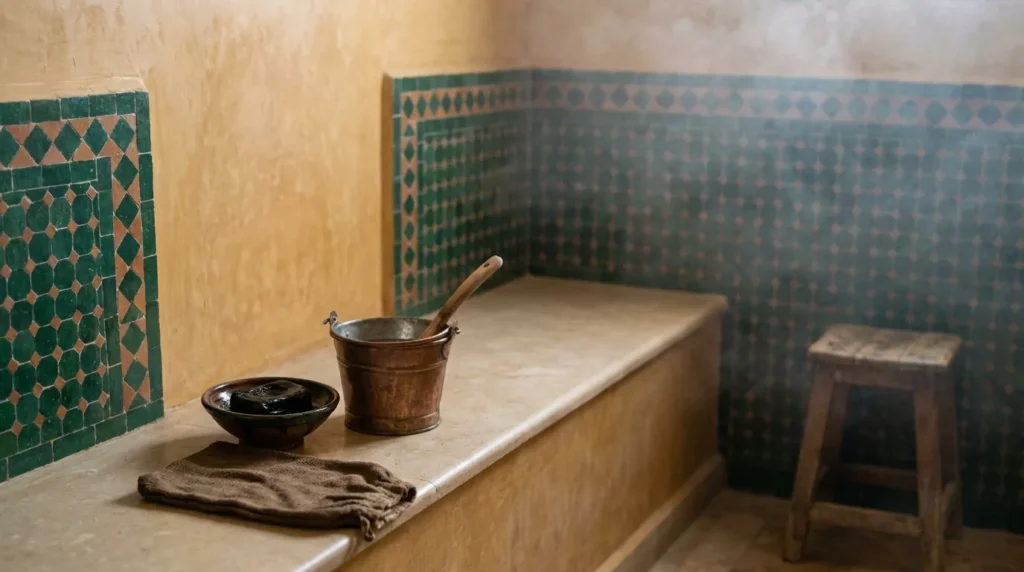
A Moroccan bath is a steam and scrub cleansing ritual from Morocco, built around black soap, a coarse kessa glove and ghassoul clay. Heat softens the skin, the glove lifts away dead skin cells, and the clay draws out what is left. A session runs 45 to 90 minutes and leaves skin visibly smoother.
If you have seen it on a Dubai spa menu and wondered what’s a Moroccan bath in practice, the answer sits in four stages. Below is each stage, the products a therapist actually uses, what the treatment does to your skin, and how your body tends to feel for the rest of the day.
The four stages of a Moroccan bath
Every version follows the same sequence. Spas rename it and add extras, but the bones stay fixed: heat, soap, scrub, clay. Understanding the order matters, because each stage prepares the skin for the next one. Skip the steam and the glove has nothing soft to work with.
Some Dubai menus list the same ritual as five or six steps, splitting the final rinse, the clay mask and the oil finish into separate lines, and a few add a closing body massage. The underlying sequence is the same one below.
| Stage | What happens | Roughly how long |
|---|---|---|
| 1. Steam | You sit in a hot, humid room while heat opens the pores and softens the outer skin layer. | 10 to 20 minutes |
| 2. Black soap | A therapist coats you in dark olive based soap and leaves it to sit so it can loosen surface build up. | 5 to 10 minutes |
| 3. Kessa scrub | The therapist works over your body with a coarse woven glove. Grey rolls of dead skin cells lift off as they go. | 15 to 25 minutes |
| 4. Clay and rinse | Ghassoul clay goes on, sits, then rinses off. Most venues finish with argan oil or a body cream. | 15 to 25 minutes |
The scrub is the stage people remember. It is firm, closer to a deep sports massage than a gentle facial, and the visible residue on your skin is the part first timers find strange.
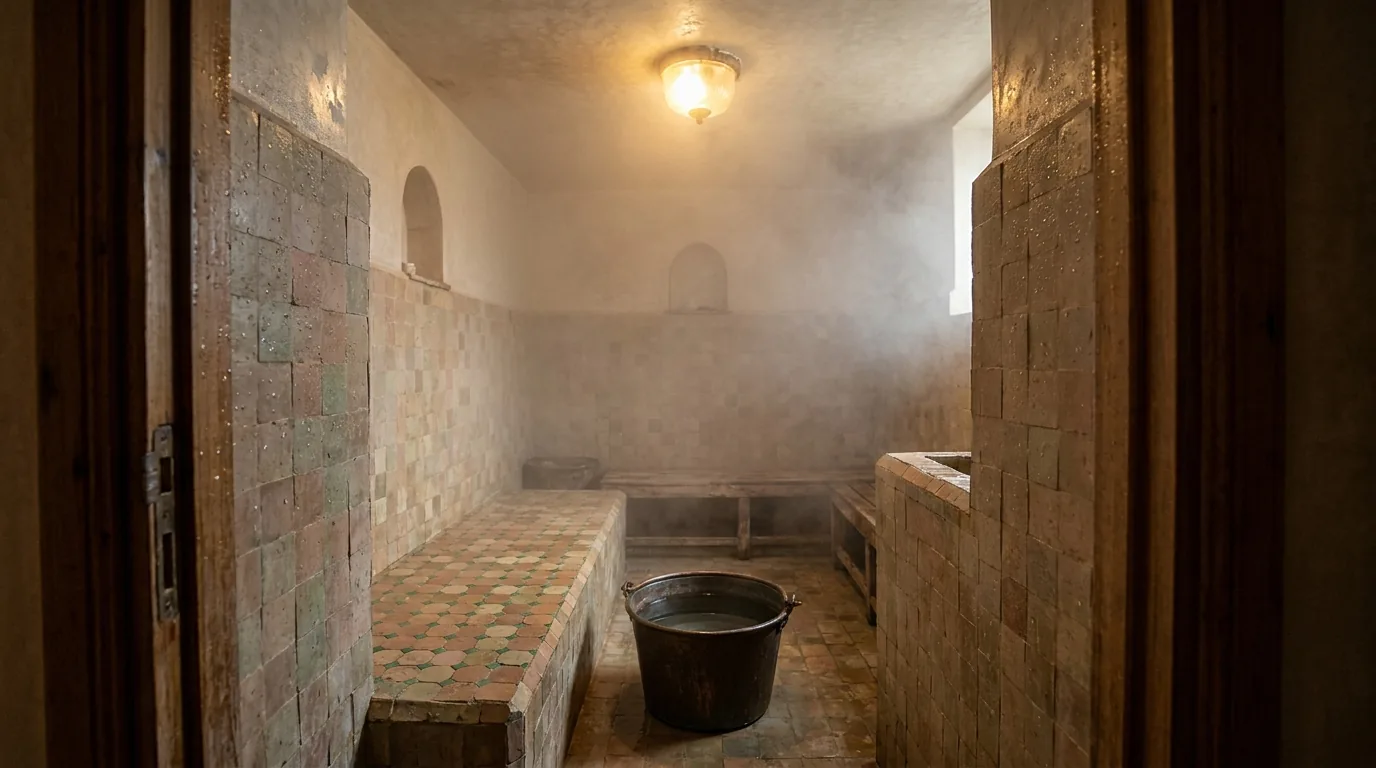
What goes on your skin: black soap, kessa glove and ghassoul clay
Three traditional materials do almost all of the work. None of them is a branded formula, which surprises people who expect a signature product line. The tradition predates the spa industry by centuries.
| Material | What it is | What it does |
|---|---|---|
| Beldi black soap (savon noir) | A soft, dark paste made from crushed olives and olive oil, sometimes with eucalyptus. | Softens the outer skin layer so the glove can lift it cleanly. |
| Kessa glove | A coarse woven mitt, traditionally goat hair or a rough synthetic weave. | Provides the abrasion. This is the exfoliation itself. |
| Ghassoul clay (rhassoul) | A mineral clay mined in Morocco’s Atlas Mountains. | Binds to oil and residue on freshly scrubbed skin, then rinses away. |
| Argan oil | Oil pressed from the argan tree, native to southwest Morocco. | Restores some of the surface oil the scrub removed. |
If a spa in Dubai promotes a specific brand name in its Moroccan bath, that is a house product layered on top of the traditional four, not a replacement for them. Ask which of the four the venue actually uses. Some budget rooms substitute a generic shower gel for real beldi soap, and the difference in how the scrub feels is immediate.
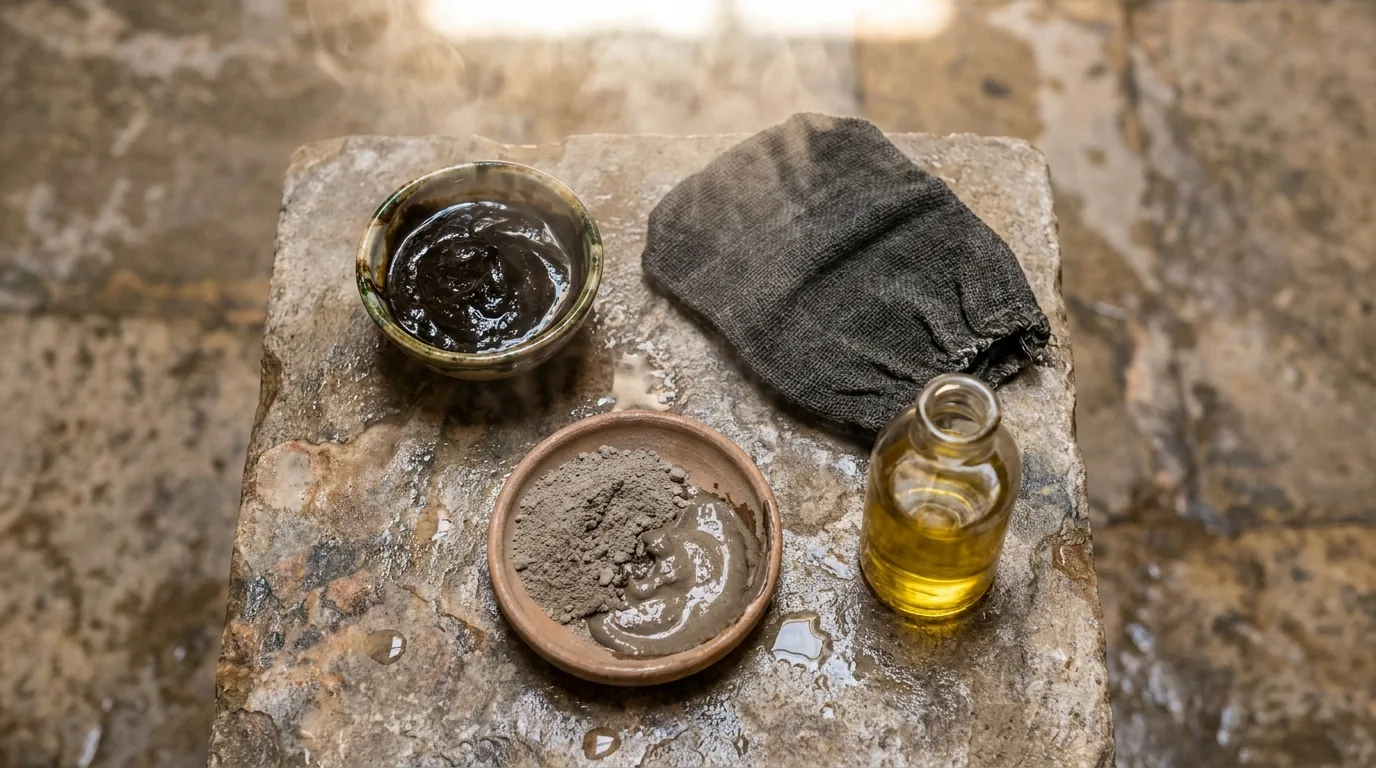
What a Moroccan bath does to your skin
The honest answer is narrower than most spa menus suggest. A Moroccan bath is a mechanical exfoliation treatment with a heat component. That combination produces real, measurable effects, and a few claimed ones worth treating with more caution.
What it reliably does: it removes the built up layer of dead skin cells, which makes skin feel smoother and helps body lotion absorb rather than sit on the surface. Regular exfoliation also reduces trapped hairs, which is why people prone to ingrown hairs on the legs book it. The heat raises blood flow to the skin, producing the flushed look afterwards. For a broader look at how mechanical exfoliation works across treatments, our guide to exfoliating scrubs covers the same mechanism in a lighter format.
What it does not do: sweating in a steam room does not detoxify the body in any clinical sense, and no scrub permanently lightens skin. The American Academy of Dermatology’s guidance on exfoliation is worth reading before you book a course of them: over exfoliating irritates skin rather than improving it, and once every four to six weeks suits most people better than weekly sessions.
How it differs from a body scrub or a Turkish hammam
Dubai spa menus list several treatments in the same family, and the names blur. The distinction is in the sequence and the tools, not the marketing.
A standard body scrub uses a granular medium, salt or sugar, applied by hand and rinsed off. There is no steam stage, no soap soak and no clay, and it takes half the time. A Turkish hammam shares the heat and glove logic but runs on a heated marble slab, uses a foam wash rather than beldi soap, and skips the clay. A facial applies a comparable idea to the face alone, with far gentler abrasion. The Moroccan version is the one built around black soap and ghassoul clay.
Timing it around waxing, shaving and epilator use
This is the question the spa menu never answers, and getting the order wrong is the most common way people end up irritated.
Exfoliation and hair removal both stress the same surface. Doing them back to back on the same day compounds the effect. General salon practice puts the Moroccan bath first, then hair removal 24 to 48 hours later, because the scrub clears the surface and frees trapped hairs so waxing or epilating grips cleanly. Going the other way, straight from an epilator into a firm kessa scrub, works over skin that has just had hair pulled from the follicle, and redness and small bumps are the usual result.
- Scrub first, remove hair 24 to 48 hours later. This is the standard sequence.
- After waxing, epilating or shaving, leave at least 48 hours before a Moroccan bath.
- Skip the session entirely on broken skin, active sunburn, or a fresh tattoo.
- Tell the therapist what you have had done and when. A good one will adjust pressure or decline the booking.
How your body feels afterwards
Most people walk out warm, slightly pink and pleasantly tired. The skin stays sensitive for a day. A few reactions catch first timers off guard, and knowing which are ordinary saves an unnecessary worry.
Mild redness and warmth for a few hours is expected, and so is a light headed moment on standing up after 45 minutes in heat. Stomach discomfort afterwards is less common but not unusual: prolonged heat, dehydration and lying on a warm surface after eating can all unsettle the stomach. It normally passes within a few hours once you have rehydrated. Persistent pain, vomiting, fainting or a fever are not part of a normal reaction, and those warrant a doctor rather than a wait.
Drink water before and after, eat something light rather than a full meal beforehand, and give yourself an unhurried hour afterwards instead of scheduling something straight after.
Freshly scrubbed skin burns faster. In Dubai’s climate, keep the treatment to a day when you are not heading straight to a beach or pool, and use sun protection on exposed skin for the following 48 hours. Chlorine also stings more than usual on the same timeline.
Sessions for men and for ladies
The treatment is identical. What differs is the facility and the staffing, and in Dubai that is regulated rather than optional.
Ladies only venues run female therapists and female only floors. Men’s sessions run in men’s spas, in dedicated male wings of larger properties, or in hotel spas with separated timings. Same gender treatment is the norm across the emirate, so a Moroccan bath for men is booked at a men’s venue rather than as a variation at a ladies salon. Mixed couples rooms exist at some hotel spas, where a couple shares a suite with a therapist of the matching gender for each person. When you filter massage and spa venues in the directory, the listing tells you which category a venue falls into before you call.
Where you can book a Moroccan bath in Dubai
Availability is wide. The treatment is a standard fixture on Dubai spa menus rather than a specialist booking, and it sits at nearly every price point in the city.
Across the directory, 454 venues list a Moroccan bath among their services. Concentration follows the usual pattern: older, denser districts carry the highest count of independent hammams, with Deira the strongest for traditional, no frills rooms at the lower end. Dubai Marina and Jumeirah skew toward polished day spas, while mall based venues at Dubai Mall and Dubai Hills Mall trade on convenience and late opening hours. Dubai Silicon Oasis and the newer residential clusters have a smaller but growing set of neighbourhood salons. If you are searching for somewhere open now, mall spas and hotel spas hold the longest hours, typically to 10pm or later.
Prices swing widely by setting, and deal platforms such as Groupon list heavily discounted Moroccan bath vouchers that are worth reading carefully, since the cheapest tier often means a shared room and a shorter scrub. Our Moroccan bath in Dubai guide breaks down what each price band actually buys. Reddit threads on Dubai spas are a reasonable sanity check on individual venues, though they skew toward the extremes of very good and very bad experiences.
One practical filter before booking anywhere: a legitimate venue holds a Department of Economy and Tourism (DET) trade licence to trade at all, and any spa offering health or wellness services also needs the relevant Dubai Health Authority (DHA) licence for its category. Licence numbers are usually displayed at reception. Our ranking methodology explains the rest of what we check.

Popular spa and wellness venues in Dubai
On the first floor of Dubai Festival City Mall, Heal Spa runs aromatherapy, deep tissue, hot stone and sports massage alongside couples massage, reflexology, a Moroccan bath and IPL hair removal. It's rated from reviews.Reviewers describe some of the best massages they've had in Dubai here, with the therapists praised for reading pressure correctly and adjusting through the session rather than working to a fixed routine. The space itself comes up as clean and calm, and the team is described as consistently friendly across a large number of reviews.Booking ahead is worth it, and outdoor and on-site services are available. The venue has gender-neutral toilets and wheelchair-accessible parking, entrance, seating and toilet facilities throughout.
On the HC floor of the Grand Excelsior Hotel on Kuwait Street in Al Mankhool, Lavana Spa Bur Dubai offers Swedish massage, deep tissue massage, Moroccan bath and reflexology, rated from reviews. Swedish massage comes up repeatedly as a highlight, with reviewers describing sessions as deeply relaxing against a calm, soothing atmosphere throughout the spa. Front-desk staff are also praised for recommending the right treatment based on what a client is looking for, rather than defaulting to a standard package. The spa is wheelchair accessible, including parking, entrance and toilet, and appointments are recommended ahead of a visit, opening from 10am. Good for anyone in Al Mankhool after a proper unwind rather than a rushed treatment.
Touch Life Spa sits inside TIME Oak Hotel & Suites in Barsha Heights, rated from reviews. Reviewers consistently describe a calm, clean and welcoming atmosphere, with attentive, professional staff who take time over every detail. Several guests single out the massage treatments and Turkish hammam for easing tension and back pain, and describe the whole visit as well organised and hygienic from start to finish. The treatment menu runs from deep tissue, hot stone, Swedish and Thai reflexology massage to aromatherapy, back, scalp and sports massage, alongside gel pedicures, manicures and yoga classes. The spa is wheelchair accessible throughout, with an accessible car park, entrance, seating and toilet, and appointments are recommended given its popularity in the Barsha Heights hotel district.
Sea7 Spa, in The Binary by Omniyat, Business Bay, is rated from reviews. Alongside in-salon appointments, the spa offers outdoor and at-home visits, with one reviewer describing booking a couples massage at home after a long flight and being impressed with the therapists' technique.The treatment list spans deep tissue, aromatherapy and couples massage, body scrub, body waxing, French manicure, gel nails, eyebrow threading and tinting, and anti-aging facials. Reviewers who booked waxing or massage mention therapists taking their time rather than rushing through a treatment.There is a toilet on site, and the car park is wheelchair accessible. Appointments are recommended, and it suits clients who specifically want the option of a treatment at home or another location rather than only in-salon.
Luxe Spa Dubai in Wadi Al Safa 5 is rated from reviews. The spa offers Swedish, deep tissue, Thai and couples massage, aromatherapy, hot stone massage, reflexology, body scrub and a Moroccan bath, alongside nail services, spanning most massage styles under one roof.First-time visitors consistently mention therapists who explain the process clearly and check in throughout the session, helping nervous clients feel at ease. Reviewers describe the overall experience as professional, unhurried and attentive, with small touches like tea offered afterwards that make the visit feel considered rather than rushed.The spa has a wheelchair-accessible car park, entrance and toilet. Appointments are recommended, and it suits both first-timers and regulars after a calm, well-paced massage, particularly couples booking a joint session together.
You can also browse every Moroccan bath listing in Dubai directly, filtered by area and rating.
Browse all 454 Moroccan Bath providers on our directory.


